When the International Sculpture Center (ISC) chose Pittsburgh as its new home, the decision reflected an affinity already written into the city’s cultural fabric. Long shaped by cycles of industrial production and reinvention, the city has increasingly become a place where cultural institutions test new models of engagement, ones that acknowledge history without being bound by it. For the ISC, founded in 1960, Pittsburgh offered something particularly compelling: an arts ecosystem where experimentation and collaboration are already central to how cultural work gets done.
Lawrenceville Embraces the International Sculpture Center’s Pittsburgh Move
The ISC’s new home in Lawrenceville marks a shift in how the organization imagines its role. Most recently based at Grounds for Sculpture in Hamilton, New Jersey, the Center has long operated through partnerships rather than a single, sustained exhibition venue. “Partnering is second nature to us,” says Executive Director Johannah Hutchison, noting that the organization has always functioned through collaboration, even when it lacked a permanent public venue. The Pittsburgh space gives that ethos a physical home, positioning the ISC as both convener and connector within the city’s cultural landscape.
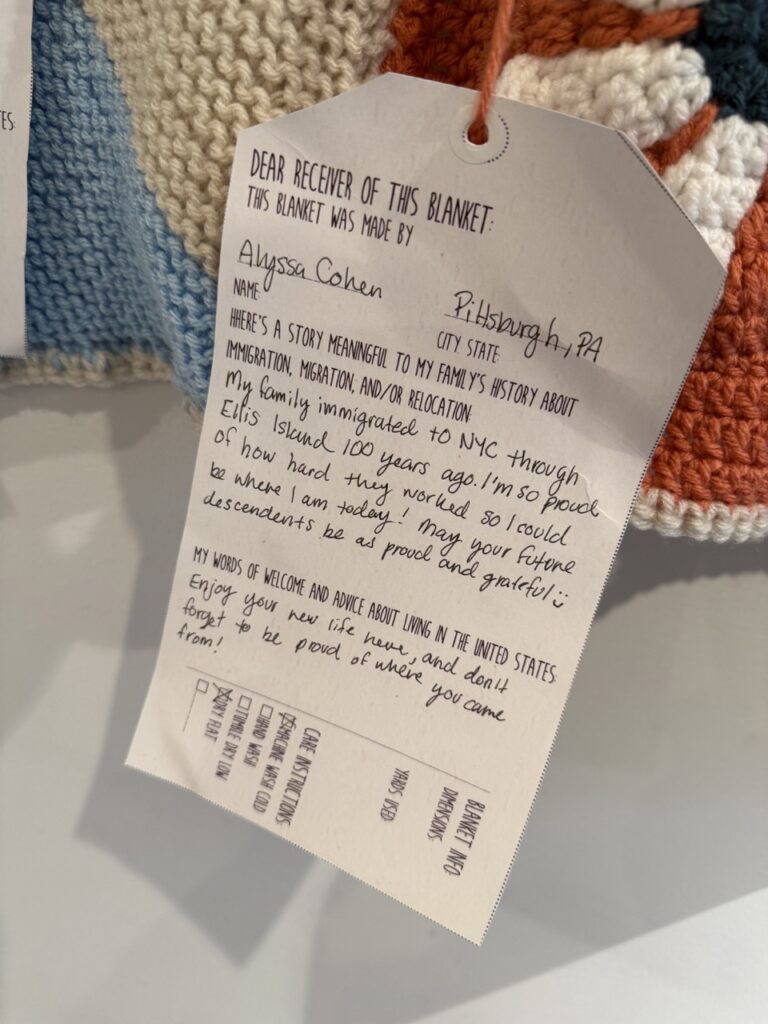
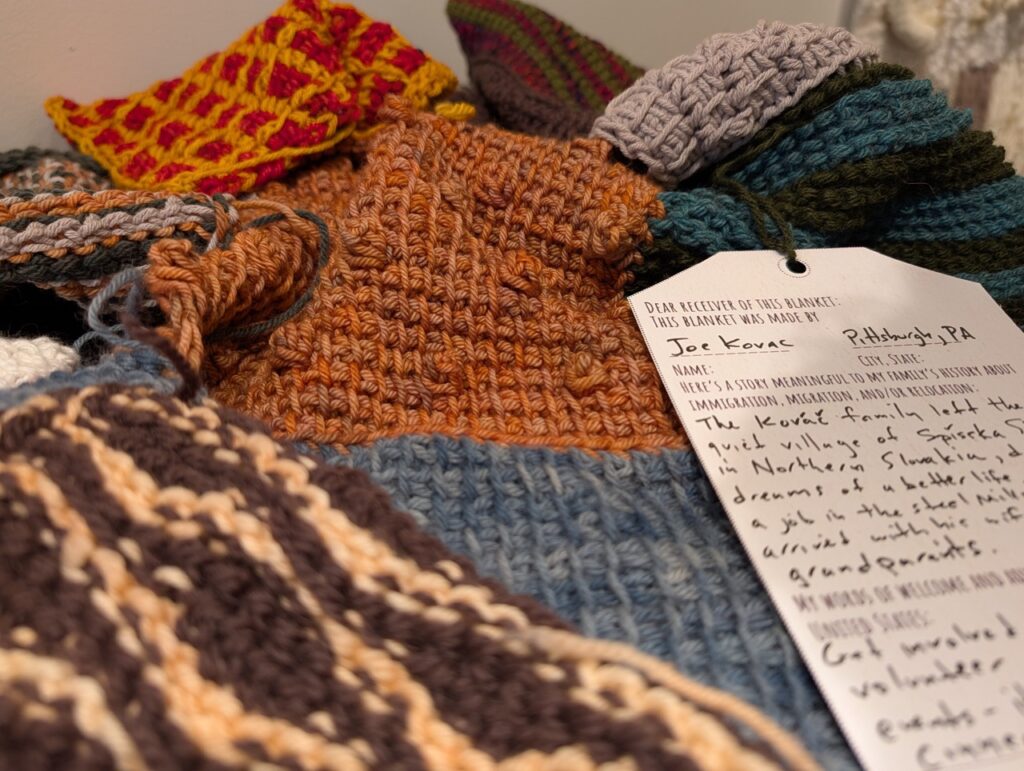
That orientation is evident in the way the Center introduces itself to Pittsburgh. The ISC’s inaugural exhibition, SOFT Launch, was a member exhibition focused on fiber-based and soft sculpture works, exploring themes of comfort, tactility, memory, and resistance. The exhibition closed in tandem with the grand opening of the Lawrenceville space, which also debuted the Welcome Blanket Project, a participatory workspace inviting the public to contribute handmade blankets for refugees and immigrants to the United States. Together, the two projects established a shared emphasis on material knowledge and collective making as foundational values of the new space.
More on the Welcome Blanket Project
Rooted in textile traditions often sidelined within dominant sculptural narratives, Welcome Blanket frames sculpture as something relational and accumulative rather than monumental. Softness, here, is a political proposition; Hutchison emphasizes sculpture’s capacity to create accessible entry points for complex conversations. In the Welcome Blanket workspace, participants contribute at their own scale—sometimes a single knitted square, sometimes a stitched panel, sometimes something much larger. Hutchison recalls being particularly moved by a young girl. She stopped in and without prior experience made a 40-by-40-inch quilt. The gallery, in these moments, functions less as a site of display than as an active workspace where art unfolds through participation.
Founded in 2017 by Jayna Zweiman, the Welcome Blanket Project began as a response to the proposed U.S.–Mexico border wall, translating its 2,000-mile length into an equivalent expanse of handmade blankets. The initiative quickly exceeded that goal, evolving into an international network of makers who pair textiles with personal stories of migration and relocation. In its current iteration at the ISC, the project highlights how sculpture can act as a support structure, offering literal warmth while prompting sustained conversation about immigration policy and national identity.
Accessibility and Expansion
This expanded understanding of sculpture aligns closely with the ISC’s broader mission. Known internationally for Sculpture Magazine and for maintaining one of the most extensive physical archives of contemporary sculpture, the organization has long used its hallmark annual conference as a way to take the field’s pulse. “If you come in and see something you don’t think is sculpture,” Hutchison says, “let’s talk about that.” The Pittsburgh space extends that spirit of inquiry year-round, encouraging discomfort and debate.
The relocation also reflects the particular strengths of Pittsburgh’s arts ecosystem. Universities, museums, artist residencies, and craft networks exist here in close proximity, fostering cross-disciplinary exchange. The ISC plans to engage that landscape through a dual programming model: virtual initiatives that serve its more than 4,000 global members, alongside in-person exhibitions, workshops, and public programs aimed at local audiences. A new Member Residency program will further anchor the organization in place, inviting artists to spend time in Pittsburgh while contributing to the Center’s evolving conversations.
Opportunity for Free Thinking
Crucially, the Lawrenceville gallery is non-commercial. Freed from market pressures, projects are able to unfold slowly, prioritizing dialogue and durability over spectacle. Hutchison traces her own connection to the city back to a 2012 visit, when she first imagined Pittsburgh as a possible future home for the ISC. More than a decade later, that vision has taken shape—not as a declaration of what sculpture must be, but as an open invitation to rethink what it can do, who it can reach, and how it can circulate in the world.
The ISC’s arrival in Pittsburgh does not present a definitive vision of sculpture’s future. What it offers instead is a space for testing and collectivity, a space that understands relevance as something built over time, stitch by stitch.
The International Sculpture Center is located at 5126 Butler Street in Lawrenceville, Pittsburgh. The Welcome Blanket Project runs through March 5, 2026.
Story by Shawn Simmons
Photos Courtesy of The International Sculpture Center
Subscribe to TABLE Magazine’s print edition.