In the town of Avella, about 38 miles west of Pittsburgh at the Meadowcroft Rockshelter and Historic Village, two baseball teams will take the field on August 22 for a Saturday doubleheader. Bats will swing during warmups and the crowd will settle in for what looks like a perfectly ordinary afternoon of baseball. But this is Meadowcroft’s annual Vintage Base Ball game—yes, it’s two words—played according to 1860s rules. Once the game starts, it will be obvious just how strange America’s pastime used to be.
Facing off will be the Addison Mountain Stars and the Somerset Frosty Sons of Thunder, regional teams that spend summer weekends recreating baseball as it was played long before it was standardized, professionalized, and monetized. Suiting up for the Mountain Stars will be Jayson “Rookie” Bell, 52, of Plum, wearing a uniform styled after the woolen pantaloons and jerseys worn in the 19th century, including a gray flannel boxcap.
Bringing Back Vintage Base Ball
Bell, who has been a vintage base ball enthusiast for almost a decade, crafts period-inspired equipment in the offseason while watching Steelers games. For the roughly six-ounce baseballs, he creates an inner core with rubber bands, winds it with acrylic yarn, then stitches on a leather cover with a needle and string. He also makes bats on a lathe. “I love the game and I love talking to people about it,” says Bell. “It actually turned me into a history buff.”
Pittsburgh has no shortage of baseball history. The city’s first recorded game took place on the North Side in 1857, when teams from Pittsburgh and Allegheny City squared off, and by the early 20th century the game had become a popular pastime among coal miners around Avella. That long local backstory is part of what makes Meadowcroft such a natural place to rewind the game to the 1860s, when baseball hadn’t quite become baseball yet.
Here are the oddities to watch for during the doubleheader.
6 Strange Rules and Customs of 1860s Vintage Base Ball
1. Gloves? Not in This Game
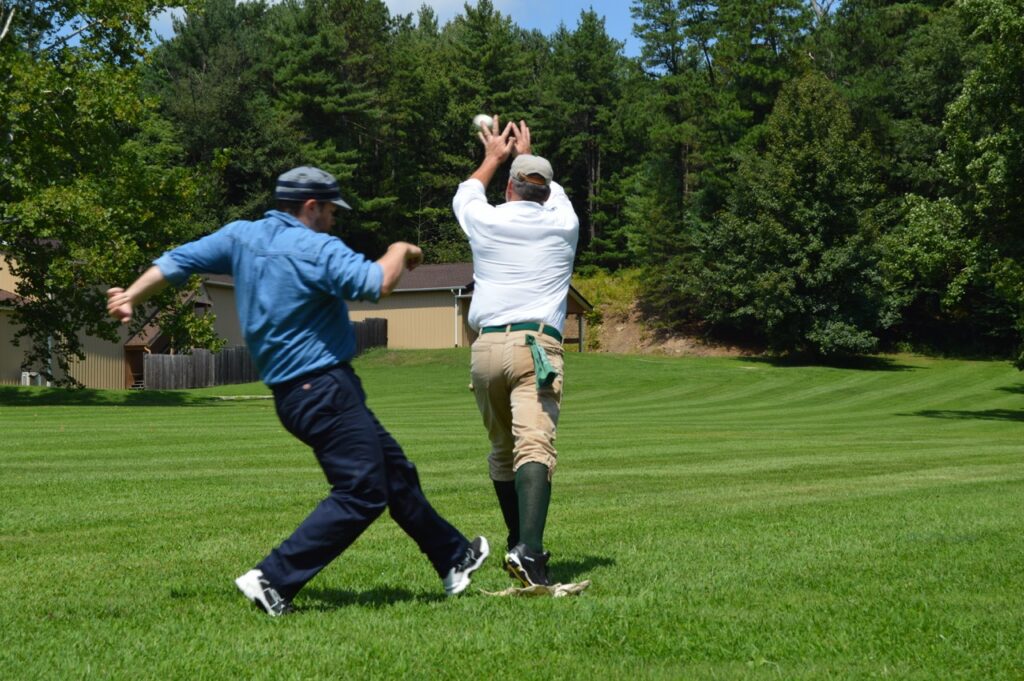
Modern baseball fans will instantly notice what the players aren’t wearing: gloves. Fielders catch and throw barehanded, and while the handmade baseballs are slightly softer than modern versions, they’re still hard enough to hurt. Broken, twisted, and dislocated fingers are part of keeping the game historically accurate.
2. One Bounce Still Counts As an Out
In modern baseball, a batter is out if a fielder catches a batted ball before it hits the ground. In 1860s base ball, if the ball bounces once and is then caught, the batter is still out. David Scofield, director of Meadowcroft, calls it his favorite rule, and he has seen it lead to some seriously strange plays. In 2017, a Frosty Son hit a fly ball into left field, where it got stuck in a sycamore tree. A half-dozen opposing Mountain Stars players gathered underneath and waited for the ball to come down. When it finally did, a Mountain Star caught it—and the batter was out.
3. The Pitcher Isn’t Trying to Strike Out the Batter
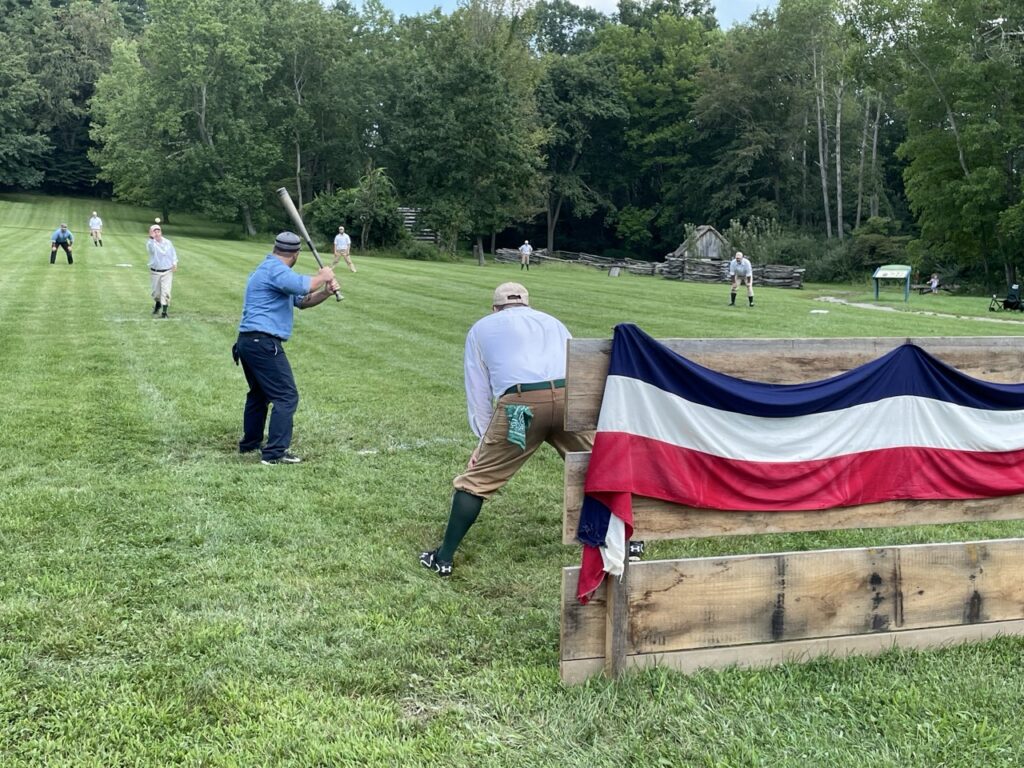
In 1860s base ball, the pitcher’s job was to give the batter a hittable ball to get the action started. The pitcher threw underhand, and the batter could even request a high or low pitch—if the batter liked the ball at belt height, the pitcher tried to put it there.
4. The Pitcher Is Only 45 Feet Away
In modern baseball, the pitcher stands 60 feet, 6 inches from home plate. At Meadowcroft, he’s just 45 feet away. Bell says the distance can make pitching nerve-racking because a hard-hit ball can come screaming right back at you.
5. A Fielder Can Let the Ball Drop
In modern baseball, the infield fly rule keeps a fielder from deliberately dropping an easy pop-up to turn it into a cheap double play. There’s no such rule in 1860s base ball, so a fielder can let a routine fly ball bounce, scoop it up, and go hunting for confused runners who thought they were safe. Scofield says a fielder who knows what he’s doing can turn one lazy fly ball into a double- or even triple-play—the kind of move that would get a player booed out of a modern ballpark.
6. No, You Can’t Throw the Ball at a Runner
Some early versions of base ball allowed “soaking”—a fielder could hit a runner with the ball to get him out. Meadowcroft doesn’t play by that rule, so don’t expect players to start winging balls at each other.
What To Know Before You Go
- Enter 401 Meadowcroft Road, Avella, for GPS directions to Meadowcroft.
- Admission is $15 for adults, $14 for seniors, $7 for children and students with a valid ID. History Center members and children under 5 can enter for free. Active duty or retired service members receive a $2 discount.
- There are no bleachers or seating, so bring a lawn chair or a blanket.
- Concessions include classics like hot dogs, popcorn, peanuts, and root beer floats.
- For additional information, go to heinzhistorycenter.org
And for baseball enthusiasts looking for more to do after the game, head to The Westmoreland Museum of American Art to view a special collection of painted baseballs.
Story by Tom Davidson
Photography by David Scofield
Subscribe to TABLE Magazine‘s print edition.