Thirty-five years ago, after we bought our South Oakland house from the Italian family that built it, we used to take bored relatives and edgy young friends to see the homey Shrine of the Blessed Mother. It was an important part of a quirky tour of our new neighborhood. Now we’re the old neighbors of the block; we haven’t done the shrine tour in ages.
But our adult daughter, newly arrived from a year in Israel, perks up. What shrine? You know, on the other side of the Boulevard.
Rosalie, a graduate student in diplomacy, has traversed the globe and installed herself in Israel, France, Brazil, Romania, and other foreign lands. She has, however, never been to the other side of the Boulevard of the Allies. Just a block from our home, its waves of traffic must have gently crashed through all of her childhood dreaming.
And so we strap on our masks and head out together to cross the Boulevard to visit the Shrine of the Blessed Mother.
Faith and Memory in the Shrine of the Blessed Mother
The path to the shrine offers stations for veneration of South Oakland’s minor saints. Dan Marino’s childhood church. The Warhol family’s row house. Every step we take was once trod by the monumental feet of Bruno Sammartino, hallowed wrestler from Abruzzo.
But the Shrine of the Blessed Mother is not even visible from this route. Its final approach is a dead end. Just a cobblestoned plummet, deterring all but the most determined pilgrims, to the steep bluff that shoulders Oakland and the entire East End of Pittsburgh.
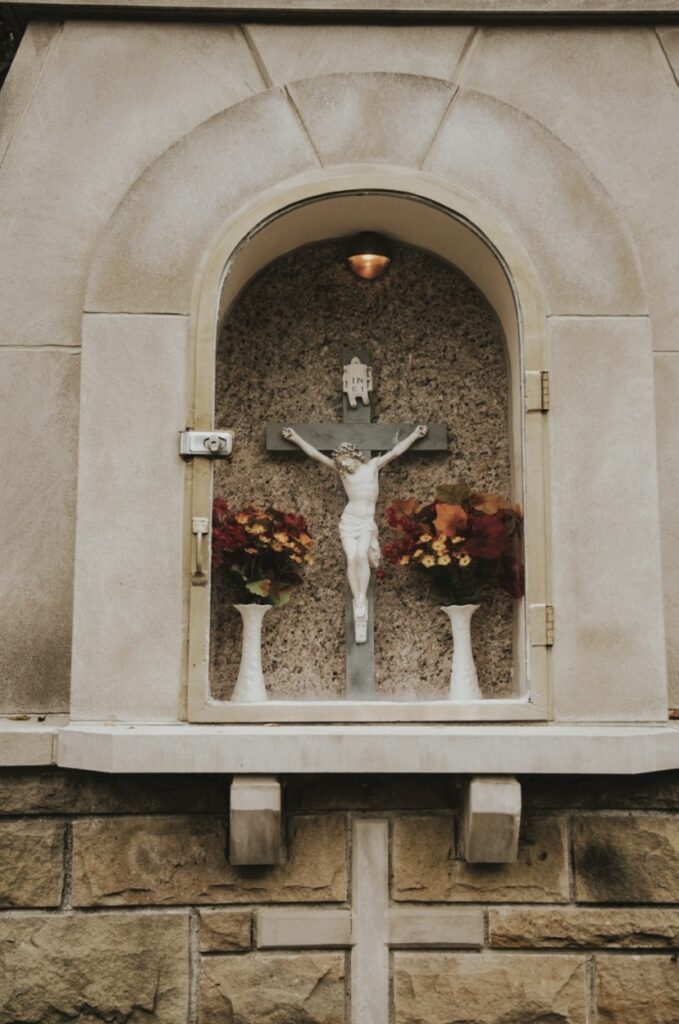
For most, the Blessed Mother can only be seen from the Parkway East. This explains how she has come to be known as Our Lady of the Parkway. It is fitting that this fleeting vision appears by looking up from a roaring machine, as the Blessed Mother’s original witness was Philip Marraway, a steelworker at the Jones and Laughlin mill that once consumed the river bank the Parkway now dominates. Mr. Marraway was at the end of his shift in 1956 when he spied a beacon shining from the bluff. Upon ascending to the luminous site, he encountered Sophie Toma, a believer equally drawn to the spot. A dream suggested that she’d meet a man named Philip.
A Miraculous Tale
This miraculous tale is shared with us by another family – mother, father, adult daughter – who happen to be visiting the shrine as we arrive. We respect their privacy, as they kneel in the Blessed Mother’s bathtub grotto and take pictures of the concrete angels and plastic flowers gracing her altar. Then the mother approaches us. It was her father, she says, the prophesied Philip, who had the vision to construct this very shrine. They have brought their daughter today, after a very long absence, to touch her late grandfather’s apparition.
Our mirrored families perch awkwardly on the canted ledge, breathing softly against the thunder of the traffic below. We are each, I suspect, taking measure of our faith. I steady myself on my daughter’s arm, just returned to me from the unbearable distance of the Holy Land, and remember that I am a mother blessed.
I catch the eye of her father, my companion in countless peregrinations. A year of plague and flood and fire, of monstrous trespasses and righteous rage, looms behind us—a year that has pushed us, out of need, desire, or sheer boredom, to this precarious spot where we stand rooted. Nowhere to come today but here. Nowhere to go now but home.
What We Find When We Stop Searching
I don’t believe in miracles, or even God. But there is a parable in this story that I feel is 2020’s parting message and perhaps its gift to me. The destination, that we once imagined was elsewhere, that we once dreamed could be anywhere on earth, is here. Here is the vision.
Story by Kristin Kovacic
Photography by Ben Petchel
Subscribe to TABLE Magazine’s print edition.