Before its larger themes come into focus, the 59th Carnegie International draws attention to the act of looking itself. The works on view, sourced from 61 artists and collectives, frequently reveal themselves through delayed recognition: you glance up and realize you’ve missed something overhead; you pass beneath a threshold and only later register its weight. Details sit just out of view, or just out of focus, until they insist on being seen.
Before its larger themes come into focus, the 59th Carnegie International draws attention to the act of looking itself. The works on view, sourced from 61 artists and collectives, frequently reveal themselves through delayed recognition: you glance up and realize you’ve missed something overhead; you pass beneath a threshold and only later register its weight. Details sit just out of view, or just out of focus, until they insist on being seen.
The 59th Carnegie International Explores Attention, Visibility, and Collective Experience
Organized by Ryan Inouye, Danielle A. Jackson, and Liz Park, the exhibition unfolds across Carnegie Museum of Art and a network of sites throughout Pittsburgh, including the Mattress Factory, Children’s Museum of Pittsburgh, the Kamin Science Center, and the Thelma Lovette YMCA. Titled If the word we and drawing in part from an essay by writer and translator Haytham el-Wardany, the exhibition treats collectivity as contingent and subject to constant revision. That idea circulates through the galleries as a set of conditions for noticing: how we move through space, what we overlook, and what only comes into view after a second pass.
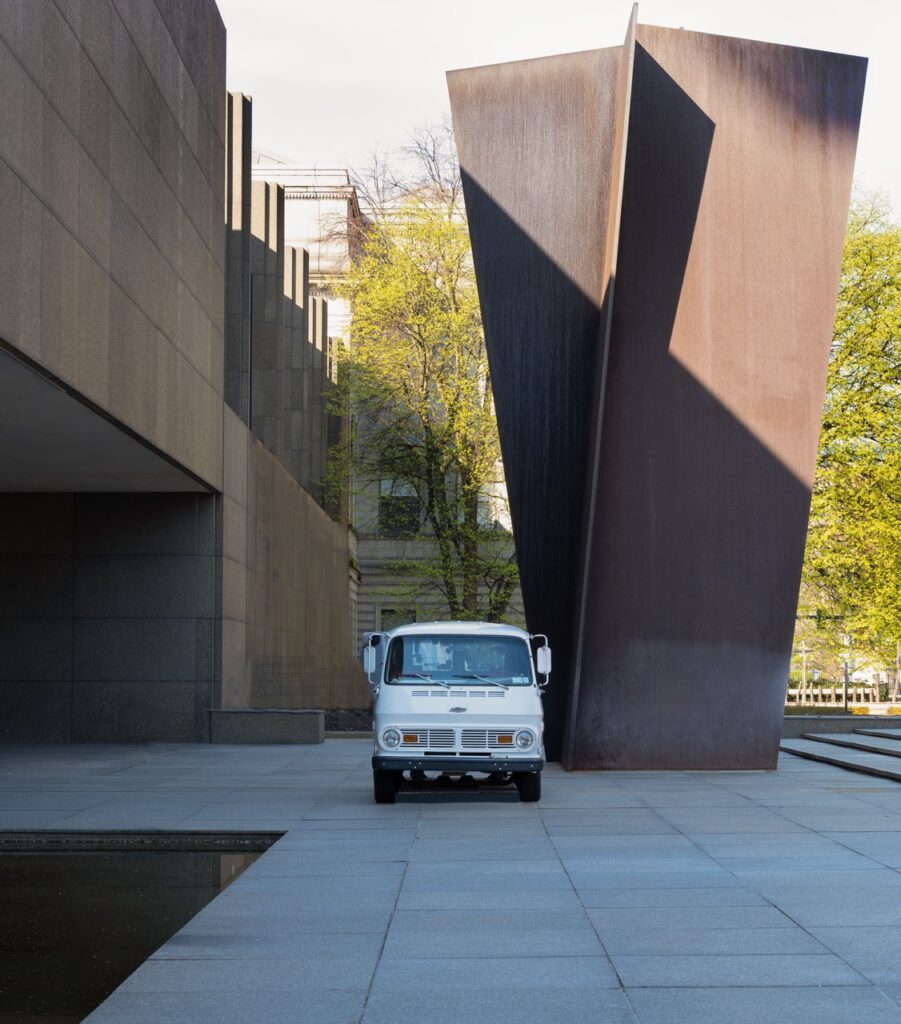
Visitors are met on Carnegie Museum of Art’s outdoor plaza by Abraham González Pacheco’s weathered concrete murals, which read like remnants of a speculative archaeology, and by G. Peter Jemison’s recreation of a 1975 touring group exhibition of Haudenosaunee art (Jemison transported the works to Pittsburgh in a vintage Chevy van, now parked outside the museum with his painting Ganondagan Autumn stretched across its side). Inside, the exhibition continues to disperse. This expansion situates the International within a broader set of social and institutional spaces, where the “international” is understood as a set of relations moving through—and occasionally rooted in—Pittsburgh.
How the Carnegie International Uses Space and Architecture to Shape Viewer Attention
In the Hall of Sculpture, Cinthia Marcelle’s Green Hall Annex (2026) introduces a different kind of shift. The floor is full of green carpeting, echoing the interior of Brazil’s National Congress Building after its reconstruction following the January 8, 2023 attacks, an event widely understood in relation to the January 6, 2021 assault on the U.S. Capitol. Installed within a gallery modeled after the Parthenon, the gesture pulls these architectural and political histories into uneasy alignment.
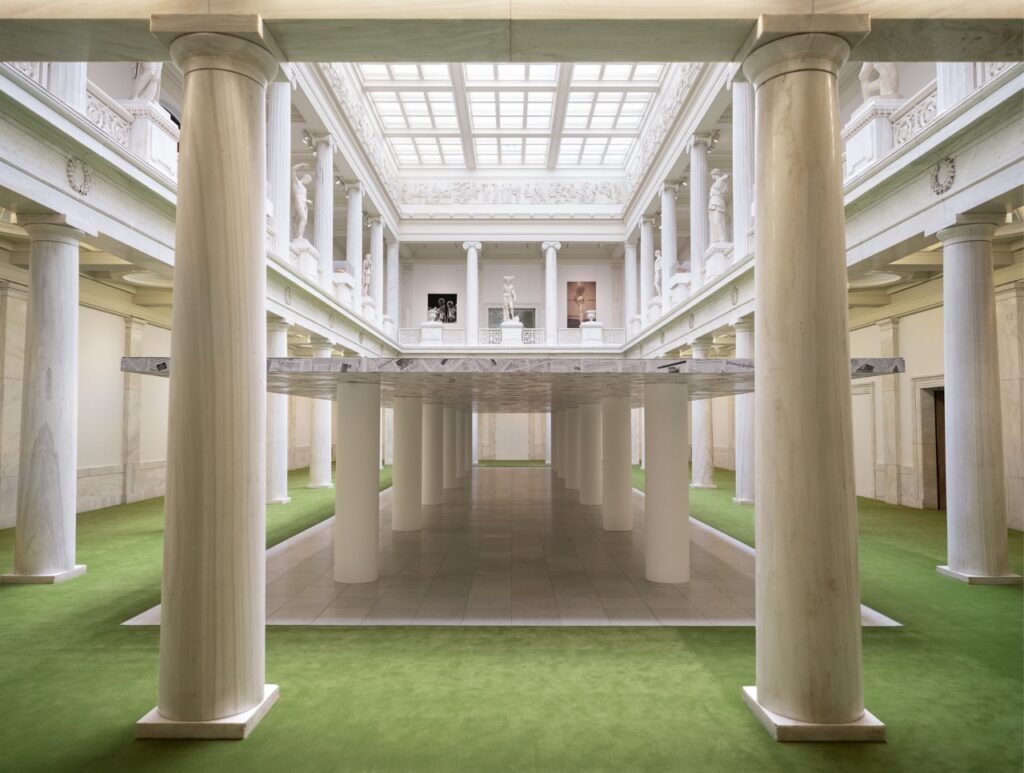
of Art, Pittsburgh (May 2, 2026–January 3, 2027), featuring works by Cinthia
Marcelle; photo: Zachary Riggleman / © Carnegie Museum of Art, Pittsburgh
The room’s symmetry holds, but its surface no longer feels stable. Standing within the structure, we look up to find a layer of digitally collaged material—screenshots of newspaper articles, images, historical documents, their overlaps and distortions left visible. Off to one side, a framed document records the artist’s request to register the work with the Brazilian government; a return slip stapled to its surface indicates that the request was denied. It opens onto questions of recognition and the limits of institutional acknowledgment.
Art You Walk Through
In Ana Raylander Mártis dos Anjos’s Justice (2026) in a connective hallway, 3,000 silhouetted “white weapons” suspend overhead in illuminated boxes. Visitors pass beneath them before realizing what is hanging above. Once recognized, the objects fundamentally alter the space. The work draws on the circulation of such objects within systems of policing and state power, where they may confiscate, plant, or repurpose the objects as evidence. The viewer’s awareness of the installation emerges belatedly, through the act of looking up and recognizing the conditions they are already moving through.
A similar dynamic animates Jasleen Kaur’s Supra (2026), where a lintel composed of weighty Encyclopedia Britannica volumes spans the entrance to the installation. It is easy to walk beneath it without noticing. Once recognized, it becomes difficult not to think about the weight it carries: knowledge assembled, sanctioned, and fixed into place.
Jasleen Kaur, Georges Adéagbo, and the Politics of Knowledge and Exchange
Will these heavy volumes fall? Will they crush us? The possibility is never confirmed, but it alters how I move. The installation opens into a space that suggests gathering but remains structured by the weight overhead. A simulated sun casts moving patterns through faux stained-glass windows onto a red carpet, cycling the room between day and night. On a windowsill sits a miniature reproduction of the Babri Masjid in Ayodhya, India, demolished by Hindu nationalists in 1992; cast in uranium glass, it intermittently glows a vivid green. Nearby, a gold-plated cast of the artist’s teeth rests along the sill. Kaur describes the work as an engagement with “the systems and frameworks we live within and feel through,” with each instrumentalist representing a structure: border, nation-state, belief, body.
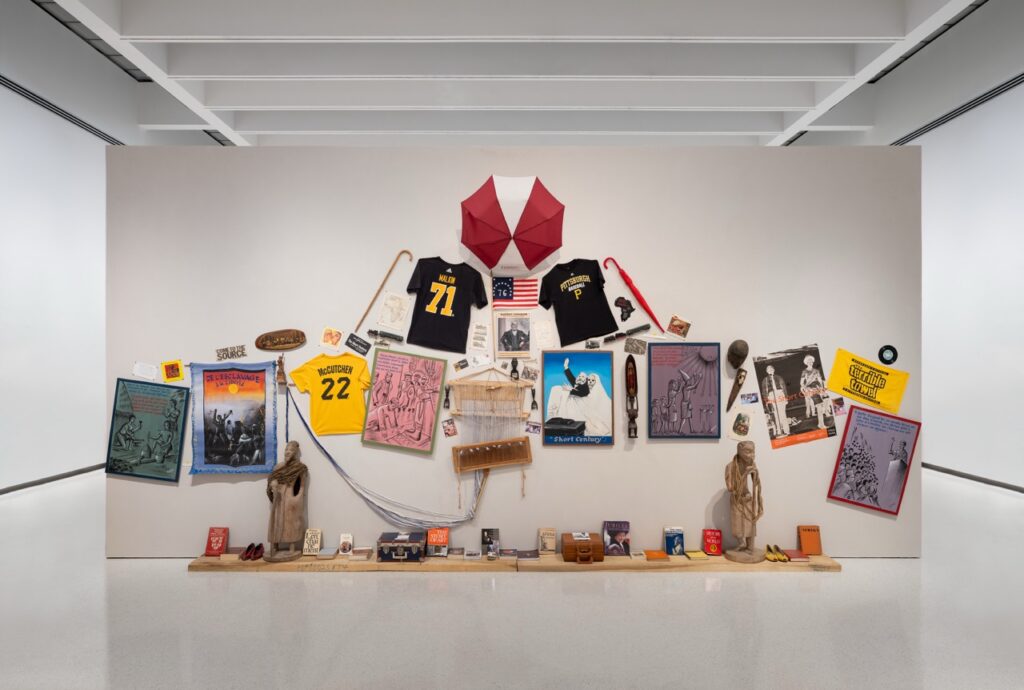
Questions of circulation and exchange come to the fore in Georges Adéagbo’s expansive installation Le Socialisme Africain (2001–04/2026). Composed of everyday objects collected by the artist, the work unfolds as a dense, associative environment (is it an archive? A marketplace? A social gathering?). For its presentation in Pittsburgh, Adéagbo incorporates items that index the city’s identity: a Terrible Towel, two jerseys bearing the names of familiar athletes. These objects operate as points of contact, linking disparate histories and geographies without smoothing over their differences. The installation invites viewers to move through it collectively, to read across its juxtapositions, and to situate themselves within its shifting coordinates.
Multimedia Installations and Sensory Experiences
In the Hall of Architecture, Wu Tsang’s on our way to the general strike (2026) draws on the long history of Carmen in performance and film. The work assembles a visual and sonic archive that moves across interpretations of the opera, from stage to screen and back again.
The massive screen sits low and wide, cutting across the open floor rather than rising to meet the surrounding architecture. Behind it, casts of monumental structures hold their ground—arched portals, columns, pediments—fixed in place and scaled for permanence. Tsang’s borrowed images move against the backdrop of monumental facades and classical structures. The work never fully resolves the tension between the moving image and the museum’s historical staging of culture and civilization.
Throughout the exhibition, material processes extend into other sensory registers. In Camara Taylor’s Permanent Futures (2026), the scent of Caribbean dark rum saturates the gallery as the liquid circulates through a system of pipes and containers. The work draws on the historical entanglements of rum production with the transatlantic slave trade, as well as its role in ritual contexts. Moving through the gallery with a colleague, I nearly missed a small detail in the wall label—Taylor’s birth date listed as 1625—until she pointed it out. At first glance, it reads as an error. A quick check suggests otherwise, linking the date to the early history of English colonial expansion and the emergence of the rum trade.
Historical Memory and Institutional Critique at Carnegie Museum of Art
Historical layering extends beyond the exhibition itself. Concurrent with the 59th International, the museum recently rehung one of its Scaife galleries with works acquired from previous iterations of the Carnegie International, charting more than 130 years of the exhibition’s history through a dense salon-style installation. Though not officially part of the 59th edition, the gallery inevitably reframes it. Installed among past acquisitions is a 1985 Guerrilla Girls poster declaring: “ONLY 4 OF THE 42 ARTISTS IN THE CARNEGIE INTERNATIONAL ARE WOMEN,” a reminder that the history of the International has always been shaped by disputes over visibility.
In this gallery, I found myself pausing before Pittsburgh-born Henry Ossawa Tanner’s Christ at the Home of Mary and Martha (ca. 1905), its figures emerging slowly from the surrounding dimness. Widely regarded as the first African American painter to receive international acclaim, Tanner occupies a complicated position within this history of visibility and exclusion. Light gathers around the table at the center of the scene while much of the room remains obscured, requiring us to spend time with the painting before its details fully register. Seen alongside the current International, Tanner’s work begins to echo the exhibition’s recurring concern with attention itself: what becomes visible, what remains difficult to perceive, and how the institution shapes those conditions of recognition.
The Meaning of “We” in the 59th Carnegie International Exhibition
What emerges across this International is a conception of “we” grounded in shared acts of attention. The exhibition avoids consensus. It asks something quieter: that viewers remain present to what unfolds around them, that they recognize the partiality of their own perspective, and that they allow for the possibility of connection without resolution.
This approach is not without its tensions. The exhibition’s language of collaboration and “thought partnership” suggests a level of cohesion that can be difficult to fully apprehend across its many sites and formats. No single visit can encompass the entirety of what is on offer. Yet this incompleteness feels less like a shortcoming than a structural condition. The “we” proposed here is necessarily provisional, shaped by what one encounters and what remains out of reach.
The exhibition’s conceptual scaffolding is laid out across three catalog essays by the curators, each of which takes up the question of collectivity from a distinct position. Their differences are productive. Taken together, they offer one of the more thoughtful and internally varied curatorial statements of today’s large-scale surveys, moving between questions of relation and institutional history without collapsing into a single voice.
Taking a Compassionate Viewpoint
That complexity, however, sits in tension with the smoother language that often accompanies large international art surveys—collaboration, partnership, openness—terms that risk becoming generic through repetition. Park addresses this directly. “I do not expect museums to be free of contradictions,” she writes, “but the paradoxes and at times outright hypocrisies do need to be acknowledged…” Her statement resists the idea of the museum as a seamless “meeting ground,” insisting instead on the uneven conditions that structure any encounter within it. Read in this light, the exhibition’s emphasis on “we” feels less like a unifying gesture than an invitation to sit with those tensions as they unfold.
This is where the conditional of the title—if—becomes central. It keeps these questions open, suspended across and beyond the galleries. Nothing resolves. What takes shape does so gradually, in passing, in fragments that accumulate and disperse. We leave with an altered sense of attention toward how meaning gathers, how it slips away, how it returns later, reframed. Whatever “we” exists here does not hold still. It asks you to look again—upward, closer—until something else comes into view.
Story by Shawn Simmons
Photos by Zachary Riggleman, Courtesy of Carnegie Museum of Art
Subscribe to TABLE Magazine’s print edition.