John Burt Sanders’s shifting fields of color and texture catch and keep the viewer’s gaze, reaching from retina to mind to body.
Artist John Burt Sanders and His Perspective
John Burt Sanders has spent more than a decade living and working in Wilkinsburg, but his paintings resist the idea of settling into a fixed visual language. They operate in a state of productive instability, insisting on looking as an active, physical process rather than a simple act of recognition. His paintings do not present images so much as they generate conditions: fields of color and texture that oscillate between subtle modulation and sensory overload, holding the viewer in a prolonged encounter that is felt in the body as much as in the mind.
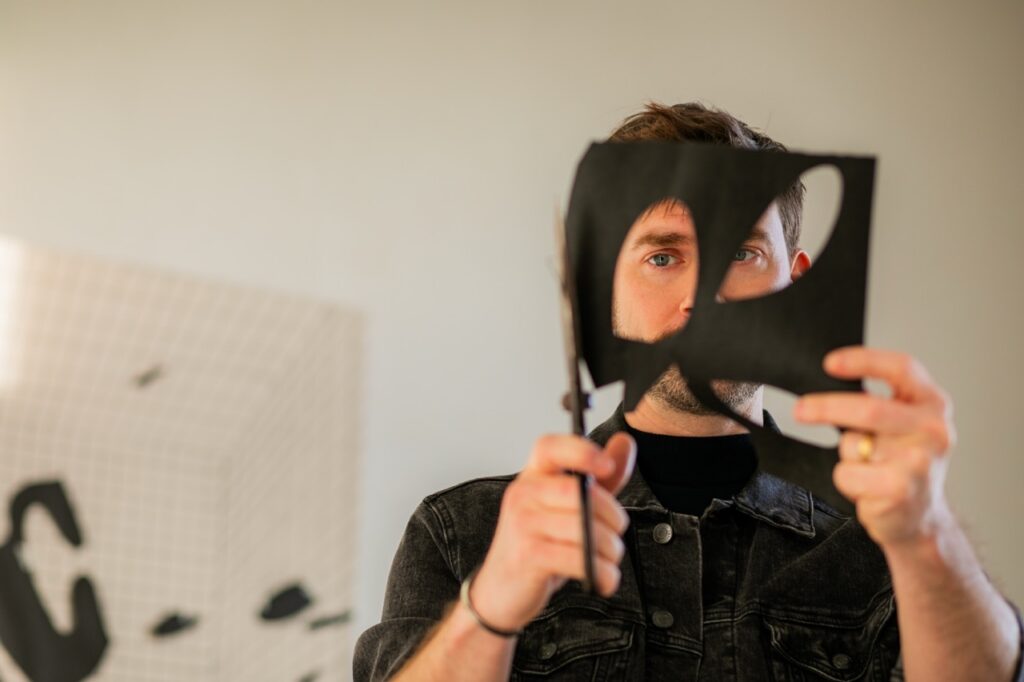
Sanders grew up in Western New York and studied painting and art history at SUNY Fredonia before pursuing an MFA in painting and drawing at Ohio University. It was during that period, through friends and mentors, that he began spending time in Pittsburgh, drawn by the possibility of sustaining a life as an artist over the long term. Fourteen years later, that possibility has taken concrete form in a studio he has occupied for the past five years: a cavernous upper floor in a late-nineteenth-century building, its soaring ceilings and arched windows providing the scale and light his work requires.
Before it became his studio five years ago, Sanders had long admired the building from the outside. He gestures to a used flat file in the corner, recalling that when he went to pick it up, he realized the address matched the same vacant Wilkinsburg building he had passed for years. Soon after, the upper floor became his studio.
His New Style of Painting
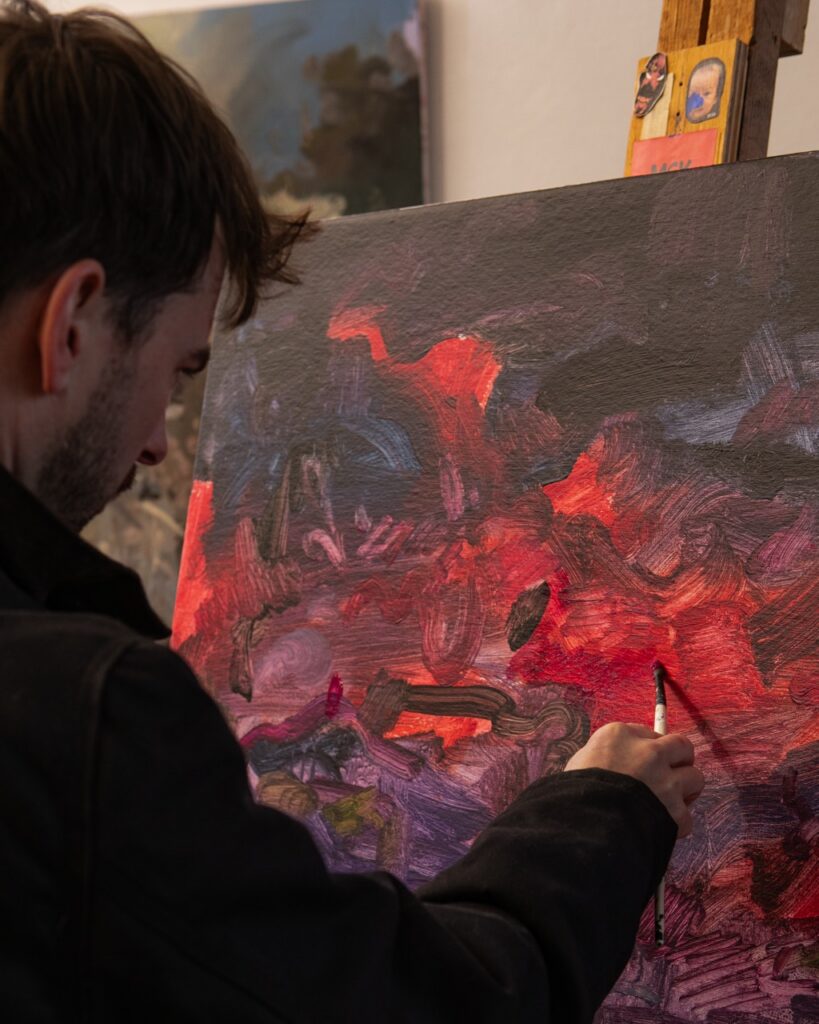
The paintings lining Sanders’s walls mark a noticeable shift from earlier work. He describes them as “unformed,” and the word feels precise. Inspired by the pastel excess of rococo painting—think Watteau or Fragonard—these new works combine that elegance with the glitchy violence of early video games. He notes that in the graphics of games like Mortal Kombat, blood splatters often resemble Rorschach inkblots, abstract forms loaded with projection. The result is a kind of visual embrace of excess and saturation.
Sanders connects these themes to growing up queer and playing video games, noting that he always spent extra time on character selection screens—spaces of fantasy where identities are tried on rather than resolved. For him, the appeal of gaming centers on multiplicity, with new characters continually opening new possibilities. “Abstraction is by its very nature indeterminant,” he says. “That’s why I come back to it.” In painting, as in queerness, formlessness becomes a site of freedom. It holds the capacity for competing impulses without forcing resolution.
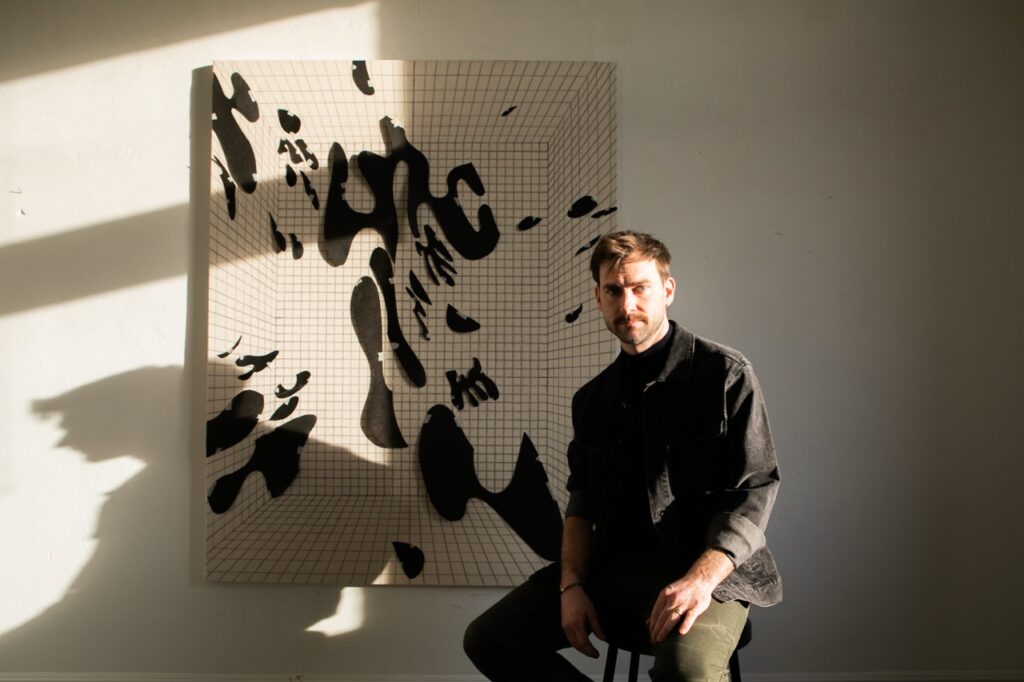
That same logic shapes the making of the work. In Sanders’s practice, influences loop back, recur, mutate. Knowing when a painting is finished is intuitive, he explains, and he is careful not to overwork a surface: “Process should never be debilitating.” What matters, in the end, is keeping the work from ever fully settling.
Story by Shawn Simmons
Photography by Laura Petrilla
Subscribe to TABLE Magazine’s print edition.