The Heinz History Center has always focused on the people and culture of Western Pennsylvania. With the new exhibit Planet Ice: Mysteries of the Ice Age, that focus expands to cover the people who lived in the region tens of thousands of years ago.
History, Meet Science at Heinz History Center’s Plant Ice Exhibit
While there’s plenty of history — albeit a somewhat more distant variety — as part of Planet Ice, the exhibition is fundamentally rooted in science. Produced by the History Center with the Canadian Museum of Nature, the careful and approachable exhibition patiently explains the basics of climate and geology that lead to Earth’s Ice Ages.
Ice, as you may have heard, is necessary to modulate the temperature on the planet. Technically, we’re in an Ice Age right now. The term applies anytime ice is present at the Earth’s poles. While that ice is receding, a concern that Planet Ice presents in no-nonsense detail, many of the adaptations made by Earth’s creatures are designed to adjust to the presence of cold and snow.
In the case of prehistoric North America, that included the presence of megafauna — massive animals including mastodon, short-faced bear, Irish Elk and the slightly whimsical giant beaver. All of these animals appear in the exhibit in the form of skeletal casts and fossils; take a moment to marvel at the 11-foot antlers of the Irish Elk, which once roamed North America.
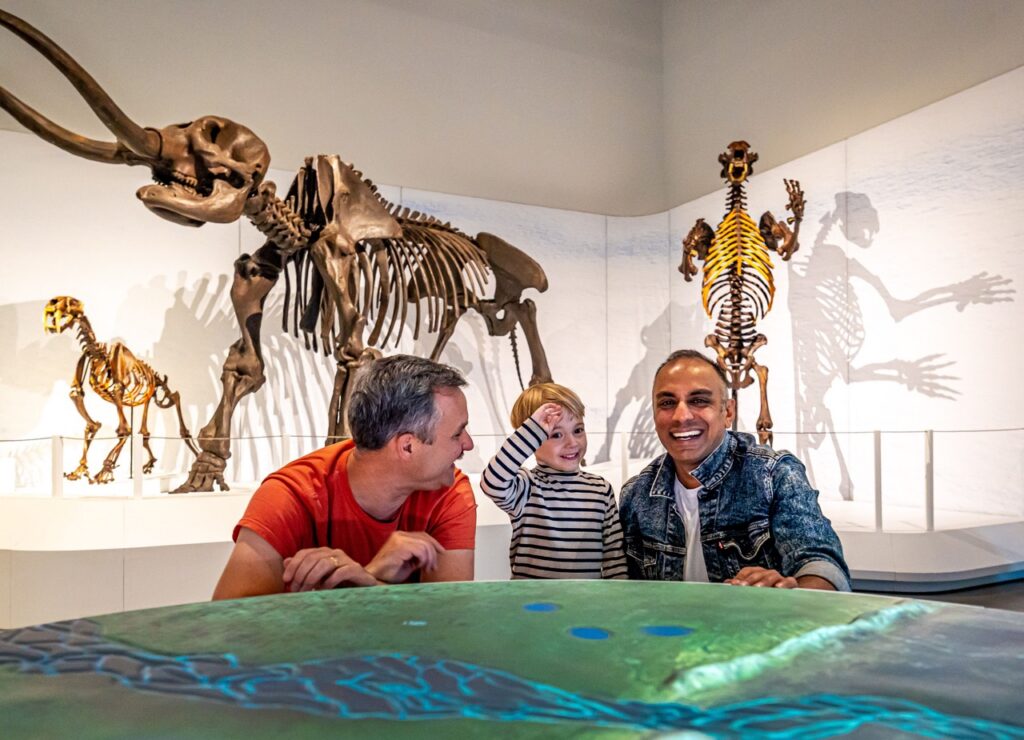
Visiting the Prehistoric Neighbors
While many of the most attention-grabbing moments in Planet Ice involve giant animals — young and old guests will enjoy touching a preserved mammoth tooth — this is also an exhibition of how humans survived and lived when glaciers reached into what is now Western Pennsylvania.
Use a microscope to inspect tools and other artifacts, including delicate decorative items. A full-scale ice-fishing hut — presented in modern format, but referencing ancient techniques — provides an added bit of immersion. You’ll even have a chance to hurl a spear using an atlatl, targeting the imposing outline of one of those short-faced bears that intimidated our prehistoric neighbors.
These moments bring the connection between the modern Pittsburghers featured throughout the History Center and the hunter-gatherers of the distant past into sharp relief. The similarities between us are obvious; the differences are in the hardships and demands of a different climate. (That’s something of a grim reminder at a time of changing temperatures; the exhibit doesn’t shy away from this fact, but does state it simply enough to still allow for an enjoyable experience.)
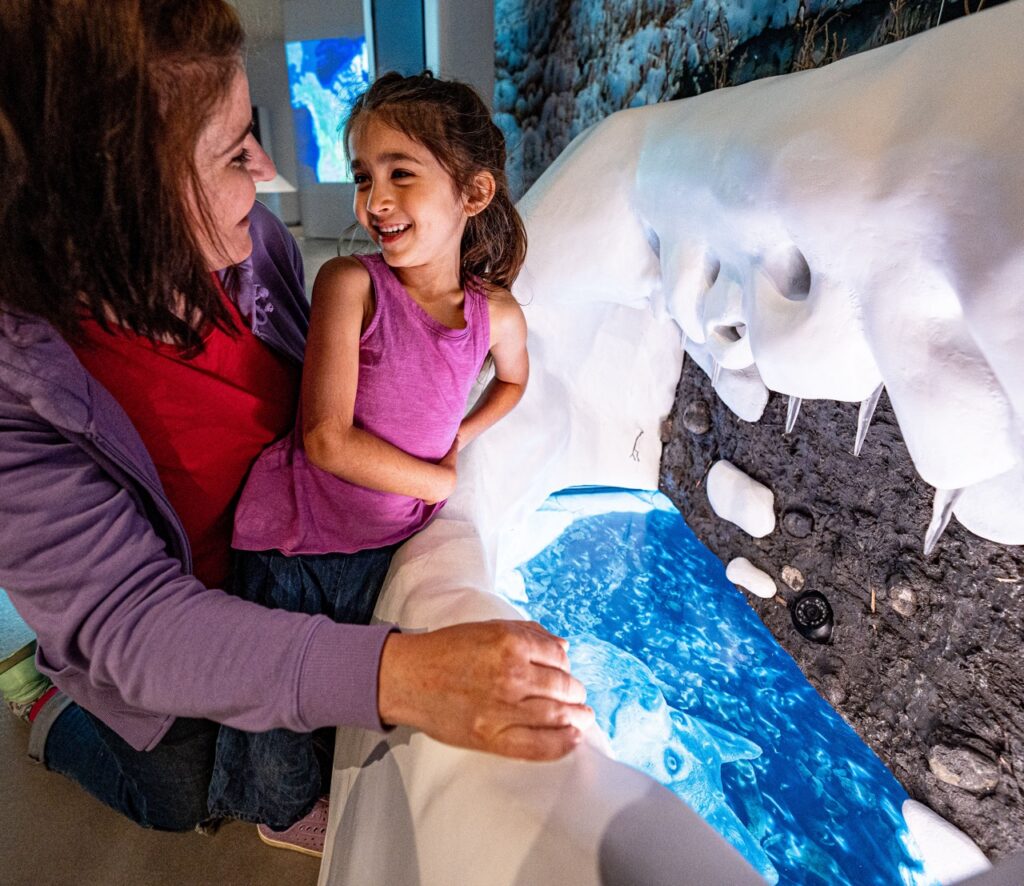
Plan an Accompanying Trip to Meadowcroft for a Prehistoric Weekend
There are, of course, sites of ice-age habitation remaining in western Pennsylvania, including areas that were literally carved by glacial forces. One site, however, pairs perfectly with Planet Ice — and it’s in the Heinz History Center family.
Meadowcroft Rockshelter, a massive rocky overhang in Washington County, is an archeological site of vital importance. In the 1970s, researchers found signs of prehistoric human habitation under the shelter of this geological formation — then dated the evidence found there, discovering that humans lived in this spot about 19,000 years ago.
That makes it the oldest confirmed site of human habitation in North America.
On a visit to Meadowcroft — which also includes a charming historic village, for a trip to the more recent past, and additional opportunities to hurl the atlatl — you’ll be able to picture those ancient residents in situ, gathering around the fire and curling up for a night’s rest. Paired with the information and clarity gained by Planet Ice, it’s a remarkable glimpse through time.
Story by Sean Collier
Photos Courtesy of Heinz History Center
Subscribe to TABLE Magazine’s print edition.