Bricolage Production Company has a play scheduled for June 4-7 as a part of their Samizdat theater series. They won’t tell you where it’s happening.
There’s a New Revolutionary, Hidden Theater Series in Pittsburgh Thanks to Bricolage Production Company’s Samizdat
They’ll tell you the name of the show — Protest, by Václav Havel, the third of three plays by the Czech writer staged as part of this series — but the few tickets that were available sold out before that name was revealed. They won’t announce who’s performing; you’ll have to go and find out.
Can you get tickets? Maybe. (There’s a wait list.) But be quiet about it.
The project is Samizdat, a name for the practice of dissident Eastern Bloc writers publishing and distributing publications and works in hidden ways. In the case of live theater, that often involved quietly staging a play for a few friends or like-minded thinkers in a private space — say, a residential home, or the corner of an out-of-the-way warehouse.
“As artists, we can present work that helps us have a conversation about what we are actually able to do,” says Bricolage co-artistic director Tami Dixon. “How we can be better citizens of our country, of our neighborhoods, of the world.”
Taking to Intimate, Immersive Spaces
The first installment of the series, Havel’s Audience, found its setting at a brewery; the second, The Unveiling, in a private residence, with chairs lined up in the living room. Capacity was, by necessity, very low; both sold out early, with virtually no press and little promotion.
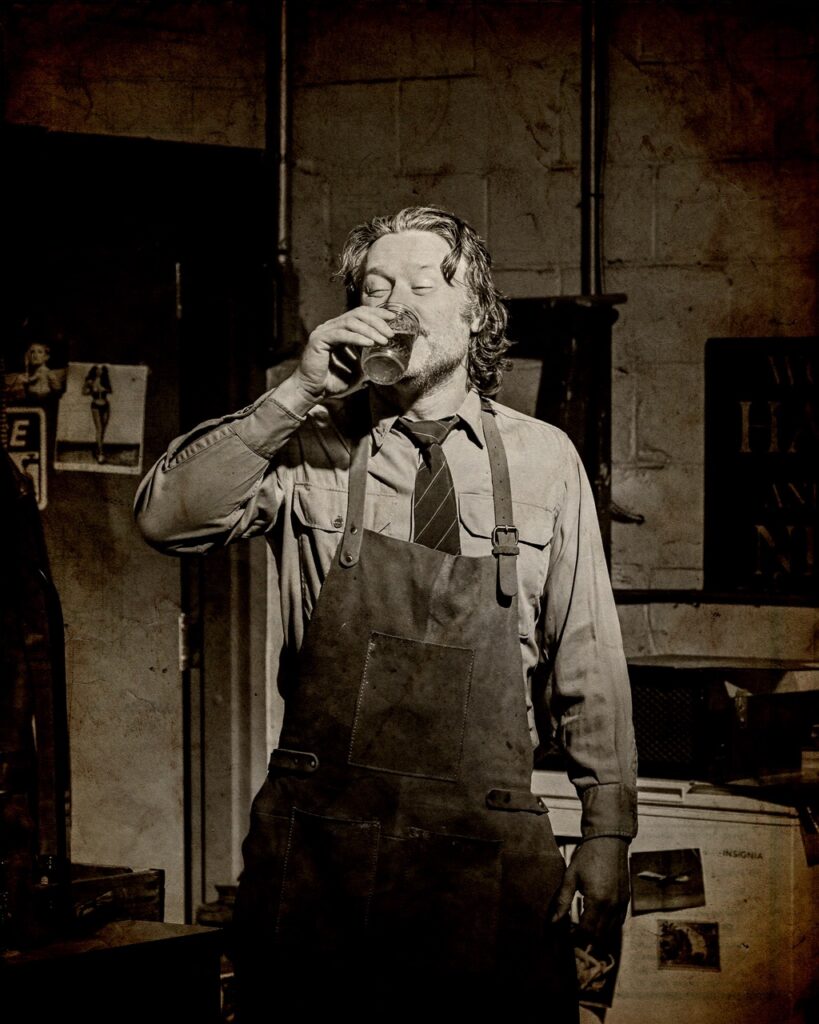
“There’s something about these small audiences right now that are really speaking to us,” says Jeffrey Carpenter, Bricolage’s founder and co-artistic director. “There’s something about that living-room space, where you’re just with people. We’re together in it.”
Performances of the plays, which are on the shorter side, are followed by open conversation between the crew and the audience, centered on the show’s themes, ideas and historic context. “The ability to be in conversation with the audience afterwards adds a whole other level of community that we don’t often get when we’re just presenting a show,” Dixon says. “This allows us to kind of sit with our audience and hear their response in a collective space, together.”
Like a Speakeasy but Theater
The presentation of the show plays into the underground trappings; you’ll have to knock on the right door for admittance, and even your pre-show instruction email will also playfully warn you not to tell your Uber driver where you’re going. If part of that attitude is intentional scene-setting, though, much of it echoes the reality of this approach: This is not carefully polished theater in a grand old hall. It’s warts-and-all, deliberately visceral — and thus vibrant — performance.
“It’s sort of like wearing a suit jacket inside out: look at the seams,” Dixon says. “Look at that. We are not covering up our tracks. We’re just artists; we’re not perfectionists and we don’t want to be. We’re not creating an illusion for you. What we are is inviting you in through the back door.”
And while that door may have closed to audiences just learning about Samizdat, whispers of more underground evenings of theater are already in the air.
“Given the state of our country,” Carpenter says, “it does feel like we would like to continue the series.”
Story by Sean Collier
Photos by @shotsbyscott Courtesy of Bricolage Production Company
Subscribe to TABLE Magazine‘s print edition.