Now, with season two of Tucci in Italy premiering May 11, we’re doing it again. This time, Tucci travels through Naples and Campania, Sicily, Le Marche, Sardinia, and Veneto. Each of these five regions carry different distinct ingredients, techniques, and food traditions.
For each stop, we pair a recipe that connects directly to that region. So when season two drops on National Geographic, Disney+, and Hulu you can join in on the fun by making a recipe for each episode, joining Tucci in his own discoveries.
Recipes for Cooking Through Tucci in Italy Season Two
In Naples and across Campania, Pasta Fagioli is a part of everyday cooking. It comes out of the region’s cucina povera tradition, using beans, pasta, and aromatics to create something filling and practical at a low price. In Naples, it’s often made thicker than a soup and a bit closer to a stew. It’s a dish that’s less about a fixed recipe and more about the method itself. Oh: and the flavor too!
Sicily is home to Pasta alla Norma and you’ll find it all across the region. Eggplant, tomatoes, basil, and ricotta salata form the base, reflecting ingredients that are central to Sicilian agriculture. Even the name is specific to the place. Pasta alla Norma is believed to reference the operaNorma by Vincenzo Bellini, linking the dish back to one of Sicily’s major cultural figures.
In Le Marche, fresh egg pasta is a defining part of the food culture. In turn, tagliatelle is one of the most common shapes. It’s typically paired with a ragù that comes from beef and San Marzano tomatoes as well as a slow cooking technique. It’s a straightforward combination that reflects how central pasta-making is to the region.
Sardinia is where fregula, a small, toasted pasta, originates. This pasta’s texture and flavor come from the toasting process, which gives it a slightly nutty taste. You’ll see fregula in soups or alongside seafood like mussels and fish, tying it back to Sardinia’s geography as an Italian island in the Mediterranean Sea.
In Veneto, Sarde in Saor is a traditional dish with roots in Venice. Sardines are paired with onions, vinegar, and raisins, a combination that reflects Venice’s long history as a trading center because it draws upon flavor influences from the Eastern Mediterranean. Originally used as a way to preserve fish, the dish remains a part of the region’s standard cooking repertoire.
What does it take to reach financial success in 2026? We talk with financial professionals about how to nurture your nest egg to meet your financial goals.
How to Reach Financial Success in 2026
What Does It Mean to “Stay the Course” in Investing, and Why is It so Important?
“Staying the course” refers to the disciplined practice of holding assets and continuing to invest despite market volatility. It prioritizes adhering to a long-term financial plan and avoids getting caught up in short-term turbulence.
Investors tend to let fear and greed obstruct their best judgment. Emotional biases may be the single largest factor that hinders individuals’ investment returns. In the last 13 months, investors have panic-sold assets in wake of both the tariff announcements in April 2025 and the recent war with Iran. In both cases, if they had simply stayed firm, their portfolios would likely have rebounded to all-time highs in less than a month’s time. Instead, they locked in losses AND subsequently missed out on much of the rebound growth.
“Staying the course” means to step back, take a deep breath, and remember that market downturns and negative economic cycles are inevitable. If you understand how much risk you are comfortable bearing, the best choice is almost always staying committed to your long term financial plan.
Beyond Investment Portfolio Performance, What Should Investors Expect From Their Wealth Advisor?
Beyond performance, investors should expect a wealth advisor to serve as a fiduciary partner, or someone legally and ethically committed to putting the client’s interests first. This includes disciplined advice, transparent reporting, and clear objectives that connect investments to real-life goals and priorities. A preferred advisor should disclose all known fees and avoid incentives tied to product sales, commissions, or brokerage activity. Advice should be thoughtful, adaptive, and grounded in long-term alignment. Investors should also expect proactive problem-solving during periods of market stress, major life transitions, or changing family needs. Ultimately, the advisor’s role is to provide structure, perspective, and accountability so financial decisions are made with clarity rather than emotion.
What is Your Investment Philosophy, and How Do You Adapt Your Approach to Current Market Conditions and Investor Needs?
Our investment philosophy is rooted in discipline, thoughtful research, and a focus on long-term outcomes. Advisors at Henderson Brothers Financial Partners take time to understand each client’s goals, priorities, and comfort with risk, then build diversified portfolios using both fundamental and technical analysis. Rather than reacting to short-term headlines, decisions are guided by market trends, economic conditions, and individual needs. As life and markets evolve, portfolios are monitored, stress tested, and adjusted to remain aligned with what matters most. Our team believes in participating in the market to grow, with an emphasis to protect the assets you worked so hard to acquire.
With the Growing Complexities of Estate Planning, How Do You Distinguish Between the Need for a Will Versus a Trust in Today’s Market?
When planning your estate, you might wonder: do I need a will, a trust, or both? A will outlines how your assets are distributed after death but must go through probate, which can be lengthy and public. A trust, by contrast, offers greater control and privacy, avoids probate, and allows for planning in case of incapacity—something a will doesn’t address. Trusts are especially useful for larger estates or complex family situations, offering more flexibility in managing and distributing assets. Ultimately, consulting our firm can help you create a personalized plan that aligns with your goals and preserves your legacy.
What Do We Expect for the Second Half of 2026 and Where Do We See Opportunity?
The first quarter of 2026 brought heightened market volatility, and we expect this to persist through year-end. Recent geopolitical developments—including ongoing Middle East conflict, leadership change in Venezuela, and strategic focus on Greenland’s mineral resource—have contributed to the disruption and uncertainty. These dynamics highlight the growing importance of reliable energy and infrastructure to support AI-driven data center expansion and global chip production. In this environment, our disciplined, long-term approach remains essential. We continue to identify attractive opportunities, in electric utilities and infrastructure sectors, which we believe are foundational to meeting rising energy demand and enabling the next phase of technological growth.
Given the Current Economic Volatility, How Do You Manage Market Downturns & Mitigate Risks in My Investment Portfolio?
The key to managing market volatility is by being proactive rather than reactive. This involves structuring a portfolio with built-in downside protection, while still being able to take advantage of long-term market growth. By maintaining a disciplined strategy and focusing on high quality assets, investors can navigate periods of uncertainty with greater confidence and stay on track toward their financial goals.
Can You Help Me With Retirement Planning, Including Forecasting Potential Expenses and Income Needs as Market Conditions Change?
Markets will always fluctuate. But whatever way they move, a comprehensive financial plan is one of the best strategies to stay on track toward your retirement goals. Your UBS Financial Advisor monitors the current environment and will work with you to ensure your retirement plan and your portfolio reflect changing conditions. Volatility may be unsettling, but with a long-term plan in place, you can feel more confident about the future.
Disclosure: Any information presented is general in nature and not intended to provide individually tailored investment advice. Investing involves risks and there is always the potential of losing money when you invest. For our client relationship summary disclosures, please visit ubs.com/relationshipsummary. UBS Financial Services Inc., Member FINRA/SIPC
If you haven’t seen the delightful trailer for The Sheep Detectives, the title may convince you this is an animated, family-friendly adventure. It’s certainly gentle enough — but, talking sheep aside, the film is actually a witty and even erudite murder-mystery satire.
Someone’s Been Very Baa-d in The Sheep Detectives
Hugh Jackman stars as the lonely but gentle shepherd George Hardy. He lives a simple life tending to his flock outside of a quaint English town. Each night, he reads to the appreciative sheep from his collection of pulpy whodunits. When he turns up dead, the local police are outmatched, and the townsfolk are bewildered.
Fortunately, these are no ordinary ungulates. The group of clever sheep and lambs — voiced by an enthusiastic cast including Julia-Louis Dreyfus, Bryan Cranston, Chris O’Dowd, Patrick Stewart and Regina Hall — have been taking notes on the plots of all those page-turners. Determined to do right by their fallen friend (and avoid being sold to a rival farmer’s slaughterhouse), the sheep set out to unravel the mystery.
In an era when too many comedies remain fundamentally mean-spirited, this one is pleasantly kind-hearted. That should not, however, suggest a lack of depth; these are barnyard animals with some serious concerns. I expected to laugh; I didn’t expect to consider whether the occasional memento mori was essential for a true appreciation of life. The Sheep Detectives has surprising power.
A Seasoned — and Multifaceted — Screenwriter
Much of the credit must go to screenwriter Craig Mazin. He made his name on broad comedies such as Identity Thiefand entries in the Scary Moviefranchise. But he also turns to prestige TV, writing the acclaimed HBO miniseries Chernobyland directing The Last of Us. A combination of wit and gravitas is a powerful thing; Mazin’s career has allowed that confluence to develop nicely.
The look of the film is less impressive. It’s sets are a watered-down repeat of last year’s Wake Up Dead Man, and Kyle Balda’s direction is presentational. Unfortunately, the sheep themselves recall the errors of Disney’s “live-action” animated animals, seen in the recent Lion Kinginstallments. There’s no good way to combine photorealistic animals and awkwardly moving CGI faces. You’ll be charmed enough to overlook the awkward appearance of these rams and ewes but not ignore it.
Otherwise, though, The Sheep Detectives is a rare thing: An all-ages film that will actually appeal to all ages.
Mortal Kombat II and More New at Theaters
The long-running video game series Mortal Kombatgave rise to a very bad movie in the ’90s, then a surprisingly entertaining one in the pandemic era. Now, a sequel to that film arrives, and it’s a serviceable affair. Mortal Kombat II, directed by rising Australian action helmer Simon McQuoid, has no delusions about it: Neither too tongue-in-cheek nor overly maudlin, it’s content to be a gory and vivid spectacle. The sets impressively recall the games; while the acting leaves something to be desired, the action will satisfy fans.
Happy 40th birthday to Top Gun, which was released to giant box office (and elevated Air Force recruiting, if you believe the legend) back in May of 1986. The Tony Scott film will be back in theaters this week.
Before its larger themes come into focus, the 59th Carnegie International draws attention to the act of looking itself. The works on view, sourced from 61 artists and collectives, frequently reveal themselves through delayed recognition: you glance up and realize you’ve missed something overhead; you pass beneath a threshold and only later register its weight. Details sit just out of view, or just out of focus, until they insist on being seen.
Before its larger themes come into focus, the 59th Carnegie International draws attention to the act of looking itself. The works on view, sourced from 61 artists and collectives, frequently reveal themselves through delayed recognition: you glance up and realize you’ve missed something overhead; you pass beneath a threshold and only later register its weight. Details sit just out of view, or just out of focus, until they insist on being seen.
The 59th Carnegie International Explores Attention, Visibility, and Collective Experience
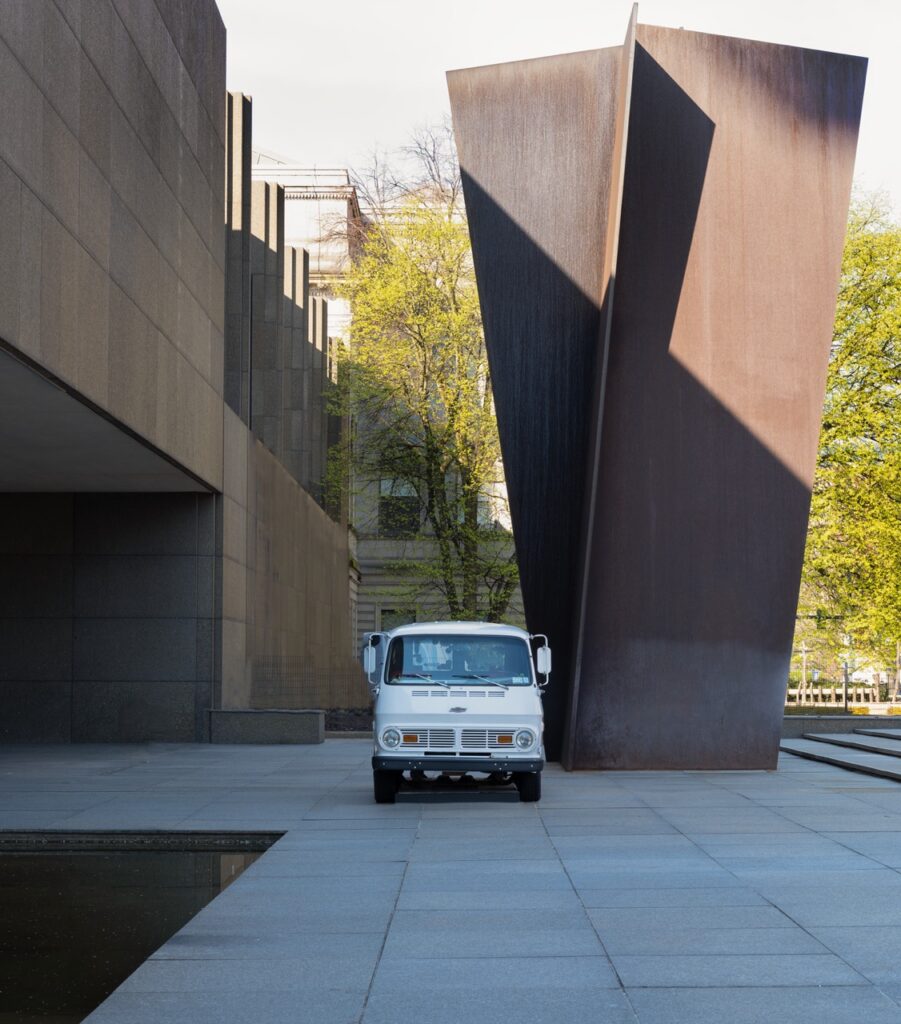
Visitors are met on Carnegie Museum of Art’s outdoor plaza by Abraham González Pacheco’s weathered concrete murals, which read like remnants of a speculative archaeology, and by G. Peter Jemison’s recreation of a 1975 touring group exhibition of Haudenosaunee art (Jemison transported the works to Pittsburgh in a vintage Chevy van, now parked outside the museum with his painting Ganondagan Autumn stretched across its side). Inside, the exhibition continues to disperse. This expansion situates the International within a broader set of social and institutional spaces, where the “international” is understood as a set of relations moving through—and occasionally rooted in—Pittsburgh.
G. Peter Jemison (Native American, born 1945);Our Journey to Deyo:gê:h (between two rivers);2026;1968 Chevrolet Mini 90 van and vinyl;overall: 75 × 86 × 1668 in. (190.5 × 218.4 × 4236.7 cm);Courtesy of the artist and 47 Canal, commissioned by Carnegie Museum of Art for the 59th Carnegie International;Installation view of G. Peter Jemison, Our Journey to Deyo:gê:h (between two rivers), 2026, in If the word we, the 59th Carnegie International, Carnegie Museum of Art, Pittsburgh (May 2, 2026–January 3, 2027);CI.2026.7.4
How the Carnegie International Uses Space and Architecture to Shape Viewer Attention
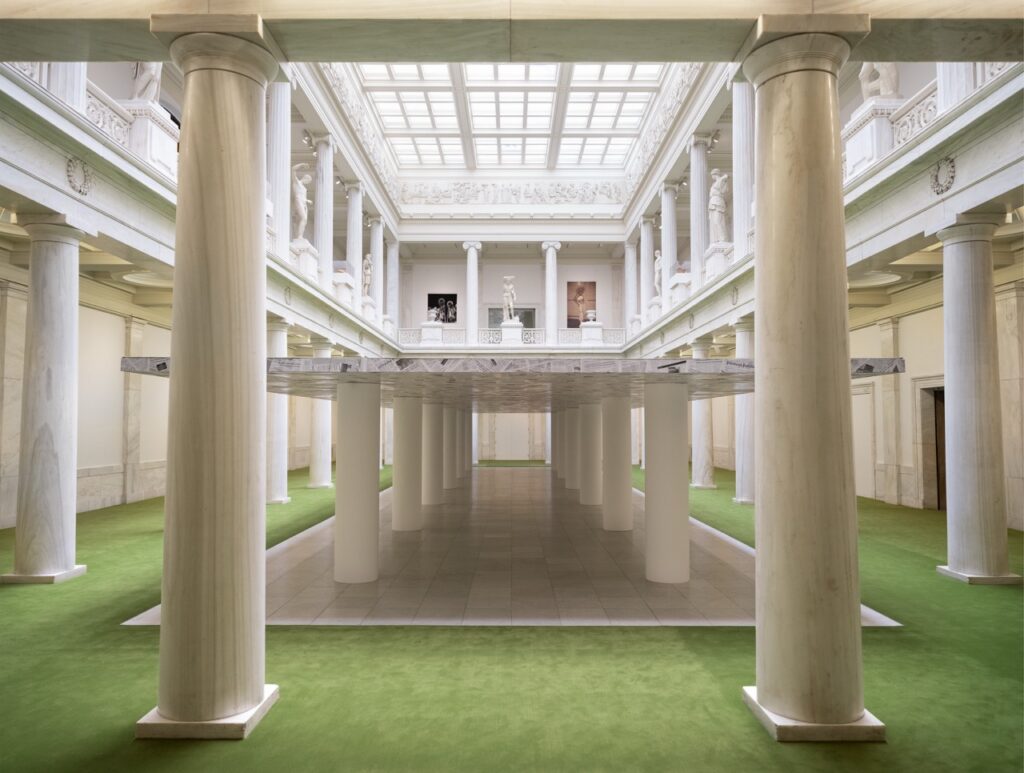
In the Hall of Sculpture, Cinthia Marcelle’s Green Hall Annex (2026) introduces a different kind of shift. The floor is full of green carpeting, echoing the interior of Brazil’s National Congress Building after its reconstruction following the January 8, 2023 attacks, an event widely understood in relation to the January 6, 2021 assault on the U.S. Capitol. Installed within a gallery modeled after the Parthenon, the gesture pulls these architectural and political histories into uneasy alignment.
The room’s symmetry holds, but its surface no longer feels stable. Standing within the structure, we look up to find a layer of digitally collaged material—screenshots of newspaper articles, images, historical documents, their overlaps and distortions left visible. Off to one side, a framed document records the artist’s request to register the work with the Brazilian government; a return slip stapled to its surface indicates that the request was denied. It opens onto questions of recognition and the limits of institutional acknowledgment.
Art You Walk Through
In Ana Raylander Mártis dos Anjos’s Justice (2026) in a connective hallway, 3,000 silhouetted “white weapons” suspend overhead in illuminated boxes. Visitors pass beneath them before realizing what is hanging above. Once recognized, the objects fundamentally alter the space. The work draws on the circulation of such objects within systems of policing and state power, where they may confiscate, plant, or repurpose the objects as evidence. The viewer’s awareness of the installation emerges belatedly, through the act of looking up and recognizing the conditions they are already moving through.
A similar dynamic animates Jasleen Kaur’s Supra (2026), where a lintel composed of weighty Encyclopedia Britannica volumes spans the entrance to the installation. It is easy to walk beneath it without noticing. Once recognized, it becomes difficult not to think about the weight it carries: knowledge assembled, sanctioned, and fixed into place.
Jasleen Kaur, Georges Adéagbo, and the Politics of Knowledge and Exchange
Will these heavy volumes fall? Will they crush us? The possibility is never confirmed, but it alters how I move. The installation opens into a space that suggests gathering but remains structured by the weight overhead. A simulated sun casts moving patterns through faux stained-glass windows onto a red carpet, cycling the room between day and night. On a windowsill sits a miniature reproduction of the Babri Masjid in Ayodhya, India, demolished by Hindu nationalists in 1992; cast in uranium glass, it intermittently glows a vivid green. Nearby, a gold-plated cast of the artist’s teeth rests along the sill. Kaur describes the work as an engagement with “the systems and frameworks we live within and feel through,” with each instrumentalist representing a structure: border, nation-state, belief, body.
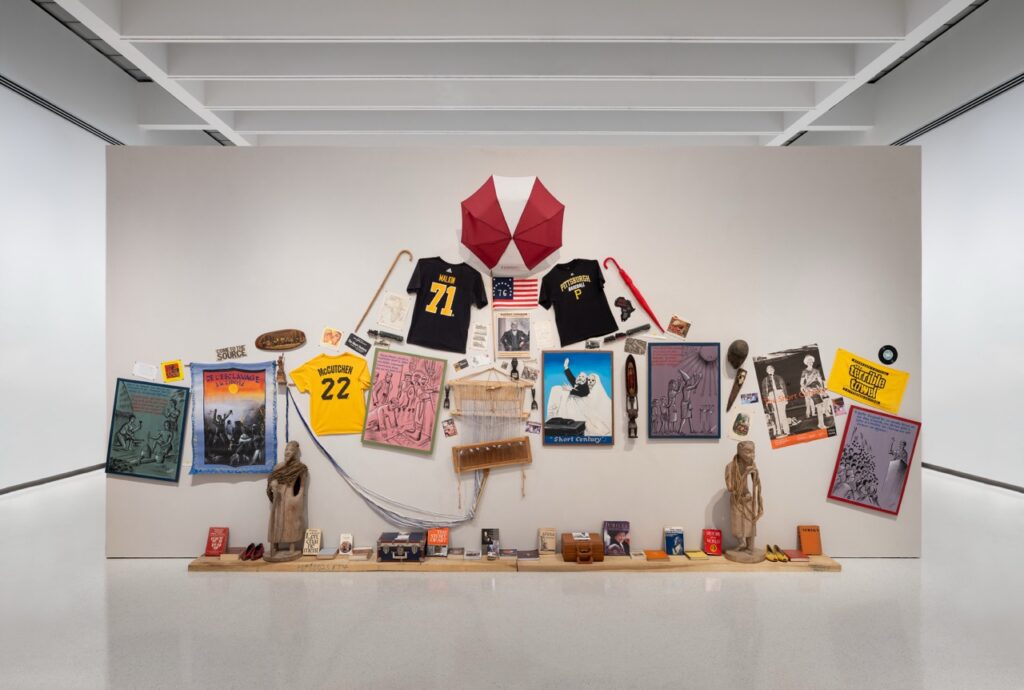
Questions of circulation and exchange come to the fore in Georges Adéagbo’s expansive installation Le Socialisme Africain (2001–04/2026). Composed of everyday objects collected by the artist, the work unfolds as a dense, associative environment (is it an archive? A marketplace? A social gathering?). For its presentation in Pittsburgh, Adéagbo incorporates items that index the city’s identity: a Terrible Towel, two jerseys bearing the names of familiar athletes. These objects operate as points of contact, linking disparate histories and geographies without smoothing over their differences. The installation invites viewers to move through it collectively, to read across its juxtapositions, and to situate themselves within its shifting coordinates.
Georges Adéagbo (1942);Le Socialisme Africain;2001–2004, version 2026 ;carpets, newspaper clippings, books, records, prints, found objects, painted portraits by Cotonou-based artists;Courtesy of the artist, commissioned by Carnegie Museum of Art for 59th Carnegie International;Installation view of Georges Adéagbo, Le Socialisme Africain, 2001–2004, version 2026, in If the word we, the 59th Carnegie International, Carnegie Museum of Art, Pittsburgh (May 2, 2026–January 3, 2027);CI.2026.28.1
Multimedia Installations and Sensory Experiences
In the Hall of Architecture, Wu Tsang’s on our way to the general strike (2026) draws on the long history of Carmen in performance and film. The work assembles a visual and sonic archive that moves across interpretations of the opera, from stage to screen and back again.
The massive screen sits low and wide, cutting across the open floor rather than rising to meet the surrounding architecture. Behind it, casts of monumental structures hold their ground—arched portals, columns, pediments—fixed in place and scaled for permanence. Tsang’s borrowed images move against the backdrop of monumental facades and classical structures. The work never fully resolves the tension between the moving image and the museum’s historical staging of culture and civilization.
Throughout the exhibition, material processes extend into other sensory registers. In Camara Taylor’s Permanent Futures (2026), the scent of Caribbean dark rum saturates the gallery as the liquid circulates through a system of pipes and containers. The work draws on the historical entanglements of rum production with the transatlantic slave trade, as well as its role in ritual contexts. Moving through the gallery with a colleague, I nearly missed a small detail in the wall label—Taylor’s birth date listed as 1625—until she pointed it out. At first glance, it reads as an error. A quick check suggests otherwise, linking the date to the early history of English colonial expansion and the emergence of the rum trade.
Historical Memory and Institutional Critique at Carnegie Museum of Art
Historical layering extends beyond the exhibition itself. Concurrent with the 59th International, the museum recently rehung one of its Scaife galleries with works acquired from previous iterations of the Carnegie International, charting more than 130 years of the exhibition’s history through a dense salon-style installation. Though not officially part of the 59th edition, the gallery inevitably reframes it. Installed among past acquisitions is a 1985 Guerrilla Girls poster declaring: “ONLY 4 OF THE 42 ARTISTS IN THE CARNEGIE INTERNATIONAL ARE WOMEN,” a reminder that the history of the International has always been shaped by disputes over visibility.
In this gallery, I found myself pausing before Pittsburgh-born Henry Ossawa Tanner’s Christ at the Home of Mary and Martha (ca. 1905), its figures emerging slowly from the surrounding dimness. Widely regarded as the first African American painter to receive international acclaim, Tanner occupies a complicated position within this history of visibility and exclusion. Light gathers around the table at the center of the scene while much of the room remains obscured, requiring us to spend time with the painting before its details fully register. Seen alongside the current International, Tanner’s work begins to echo the exhibition’s recurring concern with attention itself: what becomes visible, what remains difficult to perceive, and how the institution shapes those conditions of recognition.
The Meaning of “We” in the 59th Carnegie International Exhibition
What emerges across this International is a conception of “we” grounded in shared acts of attention. The exhibition avoids consensus. It asks something quieter: that viewers remain present to what unfolds around them, that they recognize the partiality of their own perspective, and that they allow for the possibility of connection without resolution.
This approach is not without its tensions. The exhibition’s language of collaboration and “thought partnership” suggests a level of cohesion that can be difficult to fully apprehend across its many sites and formats. No single visit can encompass the entirety of what is on offer. Yet this incompleteness feels less like a shortcoming than a structural condition. The “we” proposed here is necessarily provisional, shaped by what one encounters and what remains out of reach.
The exhibition’s conceptual scaffolding is laid out across three catalog essays by the curators, each of which takes up the question of collectivity from a distinct position. Their differences are productive. Taken together, they offer one of the more thoughtful and internally varied curatorial statements of today’s large-scale surveys, moving between questions of relation and institutional history without collapsing into a single voice.
Taking a Compassionate Viewpoint
That complexity, however, sits in tension with the smoother language that often accompanies large international art surveys—collaboration, partnership, openness—terms that risk becoming generic through repetition. Park addresses this directly. “I do not expect museums to be free of contradictions,” she writes, “but the paradoxes and at times outright hypocrisies do need to be acknowledged…” Her statement resists the idea of the museum as a seamless “meeting ground,” insisting instead on the uneven conditions that structure any encounter within it. Read in this light, the exhibition’s emphasis on “we” feels less like a unifying gesture than an invitation to sit with those tensions as they unfold.
This is where the conditional of the title—if—becomes central. It keeps these questions open, suspended across and beyond the galleries. Nothing resolves. What takes shape does so gradually, in passing, in fragments that accumulate and disperse. We leave with an altered sense of attention toward how meaning gathers, how it slips away, how it returns later, reframed. Whatever “we” exists here does not hold still. It asks you to look again—upward, closer—until something else comes into view.
Alfresco dining season in Pittsburgh is a game of meteorological roulette. You can obsessively refresh your weather app, convinced this time the forecast will cooperate, only to be blindsided by a pop-up thunderstorm or soul-sapping humidity. When the perfect outdoor dining day does arrive, you’d better know where to go. Here, Hungry Jess shares her favorite Pittsburgh restaurants for the city’s fleeting outdoor dining season, from laid-back neighborhood favorites to once-a-summer splurges.
While Pittsburgh isn’t a city of many rooftops, there are plenty of noteworthy spots for outdoor dining and drinking. Although it’s been cloudy and a bit chilly, I’m writing this article to manifest an ideal summertime forecast: 70 degrees, sunny, and the ultimate patio lineup.
Plus, if I’m being candid, one of the only things on my mind during a mid-workday daydream is, “I wish I were sipping a cold cocktail outside right now.”
Hungry Jess’ Favorite Pittsburgh Restaurants for Outdoor Dining
This is, by far, my favorite patio in the entire city of Pittsburgh, and you can quote me on it. As they’re in their seventeenth year of business, I’ve been coming here for a solid nine of them. In a full circle moment, they’re also now a client of mine, which only makes me love them more.
Cantina is doing everything exquisitely, from their cocktails to food. And the patio is no exception: it truly gives a sense of hanging out in your bestie’s backyard. You won’t want to leave… especially when a pitcher of their Classic Margaritas is involved.
For special occasions (or just because), you can book their cabana, an outdoor, cushioned space for ultimate chilling.
Café Du Jour is probably one of the best-kept secrets in the city. Every time I step through the doors, it’s a revolutionary experience from start to finish. It’s so treasured that, when I posted about it on Instagram, it made some people mad. While I understand not wanting your tried-and-true spot to blow up, I also want nothing more than for Paul and his team to thrive in the South Side.
Spinach and Artichoke Dip
Open Thursday through Saturday, the menu balances customer favorites, like the Spinach and Artichoke Dip, with innovative new dishes. The patio is like an urban garden, filled with greenery and a koi pond. They’ve seen proposals, birthdays, and even wedding receptions. I highly recommend calling weeks in advance to book your table!
While this list leans heavily into the Lawrenceville neighborhood, I can’t write an article about outdoor dining without including Pusedee’s. Much like Café Du Jour, this spot leans into fine dining, creating a setting where you can dress up and enjoy a meal under golden hour light. One of my favorite dishes is the Yellow Curry with Roti.
Yellow Curry with Roti
Reservations are tricky to come by, but if you take casual peeks at their reservation page, you may get lucky. Or, arrive early to line up for walk-in seats. To request seating in their garden, you must note it in your reservation, as Pittsburgh’s weather is unpredictable.
Continuing with the high-end dining theme, Hyeholde is known for its Chef Table experiences and castle-like ambiance. However, one thing they offer that is super unique and outside is their Picnic Series. Guests can book picnics for two on their lawn with a rotating menu and limited availability each month. This month’s menu includes Smoked Carolina Mustard Brisket Sandwiches, Cucumber Salad, Grilled Peaches, Orzo with Grilled Vegetables, and Olive Oil Cake with Sweet Balsamic Strawberries.
It’s the perfect way to experience the charm and character of Hyeholde, outside. Get the group chat together or win the best date award with a booking here! They’ll be announcing July and August dates soon.
I had to include a spot on Mount Washington in this piece; after all, what’s more Pittsburgh than enjoying nice weather with the views from The Overlook? They also have a front bar area with garage-door-style windows for some people-watching.
While Gordo’s doesn’t offer a view while dining, it’s still a great spot to sip on a margarita (their syrups are all made in-house), enjoy some apps, and take a stroll afterward. Plus, if you’re a big sports fan, they have televisions outside to catch the game with.
This is a new-to-me spot that caught my attention very quickly. Ippa is a woodfired sandwich truck that’s now permanently parked “on the green” next to Lolev in Lawrenceville, and it’s pretty new. AKA, there’s no better time to check ‘em out than now.
As breweries step into the more “semi-permanent” food space, this will be exciting to watch grow as Pittsburgh summer kicks off. Grab a beer, a sandwich, and chill. It’s really giving the ultimate ‘Sunday funday’ vibes.
Pittsburgh is blessed with so much outstanding pizza that Dan Gigler is pleased to report that his 2026 list has no repeats from the last few How to Pittsburgh issues. He’s found fresh sauce-and-dough options for us all to try ASAP.
Craving Cheesy, Crispy Crust and Sauce? Head to These Pizza Places Around Pittsburgh
At the risk of sounding provincial, the Yinzer lurking in my black-and-gold soul takes umbrage when locals lose their minds over some new shiny bauble that enters our market from out of town. To wit: I’m wholly unmoved by shacks that make shakes or the expense account crowd’s latest Downtown steakhouse-of-the-month. So I gave healthy skepticism to the much-hyped grand opening of F&F Pizza in Mount Lebanon, the Pittsburgh outpost of the famed New York City collaboration between Frank Falcinelli and Frank Castronovo. The hairy eyeball isn’t necessary, though: this pizza is fantastic.
They do it New York-meets-Neapolitan style and manage to honor both pizza lineages with a micro-thin crust which positively crackles when you bite into it. That it’s served in a gorgeous renovation of the former Bado’s home on Beverly Road is poetic. These are the kind of new neighbors we’re happy to welcome to town.
It’s been 30 years since Ron Molinaro opened this temple to Neapolitan pizza and somehow it only manages to get better. You can’t go wrong here, but try the purist’s choice, the Margherita DOC with San Marzano tomatoes, Mozzarella di Bufala, Parmigiano, basil, and extra-virgin olive oil. This is the truest pizza this side of the Spaccanapoli.
At a recent pop-up, Eric Grasso pulled a gorgeous Detroit-style square pizza out of the oven. After letting it rest, he slowly cut it with his rocker blade, unleashing a slow hissing CRONCH sound that could be the stuff of an ASMR video. Their guiding ethos, “everyone gets a corner slice” is the kind of pizza populism we can get behind. La Grassa has moved up and down Butler St. from pop-ups at The Vandal to a regular Tuesday residence at Field Day. Later this year, Mr. Grasso opens a permanent spot on the 5400 block of Butler in the former home of Cure.
The emergence of his fellow New Yorkers at F&F understandably garnered all the social media attention, but Chef Richie Sphatt Sr., a Brooklyn-native, opened La Vera with his sons Richie Jr., Matthew, and Thomas, further burnishing Mt. Lebanon’s embarrassment of Pizza riches. The elder Richie worked for years across the street at Il Pizzaiolo and is the executive chef at Mt. Washington’s Monterey Bay Fish Grotto. The slices are excellent, but the Sicilian pies are worth the visit – get the trio with vodka, pesto, and San Marzano tomato sauces, fresh mozzarella, and pecorino.
If this place didn’t exist you’d have to invent it: a combination cocktail and coffee bar with a wine shop and a colorful “modern German beer hall” that looks like it came out of a Wes Anderson movie. AND they also have stellar pizza – woodfired, as you might’ve guessed from the name. A ton of places do a sweet and spicy pie with pepperoni and hot honey but Woodfired kicks it up a notch with the addition of pickled jalapeños.
For over 15 years Rico Lunardi and his Slice on Broadway squad have turned out excellent “New York Style, Yinzer Made” pies with remarkable consistency at multiple locations around Allegheny County. His new Carnegie restaurant, named for his sons Luca and Santino, is an homage to the red sauce restaurant his parents owned and ran in Beechview when he was growing up, but with modern updates to the decor and especially the menu. Loud and bustling, it’s like walking in on a lively family dinner, but the only one in Pittsburgh that serves round Roman tavern pies called Scrocchiarella – an onomatopoeic Italian word for “crunchy,” as these flavor-packed pies practically shatter like glass when you bite into them. Try the white clam pie for something completely different.
Come for the wine and vibes, stay for the pizza. The wine library at the PA Market is as chill a hang as you can ask for in the Strip – a ton of space, lots of comfy seating, and a wine list as good as you’ll find anywhere – not to mention excellent beers and cocktails. Their thin crust New York-style pizzas make an excellent drinking partner. Pick a bold Italian red to pair with the rich and earthy White Oak – a white sauce base, with mushrooms, sautéed spinach, caramelized onion, and truffle oil.
This new pizza shop is such a recent addition to the scene that it opened the same week this article’s deadline came due, so details are scant except for one very important one: this is exceptional New York-style pizza. Chris Firman, owner of the South Side nightclub Enclave, opened this shop with his brother and his wife in a spot that’s been pretty much a revolving door location over the past few years. This place has the makings of a place that’s going to be around for quite a while.
WQED’s Rick Sebak shares a list of just a few of his favorite places to eat around Western Pennsylvania (Okay, well, maybe a little outside Western PA too, but there’s nothing wrong with trying something new!) He loves new surprises as well as tried-and-true stalwarts, and values the immigrant influences that enrich American foodways so beautifully and deliciously. Warning: Prepare to be hungry after reading this list!
Where Rick Sebak Eats in Western Pennsylvania (and Beyond)
I eat dinner at this neighborhood bar and restaurant almost every Wednesday night (after spinning vinyl records there in the bar for a couple of hours) and it’s consistently superb. Chef Dante Rau creates great bar foods like wings (get the Huli Huli sauce) and smash burgers, but unusual choices like Cucumber Salad and Street Noodles make meals here exciting and often spicy. All the classic and crazy cocktails from head bartender Madison Delia are worth a separate story. Get the Pittsburgh Handshake as a nightcap.
I met Kye-Won last year when she won Pittsburgh City Paper awards for her Korean foods and her glorious chicken wings. I’ve since found out that both honors were well deserved! Her restaurant, Pocha, shares a comfy space with Grist House Beer in one corner of the Sprankles Neighborhood Market in Saxonburg, and I’ll gladly drive there for her BiBimBop, her Bulgogi, or her family-made Mandu. However, her “Left-Handed Crab Cakes” may be among the best I’ve ever had. And there’s lots more on the menu (Dakdoritang!?) for me to try!
Assorted Chocolate Shops
Various locations
Across the Easter season last year, I learned that Western Pennsylvania is blessed with an outstanding number of local chocolate shops, making candies that have a smooth, rich taste that puts them in a different league from ordinary candy bars and national brands. I wholeheartedly recommend the chocolate-covered potato chips at Dorothy’s Candies in White Oak, the Himalayan Salt Caramel Truffles at Clark Candies in Tarentum, the Pecan Treats (aka Turtles) at Anderson’s in Baden, and the scrumptious Dubai Chocolate Bar at Pink House Chocolates in Finleyville. This list could go on for miles.
This is a summertime treat of astounding deliciousness created with whole chickens roasted over open fires every Wednesday by a battalion of mostly men who clean, season (with just salt and pepper), skewer, and cook some of the best poultry I’ve ever encountered. The scene on Wednesday evenings when folks come to feast at the Serbian Picnic Grounds in Weirton, WV is world class and reassuring. The hardest thing is getting on the list! Look for my WQED video on YouTube.
The HK stands for Hong Kong, and they say the dishes are carefully cooked with “authentic Cantonese soul.” I don’t have a lot of dim sum experience but this relatively new, beautiful Chinese restaurant in North Oakland has delighted me with delicious dumplings, lovely lunches, and even a tasty bowl of congee with sliced fish one afternoon. Great spices. Superb flavors and presentation. Fine friendly service. I’m quickly becoming a regular.
Anthony Badamo and his staff have been making great pizza since 2010 when they opened in Mount Lebanon, where I learned to love his bright little red peppers on top of his excellent slices. They’ve since moved that shop to Potomac Avenue in Dormont and opened another location on Federal Street on the North Side. You can get superb whole pies, either traditional round or rectangular Sicilian, but they also offer a beautiful array of slices with lots of toppings to choose from at both locations. And I can’t stop at either shop without getting a half dozen garlic knots for snacking in the car and on lots of other occasions. And if they have any of Anthony’s unpredictable focaccia sandwiches (mortadella? porchetta? Calabrian chiles? chimichurri?), grab a couple for lunch the next day.
The last time I visited this fabled Italian restaurant in McKeesport, I had their exclusive Parmioli entree: chicken parm baked with a cheese ravioli on top. Sublime. This is just one of those lovely places that can be instantly comfortable and totally delicious, almost like being at the home of a friendly family. Owner Angelo Teti — his mother Matilda was Tillie —has been helping to keep the kitchen and the service in top form since it opened in 1962. Homemade pastas. Great sauce. And next time I want to try the special Pork Palena because the bacon-and-artichoke-butter sauce sounds so good.
This family-owned-and-run farm near Avella in Washington County produces a variety of organic grains, grass-fed beef, beans, and eggs, but several years ago I first learned to love putting their rolled oats in my oatmeal-raisin cookies. Then one of the Tudor family — mom Marcy, dad Dale, or son Nigel — told me to consider einkorn flakes, and I’ve never looked back. Their ancient grains (spelt, emmer, and einkorn) add texture and flavors to all my baking now. They also make a startling variety of flours from rye to buckwheat to Appalachian bread flour. And you can order their products online then drive out there once a month to pick them up and chat with the Tudors. Weatherbury corn also led to Wigle Whiskey creating its very tasty Pennsylvania Wapsie Bourbon. All good.
This small Korean cafe is a favorite of mine after work. Easy parking nearby. Friendly staff. I love the crispy, spicy soy garlic wings, the pork gyoza, and also the soft and scrumptious Japanese fried octopus called takoyaki. One time a fellow patron told me, “Oh, get the taro milk tea with the tapioca bubbles here!” And I’ve added that “bubbly” to my order ever since. There are a few outdoor tables, or you can take the food next door to their brother business called Oishii Bento. I usually get it to go, sample some in my car, and reheat what’s left in my air fryer at home. Happy.
This generation has grown up in a world where milestones are both honored and reimagined. They understand that a moment isn’t just lived, it’s remembered, shared, and shaped in a way that feels personal.
From the first day of school to the final walk across the stage, a graduate’s journey is a shared family story. While the ceremony honors the achievement, the celebration honors the person.
Redefining Graduation Celebrations at Common Plea Catering
“The celebration should feel like an extension of who the graduate is,” says the team at Common Plea Catering. “And what better way to do that than through food.”
That shift is changing how people approach graduation parties. Hosts are moving away from one-size-fits-all gatherings and toward something more thoughtful and reflective. Food, design, and flow are all working together to create an environment that feels natural, welcoming, and distinctly personal, where guests can move, interact, and enjoy the moment as it unfolds.
The Menu as Identity
If the ceremony honors tradition, the menu expresses the individual.
At Common Plea Catering, graduation menus are no longer built around standard packages. They are designed around the graduate.
“We’re seeing clients want the food to reflect personality,” the team shares. “It could be elevated versions of comfort foods, global flavors, or small plates that let guests try everything. The goal is to make it feel intentional.”
Interactive dining continues to lead this shift. Stations are designed to encourage movement and engagement, allowing guests to experience the event rather than simply attend it.
Styled, Not Piled
Grazing tables are still a staple, but the approach has evolved. What was once about abundance is now about intention. Instead of filling a table edge to edge, the focus has shifted to thoughtful presentation. Layered compositions, varied heights, and curated elements turn these displays into part of the overall design. From smaller, reimagined grazing moments to individual portions and more dimensional setups, the goal is to create something visually engaging while still allowing guests to move and interact naturally.
Small Plates, Big Impact
One of the biggest shifts in catering right now is the move toward smaller, more intentional portions. Instead of committing to one plate, guests are given the freedom to try a little bit of everything. We love composed bites served on spoons, in mini glasses, or as handheld portions that are easy to enjoy while mingling. These smaller plates allow for more variety across the menu and keep the energy of the event moving.
“We’re seeing clients want more options without making the event feel heavy,” says Common Plea Catering. “Small plates create that balance, while also making it easier to accommodate dietary restrictions and different preferences.”
The Bar as a Focal Point
The bar is no longer secondary. It is part of the experience.
One of the most requested features this season is the Dirty Soda Bar, a customizable station where guests mix soda bases with syrups, citrus, and cream finishes to create something uniquely their own.
“It’s fun, it’s interactive, and it works for every age group,” says Common Plea Catering.
As a full service caterer, Common Plea Catering also offers a traveling liquor license, allowing hosts to seamlessly pair non alcoholic options with full bar service. Dirty sodas for the kids and elevated versions for the adults create a cohesive experience.
“It’s about making everything feel effortless for the host and engaging for the guest,” the team adds.
A Celebration That Stays With You
There’s a growing shift toward graduation parties that feel more thoughtful and put together, where the food, design, and flow all work naturally together.
“At the end of the day, what people remember is being together,” says Common Plea Catering. “The food and the experience just help create the space for that.”
Because in the end, a graduation party is more than a gathering. It marks a transition, and it should feel as meaningful as the journey that led there.
With decades of experience, Common Plea Catering approaches every celebration with a focus on personalization, thoughtful design, as well as seamless service.
Because the best celebrations are not just seen. They are experienced.
The headlining music artists for this year’s Dollar Bank Three Rivers Arts Festival — the first to be held at the newly unveiled Arts Landing development — were revealed on Monday. The lineup of shows, all of which are free and open to the public, features hitmakers and critical favorites across a variety of genres, as well as spotlight appearances by local performers.
Who’s Playing Music and Performing at Three Rivers Arts Festival 2026?
These headline acts will take the Dollar Bank Stage which is also the centerpiece of Arts Landing’s Great Lawn:
Osborne, best known for her hit One of Us, has also spent recent years exploring Bob Dylan’s catalogue through tours and albums. ’90s favorites Spin Doctors, whose modern-rock hits Two Princes as well as Little Miss Can’t Be Wrong you may know, played to a packed crowd in late 2024 at Pittsburgh Brewing Company.
Pittsburgh stalwart Buffalo Rose will headline a night of local acts on the Dollar Bank stage; fellow regional standouts Coltt Winter Lepley and the Briar Valley Rangers will also appear on the bill (playing from 6-7 p.m., before Buffalo Rose takes over at 7:30 p.m.).
Headlining sets begin at 7:30 p.m., with additional entertainment scheduled throughout the day.
War and Treaty
Much More to Discover
In addition to the annual art shows and visual-art displays throughout the Cultural District — and the opportunity to explore Arts Landing itself — several large-scale installations were announced for the festival.
Squonk, the Pittsburgh-based arts collective known for innovative, large-scale performances, will also present the world premiere of Joy Machine. In this original creation, the audience joins the performers onstage throughout the performance, collaborating in the creation of the show.
Five performances of Joy Machine are scheduled between June 5-7.
An eye-catching exercise in “vertical performance” is also on the schedule. Taking over the facade of Arts Landing’s BNY Visitors Center as their stage, BANDALOOP, a California-based dance group, will present the perspective-shifting The Sky Is Not the Limit. Two performances per day are scheduled for June 12 and 13.
One of Pittsburgh’s iconic institutions is about to get a lot bigger. The Sen. John Heinz History Center on Thursday, April 30, broke ground on an expansion that will add more than 92,000 square feet of exhibit and event space.
The Smithsonian’s Heinz History Center Expands Its Offerings
The expansion, which is projected to be completed by 2028, will be visible immediately upon entry, as visitors encounter an expanded Great Hall and a new theater for film screenings and events. Another new, interactive exhibition will focus on the life and work of Fred Rogers; added outdoor spaces, including a new dedicated gathering space dubbed Penn Avenue Plaza, will incorporate more of the surrounding area into the History Center’s offerings.
The museum will be expanding existing offerings, including the Franco Harris Sports History Museum and collections focusing on the region’s Italian and Jewish heritage.
A new “museum within a museum” is also opening as part of the expansion. The forthcoming Museum of African American History, located on the fourth floor of the expanded History Center, will the impact and importance of Black communities to the history and culture of both Western Pennsylvania and the nation.
More Room for Kids
The expansion will also add “smart” classrooms to the History Center, part of a stated goal of increasing field trips by 50%.
Admission to the History Center is free for kids 17 years of age and under, the result of a major gift from Daniel G. and Carole L. Kamin. That gift allows free admission to young visitors — including school groups — in perpetuity.
A capital campaign has already raised more than 70% of the $80 million targeted for the expansion project.
On Now at the Heinz History Center
The facility will remain open during expansion. Programming and exhibits are scheduled throughout the year to commemorate the 250th anniversary of the United States, including the current exhibit My America: An Illustrated Experience, for which the History Center partnered with the Pittsburgh Society of Illustrators; 35 individual artists participated in the vivid display.
Next week, the History Center will host Hidden History Trivia Night, a nighttime competition quizzing guests on Pittsburgh’s crossovers with pop-culture.