Pittsburgh native, self-taught artist, and minor league umpire George Sosnak packed decades of baseball history onto 800 hand-painted baseballs. A new exhibition at the Westmoreland Museum of American Art, Play Ball!, proves he was in a league of his own.
Swing for the Fences With Play Ball! The Art of George Sosnak at the Westmoreland Museum
Every artist needs a canvas. George Sosnak chose one with 108 raised red stitches, almost no flat surface, and a tendency to roll away when you set it down.
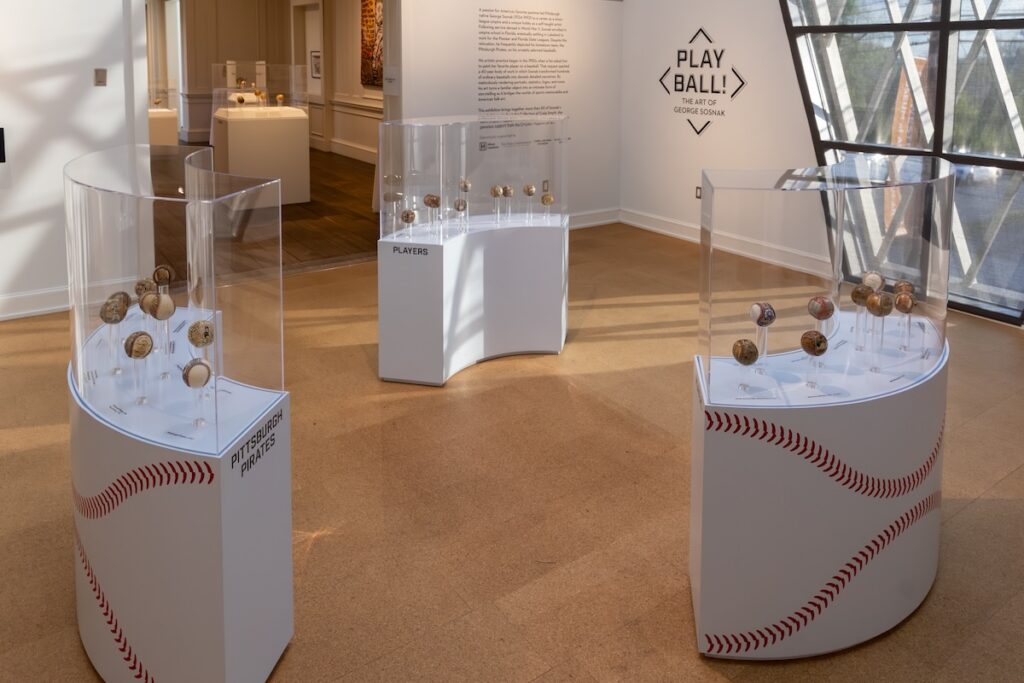
Sosnak spent four decades—from the 1950s until his death in 1992—painting on baseballs. Working on just nine square inches of curved white cowhide, he covered each regulation ball with player portraits, box scores, statistics, logos, and obscure baseball trivia only an obsessive would track down. His baseballs are held by the Smithsonian and the National Baseball Hall of Fame and Museum and are prized by collectors, baseball fans, and folk-art enthusiasts. Now more than 60 are on view at the newly opened Play Ball! exhibition at the Westmoreland Museum of American Art in Greensburg.
“Until you see the baseballs in person, you don’t really understand the level of detail,” says Dr. Erica Nuckles, the museum’s Director of Learning, Engagement, and Partnerships. “It is unbelievable what Sosnak got on these.”
Luckily the museum provides magnifying glasses so visitors can read thread-thin text, decipher tiny hit-run-error grids, and parse miniature figures mid-swing. “It’s almost like he’s putting a baseball card on an actual baseball,” says Nuckles.
History on a Sphere
What Sosnak immortalized ranged from the sport’s biggest moments to its footnotes and forgotten lore. There are balls showing Hall of Famers like Ted Williams, the 1989 World Series earthquake in San Francisco, and the minor league player traded for a candy bar. Pittsburgh fans will find plenty to linger over. The exhibition includes several Pirates-themed baseballs, among them tributes to hometown icons Roberto Clemente and Bill Mazeroski, whose walk-off home run clinched the 1960 World Series.
Born in Pittsburgh in 1924, Sosnak grew up collecting autographs from Pirates players. But the baseball career that would define his life began in Germany, entirely by accident. Serving with the Army after World War II, he was told by his First Sergeant he’d be reporting to “umpire school”—and assumed it had something to do with field maneuvers. It didn’t. He’d stumbled into an enormous military baseball operation: by 1945, more than 200,000 American servicemen were playing organized ball across occupied Europe. Hall of Famers, Negro League stars, and hundreds of minor leaguers filled military rosters. The Army built fields, organized tournaments, shipped in thousands of bats and balls, and trained umpires to manage games that sometimes drew 50,000 spectators. Sosnak was one of those umpires, and he’d found his calling.
Back in the States, he enrolled in umpire school in Florida and worked his way through the minor leagues, making it as far as the Class A Florida State League before stepping back from full-time umpiring in 1964. To supplement his income, he worked as a baker, construction worker, and corrections officer, but baseball was the constant. So was the drawing. Sosnak was an almost compulsive doodler, sketching on envelopes, decorating letters to relatives, and covering any blank surface with illustrations and drawings.
Over 40 Years of Painting
The baseballs began in 1956, while Sosnak was umpiring a game in Idaho. A young fan asked whether he could paint her favorite player on a baseball. He obliged, and word spread. Before long, players, managers, team owners, politicians, batboys, hospitals, churches, charity groups, foreign dignitaries, and fans were seeking out Sosnak baseballs. Sometimes he charged for the work, but “often he was just gifting these to people,” says Nuckles.
To apply the black outlines of his design with India ink, Sosnak’s tool of choice was the crow quill pen, an ultra-sharp, steel-nib instrument traditionally used by comic book inkers and mapmakers to achieve hair-thin lines. A player portrait, historic moment, or actual signature anchored the center of each ball. Around it, he packed in statistics, anecdotes, career highlights, as well as historical notes, all in lettering sometimes too small to read without a lens. “He had an incredibly steady hand,” says Nuckles. Color was added using acrylic and enamel paint. A final coating of shellac sealed everything in a high-shine glaze.
The Collection of a Lifetime
By the end of his life, Sosnak had started on more than 3,000 baseballs and completed around 800. The exhibition includes several unfinished works that let visitors trace the progression from spare black-ink sketches to dense, layered compositions—and understand, in the process, just how much work went into every square millimeter of the ones he did complete.
“His output is astonishing,” says Nuckles. “It just shows how baseball never went away for him, just like it’s never gone away for American culture.”
Play Ball! The Art of George Sosnak runs through April 4, 2027 a the Westmoreland Museum of American Art, 221 North Main Street, Greensburg.
Story by Kathleen Renda
Featured Photo by Ed Pollard, Chrysler Museum of Art Photographer
Additional Photography Courtesy of Westmoreland Museum of American Art
Subscribe to TABLE Magazine‘s print edition.