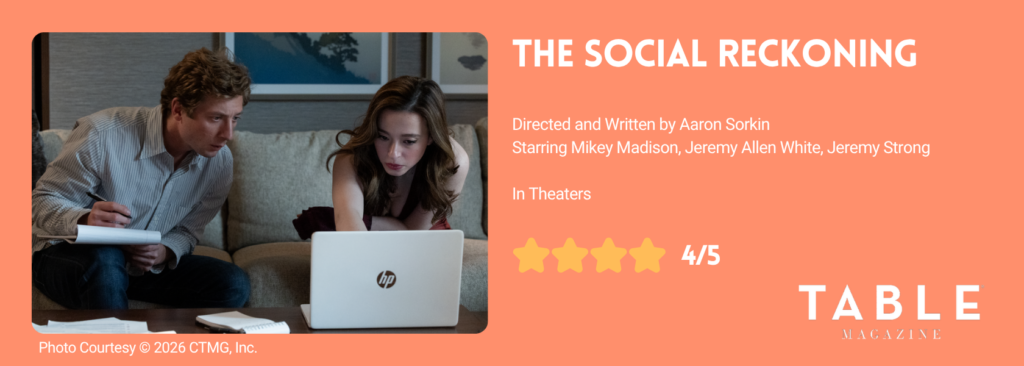
The 2010 film The Social Network, directed by David Fincher and written by Aaron Sorkin, was a scathing (and tremendously entertaining) indictment of the attitudes and egos that led to the rise of Facebook — and, thus, the dawning of the social-media era. Sixteen years later, Sorkin returns to the topic of the tech giant with The Social Reckoning, writing and directing an account of a rare moment when it looked like Mark Zuckerberg might actually be forced to confront the consequences of his actions.
The Social Reckoning Stars Jeremy Strong as a CEO Wearing Blinders
In the late 2010s, Mark Zuckerberg (Jeremy Strong, taking over for Jesse Eisenberg) makes a decision that will change the direction of Facebook — by then one of the largest and most influential companies on the planet. Until that point, the platform’s algorithm prioritized content that users liked, literally — if users clicked like on something, they were served similar content.
At the time, it was a system that was hurting the company’s bottom line. Users were disengaging, with younger people migrating to visual-based platforms including TikTok and Snapchat. So Zuckerberg opted to prioritize content that would be shared rather than liked — a seemingly mild change with big consequences.
The most shared content, as level-headed Facebook brass pointed out, was content with the potential to enrage and inflame. Facebook embraced that content anyway, with Zuckerberg demonstrating apathy toward the possibility that inflammatory or misleading content would reign supreme.
Mikey Madison Plays a Whistleblower with an Uneasy Ally
This shift ran afoul of one division at Facebook: the civic integrity team, whose stated goal was to ensure that the platform was serving as a digital good neighbor, even if it meant arresting growth. Frances Haugen (Mikey Madison) discovers a problem: The algorithm is pushing users toward extremist groups, including those who promote hate and sow misinformation.
When she tries to voice this discovery, she’s ignored — in fact, cut off before she can even be ignored.
Reluctantly, she meets with an investigative journalist (Jeremy Allen White); she stresses that she believes in the company and is only cooperating to help it. As the problem grows, however, she takes bigger risks to share the truth.
The Social Reckoning is carefully — even elegantly — split between timelines; we see Haugen’s efforts in the 2010s, then watch as Zuckerberg prepares to defend his company before Congress in 2021. The exact dates will be revealed later; in a bit of illuminating timing, Zuckerberg’s testimony is being prepared on what will become a momentous day in American history.
The Filmmaking Is Pedestrian, but the Script Speaks Clearly
This isn’t Sorkin’s first time in the director’s chair; he began helming his own films in 2017 with Molly’s Game, following that drama with The Trial of the Chicago 7 and Being the Ricardos. He’s not as inventive as a director as he is as a screenwriter; it would be a hard mark to hit, given that he’s among the best scribes of film and television. Still, The Social Reckoning suffers somewhat in comparison to The Social Network; going from David Fincher to a director who is mostly presentational (and losing Trent Reznor and Atticus Ross as composers, to boot) makes for a less remarkable piece of filmmaking.
As a vessel for the script, though, The Social Reckoning serves well. Freed from its predecessor’s need to define Zuckerberg as an individual, this movie is emboldened to make an argument: Facebook, as well as its sister companies, are playing an active and unchecked role in an overarching societal sickness — and that is the result of deliberate choices.
It’s didactic, sure, but it’s undoubtedly correct. Sorkin identifies and illuminates the kind of truth that Zuckerberg and his supporters have worked hard to obfuscate. Not all speech is created equal — and harm cannot be measured in likes and shares. The result is a film that overcomes its weaknesses to stand as a sturdy and even enjoyable history lesson.
Oscar Winner Jessica Chastain Gets Literally Unhinged and More New Movies Out This Week
The Conjuring meets A Nightmare on Elm Street in Other Mommy, a playfully diabolical new horror film from director Rob Savage. Jessica Chastain stars in a dual role: Ursula is a hardworking mother growing estranged from her husband (Jay Duplass) and daughter (Arabella Olivia Clark), unaware that she’s being supplanted by Other Mommy, a demonic doppelganger hiding in the darkened corners of the family home. Other Mommy wastes no time trying to prove its villain is real; the whole family encounters her within moments of the film beginning, leaving the remainder of the fast-paced film a desperate attempt to understand and defeat the creature. Savage employs dreamlike images — and dream logic — to weave a tale that recalls the more fantastic tales by Stephen King. It stumbles here and there but emerges as a memorable and well-acted spooky-season treat.
There’s a pair of less-heralded throwbacks hitting cinemas this weekend. Angel and the Badman digs deep to reboot the 1947 John Wayne western with a cast that includes Tommy Lee Jones and Zachary Levi; the remake, which comes from faith-based distributor Angel Studios, hasn’t received warm notices. Meanwhile, Samuel L. Jackson is the President of the United States (if only) in The Beast, an action flick that seems straight out of the ’90s; this one is receiving a bit better buzz as a good-time romp. (Just don’t confuse it with Heart of the Beast when purchasing your ticket.)
A Look at the Prior Weeks’ Releases
The Colleen Hoover adaptation Verity was last week’s box-office winner, as Tom Cruise’s Digger flopped hard enough to break a glacier in half (or whatever that movie was supposed to be about). I reviewed both films and solidly preferred Verity, even if most other critics aren’t being as friendly. Elsewhere at the multiplex, in addition to The Other Mommy, Resident Evil will likely be the go-to choice for those looking for a new release as Halloween approaches — or, of course, you could head to any number of cinemas for a vintage fright.
Read more of Sean Collier’s movie reviews in our guide to the arts, culture, and entertainment.
About the Author
Sean Collier is the editor-in-chief of Shady Ave and the arts and culture editor of TABLE Magazine. Before joining the TABLE Media team, he spent nearly 15 years as a writer, editor and columnist at Pittsburgh Magazine. As the in-house film critic for the top-rated WDVE Morning Show since 2009, he’s been Pittsburgh’s most widely heard voice on movies for nearly two decades. A Pittsburgh native, Sean has since 2020 appeared weekly on KDKA-TV’s popular Pittsburgh Today Live talk show. He’s the co-founder of Vigilance Theater Group and an active stand-up comedian and event host. He can be found on Instagram and Twitter at @seancollierpgh.
Photo Courtesy of © 2026 CTMG, Inc.
Subscribe to TABLE Magazine’s print edition.