The traveling exhibit Lewis Hine Pictures America, on view now at the Frick Pittsburgh, is a revealing glimpse into America’s past — and, for Pittsburghers, it’s a very personal exhibit.
Lewis Hine Pictures America Arrives at The Frick Pittsburgh
As I considered the dozens of photographs featured in Lewis Hine Pictures America, I paused in front of one: Slovak Immigrant Sleeping, taken in 1905 at Ellis Island. A thought occurred to me: This woman could be my great-grandmother.
I don’t mean that figuratively, I mean it literally: My great-grandmother was a Slovakian immigrant who passed through Ellis Island around that time. I don’t have any reason to believe it is indeed my ancestor — but I don’t have any reason to believe it isn’t, either.
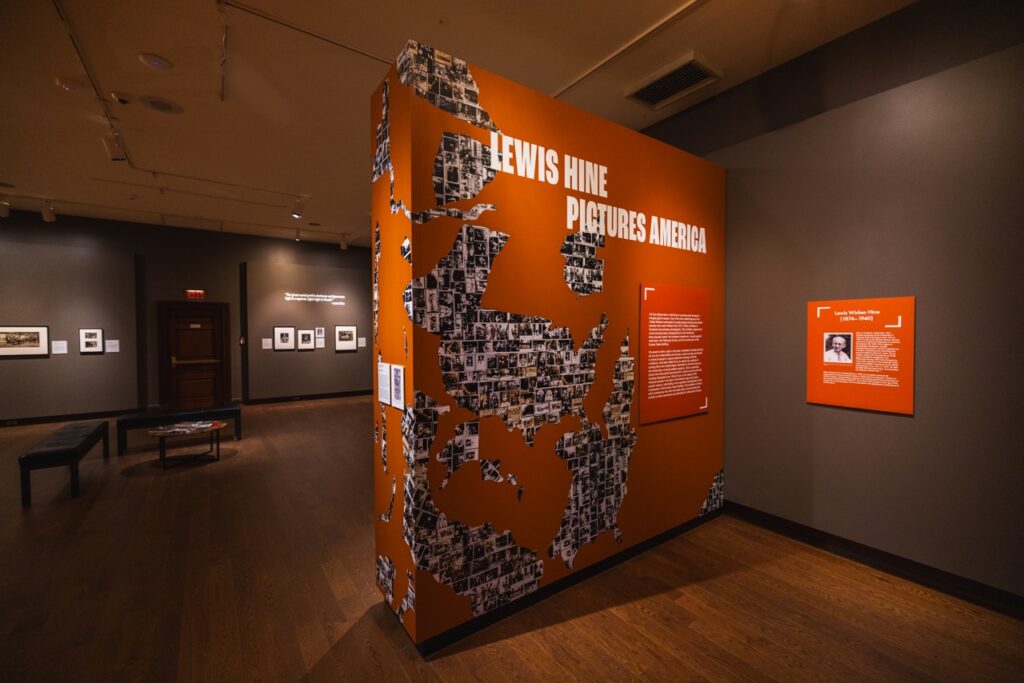
Such is the local and personal relevance many Pittsburghers will find in Lewis Hine Pictures America, a touring exhibition showcasing the work of the artist widely cited as the “father of documentary photography.” The exhibit divides Hines’ work into categories: immigrants arriving at Ellis Island; workers building the Empire State Building; photographs from the Pittsburgh Survey, used to illuminate the socioeconomic conditions of the busy yet inequitable Steel City in the early part of the 20th century.
In those latter photographs, visitors will see the men and women whose labor made Pittsburgh. In all corners of this illuminating exhibit, however, viewers will find relatable and affecting work that resonates deeply, even 120 years later.
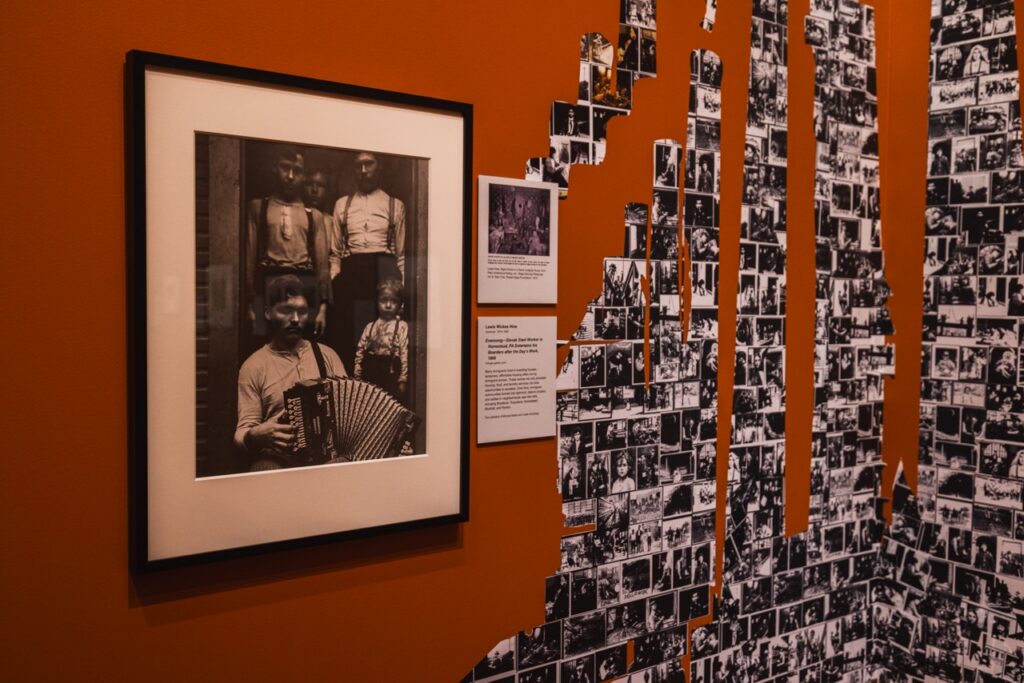
Connecting With the Past
The first image in the exhibition, Italian Family Looking for Lost Baggage, is from 1905. But this photo could have been taken yesterday but for the period-appropriate clothing. Hine’s ability to capture natural expressions (even though some photographs were more or less staged, as was the custom at the time) brings the viewer into close contact with the subject.
That quality makes one section of the exhibit particularly jarring. For more than a decade, Hines photographed children at work in factories, mills and on the streets, exposing the realities of child labor in the early 1900s. These images are frequently shocking; in All These Small Boys child workers line up as if taking a school photo when they’re actually on a rare break from work at a cotton mill. Their faces bear the weary expression of adults; cigarettes hang from their mouths.
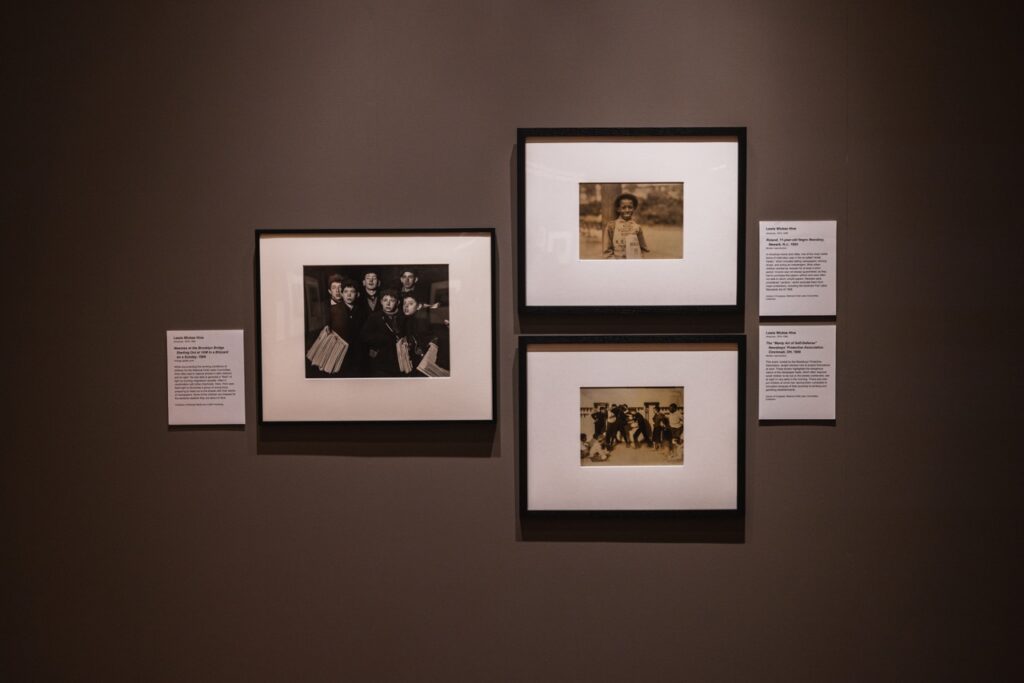
Hines’ work, partially supported by the National Child Labor Committee, helped raise awareness of the lack of protection for child workers. Change was slow — a national ban on child labor didn’t arrive until 1938 — despite Hines’ jarring photos being used as a lobbying tool.
“We tried to ground his photographs in the social and economic realities of that moment,” says Dawn Brean, the Frick’s Chief Curator and Director of Collections.
“Unfortunately, a lot of the conversations and issues that Lewis Hine is shedding light on [are issues that] we are continuing to grapple with.”
Reality Made Into Art
Serious though much of the subject matter may be, there’s plenty of joy in Lewis Hine Pictures America. In Engineman, PA, a train conductor operates his massive vehicle with obvious pride. In Topping the Mast, Empire State Building, workers focus on small details atop the then-tallest building in the world. There’s recreation in these photos, too; one, Slide, Kelly, Slide!, pictures a playground baseball game in Newark — and it may or may not feature a young Babe Ruth.
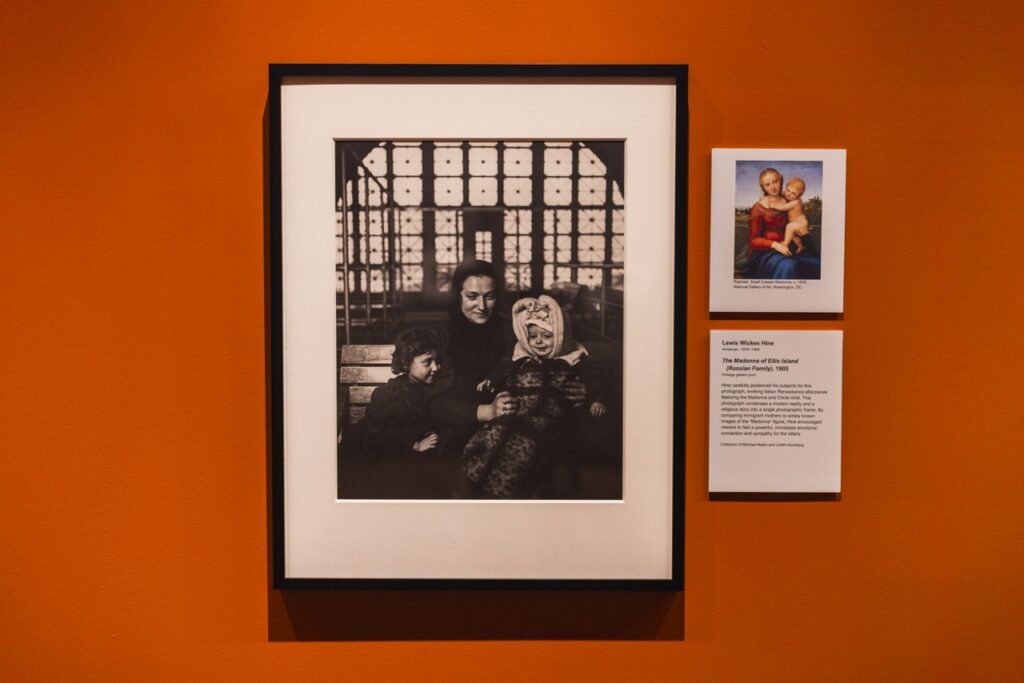
“Lewis Hine didn’t consider himself an artist,” Brean says. “He was a social reformer. So this is a perfect exhibition that does sit at that intersection of art and history. I think our crew is at our best when we’re playing with both of those ideas.”
Lewis Hine Pictures America continues through May 17. An evening Cocktails and Conversations session, featuring a talk about the exhibit paired with a specially prepared cocktail (or mocktail), is scheduled for March 5. Guests can also order a Lunch Bucket meal, themed to the exhibition, at the on-site Cafe at the Frick — complete with a limited-edition lunchbox.
Story by Sean Collier
Photos Courtesy of Seth Culp-Ressler
Subscribe to TABLE Magazine’s print edition.