We really think this Charred Heirloom Tomato and Mozzarella Salad deserves its own holiday. Seriously: shouldn’t tomato season be at least as big as Christmas? Every perfectly ripe heirloom tomato looks as pretty as a present, and a clutch of them in various colors is a feast for the eyes. And the taste? When a great tomato’s symphony of sweetness and acidity and minerality plays across the palate … that’s amore! Chef Kevin intensifies the flavors with a quick char on the grill, and brings in the fresh, bitter notes of endive and radicchio to make this salad entrée-worthy. You could head to a local deli that knows their way around Italian cheeses for fresh mozzarella. Then, seek out a family-owned farm to find oh-so-fresh summer tomatoes for this salad recipe.
Tips for Charring Tomatoes
Charring tomatoes is a simple technique that gives a chance to burn food on purpose! The key is to apply high heat directly to the tomato’s surface. You can do this on a grill, under a broiler, or in a searing-hot cast iron skillet. The rapid exposure to high heat causes the sugars in the tomato to caramelize and the skin to blister, pop, and char while the inside stays juicy. Don’t overcrowd your cooking surface since this will steam the tomatoes instead of charring them. The most important part though is to resist the urge to move them too soon. If you allow your tomatoes to sit for a few minutes on one side, it’ll create those desirable dark spots.
Charring tomatoes completely changes your salad game.
Ingredients
Scale
4 buffalo mozzarella balls
5 heirloom tomatoes, large variety
1 radicchio head, quartered and leaves separated
2 Belgium endive heads, cut in half lengthwise, core removed, and leaves separated
1 cup baby greens
15 edible blossoms
1 tbsp chives, cut fine
2 oz sherry vinegar
4 oz extra virgin olive oil
Salt and black pepper, to taste
Instructions
Preheat grill to medium-high heat.
Cut heirloom tomatoes in half and season with olive oil and pepper.
Grill tomato cut side down until charred and the tomato begins to soften.
Flip tomato and char for an additional 5 minutes. Remove from grill and allow to cool to room temperature.
In a medium mixing bowl, combine radicchio leaves, endive leaves, sherry vinegar, olive oil and season with salt and black pepper. Mix to evenly dress the greens.
Cut the cooled tomatoes into smaller bit size pieces. Be gentle, the tomato will be very tender. Season tomatoes with salt and black pepper.
Evenly divide the greens onto each plate. Evenly arrange the cut tomatoes on top of the greens on each plate. Leave some space in between the tomato pieces.
Drain any liquid off the mozzarella and break off bite size chunks and intermingle them within the tomatoes on each plate.
Garnish each piece of mozzarella with a pinch of chives, salt and pepper.
Arrange the blossoms around each plate to help add extra color and the sweet flavor of the nectar.
Recipe by Chef Kevin Hermann, 408 Heirloom Styling by Keith Recker Photography by Dave Bryce Linens by Adiv Pure Nature
Tangy, savory, and utterly delicious, you won’t be able to get enough of this Seafood Escabeche Salad.
Start with fresh calamari, shrimp, and mussels from a favorite local fishmonger. Prepare them on the grill as instructed by Chef Kevin. Then, let them marinate together overnight with summer herbs and vegetables you can find at a favorite farm store or market. The next day you have a classic seaside salad that will keep you cool even as it delights your taste buds. Keep the Italian vibe going with sips of chilled Verdicchio.
What is Escabeche?
Escabeche is actually a culinary technique in cooking that has Spanish and Portuguese roots. It involves marinating and poaching food, typically fish, seafood, and vegetables, in an acidic mixture. The combination helps provide a burst of flavor, often tangy, and also gets served cold or at room temperature. For our Seafood Escabeche Salad, the process starts by lightly cooking the seafood and then steeping it in a zesty marinade full of olive oil, vinegar, fennel, carrots, zucchini, and various herbs. This acidic bath not only infuses the seafood and veggies with bright flavors but also acts as a preservative, making this dish perfect for a make-ahead salad.
Seafood grilled to perfection and tossed with pickled vegetables? Count us in!
Ingredients
Scale
6–8 calamari tubes/ tentacles
8–12 shrimp, tail off (16–20 size), split in half lengthwise
2 lb mussels, rinsed and broken mussels removed
1 carrot, large, peeled and julienned into 3-inch-long strips
1 cup roasted tomatoes, chopped
1 cup zucchini, julienned into 3-inch-long strips
1 fennel, head, quartered and shaved thin
2 tbsp tarragon, chopped
¼ cup parsley, chopped
¼ cup basil, chopped
1 cup white balsamic vinegar
5 tbsp sugar
2 tsp salt
1 cup olive oil
Salt and black pepper, to taste
Instructions
Preheat grill to medium-high or prepare a bed of cooked down charcoal.
Clean the calamari and season with salt, pepper and olive oil. Set aside.
Season cleaned shrimp with olive oil, salt and pepper and set aside.
Place the mussels in a small pot or foil pouch to be placed on the grill.
In a small bowl combine vinegar, sugar, 2 tsp salt and 1 cup olive oil. Whisk until uniform and sugar is dissolved. Set aside.
Grill the calamari and shrimp only until there are grill marks on each item. Pull them off and place them together in a clean mixing bowl.
Once the calamari has cooled, cut into bite size pieces and add back to the cooling shrimp
Place the mussels on the grill either in the small pot with a lid or in the foil pouch. Allow to steam open. Remove and allow to cool. Once cooled pull each mussel out of the shell and place with calamari and shrimp.
Add the carrots, zucchini, fennel, tomatoes, herbs, and dressing mixture. Mix to combine evenly. Cover in airtight container and refrigerate overnight.
Serve and garnish with fresh herbs and grilled lemons for extra pizzazz.
Recipe by Chef Kevin Hermann, 408 Heirloom Styling by Keith Recker Photography by Dave Bryce Linens by Adiv Pure Nature
Let’s start with a quick Italian lesson! Scottadito means “burned finger,” referring to the sheer speed with which you will want to eat these lamb chops hot off the grill. The lamb is seasoned simply with Herbes de Provence. Grilled quickly, the meat is plated atop blistered cherry tomatoes, olives and pine nuts. Just before you singe your digits, sprinkle on a bit of crumbled feta and fresh chopped mint. The next Italian phrase you’ll need is O che buono: Oh so good! Find fresh lamb at a local farm and turn to a local cheesemaker for fresh feta.
What is Herbes de Provence?
Herbes de Provence is an aromatic blend of dried herbs from the Provence region of southeastern France. While the exact ingredients can vary, it typically includes thyme, basil, rosemary, tarragon, savory, marjoram, and oregano. Some blends may also feature lavender, bay leaf, or other additions. This versatile mixture gifts a warm, earthy, and slightly floral flavor. Try it for seasoning roasted meats, grilled vegetables, stews, and even simple tomato sauces. If you cannot find a jar ready-to-go in stores, you can always make your own and even customize your own combination.
The moist, flaky texture of Grilled Salmon Steak amps up any cookout. Add a zesty Salsa Verde and fresh radish slaw to complete your summer by the sea. Plus, salmon gives you a break from the goodies that normally take over during the summer: burgers, hot dogs, and steaks.
More on Our Grilled Salmon Steak with Salsa Verde
We love shopping at our local fishmonger. We always leave with more than we planned and enjoy a few days of fresh fish and seafood as a result. Chef Kevin’s recipe for Grilled Salmon Steak with Salsa Verde constitutes a trip. The fresh, clean simplicity of the seasoning is perfect for summer eating, as is the side portion of radish and lime slaw. The Salsa Verde, with its gorgeous blend of capers, herbs, lime, as well as spices, elevates the whole plate to a culinary journey to a tropical island. We’ll be keeping some Salsa Verde on hand for those TGIF sort of days when that kind of a trip is very much needed. The first step, though, is local: head to a farmer’s market to gather your produce. Then, find a bottle of Grechetto to put on ice about an hour before you eat.
Give the beef a break and try this salmon steak on the grill instead.
Ingredients
Scale
4 salmon steaks, cross cut
3 tbsp olive oil
1 tbsp salt
2 tbsp black pepper
4 limes, cut in half
4 radish, fine julienne
2 tbsp chives, cut fine
1 pint salsa verde
For the salsa verde:
1 cup capers
1 bunch cilantro
1 cup parsley, chopped
1 tbsp garlic, chopped
1 tsp red pepper flake
2 tbsp lime juice
2 shallot, chopped
1 tbsp coriander, toasted
1 cup olive oil
Salt and black pepper, to taste
Instructions
Preheat grill to medium-high.
Season salmon steaks with olive oil, salt and pepper. Set aside while grill heats up.
Combine salsa verde ingredients into a food processor, in smaller batch if you have a smaller unit. Puree the ingredients until small chunks remain, but all the herbs have been cut down.
Add more oil if mixture is too thick for your liking. Season with salt and pepper.
Refrigerate overnight for best results.
In a small mixing bowl, combine radish and chives. Set aside.
Once the grill has reached temperature, grill each salmon steak until desired doneness. Cooking times will vary on thickness of each steak. Bring the internal temperature to 125 degrees for a nice medium salmon steak.
Serve the steaks with a side of the salsa verde, radish slaw and grilled limes.
Recipe by Chef Kevin Hermann, 408 Heirloom Styling by Keith Recker Photography by Dave Bryce
Looking to find financial success in 2025? No matter what that means for you, start here with answers from financial professionals on your top questions.
How to Reach Financial Success in 2025
How Does Asset Allocation Differ Today, and How Do You Approach Diversification in the Current Market Environment?
We continue to recommend that our clients remain invested, as we maintain a long-term perspective on the market. Our diversified portfolios are specifically designed to withstand periods of volatility and market downturns.
Our investment focus remains on large U.S. companies with strong cash flows and stable dividends, diversified across a wide range of industries. Over the past year, we have taken a more defensive stance by trimming exposure to the “Magnificent Seven” tech stocks and reallocating toward essential sectors such as healthcare, food production, and industrials.
On the geopolitical front, it appears the Trump Administration’s overarching strategy is to bring countries to the negotiating table to establish fair trade agreements. However, the execution of this strategy has been inconsistent, and the lack of clarity continues to unsettle the markets. As a result, we are witnessing heightened volatility, particularly surrounding tariff discussions.
Despite this uncertainty, we continue to identify opportunities during market swings, focusing on high-quality companies trading at attractive, discounted valuations. We accomplish this by selecting individual stocks in a diverse group of industries and laddered individual bonds for our portfolios. We remain cautiously optimistic. Schenley Capital would welcome the opportunity to schedule a time to meet with you to discuss your individual situation. 412-445-9956.
What Should Investors Remember During Market Volatility?
Our market has remained persistent and resilient over time. The private enterprise system thrives on hard work and innovation, even when times get tough. With flexibility and a focus on innovation, businesses can keep moving forward, no matter the obstacles.
Headlines are often designed to make money, not to help you think critically.
Despite the uncertainties that may cloud the horizon, history has shown that periods of heightened volatility often give rise to innovative companies and transformative technologies that can reshape the investment landscape.
Given the Current Economic Volatility, How Do You Manage Market Downturns and Mitigate Risks in My Investment Portfolio?
At YTS Wealth Management, we manage market downturns by focusing on risk control, strategic diversification, and consistent alignment with your long-term goals. We don’t react emotionally to volatility—instead, we rely on disciplined portfolio design, active monitoring, and smart rebalancing when needed. In times of uncertainty, we also look for tax-loss harvesting and value-driven opportunities. Most importantly, we keep you informed, ensuring you understand what’s happening and why. Our goal is to protect your progress while positioning you for long-term success, no matter the market cycle. You can count on us to stay steady and proactive when it matters most.
I Hope to Retire in the Next 10 Years. What Can I Do to Help Keep My Retirement Savings Safe?
As you get closer to retirement, it’s important to protect your savings from market ups and downs while planning for the income you’ll need. Sitting down with an agent or advisor to build a personalized retirement strategy is a smart first step.
One option to consider is GBU Life’s Defined Benefit Annuity. It helps you plan with confidence by outlining your income needs, projected interest rates, and how much to set aside each month. You’ll get growth potential, protection from market losses, and the ability to turn your savings into a guaranteed lifetime income.
-Lesley Mann, Executive Vice President/CMO, GBU Life
What is Your Strategy for Managing Tax Implications Within My Investment Portfolio, and Are There New Tax-Efficient Strategies I Should Consider?
You don’t spend your portfolio’s pre-tax returns—what matters is what you keep. We help clients improve after-tax performance through strategies like tax-loss harvesting, donating appreciated assets, using tax-efficient investments, and optimizing asset location (placing the right investments in the right accounts). Tax planning strategies in retirement, such as Roth IRA conversions or qualified charitable distributions, also can serve to lower the client’s lifetime tax liability.
A thoughtful, proactive approach to tax management can significantly reduce the tax drag on your portfolio’s performance—allowing you to keep more of your return and helping you meet your financial objectives.
-Chad E. Hileman, CFA, CFP®, Director of Investment Research, Partner, Gibson Capital
With the Growing Complexities of Estate Planning, How Do You Distinguish Between the Need for a Will Versus a Trust in Today’s Market?
When planning your estate, you might wonder: do I need a will, a trust, or both? A will outlines how your assets are distributed after death but must go through probate, which can be lengthy and public. A trust, by contrast, offers greater control and privacy, avoids probate, and allows for planning in case of incapacity— something a will doesn’t address. Trusts are especially useful for larger estates or complex family situations, offering more flexibility in managing and distributing assets. Ultimately, consulting our firm can help you create a personalized plan that aligns with your goals and preserves your legacy.
How do you assess and adjust a client’s risk tolerance – with recent market volatility?
A well-crafted Investment Policy Statement (IPS) is essential for every investor, whether you are experienced or just starting out – especially during times of market volatility. An IPS defines your financial goals, risk tolerance, asset allocation, constraints, and the timeline for reviewing your portfolio and the IPS itself.
Great outcomes begin with solid planning. Before investing, create an IPS by answering key questions. What are my financial goals in terms of time and money? How much will I need, and when? Next, assess your risk tolerance – how much risk can you handle without losing sleep? Consider the worst-case decline in both percentage and dollar terms. From there, determine your asset allocation. Aggressive investors may lean toward equities, while conservative portfolios might focus on fixed-income options like CDs, bonds, or money market funds.
Risk tolerance is the cornerstone of your IPS. By making rational decisions about risk during stable times, you will have a clear guide to follow when markets turn turbulent. Regularly review your portfolio every three to six months, making small adjustments to optimize performance or mitigate risk. Thoughtful planning and consistent reviews pave the way for successful investing outcomes.
-Ward L. Garner, CFP®, Senior Vice President, Bill Few Associates, Inc. “CFP Board owns the marks CFP®, CERTIFIED FINANCIAL PLANNER®, and CFP® (with plaque design) in the U.S.”
Can You Help Me With Retirement Planning, Including Forecasting Potential Expenses and Income Needs as Market Conditions Change?
Markets will always fluctuate. But whatever way they move, a comprehensive financial plan is one of the best strategies to stay on track toward your retirement goals. Your UBS Financial Advisor monitors the current environment and will work with you to ensure your retirement plan and your portfolio reflect changing conditions. Volatility may be unsettling, but with a long-term plan in place, you can feel more confident about the future.
-Walnut Wealth Management Group, UBS Financial Services Inc., Lee Oleinick Any information presented is general in nature and not intended to provide individually tailored investment advice. Investing involves risks and there is always the potential of losing money when you invest. For our client relationship summary disclosures, please visit ubs.com/relationshipsummary. UBS Financial Services Inc., Member FINRA/SIPC.
At one point in history, Pittsburgh was America’s melting pot. The abundance of jobs brought a plethora of immigrants from Eastern Europe to work in the steel industry and settle in the city. But they often spoke their native language, an obstacle in this strange, new home with different cultural norms. Places like the Bulgarian Macedonian Cultural Center in West Homestead became community gathering spaces where recent immigrants could set a balance between assimilating into their new home and finding common ground, community, and shared values.
The Bulgarian Macedonian Cultural Center Sheds a Light on Immigrant Stories
Lambe Markoff founded the club in 1939. His grandson, Ed, is the president, and Ed’s daughter, Hayley Markoff Hinkle, serves as the secretary. Keeping a culture alive inter-generationally can be a difficult task with changing values and a shifting global landscape, but the Markoffs have kept the flame alive. “At the Center, we’re apolitical. We’ve navigated the changing politics and borders of Bulgaria and Macedonia from 1939 to now,” Ed Markoff said. They boast the title of being both the oldest, largest, and most active Bulgarian Macedonian club and the one with the largest collection of Bulgarian art, costumes, and jewelry in the United States.
The exterior of the Bulgarian Macedonian Cultural Center, lit up in the colors of the Bulgarian flag. Courtesy of the Bulgarian Macedonian Cultural Center.
Behind the Center’s unassuming doors in West Homestead is a deep well of history. When you walk in, a door downstairs reads MEXAHA in Cyrillic letters. A portrait of Lambe Markoff hangs on the rustic walls. You immediately get the sense you’re in a place of shared history. While the space is beautiful, it isn’t sterile the way a museum is. Even when no one is around, the room feels as if it still has the energy of past celebrations hanging in the air. “[MEXAHA] means a tavern in Bulgarian and Macedonian. The old immigrants would sit down there at the table and hand-roll cigarettes,” Ed Markoff recalled. The Center has a commercial kitchen and a liquor license and gets most of its revenue from donations and cultural events. It’s open to the public and free to look around, which both Markoffs encourage.
The First American Adoptee from Bulgaria After Communism
Markoff Hinkle was adopted from Bulgaria at 16 months old—the first Bulgarian child to be adopted by an American couple after the fall of communism in 1990. “The center is like a second home to me,” she said.
The social club also allowed her to learn about her home country and then in turn teach her own children about it. “In the 90th anniversary mural behind the stage, I was pregnant at the time, so I like to say both me and my daughter are on the wall here,” she said.
Folk Dance as Tradition
Folk dance is one of the Bulgarian Macedonian Cultural Center’s biggest programs. Pittsburghers might be familiar with the Tamburitzans, a folk dance group that’s performed in the city for more than 80 years.There’s a lot of crossovers between the Tamburitzans and the Bulgarian Macedonian Cultural Center’s group, Otets Paisii.
There are 40 dancers in the group, with most, including Markoff Hinkle, learning from a young age. It’s a real treat to visit the Center’s archival storage and see the radiant colors of the costumes for each dancer. Deep hues of shine with hand-stitched patterns on the fabric. “My sister and I danced in the very first Pittsburgh Folk Festival at Syria Mosque in 1955,” Markoff remembered. The group gets its name from a Bulgarian monk who documented the history of his people. They travel regularly to Bulgaria to perform or to learn more about their culture.
“Each region of Bulgaria has its own style of dance,” Markoff explained. “And Bulgaria and Macedonia are where Catholicism, Eastern Orthodoxy, and Islam converge.” Markoff himself is the story of cultural convergence. His mother was Hungarian and his father was Bulgarian, making their union a mixture of the Catholic and Eastern Orthodox faiths. But both came to Pittsburgh as new immigrants and found common ground. At the time, it was common for Bulgarians to become bakers, which Markoff’s father did. You can still get Bulgarian baked goods at Jak’s Bakery in Bloomfield, or if you come to the center for one of their events.
A Place for Learning
Markoff Hinkle hasn’t been to Bulgaria yet, but takes Bulgarian classes and is enthusiastic about her culture. Spaces like the Bulgarian Macedonian Cultural Center celebrate not just the nostalgia of the homeland, but what immigrants bring to the places they come to. You can’t replicate Bulgaria and Macedonia in its entirety in Pittsburgh (though the topography of mountains and lakes is somewhat similar), but you can create something new, paving the road for a community’s future with memories and traditions of its past.
The Bulgarian Macedonian Cultural Center shows the power of immigrant communities to be safe havens. In a moment of political turmoil, when immigrants’ presence in our city and the country at large is in peril, it’s imperative to “look for the helpers” as the quote attributed to Fred says. Where are people welcome? Where do communities nurture and uplift each other? The heyday of Eastern European immigration to Pittsburgh may be over, but there are new community-building challenges to face. The Bulgarian Macedonian Cultural Center is free and open to the public and welcomes anyone with a curiosity about Bulgarian and Macedonian culture to look at their beautiful costumes or try some of their delicious food. “The culture is rich, and that’s how we’ve survived,” Markoff said.
There’s nothing like jumping into a swimming pool of cool blue water whenever the Pittsburgh sun wraps us in its warmth. All of the city’s pools will open within the next month to make sure that you and your family have an escape that’s a bit more fun than air conditioning. Plus, we even have a few recommendations in case you want to try something other than the rectangular pool you’re used to. So, grab a few beach towels, your swimsuits, and load the kids into the car for a daytime escapade that’ll cool everyone down. All Citiparks Pools open on June 15 so there is no better time than now! Plus, the city just added nearly 300 new chairs and loungers to the pools for your relaxation.
Where to Swim Around Pittsburgh at Citiparks Pools and Beyond
As a part of Citiparks Pools, the Highland Pool in Highland Park lets you in all year for just $30 for an adult pass with discounts available for families and free entry for Pittsburgh residents 15 and under. Right next to the zoo, families can also gather for volleyball, tennis, and picnics near this public pool. This is one of the more popular pools, so you’ll want to get there early to claim the best spot.
Slide into Dormont Pool (quite literally, thanks to their blue waterslide and duck slide) to cool down on those bright and sunny days. This 1.85 acre pool means plenty of room for all residents without feeling like you’re shoulder to shoulder the whole time. You can even bring single person inflatables in case you want to kick back in the water and sunbathe.
Mt. Washington’s city pool is a little secluded getaway from busy city life. At this swimming pool there is shade surrounding the area as well as playground equipment and a gradual slope inside the pool for deep and shallow swimmers alike. There are even ropes around the deep end for those looking to get their laps in.
Kids, adults, and even grandparents will love all that North Park Swimming Pool has to offer. From a designated baby pool to a floating obstacle course, there’s something for everyone regardless of swimming skill level. The pool also has a mechanical lift into the shallow end for those with disabilities. Purchase a season pass or visit this McCandless location when the mood strikes.
Let the soft tide of the South Park Wave Pool lull you into relaxation this summer. In Bethel Park, families can spread out on the green around the pool or bring along an inner tube to float with the waves. The motion of the water may be a bit more difficult for little ones, so be sure to prepare them with a swim floatation vest.
Missing the beach? While Pittsburgh does not have the white sands you imagine on your perfect vacation island, there is a beach area at Raccoon Creek State Park. Bring a picnic or BBQ ingredients to cook up as the kids play in Raccoon Lake. You can even hike through the woodlands and stroll through the Wildflower Reserve to see seasonal blooms and wildlife.
Recently renovated and ready for a summer of fun, the Oliver Bath House on the South Side is a historic indoor swimming pool. With programming for those looking for adult only lap time and open swim too, the Oliver Bath House gets you out of the glaring sun and into the water. The pool is budget-friendly too, offering day passes at $5 for adults and $3 for non-resident kids while residential kids are free.
In case you’re looking for thrills beyond regular pool swimming, Sandcastle Waterpark in Homestead is the adventure you crave. Right beside the Monogahala River, dive into high-speed slides, lazy rivers, wave pools, and much more. They even have a new free-fall drop slide this year with an inverted loop and 26 feet per second drop.
Story by Kylie Thomas Photo Courtesy of Nellie Adamyan
Artist Patrick Shearn has been going to Burning Man for 23 years and operated the raptors in the first Jurassic Park film, but those aren’t even the most interesting things about him. Now based in Colorado, Shearn operates Poetic Kinetics, a design firm specializing in aerial public art. Through a partnership with Pittsburgh Botanic Garden, Shearn is bringing a brand new installation, Momentum, to life. Shearn’s work is captivating—you gasp when you see it for the first time, with all the undulating colors floating in mid-air. Momentum at the Pittsburgh Botanic Garden sits suspended in the air above the garden’s Lotus Pond. Redwing blackbirds flit in and out of cattails, accompanied by playful baritone of bullfrogs and the rustling of wind in the trees.
But behind the beauty is a huge amount of technical mastery, which he picked up from making installations at Burning Man and during his time operating props in the film industry. “This isn’t a hobby,” Shearn said. “It seems simple, but the rigging is very complicated.” The streamers are a thin, delicate kite fabric and the ropes are a small but mighty military-grade string that can hold up to 1600 pounds. Elevated Reflections, as the Lotus Pond part of the installation is called, only weighs about 150 pounds, despite its grandeur. It sways with the wind, evoking a firework or a blooming flower.
Patrick Shearn Brings Poetic Kinetics to Pittsburgh Botanic Garden
“When I did a site visit here, we looked all over the garden, but at the pond it’s almost like you’re doubling your money. It creates a whole new perspective on the piece. You’re seeing it from different perspectives all the time,” Shearn explained. “This little low spot is like a jewel box.” When walking around the perimeter of the pond, you can see the vibrant, shimmering colors of Shearn’s work through the green of the trees, which is a true visual delight.
At different places around the pond, the streamers change shape and form. Some of them almost touch the surface of the pond, which Shearn is perfectly okay with. When Shearn installed the piece, it started in the water and then rose up to its full iteration, so there’s no issue with getting it wet. Part of his goal is to make people more aware of the many parts of the natural world, how earth, water, and air interact with each other. “[When you see the installation], you become much more aware of the symphonic motion of wind, It really connects you to the nature around you,” he added.
From Burning Man to the Olympics
Shearn’s practice has taken him to Berlin, St. Petersburg, the Australian Gold Coast, and Beijing, as well as various locations across the United States. He had been making large-scale aerial art for Burning Man, and someone who saw his work got in touch to say they needed an artist to make an aerial puppet show for the 2008 Beijing Olympics. That was how Shearn ended up making the “Warrior and the Girl” performance in Beijing that combined sculpture, puppetry, modern dance, and animatronics.
Shearn began making public art out of two-dimensional materials with architecture students in Los Angeles. Someone had left him a truckload of Mylar film and he wasn’t sure what to do with it, so he took his students to a city park and started tinkering with ways to create something beautiful out of the film. Since then, he focuses mostly on the aerial sculpture part of his art practice through Poetic Kinetics.
Working in natural spaces makes up some of his favorite projects, though. “I love working with people in the ‘garden scene,’” Shearn said. “They’re so friendly, they’re all doing good work, breathing good air. People walk out of their office and they’re in a beautiful place.” He began bringing public art to botanical gardens and conservatories through a project with the Atlanta Botanical Gardan and later connected with Executive Director Keith Kaiser at another installation project in Boston.
An Interactive Installation for All Ages
Shearn also made a more interactive installation in the Five Senses part of the Garden grounds that’s for children. The Garden allowed children to write on the streamers six words of what plants and nature meant to them, hung at a low height so that they could easily walk through it. Adults are welcome to, as well. Inside of this installation feels like a forest of color and light, easy to see why Shearn’s work was so popular at Burning Man.
This isn’t the first time Shearn has added a written component to his work. In one iteration of Poetic Kinetics, he and his team made aerial sculpture for the 30th anniversary of the fall of the Berlin Wall, where he allowed participants to write their messages and feelings on the fabric. “It was really very transformative. I found it erased nation borders and led to really raw human connections,” he remembered.
He later took it to the Demilitarized Zone in South Korea, where he gave people a similar prompt to write on the fabric and engage with the work. “To work for a call to action is very special to me. Spectacle is great, but as an artist to be able to move the needle is really meaningful,” Shearn said.
Public Art to Do Good
He particularly enjoys anything where he gets to see children’s inner thoughts and feelings. “I’m interested in situations where you ask children what they want for their future,” he said. “I did an installation once where I had children etch into metal what they wanted for their future, as a way of holding other generations accountable.” The streamers in the Five Senses portion of Momentum read “plants give love to my heart,” “beauty, oxygen, life” or strings of drawings of butterflies, bees, and flowers.
Shearn’s Momentum will be up through the summer, where visitors to the Botanic Garden will be able to see how it sways in the wind from the oak, cherry, and maple trees and interacts with the wildlife. The redwing blackbirds enjoy perching on the rope as if it’s another tree at the Lotus Pond, and Shearn says he values a “leave no trace” approach with his artwork in natural spaces. “I’m so happy with it. It came out exactly how I imagined,” he said. “I just want to do something good in the world.”
Story by Emma Riva Photos courtesy of the Pittsburgh Botanic Garden
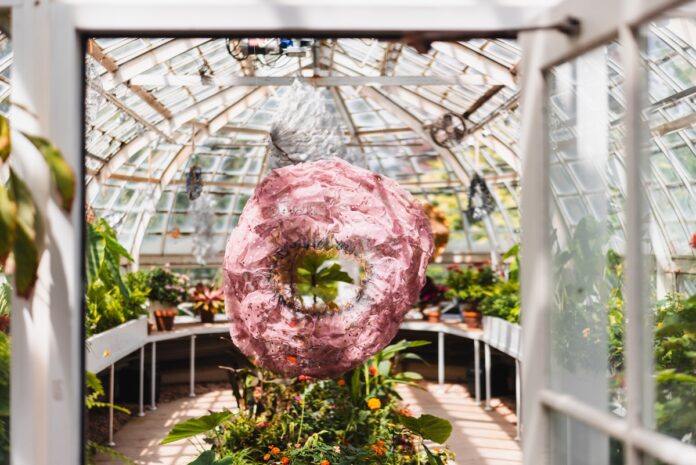
Atticus Adams knew right place for his work was, but didn’t know how to get there. His series of hanging mesh sculptures, Catching Sunbeams from the Porch Swing of Wisteria Castle, needs light and space that a traditional gallery might not provide. Greater Pittsburgh Arts Council CEO Patrick Fisher visited his studio and asked him what he saw the ideal environment for his work was. “A greenhouse,” Adams answered. “But who do I know who has a greenhouse?”
Atticus Adams Explores Memory in The Frick’s Greenhouse
Fisher suggested the Frick Pittsburgh. “I thought ‘no way could I get in touch with someone at the Frick,’” Adams said. “Patrick said he could get me in touch. I thought to myself ‘oh, sure you will.’” Adams figured it was an empty art world networking promise. But the very next day, Fisher put him in touch with curator Dawn Reid Brean. The show soon came to life in the free greenspace on the Frick grounds.
The Frick turned out to be the ideal place for Adams’ work. “Helen Clay Frick made a time capsule of a place where she was really happy, which is also what I’ve done,” Adams explained. “My grandmother’s things are gone, but the memories are there.” His grandmother lived in Morgantown, West Virginia, in a home that’s still in his family. However, they renovated it in the years since, leaving him with only the memories. Where he remembers a wooden porch draped in wisteria is now mostly concrete. But Helen Clay Frick had the opportunity to do something of a reverse renovation where the space became a shrine to her memories. (Those who go on the Clayton tour can see the room where she grew up in, which she still slept in as an adult).
Work by Atticus Adams.
Clouds of Memory
Adams and Brean decided that Adams would make one sculpture specifically for the Frick. He based it on Helen Clay Frick’s memories of her mother’s beautiful bright pink and gold sequined gowns. The reference to Adelaide Frick’s dresses also aligns with Adams’ own memories of playing with the dresses in his grandmother’s trunk as a child. Inside the mesh sculpture, Adams placed four golden nests and one silver one, representing the Frick parents, the two adult children, and then Henry and Adelaide’s daughter, Martha, who died at age six. “Helen was a real bird lover, and I also wanted to use the nests to call back to the idea of nesting in your home,” Adams explained.
He called that particular sculpture a “cloud of pink memory.” One of the technical achievements is to make mesh, a metal material, into something light and almost soft. Some do look like clouds, others like gossamer portals or offerings from some sort of woodland fairy—the kind of thing you’d see on a long hike as evidence that the local fae is watching out for you.
Art Open to the Public at the Frick
Adams’ exhibit coincides with the closing of Frick’s main museum space over the summer. Brean described the project as the “very glamorous” work of installing a new fire alarm system. In spite of the closure, “our site is so varied, and there’s so much to see,” Brean said. Another major draw for Catching Sunbeams from the Porch Swing of Wisteria Castle: entrance into the greenhouse is free. No museum admission required. Adams’ work shares space with the flower collection and the Frick’s edible garden partnership with Grow Pittsburgh. He likes it that way. His sculptures now get to live alongside flowers, in a space where the air smells like orchids, marigolds, and roses.
Adams has been making what he calls “neo-Appalachian folk art” for his decades-long career, but this specific body of work came about during 2020. He was often alone in his studio in Lawrenceville and thought of the things that made him happy as a child. “I was trying not to get depressed,” he said. “I would see this little profusion of rainbows and think that things were going to be okay.” Despite all of his years of formal training at Rhode Island School of Design, Yale School of Art, and Harvard School of Architecture, making that body of work taught him that art’s deepest value is as a source of healing and comfort.
“Resilient despite being delicate.”
And though the sculptures look soft, they can weather the elements. “They’re really resilient despite being delicate,” Adams said. He hung them high up in the greenhouse so they float slightly above eye level and don’t disturb the plants. Catching Sunbeams from the Porch Swing of Wisteria Castle will be open through October 26, and while the museum space is closed, the Frick grounds remain entirely open. “I’m sure some things will fade, but I’m cool with that,” he expressed. “It was just an amazing opportunity. It’s a rare thing as an artist that you get such a great fit.”
Story by Emma Riva Photography courtesy of the Frick Pittsburgh
A natural lightness hovers around Gemini and we’ve got the perfect menu to match this zodiac sign. The twins of the zodiac are often seen as clever, curious, and hard to pin down because they’re oriented toward variety. Gemini is always in motion: mentally, socially, sometimes even physically. Their joy lies in seeing, saying, and sampling. This makes them seem eternally young, and in many ways they are – quick to laughter, alert to possibilities, and reluctant to close the door on any experience that might teach them something new.
Gemini, the Twins who Speak in Multiple Tongues
Gemini’s image in the heavens is the pair of twins Castor and Pollux, who, in myth, shared everything, including immortality. One was mortal, the other divine. When Castor was killed in battle, Pollux begged Zeus to let them remain together. The god agreed, and the brothers became stars, spending half their time in the underworld and half in the heavens. Many Geminis live across dualities – of identity, of interest, of geography or profession. Rather than choosing between them, they learn to move fluidly back and forth, making a whole life out of two distinct halves.
There is something deeply endearing about Gemini’s openness. This is the sign of shared laughter, stories half-told, friendships struck up in train stations and libraries. Its classical associations with fraternity and ‘brotherhood’ extend beyond gender or blood ties – they gesture to the human capacity to connect across difference through imagination and reason. Gemini recognizes that we are not meant to live in isolation, and that a well-placed word can build a bridge between two seemingly distant minds.
Still, this is a sign that may take time to grow into itself. Like the pre-pubescent twins it represents, Gemini’s early expressions are often playful, scattered, or fleeting. It’s easy to mistake this for a lack of seriousness, but time reveals something subtler: a lifelong learner, one who resists becoming calcified too early. Gemini matures not by settling down, but by deepening their engagement with the themes that truly captivate them. Where they find that spark, they return again and again – with wit, delight, and a growing sense of devotion.
Gemini and the Seasons
As with the other signs, it’s important to note that the sign of Gemini and the constellation of Gemini are not the same thing. Constellations are groups of stars visible in the night sky, while zodiacal signs are equal divisions of the Sun’s apparent path throughout the year, known as the ecliptic. The zodiacal signs are linked to the seasons, not the stars themselves.
The twelve zodiacal signs can be grouped into three categories based on their relationship to the seasons. The cardinal signs mark the beginning of each season and are associated with change and new beginnings. The fixed signs fall in the middle of each season and are known for their stability, determination, and resolute nature. Lastly, the mutable signs stand between the close of one season and the start of the next. These signs are associated with adaptability, flexibility, and the ability to navigate change with ease.
Deeper Into Gemini
As a mutable sign, Gemini arrives at the close of spring, when nature flits between breezes and blossoms, never quite still. This transitional quality is woven into your character, dear Gemini. You thrive in dynamic environments where ideas are exchanged freely and new perspectives are constantly unfolding. Yours is a temperament built for motion – quick to absorb, compare, and communicate, without needing to linger too long in one fixed position.
This mutability gives you a remarkable capacity for curiosity and connection. You can toggle between roles, interests, and viewpoints with ease, making you an excellent translator of language, of meaning, of people to one another. At times, however, the sheer range of possibilities can be dizzying, leading to distraction or difficulty seeing things through. Commitment issues are often part of the picture. When these arise, treat them as an invitation to learn how to make peace with motion, and to cultivate structure without rigidity. Like the season you usher to a close, your strength lies in your nimbleness, your adaptability, and your ongoing dialogue with the world around you.
New Goals for Gemini
Create thoughtful limits around input. Gemini thrives on variety – of people, ideas, and media – but too much input can lead to mental scatter and decision fatigue. Set a goal to impose a daily or weekly limit on information consumption, whether that means designated screen-free hours, a capped podcast queue, or scheduling time to be bored on purpose. These small boundaries create space for deeper thinking and rest.
Build consistency into your self-care routines. The air signs can become overheated or depleted from constant activity. Introduce regular rituals that prioritize nervous system balance: morning walks, set meal times, or journaling before bed. Keep them short and flexible, but consistent – something you return to not because you must, but because it works.
Stay with what sparks joy – longer. It’s easy for Gemini to pivot quickly when novelty fades. But not everything worth pursuing shows its depth right away. Choose one area that lights you up – a creative project, new skill, or area of study – and set a 30-day commitment to engage with it regularly and with intention, even when your interest starts to wane. You may be surprised what emerges after the first spark.
What Qualities Does Gemini Have?
As an air sign, Gemini expresses the communicative and intellectual traits common to this element – curiosity, mental agility, and a love of dialogue. But where Aquarius channels its ideals and Libra weighs relational balance, Gemini moves swiftly between ideas, drawing connections others miss. It’s not just about knowledge accumulation, but rapid mental circulation. Gemini engages with the world by naming it, interpreting it, and echoing it back (faster than most can follow).
What sets Gemini apart among the air signs is its mutable quality. This gives it a remarkable versatility, but also a tendency to disperse focus. Mutable air is restless: it doesn’t want to hold the same shape for long. That makes Gemini gifted at adapting to social and intellectual environments, capable of toggling between registers, languages, or contexts with ease. But it also means that too much fixity – too much repetition, rigidity, or confinement – can feel unbearable. Gemini often excels in short bursts or when juggling multiple interests, and may benefit from gently cultivating endurance without dulling its alertness.
Gemini’s Daily Temperament
The sanguine temperament associated with Gemini is warm and moist, producing quick energy, an easy sociability, and a bright outward demeanor. Sanguine types tend to recover quickly from setbacks and are rarely down for long. But this same constitution can also lead to overextension physically, socially, or mentally. Too much stimulation or too little sleep can result in scattered thinking, frayed nerves, and mood fluctuations that seem to come out of nowhere.
To support balance, sanguine Geminis benefit from foods and habits that keep energy steady and the nervous system well-nourished. Regular meals with grounding ingredients (like oats, fish, and leafy greens), herbal teas with lemon balm, chamomile, or lavender, and gentle physical movement – especially walking in fresh air – can help regulate overstimulation. It’s also worth watching for imbalances in the hands, lungs, and shoulders, areas classically associated with Gemini in medical astrology. When these regions feel tight, dry, or strained, it may signal a need to slow down, warm up, and reconnect to breath and body.
Best Foods to Balance Gemini
For most seasons, these foods are good for supporting the sanguine temperament associated with Gemini:
Land: Chicken, turkey, rabbit, lean pork, veal.
Surf: Trout, cod, haddock, halibut, perch, sole, tilapia, and shellfish such as shrimp and scallops.
Grains: White rice, wheat, oats, quinoa, millet; grains that cook quickly and feel light on the stomach.
Vegetation: Lettuce, cucumber, melon, grapes, apples, pumpkin, squash, ripened berries, pears, peaches, and leafy greens like spinach and arugula.
Dairy: Fresh cheeses (like mozzarella or ricotta), cottage cheese, yogurt, milk, and light cream.
Beverages: Still or lightly sparkling water, infusions with lemon balm or mint, and fresh fruit juices.
Alcohol: Crisp white wines, wheat beers, and cocktails with gin or vodka bases, particularly when infused with herbs or citrus.
In the winter months, when the cold is greater and the sanguine temperament may need to consume more heat to stay in good health, it’s advisable to introduce more warming and substantial foods:
Land: Beef, lamb, duck, goose, venison, especially when slow-cooked or spiced.
Surf: Oily fish such as salmon, mackerel, sardines, tuna, and anchovies.
Grains: Rye, barley, spelt, buckwheat, quinoa, corn, and wild rice; grains that bring warmth and endurance.
Vegetation: Root vegetables (carrots, beets, parsnips), onions, garlic, leeks, pumpkin, squash, chili peppers, ginger, cinnamon, nutmeg, dates, figs, and winter greens like kale and spinach.
Dairy: Aged or cultured dairy such as full-fat yogurt, kefir, ghee, or aged cheeses.
Beverages: Ginger or cardamom tea, chai, turmeric lattes, and warming broths.
Alcohol: Full-bodied wines, dark beer, spiced or mulled drinks, brandy, and small measures of whiskey.
The infusion of four different ingredients and herbs into Gin Mare Capri Mediterranean Gin tickles the tastebuds of curious Gemini. Gin Mare uses Arbequina olives from Spain, rosemary from Greece, thyme from Turkey, and Italian sweet basil. This classic Gin and Tonic using craft liquor sticks to the basics that Gemini knows and loves with a bit more depth than the traditional recipe.
Start your meal with Ricotta Gnocchi! Chili peppers can keep this zodiac sign warm and a helping of cheese doesn’t hurt either. This Ricotta Gnocchi takes a fresh cheese that Gemini pulls towards and adds a touch of exotic heat with Roasted Green Chiles. It’s just enough of something new without taking Gemini totally out of their element.
This spicy, Haitian specialty uses red snapper as its main protein, a suitable fish for Gemini’s main course. This recipe cooks the fish in a combination of onion, peppers, garlic, broths, and tasty herbs so that this zodiac sign can feel pleased as well as healthy. You can serve it over white rice or wild rice depending on which source of grain you find yourself needing most.
The cucumber in this side dish is one of the vegetables that supports Gemini’s temperament for every season. In this salad, it’s accompanied by the root vegetable, radishes, as well as as simple drizzle of olive oil, pepper, salt, sugar, and apple cider vinegar. Just imagine letting Gemini soak in the sun with this lunch or starter nearby.
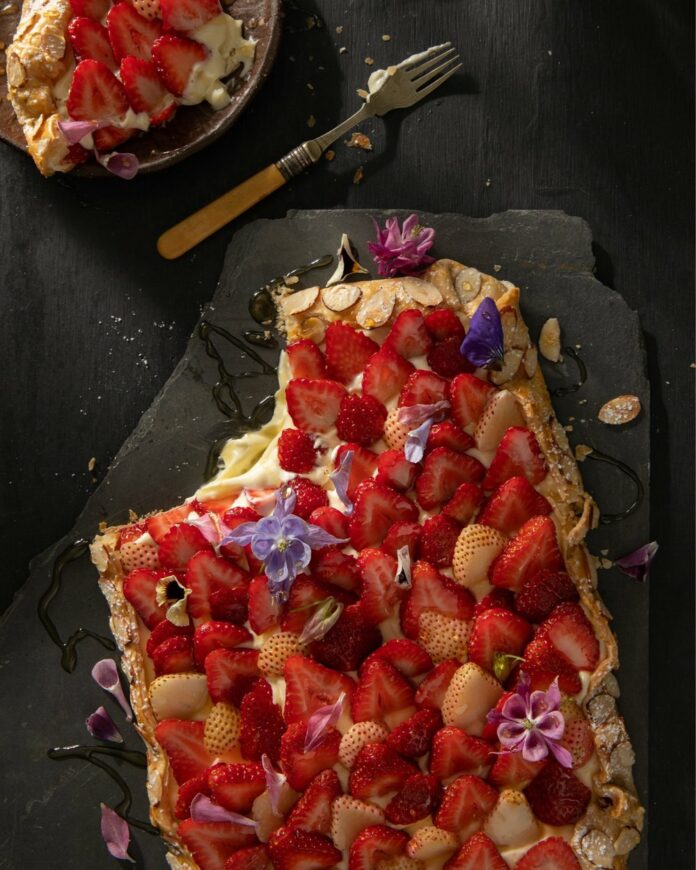
Ripe berries, much like this summertime sign, carry a bit of freshness and plenty of sweetness. For dessert, Gemini deserves a decadent Strawberry Honey Galette featuring layers of pastry cream, strawberries, and plenty of local honey. Could you imagine anything better to brighten up this zodiac sign’s day?
Author Bio
Wade Caves, based in Brooklyn, NY, is an astrological consultant and educator specializing in problem-solving applications of astrology. He teaches astrological divination and astronomy at the School of Traditional Astrology. Wade also publishes his work on world astrology through Skyscript’s In Mundo publishing desk. He even hosts the World Astrology Summit. A conference dedicated to the advancement of astrology for global problem-solving. Website: wadecaves.com • skyscript.co.uk/inmundo. Email: hello@wadecaves.com.