Home Blog Page 243

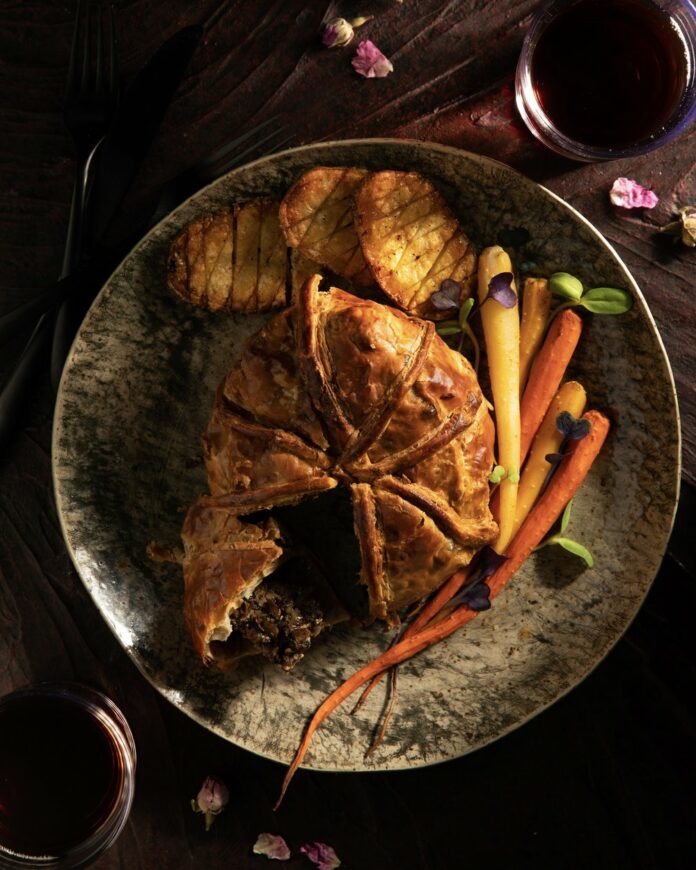
Beef Wellington with Crosshatched Potatoes & Roasted Carrots

0
An elegant dish made easy by Chef Jackie Page.

Beef Wellington makes an elegant main course to be shared with someone special. Here, Chef Jackie Page, TABLE contributor and chef-owner of Jackie Kennedy Catering, shares her recipe for the British classic alongside crispy crosshatched potatoes and gently sweetened roasted carrots.

BEEF WELLINGTON WITH CROSSHATCHED POTATOES & ROASTED CARROTS RECIPE

INGREDIENTS

 Two 6 oz beef filets

2 tbsp olive oil

1 shallot, diced

1 cup mushrooms, finely chopped

Puffed pastry

1 egg

2 tbsp water

2 yellow potatoes

Salt and pepper to taste

1/2 lb multicolored carrots

1/4 cup bourbon maple syrup

INSTRUCTIONS

  1. Sear the filets in one tablespoon of olive oil, browning all sides, then remove from the pan.

  2. Add the second tablespoon of olive oil, diced shallot and finely chopped mushrooms. Sauté until softened.

  3. Once the mushroom mixture is softened, add salt, then set aside to cool.

  4. Cut your puff pastry into individual sizes to cover the filet.

  5. Add your cooled mushroom mixture to the puff pastry and then add the filet.

  6. Close the puff pastry around the filet and brush with egg and water mixture.

  7. Roast in 400-degree oven for 15 minutes or until pastry is golden brown.

  8. Slice potatoes in 1/2-inch slices and then score them on both sides to create a hashtag pattern.

  9. Brush with olive oil and sprinkle with salt and pepper.

  10. Roast in the oven along with the beef wellington.

  11. Peel the carrots and place them into a skillet with the bourbon maple syrup, salt, and pepper. Cook to desired softness.

RECIPE BY JACKIE PAGE / STYLING BY KEITH RECKER / PHOTOGRAPHY BY DAVE BRYCE

Try some of Chef Jackie’s other delicious recipes:

Braised Beef Short Ribs with Cheddar Cheese Grits

Salmon with Saffron Risotto & Asparagus

Colossal Blackened Shrimp with Alfredo Sauce

Ravioli with Sautéed Veggies & Scallops

Jumbo Lump Crab Cakes with Potatoes, Tomatoes & Peas

Don’t miss a single delicious thing:

Subscribe to TABLE Magazine here!
Braised Beef Short Ribs with Cheddar Cheese Grits

0
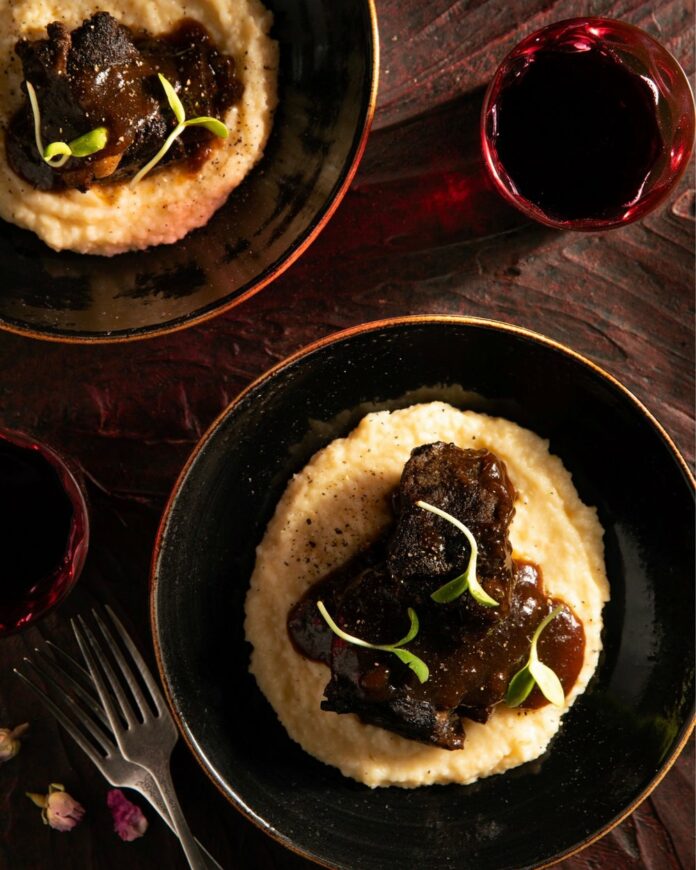
Tender braised beef atop cheesy grits for a meal full of comfort.

Chef Jackie Page, TABLE contributor, friend, and chef-owner of Jackie Kennedy Catering creates dishes full of heart and soul. It is no wonder she has become one of Pittsburgh’s sought-after culinary experts.

BRAISED SHORT RIBS WITH CHEDDAR CHEESE GRITS RECIPE

INGREDIENTS

4 short ribs

Salt, pepper, and a pinch of smoked paprika

32 oz beef broth

2 tbsp cornstarch

2 tbsp water

1 1/2 cups water

1 cup grits

1/2 cup milk

1/2 cup shredded cheddar cheese

INSTRUCTIONS

  1. Season short ribs with salt, pepper, and paprika.

  2. Sear the seasoned ribs in a braising pot, making sure to brown on all sides.

  3. Once the ribs are browned, add beef broth, cover, and place in oven for 2 hours.

  4. After 2 hours, mix together the cornstarch and water to create a slurry.

  5. Remove the pan from the oven and add the slurry into the pan juices. Cover and place the braising pan back into the oven for another 30 minutes until the sauce thickens.

  6. In a stock pot, bring water to boil and salt water as if you were making pasta.

  7. Add grits to the boiling water, lower the heat and stir continuously.

  8. Once the water has been absorbed, add the milk and cook for another 3-4 minutes then fold in the cheese.

  9. Depending on how you like your grits, you may add more water or milk to make them softer.

RECIPE BY JACKIE PAGE / STYLING BY ANNA CALABRESE / PHOTOGRAPHY BY DAVE BRYCE

Try some of Chef Jackie’s other delicious recipes:

Beef Wellington with Crosshatched Potatoes & Roasted Carrots

Salmon with Saffron Risotto & Asparagus

Colossal Blackened Shrimp with Alfredo Sauce

Ravioli with Sautéed Veggies & Scallops

Jumbo Lump Crab Cakes with Potatoes, Tomatoes & Peas

Don’t miss a single delicious thing:

Subscribe to TABLE Magazine here!
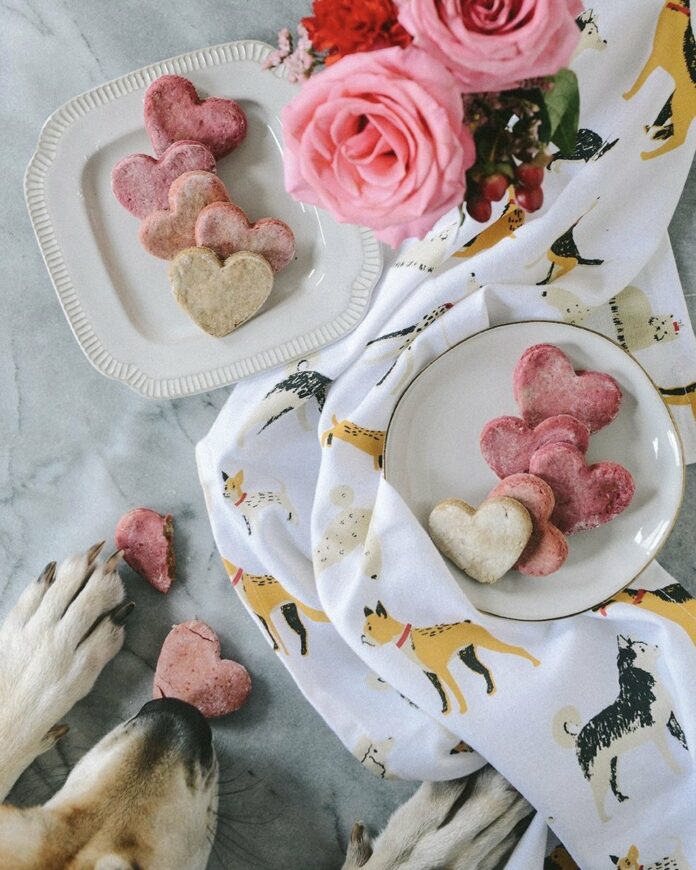
Homemade Dog Treats

0
Treats to celebrate the furry loves in our lives.

This is a call to celebrate the best examples of love in our lives: our dogs! As of last January, our hearts and our home expanded to make room for a third dog, a rescue we met while visiting my boyfriend’s family in Florida.

We couldn’t resist Pepper’s charms, and the fact that she came with a food name seemed like a sign she was meant to join Julep and Maple Le to round out our home. Our life became a fair bit more chaotic, and definitely a lot furrier (praise the geniuses behind robotic vacuums!), but life with three dogs is more joyful too.

Once we get the “sit” and “stay” commands down more consistently, I’m hoping you’ll see more of Pepper and Maple in the pages of TABLE, but for now, you can spy Julep hamming it up in several past issues. She’s no stranger to the camera, and for that, she deserves a few extra heart treats.

HOMEMADE DOG TREATS RECIPE

Ingredients

Beet Hearts

1 small beet, peeled and boiled

1 Tbsp water

1 ½ cups oat flour, more as needed

Banana Hearts

1 ripe banana

1 Tbsp water

1 ½ cups oat flour, more as needed

Apple Beet Hearts

½ small beet, peeled and boiled

1 Tbsp water

1 ½ cups oat flour, more as needed

Instructions

For each combination:

Combine the fruit/root and water in a food processor until smooth.

Add 1 ½ cups oat flour, and pulse until combined. Add more flour as needed, until a dough forms. The mixture will resemble pie dough or play dough.

Transfer the dough to a floured surface and knead until smooth. Use a rolling pin to roll to approximately ¼-inch thickness. Use a cookie cutter to cut into hearts or your shape of choice.  Transfer the shaped cookies to a baking sheet with a Silpat mat or parchment paper. Spread the cookies in an even layer.

Preheat the oven to 350°F. Bake the cookies until firm, about 30-40 minutes. Set aside to cool, then transfer to an airtight container, then reward the good boys and girls in your household.

RECIPE, STYLING, PHOTOGRAPHY AND STORY BY QUELCY KOGEL

Don’t miss a single delicious thing:

Subscribe to TABLE Magazine here!
Super Bowl Spread

0
A Super Bowl menu of epic proportion created by TABLE contributor and good friend Chef Kevin Hermann. Cocktail by TABLE Publisher, Justin Matase. Click on the photos below to build a touchdown menu.

GAME DAY COCKTAIL

Batch this Apple Cider Manhattan for a blitz!

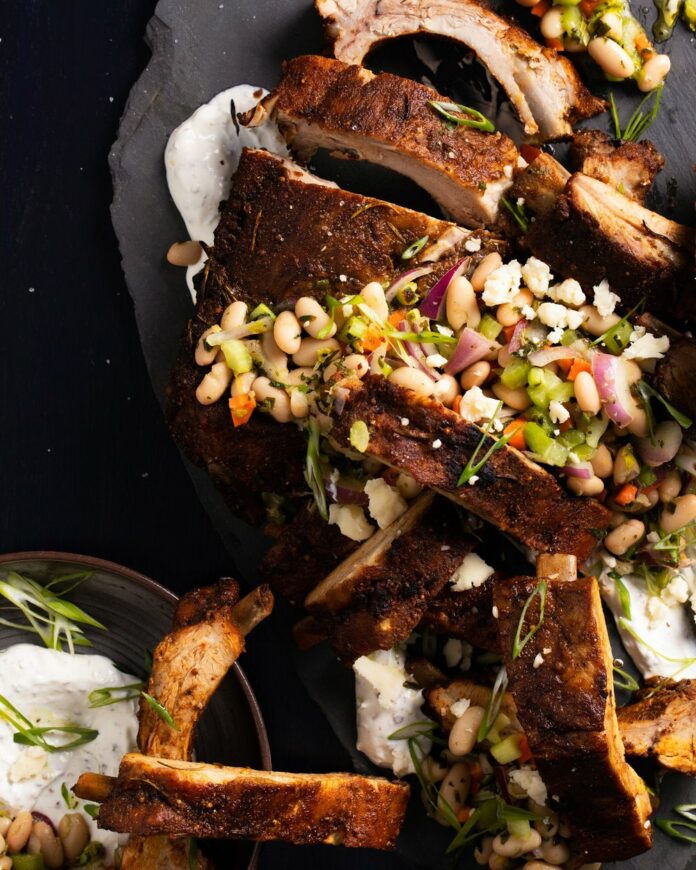
CHILI BABY BACK RIBS

These fall-of-the-bone ribs will “move the chains!”

MARINATED CHICKEN TOSTADO

No flea-flicking when it comes to this chicken.

ROASTED SAUSAGE BOARD

Hungry fans will tackle this board like it’s a running back trying to get to the edge.

ZESTY SHRIMP ROLL

Add this to your menu playbook and you’re sure to score.

BAKED PARMESAN POTATO SALAD

Guests will scramble like a quarterback under pressure for this creative bite.

Kick up your party a notch with these other TABLE recipes:

Cheesy Pepper Jelly Cigars

Crab Cakes

Artichoke Dip

Don’t miss a single delicious thing. Subscribe to TABLE Magazine here!

Flipping the Script on Mexican Cuisine

0
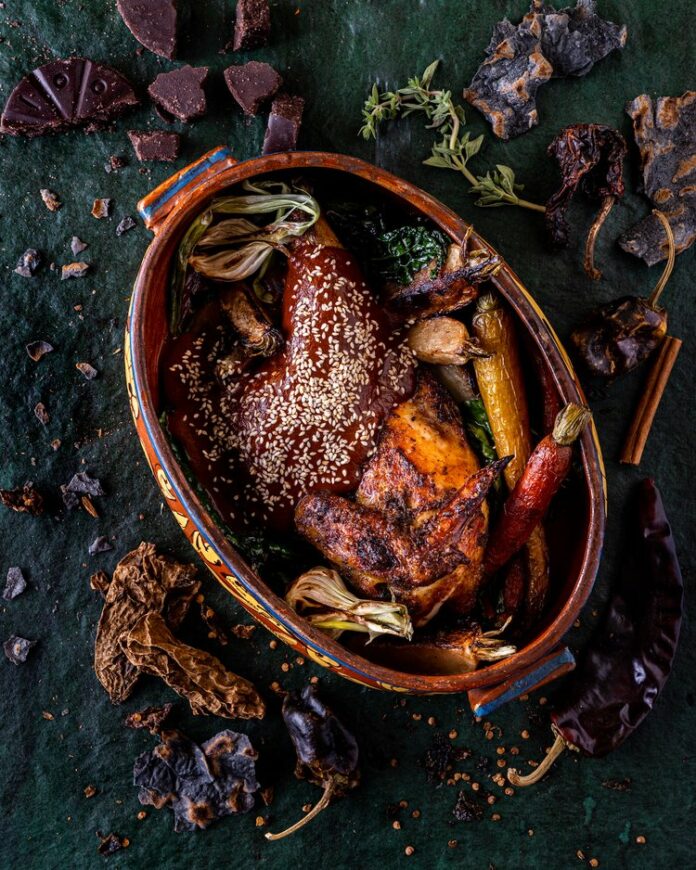
Paloma’s Chef Nathan Mayes shares special dishes from his Winter 2022 menu, all of them made with layered flavors derived from exquisite ingredients, and plated with an artist’s eye. Here: Roasted Half Chicken with Local Root Vegetables & Mole Colorado. Photography by Tira Howard.

For many diners in the United States, Mexican food is no more than a repeating cycle of the usual over-sauced and under-seasoned suspects. Among a sea of strip-mall restaurants, frozen foods, and uninspired cooking shows, the complexity and beauty of Mexican cuisine may not be visible, or even available, to the casual weekday dinner crowd. With Chef Nathan Mayes at the helm, Paloma has been quietly flipping that script for eaters since its opening.

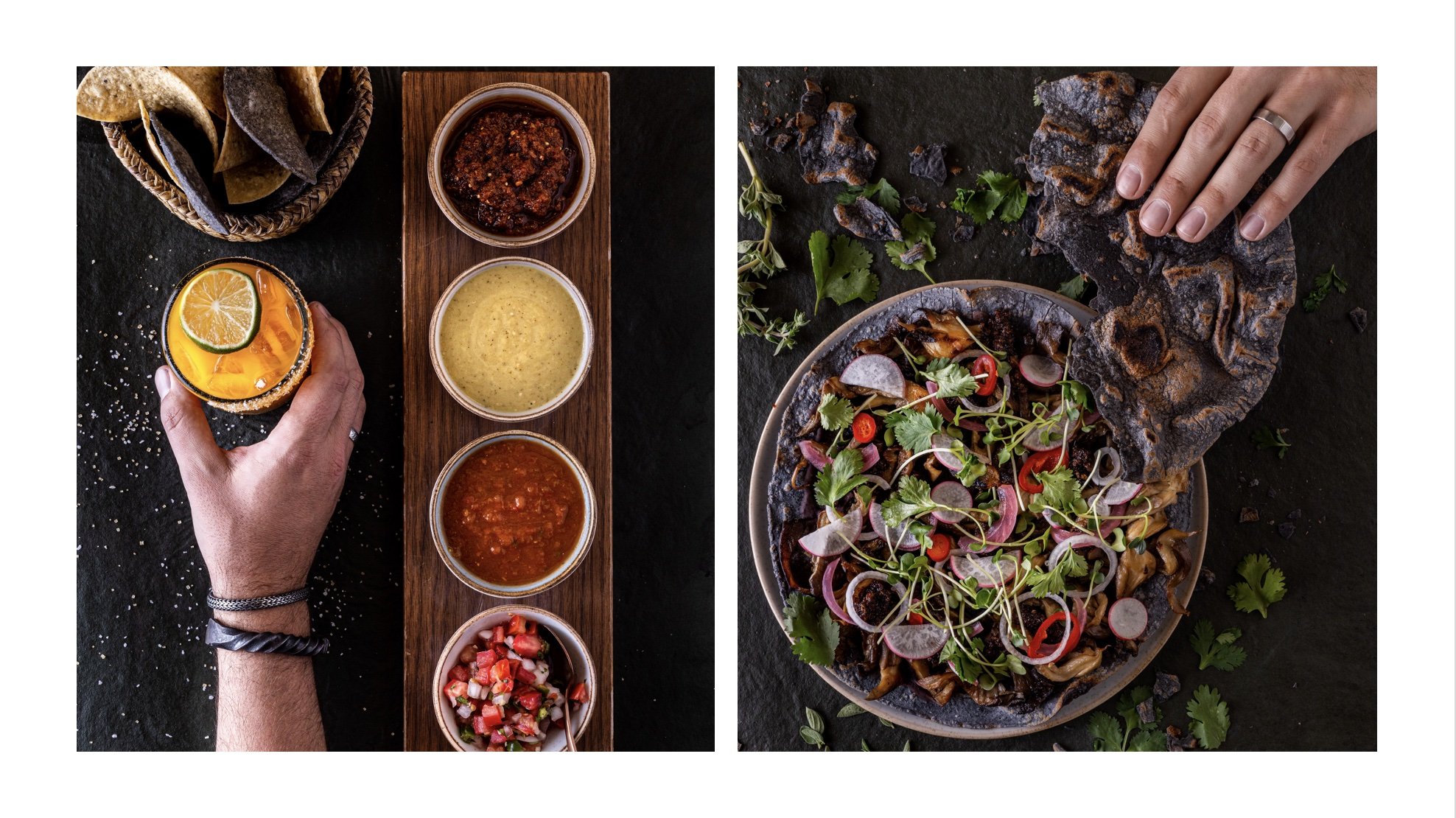
Left: There are house chips and salsa and then there are Paloma chips and salsa. Mark our words, these are a must-have aperitive with a mezcal cocktail. Reputations are built and lost on salsa, and you can bet the house with Paloma’s salsa morita, verde, roja, and pico de gallo. Right: Blue Corn Tlayuda with Refritos, Roasted Mushrooms & Market Escabeche. Chef Nathan Maye’s take on the iconic Oaxacan dish starts with a lightly fried tortilla mounded with mouthwatering mushrooms and refritos and the vinegary spike of escabeche. A perfect choice to share over cocktails.

Mexico is comprised of 32 states, each with its variation and vocabulary of ingredients and traditional food preparation. The details of what’s available to us on this end of the border are often blurred at best under the broad strokes of fajita platters and Taco Tuesday specials. And so, it’s nice, refreshing, and important when chefs like Nathan dig into the valleys of lesser-known regional cuisines of Mexico and invest in detailed research and prep work for dishes that may have familiar names but are worlds apart from our experience.

Chef Nathan is not alone. Emiliano Marentes (El Paso), Rico Torres (San Antonio), and Marciela Vega (Atlanta) are just a few visionaries working to re-write the narrative of Mexican food, where provenance is central to understanding what we’ve been missing about Mexican food all along. Santa Fe’s Paloma Restaurant, consciously or not, is part of this cohort of food creatives disrupting definitions of what is and what is not Mexican food.

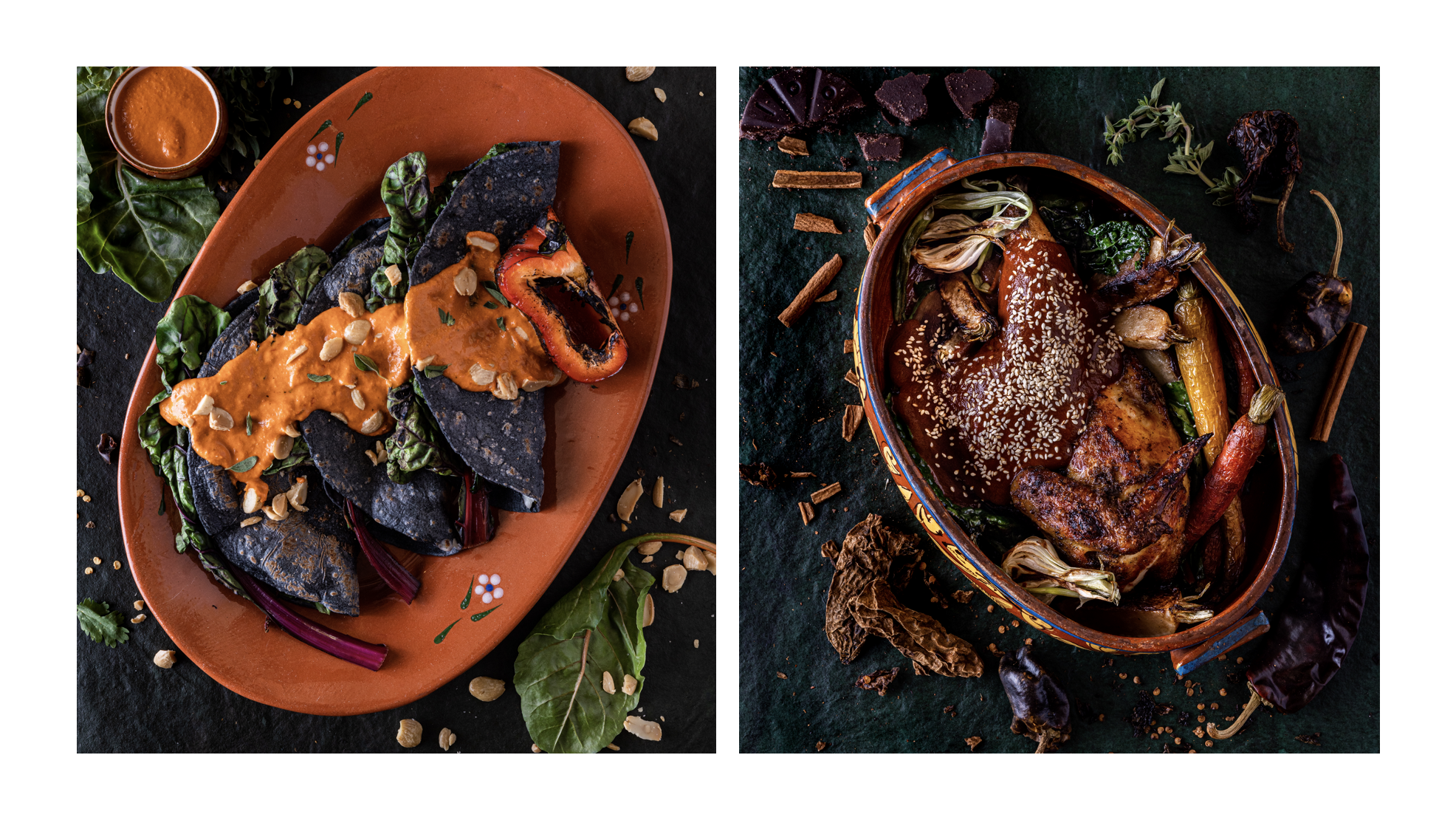
Left: Nixtamal Quesadillas with Field Greens, Quesillo & Almond Salsa. The vibrancy of fresh greens co-mingled with the enormous flavor profiles of the other ingredients of this dish makes for a playful and delicious vegetarian option. Right: Roasted Half Chicken with Local Root Vegetables & Mole Colorado. Heartwarmingly perfect for a casual weeknight out or a special occasion. The textures, flavors, and slight heat make for a crowd favorite from Paloma’s Chef Nathan Mayes.

Originally from Austin, TX, Chef Nathan grew up in what he describes as a restaurant family, which is to say that he’s been around food his entire life. After stints around the culinary world, including matriculating into and dropping out of the Culinary Institute of America and spending time in various kitchens around Santa Fe, a call from a former colleague and fellow visionary, Marja Martin, pointed their sails to what would become Paloma. “It’s been and continues to be an incredible journey,” says Nathan. “We started with items that people were familiar with, but we wanted a fresher approach.”

That approach is founded on the heart and soul of Mexican food, corn, or, more specifically, masa, which Paloma prepares using the ancient technique of nixtamalization. The nixtamal process begins with imported heirloom corn from Mexico called Cónico Azul, which they steep with calcium hydroxide (food-grade lime) that breaks down the exterior of the kernel to unlock its nutritional values and expand its flavor profile. Once ground, the masa becomes tortillas, masa snacks, quesadillas, huaraches, sopes, and other delicious wonders such as a thickening agent for their Mole Amarillo served atop a roasted half chicken.

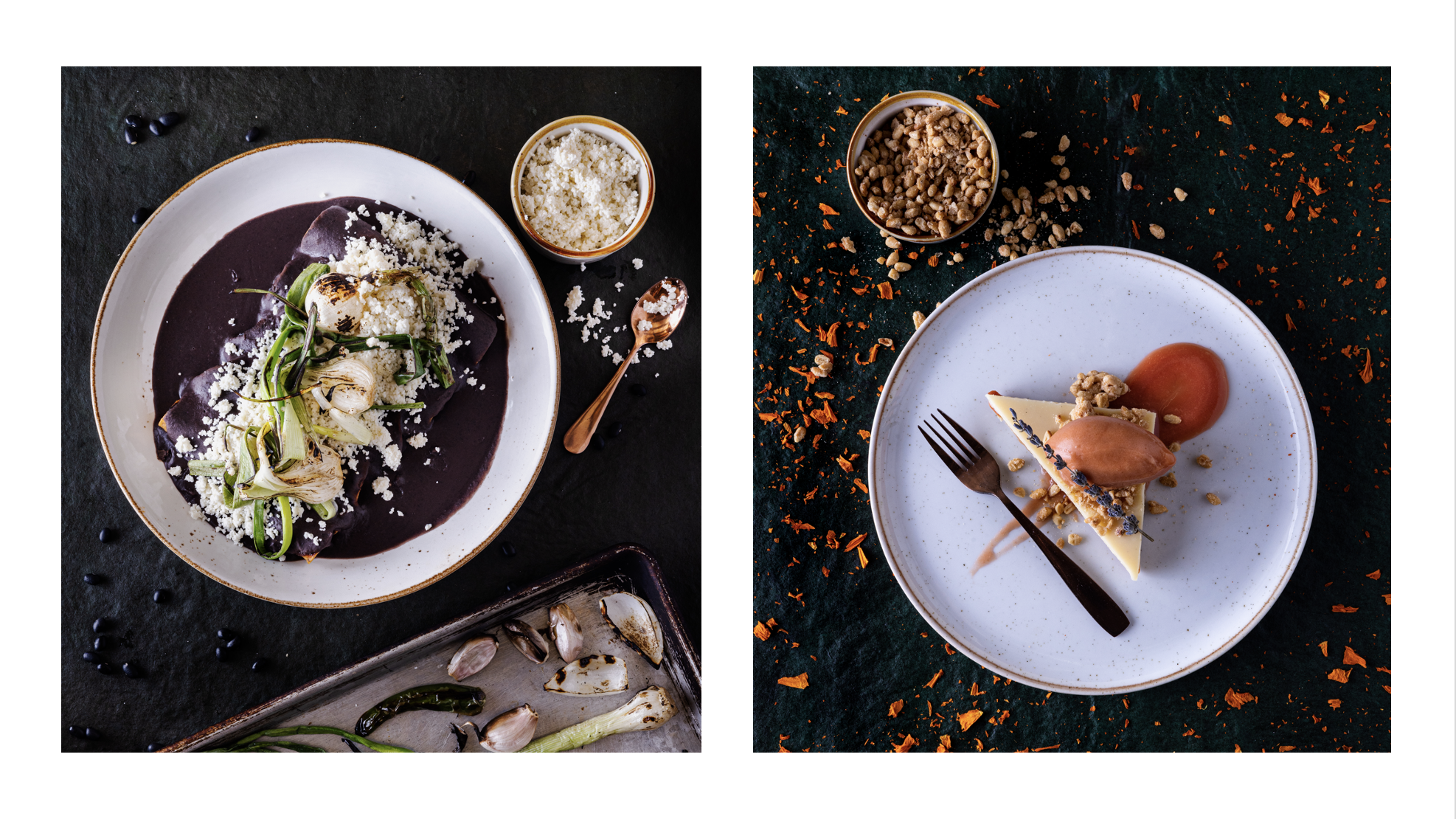
Left: Enfrijolada with Queso Fresco, Smoked Chicken & Grilled Green Onions. A classic Mexican dish similar to enchiladas but highlighting the deep affinities between pinto beans and corn tortillas––a fundamental flavor pairing. Chef Mayes shares the recipe with TABLE readers here! Right: Guava Tart with Piñon Marzipan, White Chocolate, Guava Sorbet & Local Honey. Chef Jessica Brewer’s desserts cap off every meal at Paloma with flair. Chef Brewer shares her recipe for Guava Sorbet here!

“There’s something that’s simpler and cleaner about the corn,” says Nathan when I ask about the lack of flour in his menu. “It has its flavor, and even though the corn comes from central Mexico, it feels and tastes like Santa Fe.”

Paloma is as much a place to learn as it is about the pleasure of enjoying food and ruminating flavors with familiar names that offer new experiences. It doesn’t have to source its central ingredients from Mexico or purchase the best possible ingredients from local purveyors. Still, when you travel to Oaxaca and other culinary centers in Mexico as a staff if only to seek out experiences to emulate for guests in Santa Fe, there’s no easy way to explain any of its motivations. Take one bite and the food speaks what has been taking us so long to hear.

palomasantafe.com 

STORY BY GABE GOMEZ / STYLING BY KEITH RECKER / PHOTOGRAPHY BY TIRA HOWARD

From Paloma’s mixologist Andrea Duran:

Pineapple Jalapeño Margarita

Prickly Pear Margarita

Marigold Margarita

Don’t miss a single delicious thing:

Subscribe to TABLE Magazine

Rest-In-Peeps

0
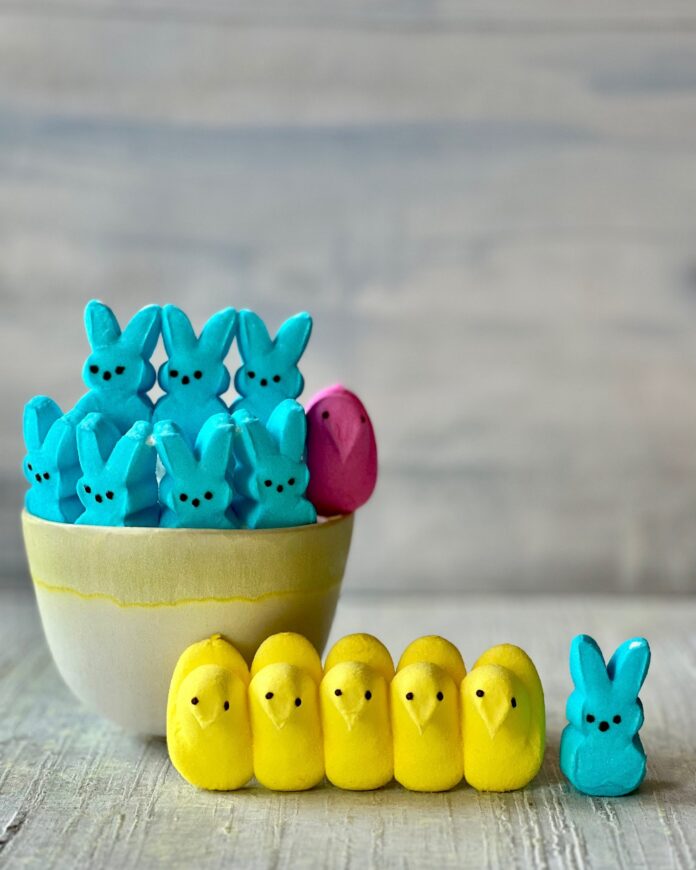
blue and yellow colors marshmallow peeps
Marshmallow Peeps, the most polarizing Easter candy.

Did you know that Easter peeps are the most polarizing Easter Candy? It’s a fact we’re talking about because Ira Born, inventor and cheerful promotor of Peeps, passed away on January 31, 2023, according to the Lehigh Valley News.

Peeps: An American Invention

Born in Ukraine, this Lehigh Valley, Pennsylvania resident for many decades turned aside a career in medicine in the late 1940s to work in his family’s candy factory, Just Born. Just a few years later, Mr. Born and an engineer focused on developing machinery to automate the making of shaped marshmallows. You guessed it: Peeps shaped and colored like newly-hatched yellow chicks started rolling out of the Just Born candy works and they soared in popularity in the novelty-driven marketplace of the 1950s. Along with shaped marshmallow bunnies, Peeps were a fixture of Easter baskets throughout the decade. By the 60s, yellow, pink and white chicks and bunnies were joined by shapes designed for Halloween, Christmas and other holidays. A lavender color option was added in 1995, and blue in 1998.

Peeps are Popular

Over the years, a Maryland Peeps Eating contest has gained popularity, with a record set in 2017 by a man who ate 255 Peeps in five minutes. Diorama competitions have been staged around the country, setting Peeps in miniature landscapes, Medieval castles made of candy, and even in perilous situations like railroad crossings with a train approaching. Wisconsin’s Racine Art Museum sponsors an Annual International Peeps Art Exhibition every April. They expect over 160 pieces of Peep art to be included this year. No word on whether the creations are eaten at the close of the show!

There’s no reason to believe that generous and good-natured Peeps inventor Ira Born would take anything other than pleasure in the fuss over Peeps. Crowds of fun-loving folks support all the Peeps-driven events discussed above. So why are peeps so polarizing?

Peeps are Polarizing?

FinanceBuzz asked 1,000 U.S. adults some essential questions about Peeps, and the results are interesting.

Americans disagree on Peeps marshmallow candies: 25% love them and 16% hate them.  The haters are winning out though: Peeps lag in Easter basket popularity behind Reese’s peanut butter eggs, Cadbury Creme Eggs, and simple chocolate bunnies.

The gooey texture you encounter when biting into a peep could be to blame. So could a relatively bland flavor profile: it’s all sugar in there! But much of the shade thrown at Peeps comes from their ingredient list: aside from sugar, you’d be hard pressed to pronounce any of the other components, all of which come from the chemistry lab rather than the farm.

If you love peeps, however, the chemistry works for you. If you don’t… pop one in the microwave to see what happens. One in three Americans already has.

Story by Carole Valle
Photography by Keith Recker

Subscribe to TABLE Magazine’s print edition.

Secure Your 2023 Valentine’s Day Plans

0
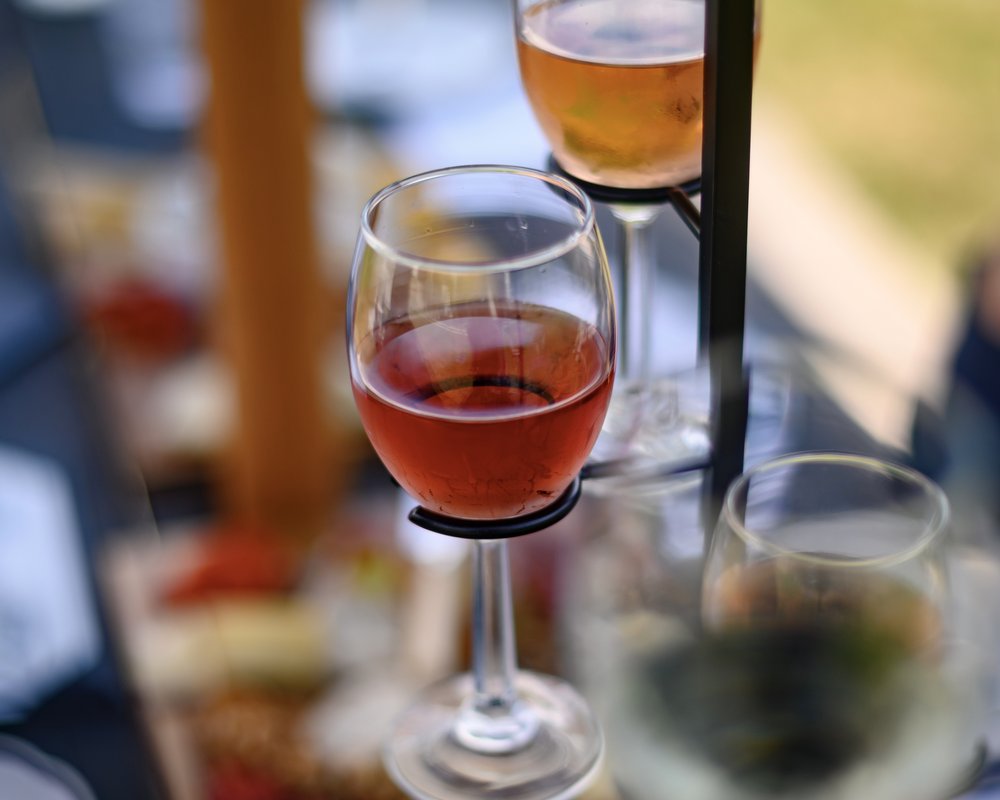
Wine, cheese and charcuterie - The PA Market

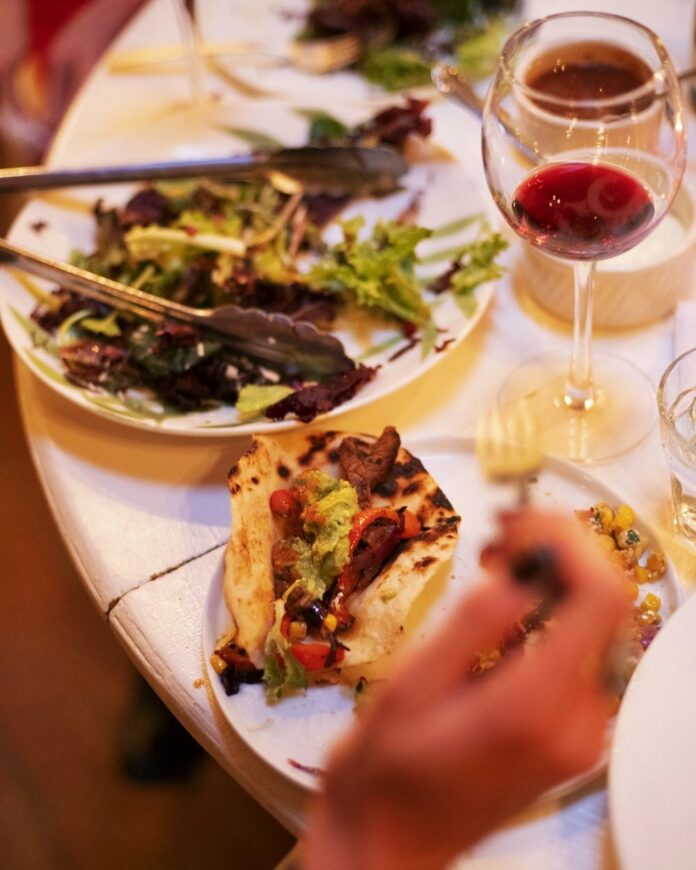
To delight in the sharing of food with the one who makes your heart pitter-patter means DOUBLE the release of dopamine into your system. If you’re still on the hunt for a hormone-boosting way of celebrating this Valentine’s Day, try one of these local offerings.

The PA Market

108 19th Street, Pittsburgh, PA 15222

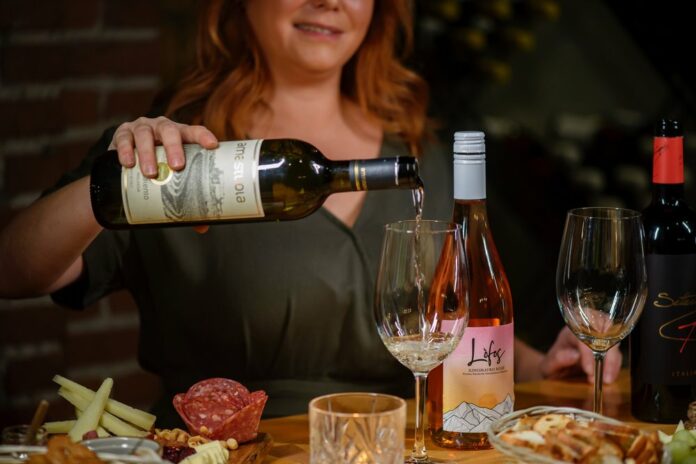
From Wednesday, February 8th to Sunday, February 12th, those dining at The PA Market can enjoy a Sparkling Wine & Charcuterie Combo complete with a bottle of Arte Latino Cava and your choice of an Italian or Spanish charcuterie board. This combo is offered in small or large portions. Raise your glass and cheers to love with a Chocolate Covered Strawberry Sangria crafted with red wine infused with dark chocolate, and strawberry.

If your Valentine loves to learn, give them the gift of a Wine and Chocolates Pairing Class. On Thursday, February 9, celebrate with Valentine’s perfect duo. Indulge in an intimate pairing of four fine wines and chocolates put together by The PA Market’s in-house experts.

Photo: Jeff Swensen for TABLE Magazine

Prix Fixe Tasting Menu at Di Anoia’s

Di Anoia’s Eatery

2549 Penn Ave. Pittsburgh, PA 15222

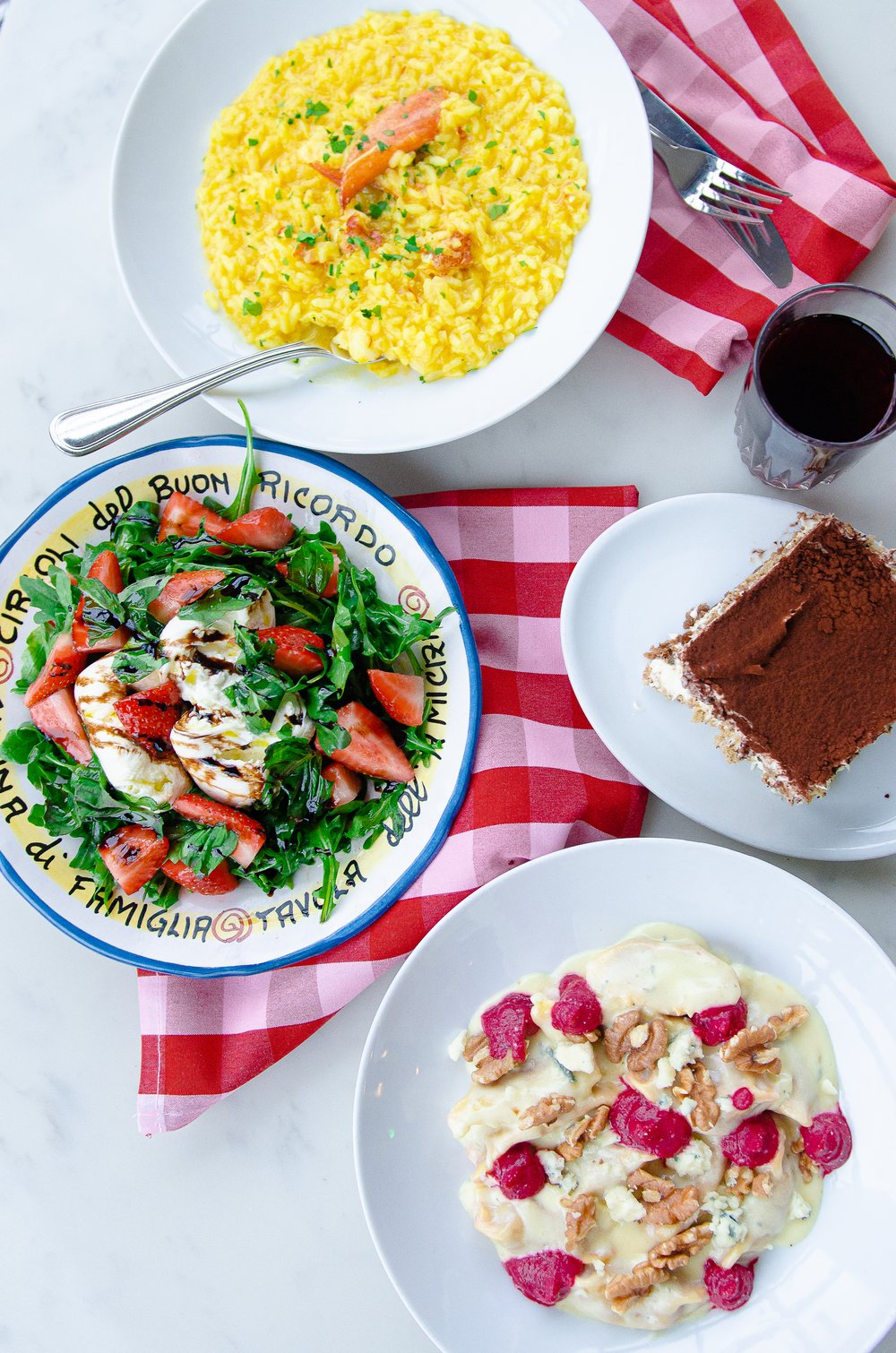
Feb. 14th-16th, in addition to its full, regular menu, DiAnoia’s will offer a dine-in prix fixe tasting menu for $72 per person composed of strawberry caprese, roasted beet caramelle with gorgonzola cream, lobster risotto, and spumoni tiramisu. Lobster tail can be added for $18 and caviar for $17.

Dine at home with Bistro to Go

Bistro to Go

415 East Ohio Street, Pittsburgh, PA 15212

Bistro to Go is offering a delicious, intimate way to celebrate Valentine’s day that is easy and elevated — a four course meal prepared cold and ready to reheat. For $55 per person, you will receive an appetizer of simple charcuterie and cheese, a beautiful Butternut Squash Salad as a first course, your choice of Roasted Chicken Marsala or Roasted Prime Rib, and cheesecake for dessert. Visit their website to pre-order by February 11th at noon, and reserve your pickup time for this dine-at-home option.

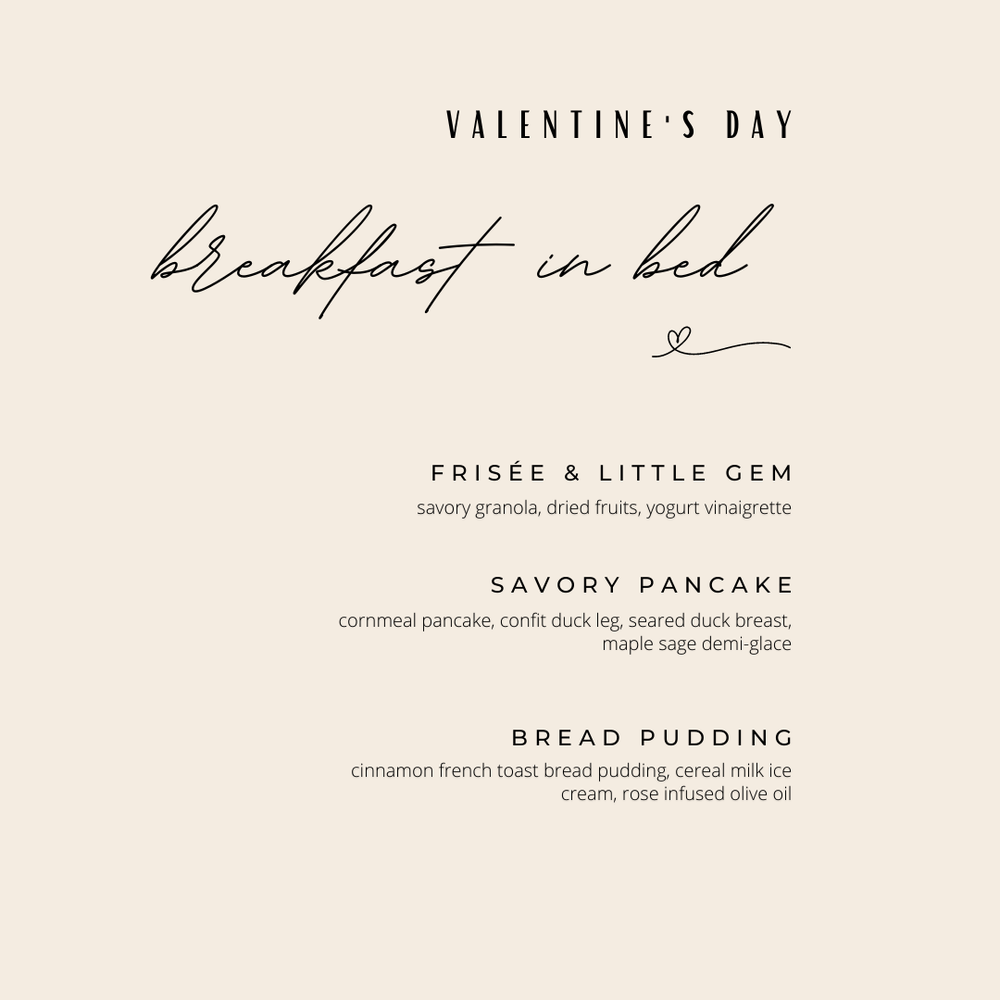
Breakfast in Bed prix fixe menu from Scratch & Co.

Scratch & Co.

1720 Lowrie Street, Pittsburgh, PA 15212

This Troy Hill favorite will be offering its highly anticipated three-course Valentine’s Day menu. From February 9th – February 12th, guests will experience the Breakfast in Bed prix-fixe in addition to the regular dinner menu. This menu starts with a Friseè & Little Gem salad with savory granola, dried fruits, and yogurt vinaigrette; followed by Scratch’s twist on a classic, the Savory Pancake, complete with a cornmeal pancake, confit duck leg, seared duck breast, and maple sage demi-glace. The meal finishes with a sweet Bread Pudding made with cinnamon french toast, cereal milk ice cream, and rose-infused olive oil. Guests will also have the option of adding a cocktail pairing to the Breakfast in Bed menu.

Two events, one night. Wine tasting with TABLE Magazine

TABLE Magazine Studios

229 Spahr Street, 2nd Floor, Pittsburgh, PA 15232

Two events, one night. TABLE Magazine Wine and Spirits contributor, Adam Knoerzer, a certified sommelier, will guide 10 couples through a half-dozen delectable Erie terroir wines. You’ll enjoy a special cheese and charcuterie board from Frances Restaurant at your very own table for two while learning interesting facts about the Erie terroir and the excellent (and still under-known) wines being made there. Each couple will go home with a tasting box of Tabbara chocolate truffles and a Valentine’s bouquet. Choose the white wine session, the red wine session….or both! A single ticket purchase covers 2 people! Please note, the studio is located on the second floor of an older building without elevator access.

Tastings will include wines from Couryard Winery, Johnson Estate Winery, Mazza Vineyards and 21Brix Winery

Photo: Jeff Swensen for TABLE Magazine

Pizzeria Davide

Locations in the Strip District and Robinson

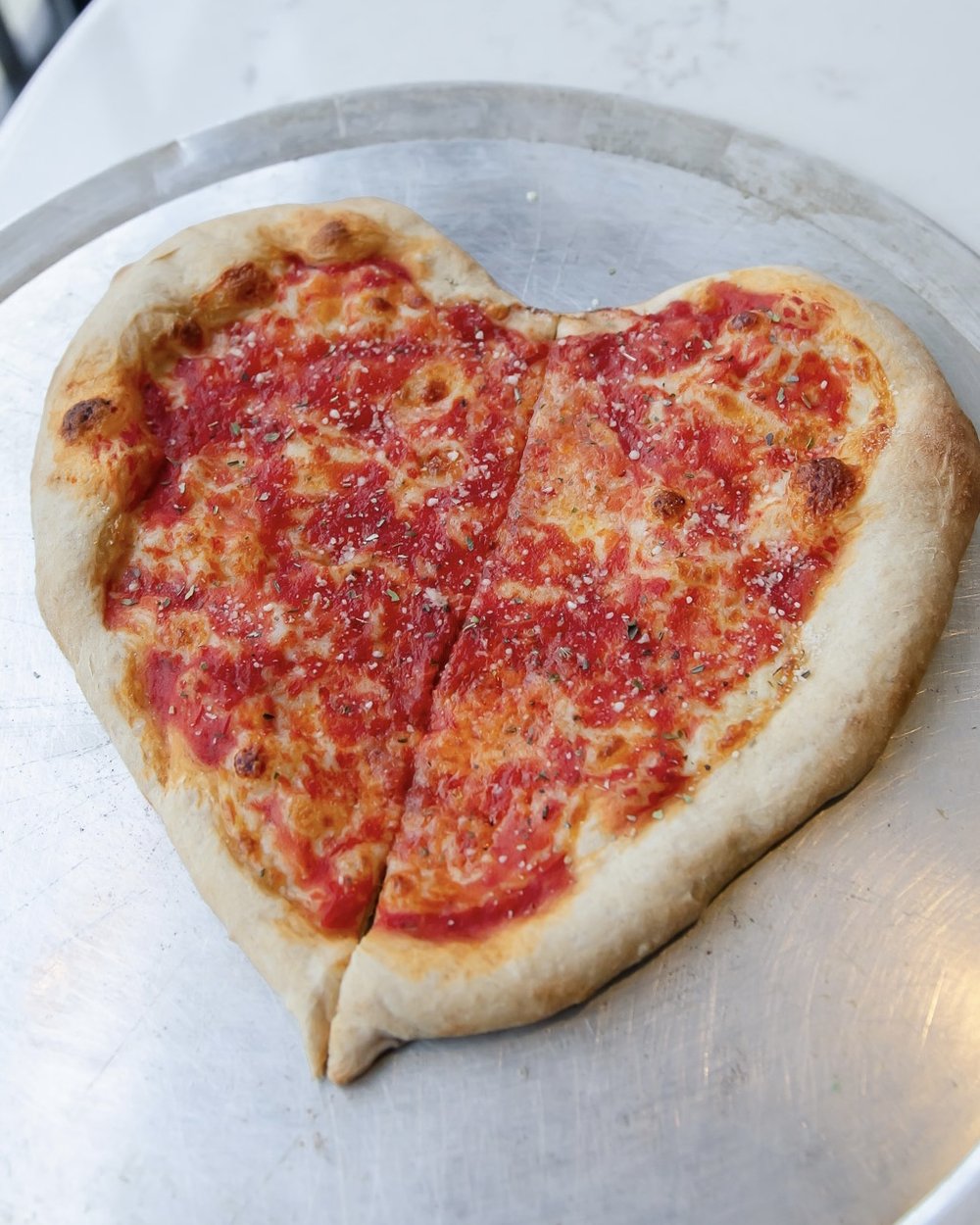
If pizza is your love language, Pizzeria Davide will shape any small pizza into a heart for an additional $2 from February 14th through 16th. For those not feeling the love, the team will “break” any heart-shaped pizza upon request with a jagged cut down the middle. Guests can order from the Strip District (412-904-4139) and Robinson (724-703-1210) locations by phone or online at pizzeriadavide.com. Online pre-orders will be accepted starting Feb. 5.

An intimate, after dinner desserts and beverage experience at Tina’s

Tina’s

4114 Main St, Pittsburgh, PA 15224

Valentine’s in Bloom is an intimate, collaborative after dinner desserts and beverage experience between Tina’s cocktail bar owner and wine expert, Sarah Shaffer, and chef and baker Daniele Brenci. They will set the mood with an entirely candlelit room, flickering just enough light for the bartenders to perform their magic, while guests are encouraged to dance to the ambient, sexy music played by DJ Doug Northcook, surrounded by roses. Sarah and Daniele draw inspiration from aphrodisiac flavors to create intentional pairings between desserts and the guest’s choice of dessert wine, cocktails or spirit free cocktails.

Aphrodisiac Menu  includes:

Guests welcomed with a pour of Domaine Mittnacht Cremant d Alsace or Leonardo Da Vinci’s Rose Water

Pre Dessert | Pistachio truffles, shortbread cookie, marinated dates and walnuts

Rose | Crostata, Peach, Rose, Cardamom

Honey | Vanilla, Pistachio, Comb

Chocolate | Zeppola, Whipped Ganache, Salted Hazelnut Praline

Looking for a Valentine’s gift for your special someone? Click here.

Don’t miss a single delicious thing!

Subscribe to TABLE Magazine here.

Five New Mexico Restaurants Make James Beard Semi-Finalists List

0
The pre-shift “family meal” at The Love Apple - Photo by Doug Merriam for TABLE Magazine

WHAT HAPPENED TO THE JAMES BEARD AWARDS

The pandemic brought not only the restaurant industry to a halt in 2020: it took the James Beard Awards with it. In August of 2020 an announcement was made that awards wouldn’t be given out. As nominees removed themselves from consideration, the organization committed to overhauling the process for 2021. But 2021 also brought a year without James Beard Awards nominees as the need to address inequity, systematic bias, and promotion of toxic behaviors continued to weigh on the organization. See the complete coverage of the allegations by Eater here.

2022 featured the reimagined James Beard Awards with revamped categories focused on greater inclusivity and validity, with a more varied and diverse set of finalists. Regional category lines were redrawn, with states like California and New York state receiving their own territories to open the field to chefs in less populated areas. Among other changes, age restrictions were lifted, and Best Chef was renamed Emerging Chef. The complete overhaul can be reviewed here.

2022 JAMES BEARD AWARD FINALISTS

The systematic transformation seems to have worked as new restaurants with more diverse chefs and cuisines made the list in 2022. Santa Fe’s much-admired Chef Fernando Olea of Sazón took the prize for Best Chef in the Southwest region in 2022. Chef Martín of Restaurant Martín in Santa Fe and the Salazar Brothers of La Guelaguetza in Albuquerque were semi-finalists in the same regional category.

Santa Fe’s Zacatlán received a semi-finalist nod for best restaurant nationwide. Nobu Mizushima and Yuko Kawashiwo of Albuquerque’s Ihatov Bread and Coffee were semi-finalists in the Outstanding Baker category.

2023 JAMES BEARD AWARD SEMI-FINALISTS
Chef David Sellers in his kitchen at Horno on Santa Fe’s Marcy Street | Photo by Tira Howard for TABLE Magazine

2023 JAMES BEARD AWARD SEMI-FINALISTS

2023 brings a new list of Semi Finalists, featuring five from New Mexico. Chef David Sellers of Horno was named in the Best Chef category, as were Andrea Meyer of The Love Apple in Taos; Basit Gauba of Tikka Spice in Albuquerque; Chef Berenice and Luis Medina of Santa Fe food truck El Chile Toreado; and Justin Pioche, Pioche Food Group, Upper Fruitland (Doolkai), Navajo Nation.

If you would like to follow along, nominees will be announced March 29th followed by an awards ceremony on June 5th in Chicago. In the meantime, we suggest you make a round of tastings to check out the nominees’ delicious offerings.

The crew at The Love Apple in Taos | Photo by Doug Merriam for TABLE Magazine

Lake Erie Wines Competing on the International Stage

0
Man drinking Lake Erie wines
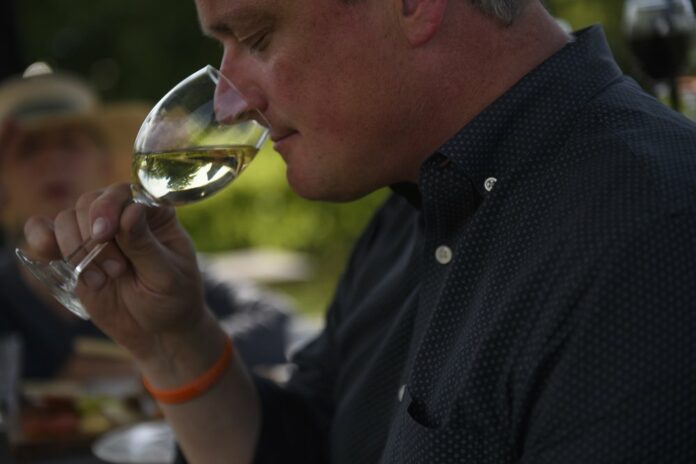
Pierre Brun tastes an Erie region white wine. Photo by Jeff Swenson

What happens when a European with an accomplished palate makes a deep study of the wines of Lake Erie? There is a French expression that says: Il n’y a que les imbéciles qui ne changent pas d’avis, which means “only fools never change their minds.” This statement applies to me regarding Lake Erie wines, and I admit that this recent change of mind came as a complete surprise. Et quelle suprise!

Let me tell you about myself.

I grew up in Friuli Venezia Giulia in northern Italy and also lived in Belgium, at the crossroads of Germany, the Loire Valley, and Alsace. Those places are all rightly famous for their many centuries of excellent winemaking. Our family table was itself a crossroads of Friuli, Collio, and Alto Adige, all places where, I believe, we find some of the best wines (and foods) from northern climates.

Fifteen years ago, my brother-in-law, who lived in Burgundy, came to visit our family to sail on Lake Erie and search for some good local wines. After tastings at several local wineries around the lake, we left quite disappointed. We were hoping to discover a unique terroir with bright, floral northern grapes, but most of the wines we tried were neither very complex nor delicate.

While a typical winery in Europe generally serves a much drier wine selection, all the wines we tasted at that time were very sweet. Traditionally, sweet wines are consumed after dinner. Around the world, they are a very risky endeavor, given the necessity of a late harvest, as with ice wines. But they are also loved by many for their unique flavors.

Erie Terroir

At the peak of harvest season this past September, Jeff Swensen, a good friend and photographer for TABLE Magazine, called me to join him on a challenge he had taken up to document winemaking in the Lake Erie region. I did not have much enthusiasm or very high expectations. But since I love all wines, even the sweet ones, I accepted, and we were on the road the next weekend.

My quick research of the area revealed why Lake Erie was chosen as a region for wines and orchards as early as the first part of the 19th century. The geological layers — both the soil and what lies underneath, which can be called the “Erie Terroir” — are a unique environment rich in the nutrients needed to grow good grapes. In Europe, the concept of terroir, however, goes beyond geology. Terroir is the specific taste of a region. It’s all about the character of a product defined by its provenance.

For example, prosciutto di Parma, made from pigs raised in Bologna and finished using the materials and traditions of the region, doesn’t taste like prosciutto di San Daniele, which is made in the northern Italian region of Friuli Venezia Giulia, which has its own distinct methods and materials. The air, the soil, and savoir faire of the farmer and the culture give each type of prosciutto its unique aroma, flavor, and texture. The unique spirit of the land, the terroir, is showcased in the tasting experience of its prosciutto. Terroir is a way of defining and celebrating what a region does best. The same is true of wines.

A Unique Microclimate

The Lake Erie region became a perfect growing location because of its ancient history. As many local farmers explained, when the glaciers retreated, they eroded the hills and left behind a perfect soil full of sand and gravel with a lower bed of clay. Why is this important? The soil is rich with nourishing minerals, to be sure. The gravel forces the vines to work hard to establish themselves, which improves the character of the grapes. The sand allows for good drainage, which keeps the roots from being too damp and prone to disease. On the other hand, the underpinning of clay means that the fields will not dry out too quickly and deprive the vines of the water they crave.

The region has also a unique microclimate to allow a longer growing season. Its combination of sun, fresh water, and the rapid warming of the lake with a generous breeze supports an almost perfect ambience in which to grow grapes. Not too much humidity, and not too much frost. The combination of geology and weather helps this region support the largest viticulture in North America, outside of California. I soon learned that the humans who live here are just as vital to the region’s terroir.

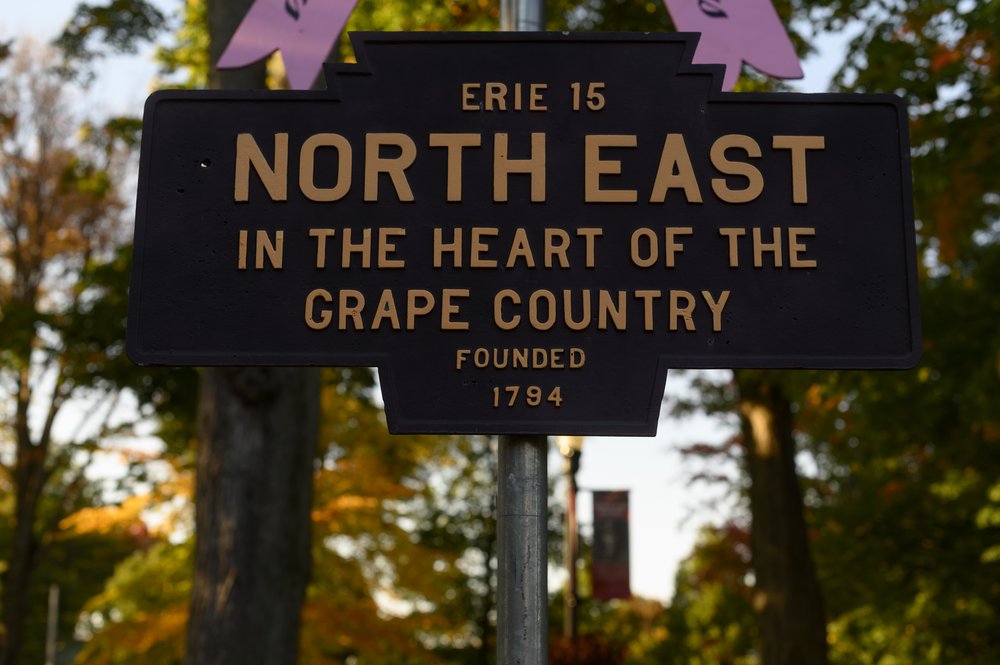
As we were heading north to the Lake Erie and Chautauqua wine trails, 50 miles long, dotted with 23 wineries, we picked Courtyard Winery in North East, PA, as our first stop. The reception we received was amazing. All the owners and winemakers (or, more simply, farmers, as they like to call themselves) were welcoming and extremely knowledgeable about their land and operation.

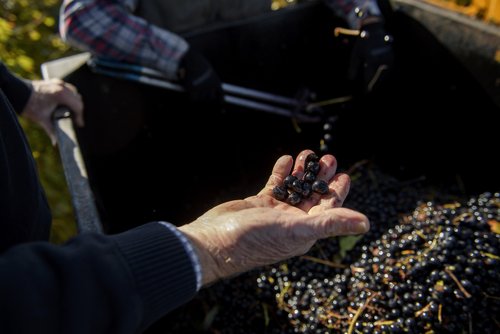
Randy Graham inspects a harvest

The Lake Erie Wine Quest Begins

When you enter a winery around Lake Erie, you are confronted with abundant sweet wine “propaganda.” Randy Graham, the owner of Courtyard, explained why this is more heritage than handicap: “Sixty to 80% of what we grow goes to Welch’s.” Concord grapes require less rigorous maintenance and can be sold easily locally for juice production. This sort of dependable economic underpinning is certainly one of the strongest advantages any farmer can have. The wine industry is not an easy market, and having some stability to lean on has afforded many farmers the chance to become better winemakers.

At Courtyard, my first glass of Merlot was a revelation. It reminded me of wines I have had many times growing up in Italy. Merlot is not a preferred grape in my region, but some do it well, and with the right local foods, it comes to life because it belongs. That’s the sensation I had when sipping this first Erie wine.

We switched to white, and we were once again bewitched, this time by the Riesling. It was not too sweet and offered just enough acidity and a beautiful bouquet…all the things I would expect from a truly good Riesling. Afterwards, while driving his truck through the vines, Randy showed us how Penn State and Cornell University have been working for many years with all the farmers to create hybrids of resilient grapes perfect for the region and its weather. The Noiret grape is certainly the best example of this effort, and it is often a feature of red wines made in the region.

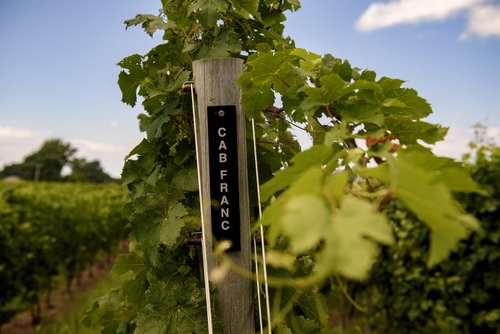
Cabernet Franc vines at 21 Brix in Westfield, NY

Voices of Lake Erie Wines

The other amazing discovery was that today’s vineyard owners represent a second or third generation of growers. Some of them left promising careers to come back home and pursue their dream of making better, more elegant wines. Kris Kane of 21 Brix Winery, our next stop, is a good example of this trend. This third-generation family farm has been growing grapes since the 1950s, currently harvesting 17 varieties.

Kris intended to become a chiropractor, but realized that his calling was vines and wines rather than bones and sinews. He apprenticed at Presque Isle Winery for 10 years. That experience, alongside a stint at a winery in Australia, fueled his family’s entry into winemaking. Each 21 Brix wine was an amazing surprise, but the Gewürztraminer and the Cabernet were the highlight of the tour. Not only do these younger winemakers use French oak, they are also attentive to allowing their wines very little oxygen contact so that they might preserve the fruit in such a way as to produce a quality wine.

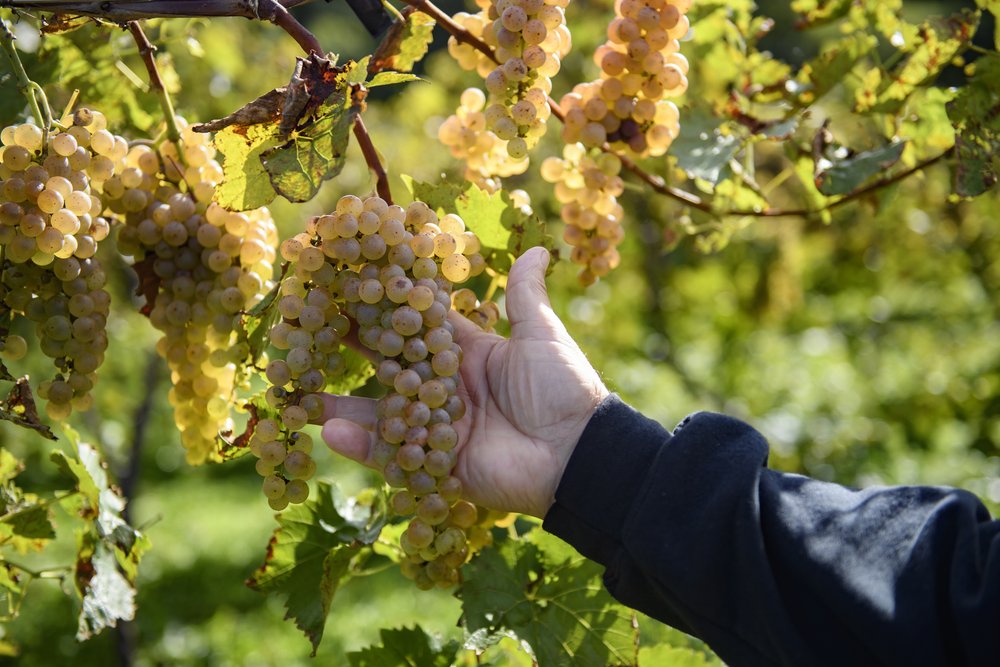
Grapes on a vine, used to make Lake Erie wines

A Visit to Johnson Estate

Soon after our first tasting, Frederick Johnson, Jr. and his wife Jennifer called us to come to the oldest estate winery of the region, Johnson Estate. Their welcome was even bigger as they accompanied each wine with a unique taste of local cheese and charcuterie. Their méthode champenoise sparkling Traminette, as well as their Maréchal Foch, were delicious discoveries.

We felt we needed three more winery visits to complete our project and were introduced to Liberty, Presque Isle Winery, and, finally, the famous Mazza Vineyards. Each opened their arms and welcomed us into their cellars, sharing not only their extensive wine selection, but also their expertise. Bob Mazza described the region’s great potential, and its constant evolution over the past 50 years. Mazza is certainly the most prominent and award-winning name in the region with winemakers coming from established wine regions in Europe and Argentina.

How to Convince Lake Erie Wine Skeptics

As we drove home, I began to wonder how I could convince my skeptical peers (both from Europe as well as the United States) that, firsthand, I saw and tasted a virtual rebirth in the region, thanks to the enthusiasm and hard work of all these producers? I remembered the story of Napa Valley wines: their rise to broad recognition required the courage of just a few people who shared them with very skeptical French wine aficionados. After a famous dinner and blind tasting called the Judgement of Paris in 1976, where Napa Valley frequently triumphed over comparable French vintages, the region began to be appreciated for its fine, accomplished winemaking.

We asked all the wineries we met with to allow us to stage a blind-tasting competition, The Judgement of Lake Erie, with our favorite Erie wines so that we could see whether our personal enthusiasm would be affirmed by a broader consensus of palates. In a second, smaller blind tasting, we then pitted the winning Erie wines against established wines from Europe to see how they would fare. I hoped that this second session would confirm my conclusions about the current level of Lake Erie wines.

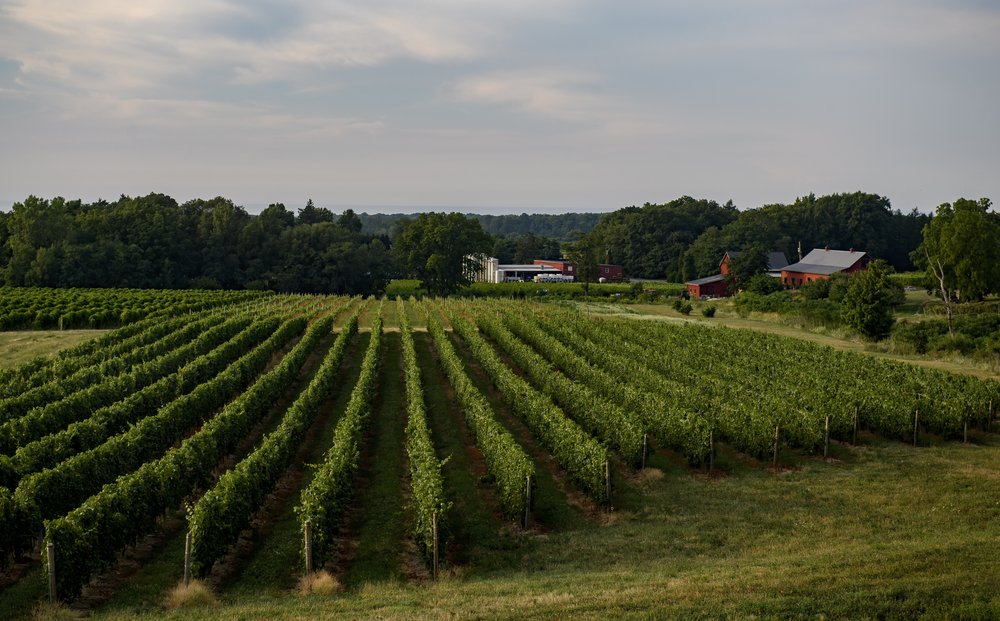
The grape field of a Lake Erie winery
Johnson Estate Winery

The Judgement of Lake Erie Wines: September 2022 

At home in Pittsburgh, we selected 12 oenophiles (six men and six women) who had a passion for wines and enough worldly tasting experience to be the judges. Because every bottle was wrapped identically and coded with numbers and letters, none of the tasters selected knew what they were drinking.

The selection consisted of 12 flights of Lake Erie wines in the following categories: Sparkling; White (Rosé, Riesling, Grüner Veltliner/Gewürztraminer, Pinot Grigio, and Chardonnay); Red (Foch/Pinot Noir, Noiret, Merlot, Teroldego, Cabernet, Blends). Our first tasting, an all-Lake-Erie blind-tasting by grape, revealed a few clear trends. The white-wine category, the highlight of the region in terms of grape and terroir, saw a global winner in Mazza Winery. They finished first in the Rosé, Riesling, Pinot Grigio, and Chardonnay categories. 21 Brix won with its stunning and flavorful Gewürztraminer.

An award for the sparkling wines (or méthode champenoise) was also given by our tasters, as they were excellent and in very consistent balance with what a non-French champagne can be. Johnson Estate Sparkling Traminette and 21 Brix distinguished themselves very clearly, suggesting that we might envision this region as an eventual “new Reims,” with distinctive wines drawn from its own viticulture.

During the red tasting, Courtyard Winery in the Merlot, Noiret, and Teroldego category was the big winner. 21 Brix, with its Cabernet Sauvignon, really amazed our group. Finally, Johnson Estate, with its Maréchal Foch, won the Pinot category, and their Freelings Creek Founders Estate won the blind tasting.

Maréchal Foch/Pinot 

Winner: Johnson Estate Maréchal Foch 100%

Sparkling 

Winner: Johnson Estate Freelings Creek Reserve Traminette

Dry Riesling

Winner: 2020 Mazza Riesling 100%

Gewürztraminer

Winner: 2020 21 BRIX Gewürztraminer 100%

Pinot Grigio

Winner: 2020 Mazza Pinot Grigio 100%

Chardonnay

Winner: 2020 Mazza Chardonnay 100%

Merlot

Winner: 2018 Courtyard Merlot 100%

Noiret

Winner: 2018 Courtyard Noiret 100%

Teroldego

Winner: 2018 Courtyard Teroldego 100%

Cabernet Sauvignon/Franc

Winner: 2019 21 BRIX Cabernet Sauvignon 100%

Rosé

Winner: 2019 Mazza The Perfect Rosé 97% Chambourcin, 3% Seyval

Red Blend

Winner: 2020 Johnson Estate, Founder’s Red 90%, Chancellor 10% Pinot Noir

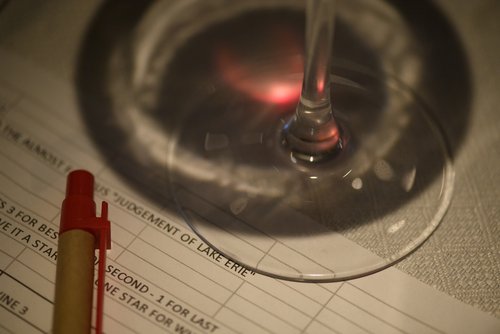
A guide sheet for ranking Lake Erie wines

The Judgement of Pittsburgh, October 2022: Lake Erie Wines vs. Euro  

Ten days later, we assembled four final tasters to compare the winning Lake Erie wines with well-known and very credible European wines.

Rosé

Winner: 2020 Mazza Perfect Rosé

This rosé again came out on top over another Erie wine and a 2020 AIX Coteaux d’Aix-en-Provence. The winning wine caressed the palate with notes of fresh red berry and nectarine aromas, all with floral and mineral overtones.

Pinot Grigio

Winners: Bottega Vinaia 2021 Pinot Grigio and 2020 Mazza Pinot Grigio 100%

A classic wine from the Trentino region tied with the 2020 Mazza Pinot Grigio for the top spot. Santa Margherita, the classic Pinot Grigio from the Adige River Valley which is consumed around the world, placed a distant third. The Mazza wine was crisp with well-balanced aromas of golden apple with a slight residual sugar.

Riesling

Winner: 2020 Mazza Dry Riesling 100%

Mazza won again, pitted against another Erie wine and a Christophe Mittnacht Terres d‘Etoiles Riesling 2019 from Alsace. The winning Mazza wine was floral, almost off-dry, with notes of lime, apple, lemon, and mineral.

Gewürztraminer

Winner: 21 Brix

21 Brix won handily against a 2021 Willm Reserve and a 2021 Trimbach. Those wines were both from Alsace, but both quite uninteresting compared to the winner. The full fruitiness of the 21 Brix wine was beautifully layered with a floral aroma and rich and delicate notes of citrus, pear, and peach.

Merlot

Winner: Courtyard

Courtyard won against another Lake Erie wine and a Right Bank Bordeaux, 2019 Chateau Haut Peyruguet. The flavors here recalled ripe blueberries and black and red fruits, alongside notes of cocoa during a long finish.

Pinot Noir

Winner: 2018 Trimbach Pinot Noir Reserve

We had our only European victory with a 2018 Trimbach Pinot Noir Reserve from Alsace and a 2020 Nicolas Idiart Pinot Noir from Loire Valley coming out ahead of the Johnson Estate 2019 Maréchal Foch.

Noiret

Winner: Courtyard

Only Lake Erie competed here because this regionally-specific grape is not grown elsewhere. Courtyard won with its 2019 Remington Road Vineyard. Noiret tasting notes included elements of raspberry, blackberry, cocoa powder, cherry, and strong espresso. The overall effect is very close to a Syrah.

Cabernet Sauvignon

Winner: 2019 21 Brix Cabernet Sauvignon

We did not necessarily imagine that the Lake Erie region would prevail here, but it did! The 2019 21 Brix Cabernet Sauvignon won against 2020 Alexis Lichine and 2020 Villa des Anges, both from the Languedoc region. The notes here were of dark fruits and cherries, blackberries, chocolate, and some spice. This wine has well-structured tannins, and a lovely long finish.

Everyone at both tastings was amazed by the quality of the wines they sipped. Some of us were able to identify grapes, or even recognize specific wines, which is a statement to the quality of the local terroir. They certainly deserve a place at our dinner tables, and at tables around the world. Their makers just as certainly deserve esteem for their efforts and the results. We predict that Lake Erie will continue to surprise more than one drinker with its stunning vineyards and amazing future.

Story by Pierre Brun / Photography by Jeff Swensen

A footer photo with a black background and subscribe info and button

Subscribe to TABLE Magazine’s print edition.

Blood Orange Tom Collins

0
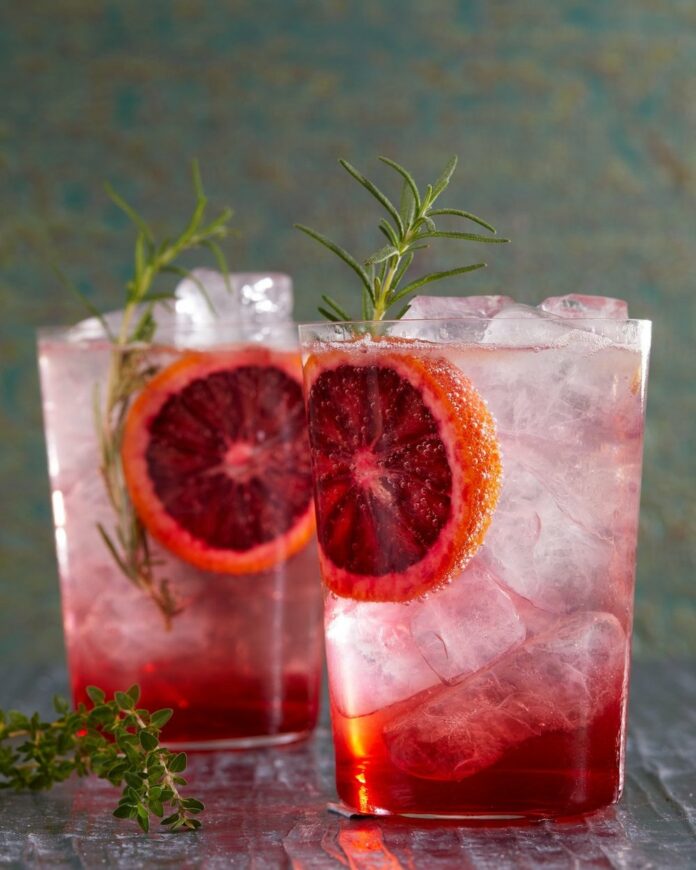
blood orange colored cocktail
A spin on the original Tom Collins for winter

Before we share our Blood Orange Tom Collins recipe, let us talk about the original for a moment. The origins of the Tom Collins can be broken into two theories. Some believe that the name for the classic gin-lemon-sugar-soda cocktail came from a longstanding New York City joke told in 1874 about a rascal named Tom Collins who traveled the city telling falsehoods. Other drinkers claim the creation ties back to Jim Collins, a London bartender said to have invented the gin-forward cocktail in the 19th Century.

Torn between these two versions, we at TABLE at least know one thing: the Tom Collins is delicious.

To add a bit of winter to this rather summery cocktail, we added a blood orange syrup. The cocktail is an easy, build-as-you-go, no-shaker-needed drink that adds a touch of bright spice to your seasonal happy hours. It’s a spice that in this post-daylight savings world, we all need.

BLOOD ORANGE TOM COLLINS

INGREDIENTS

2 oz gin
1 oz lemon juice
½ oz blood orange syrup
2 dashes of blood orange or orange bitters
Club soda
Blood orange slice, to garnish

INSTRUCTIONS

For the syrup:  Place one cup of water, one cup sugar, and the peels of four blood oranges in a saucepan and bring to a bottle. When cool, strain the syrup into a jar with a lid. Store in the fridge for a month.

Toss the peels in powdered sugar and let dry on a non-stick Slipmat baking sheet. When dry, store between layers of wax paper. Eat as candy, or chop a few when you’re baking, and add to cookies, brownies, or cakes for a lovely burst of flavor.

For the cocktail: Pour the gin, juice, bitters, and syrup into a tall glass. Fill with ice, top with club soda, and stir. Garnish with a blood orange slice and enjoy!

RECIPE BY MAGGIE WEAVER / PHOTOGRAPHY BY DAVE BRYCE