Home Blog Page 28

Pittsburgh Events: Your Guide to January 19-25

0
A man falls to his knees in front of two hooded figures.

January is in full swing which also unfortunately means the bitter cold is here as well. Thankfully, Pittsburgh is heating things up with a vibrant array of events to shake off the winter chill. Events like cozy cocktail workshops, classical concert hall performances, and even your own chance to become a painter leave you with a week from January 19-25 that’s worth leaving the house for.

Pittsburgh Events Happening January 19-25

Winter Warmers warm cocktails on a brown surface
Photo Courtesy of PA Market

Winter Warmers

PA Market, January 22

Sip into the season and banish the chill with a cozy night of cocktail crafting. Learn the techniques, flavors, and garnishes of hot cocktails and spirited cold-weather spritzes designed to bring comfort and magic to the darkest months.

Candlelight: Tribute to Metallica cello being played
Photo Courtesy of Candlelight

Candlelight: Tribute to Metallica

Heinz History Center, January 23

Bask in the music of Metallica like never before under the gentle glow of candlelight. This Candlelight concert features the iconic heavy metal anthems including hits such as Enter Sandman, Nothing Else Matters, Master of Puppets, and The Unforgiven.

Špaček Plays Dvořák
Photo Courtesy of Pittsburgh Cultural Trust

Špaček Plays Dvořák

Heinz Hall, January 23 and 25

If you did not make it to the Pittsburgh Symphony Orchestra in 2025, make a point to go this week. The concert opens with Brahms’s Academic Festival Overture, followed by Dvořák’s Violin Concerto, performed by the Czech violinist Josef Špaček. It all leads up to Bartók’s thrilling Concerto for Orchestra.

Winter Among the Pines - Bob Ross Workshop
Photo Courtesy of Evolutions Studio

Winter Among the Pines – Bob Ross Workshop

Evolutions Studio, January 24

Embrace the cozy, creative joy of painting with the Bob Ross® method and make all your “happy little tree” dreams come true. This workshop invites you to paint serene winter pine scenes, guided by the soothing techniques of Bob Ross and with all materials provided for you.

A man falls to his knees in front of two hooded figures.
Photo Courtesy of Pittsburgh Opera

Curlew River | Pittsburgh Opera

Calvary Episcopal Church, Select Dates January 24-February 1

The Pittsburgh premiere of Benjamin Britten’s profound and moving Curlew River, adapts a Japanese Noh play that tells the haunting story of a woman searching for her lost son. Following medieval and Japanese traditions, all roles in this iconic opera are performed by men.

Story by Kylie Thomas
Featured Photo Courtesy of Pittsburgh Opera

Subscribe to TABLE Magazine‘s print edition.

What Does the Arts Sector of Pittsburgh Look Like in 2026?

0
A woman in white and black sits at a table talking to the people across from her.

A roundtable dinner gathers leaders of the Pittsburgh art world to imagine the future of creative life in a city still defining how to sustain those who shape it.

A group of artists leaders sit together at a wood dining table.

Imagining Pittsburgh’s Arts Sector in 2026 with the City’s Leaders

It began, as many generative conversations do, around a shared table: plates passed hand to hand, voices rising and softening, as artists and arts leaders imagined what creative life in Pittsburgh might look like in the years ahead. The library at The Mansions on Fifth glowed with candlelight and low conversation as TABLE’s Editor in Chief, Keith Recker, rose to welcome a gathering of the city’s most vital voices in the arts. 

A man speaks to a dining table of people.

The dinner, co-hosted and convened with artist Shikeith, was conceived not as a celebration but as a moment of reckoning. Around the table sat artists, curators, and administrators who have shaped much of Pittsburgh’s cultural landscape—Jasmin C. DeForrest, Nicole Henninger, Leo Hsu, Anastasia James, Kilolo Luckett, Mario Rossero, London Pierre Williams, and Alisha Wormsley—invited to reflect on what it means to create, to sustain, and to tell the truth through art at a time when truth itself can feel embattled. 

A man in black clothes leans against a dark doorway.
Keith Recker, TABLE Magazine

“This is a space for honesty,” Recker said, raising his glass. “Be brave. Tell the truth about what you’re seeing and what’s needed. Let’s have a real conversation.” His invitation landed not as a directive but as a challenge shared among peers—a call to speak candidly about the state of art and the city that shapes it. 

As plates arrived, the hum of side conversation settled into a steady rhythm of exchange. What unfolded over the next few hours was both diagnosis and declaration: a conversation about creative courage, civic responsibility, and the fragile ecosystems that hold art in place. 

A man sits in a leather arm chair with a baseball cap on.
Shikeith, Artist

Sustaining a Creative Life 

For Shikeith, the question of sustaining an artistic life in Pittsburgh is inseparable from his own path. He recalled watching spaces like Bunker Projects grow from the ground up in 2013, and receiving an Advancing Black Arts in Pittsburgh grant that helped fund his documentary #Blackmendream, a film later listed by the Tribeca Film Institute as one of ten crucial works capturing Black life in America. He fondly calls this breakthrough his “Pittsburgh Cinderella story.” Yet even success, he reminded the group, doesn’t dissolve the challenges of sustaining a practice. Finding stability as an artist often demands a degree of restlessness and adaptability: “You have to go, you have to move,” he said, “but you also have to have a place to come back to.” 

That notion of place, of the conditions that allow creativity to root and return, threaded through the evening. Artist London Pierre Williams described the ongoing challenge of finding a studio space that feels not only affordable but also right. For many, the struggle is less about resources than about resonance, the sense of belonging to a community that values experimentation as much as outcome. 

A man in all black dress clothes.
London Pierre Williams, Artist

What emerged was a portrait of a city still learning how to care for its artists: a place of promise, but also of precarity. Pittsburgh remains a haven for those seeking space to work creatively, yet the question lingers: how do artists stay once they’ve found their footing? 

Comparing Pittsburgh to Other States

Returning to Pittsburgh to lead the Andy Warhol Museum after a decade in Washington, D.C., Mario Rossero saw in that tension the essence of the city itself. Artists and makers, he noted, are woven into Pittsburgh’s identity, their labor visible in everything from its public murals to its maker spaces and performance collectives. The challenge, he observed, lies in how to match that creative potential with visibility and support. 

A man sits in a yellow chair.
Mario Rossero, The Andy Warhol Museum

Jasmin DeForrest, who relocated from Detroit last year to lead creative initiatives at The Heinz Endowments, described Pittsburgh’s cultural landscape as strikingly rich yet uneven. “It’s a city of pockets,” she said—dense with talent, yet divided by geography and habit. “The opportunity lies in connection: how do we bridge those hills and valleys?” 

A woman in a white and black top against a wood wall.
Jasmin DeForrest, Heinz Endowments

Across the table, others nodded. The conversation turned to the city’s social scale—where there are often few degrees of separation between arts professionals—an intimacy that can be both a gift and a constraint. Sustaining creative life here, the group agreed, demands more than individual drive or good will; it requires networks of belonging that make art feel not peripheral to civic life, but essential to it. 

The Vanishing Middle Space 

When conversation turned toward infrastructure, the room’s energy shifted. The group spoke of the “missing middle”—that uncertain space between grassroots projects and major institutions where artists and arts workers often find themselves stalled. 

A woman looks out a window with white flowers behind her.
Anastasia James, Pittsburgh Cultural Trust

Anastasia James, a Director of the Pittsburgh Cultural Trust, has seen that gap from both sides. Having left the city early in her career to pursue opportunities elsewhere, she returned with a renewed awareness of what continuity requires. Pittsburgh’s challenge, she reflected, isn’t a lack of creative stock but a shortage of scaffolding, especially the middle rung that allows careers to take root rather than reset. It is no longer enough to repeat the old refrain of affordability; while Pittsburgh once promised ample space and low costs, that equation is changing fast, and the conversation must catch up. 

Heads nodded in recognition around the table. Everyone knew the pressure points: rising rents, shrinking grant cycles, overextended institutions. But alongside the challenges came examples of how new models might emerge. 

A man in a baseball hat talks to others at a table.

By the People, For the People

Kilolo Luckett, founding director of ALMA LEWIS, described designing her gallery’s residency program through consultation and community feedback. She asked dozens of peers what was missing from other residencies—how much time artists truly need, and what forms of care matter most. For Luckett, sustainability begins with listening and crystallizes with support. “We can’t underestimate the power of hustling, but we also can’t mistake hustle for sustainability.” 

A woman leans back against a tall chair.
Kilolo Luckett, ALMA LEWIS

Her words carried a quiet resonance. The idea that generosity could itself be a structural tool—asking, listening, adapting—felt both radical and familiar. Rossero smiled across the table. “That’s actually a fitting tagline for Pittsburgh’s art world,” he said. “All you have to do is ask.” 

The conversation broadened to include questions of accessibility and inclusion. Not everyone, the group noted, aspires to be a professional artist, nor should artistic participation depend on that ambition. Art must also be understood as a form of civic engagement, a way of learning, connecting, and imagining collectively. 

A woman in a black dress talks to other people at a table.

Participants reflected on the power of craft traditions that continue to thrive here, and the need to connect those lineages to younger generations. Local institutions, they agreed, must act as intergenerational bridges: translating heritage into momentum, and local pride into national visibility. There was a shared sense that while the city has built remarkable artistic infrastructure, it must also learn to celebrate and historicize its own achievements, to document what has been made and protect it for the future. 

Around the table, candles burned lower. Plates were cleared. What remained was a collective recognition that the health of Pittsburgh’s arts ecosystem depends not on scale, but on connectivity, the middle ground that holds everything together. 

An array of place settings and flowers on a table.

Art as Dissent, Art as Truth 

By the time staff cleared the main course, the discussion had widened to the role of the artist in a polarized world. 

Artists, several participants reflected, possess a rare civic function. They hold a mirror to their communities, reflecting both aspiration and unease. They are a source of solutions we haven’t yet found. “Artists understand and reflect our time and culture,” said Rossero. “They help us see ourselves, our truths, and our challenges. Through their lens, we gain a clearer view of our shared experience, and maybe even a deeper sense of compassion or connection to others.” 

A man in a black suit jacket talks to others at a table.

Kilolo Luckett described the artist’s task as inherently forward-looking. “Artists are always working in the future,” she said. “That’s what courage looks like. Stepping into what hasn’t been built yet.” Dissent, she added, isn’t an accessory to art; it’s one of its obligations. “Criticality is part of the artist’s DNA. We can’t heal what we can’t name.” 

A woman stands in a long white dress with colors all over it.
Alisha Wormsley, Artist

Alisha Wormsley reframed that courage in spiritual terms. “We are divining,” she said. “It’s ancestral.” For her, making art in difficult times is an act of worldbuilding, of summoning what’s missing and repairing what’s broken. 

The group listened in a collective stillness that felt like reverence. Anastasia James reflected on her own early encounters with museums, recalling them as both sanctuary and occasional site of conflict—a reminder that institutions can hold us, but they can also create boundaries around who does and does not belong. The challenge now, she suggested, is to rebuild those spaces with care, to make them more porous and open. 

In that moment, the dinner’s purpose was clear: if the arts are to survive, they must also transform. 

A group of men and women speak in a large open room.

Mapping What’s Next 

As dessert plates appeared and coffee was poured, conversation turned toward the future. What could Pittsburgh’s creative landscape look like in 2026? 

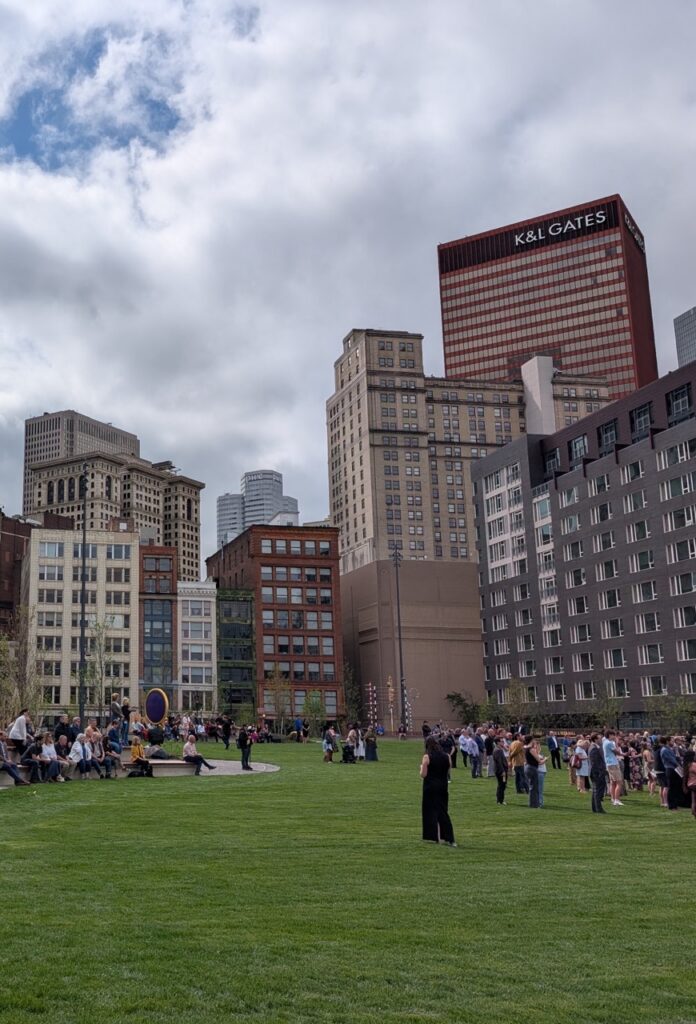
James spoke about Arts Landing, a four-acre downtown project that will merge performance and gathering spaces (including the first playground in Downtown Pittsburgh!) offering a pulse of public life in an area often quiet after dark. It is, she said, a vision of the arts as civic infrastructure, a place where daily life and creative life meet. 

A man sits on a staircase with his hands on his knees.
Justin Matase, TABLE Magazine

From there, the conversation moved toward a broader sense of orientation. Several participants reflected on the need to “make a map” to understand where the city’s creative community has been, where it stands now, and who has yet to be included in that picture. Wormsley added that such a map must be drawn with care, acknowledging histories of exclusion as part of the process of imagining what comes next. To chart the future requires an honest reckoning with the past and present. 

The group also emphasized the importance of transparency, of understanding where the gaps lie in arts education, access, and space. Only through that clarity can Pittsburgh begin to strengthen its creative infrastructure in full. 

A woman in a black dress and short brown hair leans against a wall.
Nicole Henninger, The Pittsburgh Foundation

And if mapping implies movement, Nicole Henninger reminded the group that progress also depends on nurturing the dreamers themselves. The sustainability of the city’s creative life, she noted, hinges on supporting artists not only as producers of culture but as people who are essential to the city’s civic imagination. 

A Call to Show Up 

As coffee cooled and the hour stretched late, the group circled back to a shared question: how can those who care about art—patrons, neighbors, readers—translate admiration into action? 

Leo Hsu offered a profoundly simple answer. “Show up,” he said. “Bring a friend. If you go somewhere, go back. Create a relationship.” 

A man leans his arm on a railing and looks over it.
Leo Hsu, Silver Eye Center for Photography

Luckett encouraged curiosity. “Do something new,” she said. “Step into an unfamiliar space.” 

Henninger reminded everyone that creativity belongs to all. “You’re already creative,” she said. “Keep going. That’s part of supporting the arts, too.” 

Rossero added a practical challenge for patrons: “Support the production, not just the product.” 

Recker, looking around the table, brought the group back to his initial invitation. “Take a risk,” he said. “Be bold.” 

Gold plate place settings with white dessert plates on top of them.

Chairs shifted. No one hurried to leave. Around the table—artists, curators, and cultural stewards who so often move in separate orbits—there was a rare sense of unity, a recognition that art’s survival depends on the courage to imagine together. 

As the final cups were cleared and conversation softened, Recker raised one last toast that lingered long after the candles thinned to smoke: “Great art tells the truth—and that’s something we could all use more of.” 

Three men talk together.

Participants  

Story by Shawn Simmons 
Photography by Shikeith, assisted by Mathias Rushin

Venue and Catering by The Mansions on Fifth 
Dinner Sponsored by Nancy and Michael Murphy 

Subscribe to TABLE Magazine’s print edition.
The International Sculpture Center Finds a New Home in Pittsburgh

0
Scraps of various knit squares hang on a wall.

When the International Sculpture Center (ISC) chose Pittsburgh as its new home, the decision reflected an affinity already written into the city’s cultural fabric. Long shaped by cycles of industrial production and reinvention, the city has increasingly become a place where cultural institutions test new models of engagement, ones that acknowledge history without being bound by it. For the ISC, founded in 1960, Pittsburgh offered something particularly compelling: an arts ecosystem where experimentation and collaboration are already central to how cultural work gets done. 

Lawrenceville Embraces the International Sculpture Center’s Pittsburgh Move

The ISC’s new home in Lawrenceville marks a shift in how the organization imagines its role. Most recently based at Grounds for Sculpture in Hamilton, New Jersey, the Center has long operated through partnerships rather than a single, sustained exhibition venue. “Partnering is second nature to us,” says Executive Director Johannah Hutchison, noting that the organization has always functioned through collaboration, even when it lacked a permanent public venue. The Pittsburgh space gives that ethos a physical home, positioning the ISC as both convener and connector within the city’s cultural landscape. 

That orientation is evident in the way the Center introduces itself to Pittsburgh. The ISC’s inaugural exhibition, SOFT Launch, was a member exhibition focused on fiber-based and soft sculpture works, exploring themes of comfort, tactility, memory, and resistance. The exhibition closed in tandem with the grand opening of the Lawrenceville space, which also debuted the Welcome Blanket Project, a participatory workspace inviting the public to contribute handmade blankets for refugees and immigrants to the United States. Together, the two projects established a shared emphasis on material knowledge and collective making as foundational values of the new space. 

A white tag hangs from a knit object on a wall.

More on the Welcome Blanket Project

Rooted in textile traditions often sidelined within dominant sculptural narratives, Welcome Blanket frames sculpture as something relational and accumulative rather than monumental. Softness, here, is a political proposition; Hutchison emphasizes sculpture’s capacity to create accessible entry points for complex conversations. In the Welcome Blanket workspace, participants contribute at their own scale—sometimes a single knitted square, sometimes a stitched panel, sometimes something much larger. Hutchison recalls being particularly moved by a young girl. She stopped in and without prior experience made a 40-by-40-inch quilt. The gallery, in these moments, functions less as a site of display than as an active workspace where art unfolds through participation. 

Founded in 2017 by Jayna Zweiman, the Welcome Blanket Project began as a response to the proposed U.S.–Mexico border wall, translating its 2,000-mile length into an equivalent expanse of handmade blankets. The initiative quickly exceeded that goal, evolving into an international network of makers who pair textiles with personal stories of migration and relocation. In its current iteration at the ISC, the project highlights how sculpture can act as a support structure, offering literal warmth while prompting sustained conversation about immigration policy and national identity. 

Accessibility and Expansion

This expanded understanding of sculpture aligns closely with the ISC’s broader mission. Known internationally for Sculpture Magazine and for maintaining one of the most extensive physical archives of contemporary sculpture, the organization has long used its hallmark annual conference as a way to take the field’s pulse. “If you come in and see something you don’t think is sculpture,” Hutchison says, “let’s talk about that.” The Pittsburgh space extends that spirit of inquiry year-round, encouraging discomfort and debate. 

The relocation also reflects the particular strengths of Pittsburgh’s arts ecosystem. Universities, museums, artist residencies, and craft networks exist here in close proximity, fostering cross-disciplinary exchange. The ISC plans to engage that landscape through a dual programming model: virtual initiatives that serve its more than 4,000 global members, alongside in-person exhibitions, workshops, and public programs aimed at local audiences. A new Member Residency program will further anchor the organization in place, inviting artists to spend time in Pittsburgh while contributing to the Center’s evolving conversations. 

Knit square pieces of various colors stacked on top of each other with tags hanging from them.

Opportunity for Free Thinking

Crucially, the Lawrenceville gallery is non-commercial. Freed from market pressures, projects are able to unfold slowly, prioritizing dialogue and durability over spectacle. Hutchison traces her own connection to the city back to a 2012 visit, when she first imagined Pittsburgh as a possible future home for the ISC. More than a decade later, that vision has taken shape—not as a declaration of what sculpture must be, but as an open invitation to rethink what it can do, who it can reach, and how it can circulate in the world. 

The ISC’s arrival in Pittsburgh does not present a definitive vision of sculpture’s future. What it offers instead is a space for testing and collectivity, a space that understands relevance as something built over time, stitch by stitch. 

The International Sculpture Center is located at 5126 Butler Street in Lawrenceville, Pittsburgh. The Welcome Blanket Project runs through March 5, 2026. 

Story by Shawn Simmons
Photos Courtesy of The International Sculpture Center

Subscribe to TABLE Magazine’s print edition.

Blackberry Penicillin

0
Blackberry Penicillin with cherry garnish and greenery in the background

Crafted for the modern drinker by Chef Richard Sandoval, this zero-proof, 1970’s inspired mocktail from the Art of Zero-Proof collection confidently steps beyond simple fruit mixes. This sophisticated drink is a direct descendant of the modern classics that inspired it: the fruity Bramble and the medicinal Penicillin. The Blackberry Penicillin masterfully blends the smoky depth of lapsang souchong tea with the bold spice of a ginger-honey shrub. Plus, it includes Lyre’s N/A bourbon. It is finished with a lush blackberry swirl. Thus, it delivers a multi-layered sip that redefines what a spirit-free drink can be.

Ready to shake up your Dry January? Discover more refined, non-alcoholic creations like the Blackberry Penicillin here!

Print
clock clock iconcutlery cutlery iconflag flag iconfolder folder iconinstagram instagram iconpinterest pinterest iconfacebook facebook iconprint print iconsquares squares iconheart heart iconheart solid heart solid icon
Blackberry Penicillin with cherry garnish and greenery in the background

Blackberry Penicillin


  • Author: Richard Sandoval

Description

A non-alcoholic tribute to the Bramble and Penicillin, featuring smoky lapsang souchong tea, ginger, and blackberry.


Ingredients

Scale
  • 1.5 oz Lyre’s N/A Bourbon
  • 1 oz lapsang souchong (black tea) concentrate
  • 1 oz ginger and honey shrub
  • 0.5 lemon juice
  • 0.5 oz Ghia Berry Apéritif
  • Coconut flakes
  • 3 bar spoon blackberry jam
  • Crushed ice


Instructions

  1. In a shaker, add Lyre’s Bourbon with ginger and honey shrub, and lemon juice. Add ice and shake.
  2. Strain into a double Rocks glass and add crushed ice.
  3. Finish by pouring the blackberry jam and berry aperitif over the ice and mixing.
  4. Garnish with blackberry jam & coconut flakes.

Recipe by Chef Richard Sandoval
Photography Courtesy of Richard Sandoval Hospitality

Subscribe to TABLE Magazine’s print edition.
Tomayko Foundation Features Jacob Pesci as Inaugural Award Winner 

0
A landscape with clothes handing from clothes lines and sheds in the background.

The Tomayko Foundation in Pittsburgh has named photographer Jacob Pesci as the recipient of its inaugural 2024 Tomayko Award, marking a significant milestone for both the foundation and the Pittsburgh-based artist. The award recognizes Pesci’s compelling photographic practice and supports his solo exhibition, Divine Appointments, which runs through January 16, 2026, at the foundation’s Liberty Avenue gallery. 

A man stands in front of his exhibition in the tomayko foundation gallery.

Photographer Jacob Pesci’s Solo Exhibition at Tomayko Foundation

The inaugural award establishes the foundation as an emerging force in the region’s vibrant arts ecosystem. 

Founded on principles of artistic excellence and community investment, the Tomayko Foundation operates through juried and guest curation processes designed to promote the highest quality of contemporary work. The foundation maintains an apolitical approach while demonstrating a commitment to supporting individual artists and strengthening Pittsburgh’s cultural infrastructure through partnerships with local universities including Point Park and Carnegie Mellon University. 

Two photos in white frames hang side by side on a gallery white wall.

Implementing a New Honor

“The Tomayko Award is the Foundation’s signature award, and we are so excited to be able to support Jacob through the award and a solo exhibition,” says Nina Friedman, Director of the Tomayko Foundation. “As this is our first time administering the award, we are even more excited about the prospect of how this program will impact our artist community going forward. We hope to continue to support artists like Jacob well into the future.” 

Pesci’s winning project documents a transformative six-week, 10,000-mile solo journey across the United States undertaken in Spring 2025. The resulting exhibition features thirty one photographs that place him firmly within the lineage of American road trip photography—a tradition pioneered by Robert Frank’s The Americans and continued through the work of artists like Stephen Shore and Alec Soth. 

This genre has long served as a mirror to the nation’s soul, capturing both the mythic landscape and the complex realities of American life. Pesci’s contribution to this tradition is deeply personal, informed by his military service in California where he was immersed in what he describes as a culture of hyper-vigilance and extremism. 

A broken down house with a bird flying in front of it.

Through the Lens of Photography

Photography has become Pesci’s tool for dismantling the rigid systems embedded within him during military service, allowing him to rebuild through curiosity, grace, and understanding. Divine Appointments captures politically charged sites—military bases, oil refineries, the border wall in El Paso, TX—alongside quieter moments: highway overpasses, cemeteries, intimate portraits of families and friendships.  

His travels through small towns, Native American reservations, and desert landscapes are punctuated by what he calls “divine appointments,” spiritually significant encounters that signal possibility for transformation. The exhibition embodies Pesci’s attempt to document (and reconcile) both the divisions characterizing contemporary American culture and the loving connections that persist within communities.  

A limited edition artist book accompanies the exhibition, offering Pittsburgh audiences an opportunity to witness both the launch of a significant new award and a powerful body of work that reflects today’s America. 

The award continues with Brynda Glazier announced as the 2025 winner and art enthusiasts will be able to enjoy her solo show at the gallery in December 2026. 

Story by Samantha Leon
Photos Courtesy of Tomayko Foundation

Subscribe to TABLE Magazine‘s print edition.

Multicultural Cuisine Shapes the Restaurant Industry of Pittsburgh in 2026

0
Plates of soup dumplings on a restaurant table with sauces around them too.

Pittsburgh’s food scene has always reflected the city’s immigrant roots. Once largely continental European, it’s now increasingly global and hyper-specific. In 2026, Pittsburgh diners are discovering not just Mexican food, but Oaxacan molotes and tlayudas; not just Chinese cuisine, but Shanghainese creations; not just the typical European fare, but Nordic seafood and Hungarian-Austrian dishes.  

The Multicultural Restaurants Taking Over Pittsburgh’s Food Industry in 2026

This hyper-regional specificity—driven by recent immigration and a generation of chefs eager to tell more authentic, personal stories—is deliciously rewriting Pittsburgh’s food identity while honoring its historic role as a city built by newcomers seeking opportunity. 

Recently Opened and Upcoming Globally-Derived Spots 

In SouthSide Works, Nan Xiang Xiao Long Bao brings Michelin-guide-recognized Southern Chinese soup dumplings to a neighborhood already known for its diverse Asian dining scene. While Mike Chen’s team behind Everyday Noodles opened a Shanghainese concept on Forbes Avenue in Squirrel Hill.  

A plate of chicken in between a glass of wine and restaurant menu.
Photo Courtesy of Titusz

Lawrenceville’s highly anticipated Titusz will offer Hungarian-Austrian cuisine as a tribute to chef-owner’s grandmother. Meanwhile, Mr. Friez is putting a Belgian spin on one of Pittsburgh’s most iconic foods—the french fry—proving that even familiar items can be reimagined through a specific cultural lens. Filipino cuisine is carving out a spot with Amboy Filipino Restaurant opening on the North Side, while Chef Julio Peraza’s Torogoz brings contemporary Latin American fare to Sewickley.  

A table full of mediterranean food on various sizes of plates.
Photo Courtesy of ELIA

Downtown’s ELIA will add to a growing Mediterranean presence, while Shibam Coffee offers Yemeni coffee traditions, and Piyola’s authentic Uzbek menu expands Pittsburgh’s understanding of Central Asian cuisine with continued strong reviews since its 2024 debut. The thread connecting these diverse restaurants is their refusal to generalize—each offers a deep dive into a specific culinary tradition rather than a broad-strokes approach to international cuisine. 

Stands, Trucks, and Pop-Ups in Pittsburgh Serve as Pipeline to Full Service, Awards 

Stands, food trucks and pop-ups allow chefs to test concepts with lower overhead while building community followings through social media and word-of-mouth—a strategy that often leads to permanent locations.  

A breakfast sandwich and egg sits on a plate beside a cup of coffee on a small plate.
Photo Courtesy of Colombino

One of our favorites is Colombino, which has moved from The Strip District to a permanent location in Lawrencville and represents yet another layer of South American specificity with its distinctly-Colombian sips and bites.  

More notable food trucks include Gari Shoyu Sando Co., serving Japanese milk bread sandwiches that showcase its signature soft, pillowy texture, while Sahar’s Food Lab explores Middle Eastern and North African flavors—both of which you can track on Instagram.  

Big players once had humble beginnings, too. Bloomfield’s Fet-Fisk (which originally started as a pop-up dinner series in 2019) was named one of ten finalists nationally for Best New Restaurant by the James Beard Foundation in 2025 for its innovative Scandinavian-inspired cuisine.  

A chef squeezes juice into sliced red cabbage.
Photo Courtesy of Fet-Fisk

Sustained growth and accolades underscore Pittsburgh’s evolution from a “meat-and-potatoes” town into a destination where specificity, authenticity, and innovation coexist. The city’s restaurant scene is no longer asking diners to settle for approximations—it’s offering the real thing. 

Story by Samantha Leon
Featured Photo Courtesy of Nan Xiang Xiao Long Bao

Subscribe to TABLE Magazine’s print edition.
Smoked Old Fashioned

0
Smoked Old Fashioned with cherry garnish and greenery in the background

For Dry January—or any month—we’re featuring a no-alcohol cocktail that proves zero-proof doesn’t mean zero complexity. The Smoked Old Fashioned from Chef Richard Sandoval’s Art of Zero-Proof collection honors the original’s 1850s roots. It introduces a new layer of craft. With N/A bourbon, homemade bitters, and a final aromatic veil of smoke, it’s a ritual in a glass. It’s proof that the craft of cocktail making thrives, with or without the alcohol.

If you are intrigued by the Smoked Old Fashioned, click here to find more Dry January Mocktail recipes!

Print
clock clock iconcutlery cutlery iconflag flag iconfolder folder iconinstagram instagram iconpinterest pinterest iconfacebook facebook iconprint print iconsquares squares iconheart heart iconheart solid heart solid icon
Smoked Old Fashioned with cherry garnish and greenery in the background

Smoked Old Fashioned Mocktail


  • Author: Richard Sandoval

Description

We’re replacing whiskey with Lyre’s N/A bourbon and adding a whisper of agave and vanilla.


Ingredients

Scale
  • 2 oz Lyre’s N/A Bourbon (or another NonAlcoholic Bourbon)
  • 0.25 oz agave
  • ½ tsp vanilla essence
  • 4 dash non-alcoholic aromatic bitters
  • Fresh orange peel
  • Peel of grapefruit
  • Cherry
  • Smoke
  • Large format ice


Instructions

  1. In a mixing glass, add all the ingredients except the orange peel and stir with a spoon (without ice).
  2. Strain into a double rocks glass and add a large ice cube.
  3. Zest drink and rim with orange peel.
  4. Garnish with grapefruit peel and cherry.
  5. Finally, smoke the cocktail on the table or bar.

Recipe by Chef Richard Sandoval
Photography Courtesy of Richard Sandoval Hospitality

Subscribe to TABLE Magazine’s print edition.
15 Mocktail Recipes That Prove Dry January Can Be Delicious Too

0
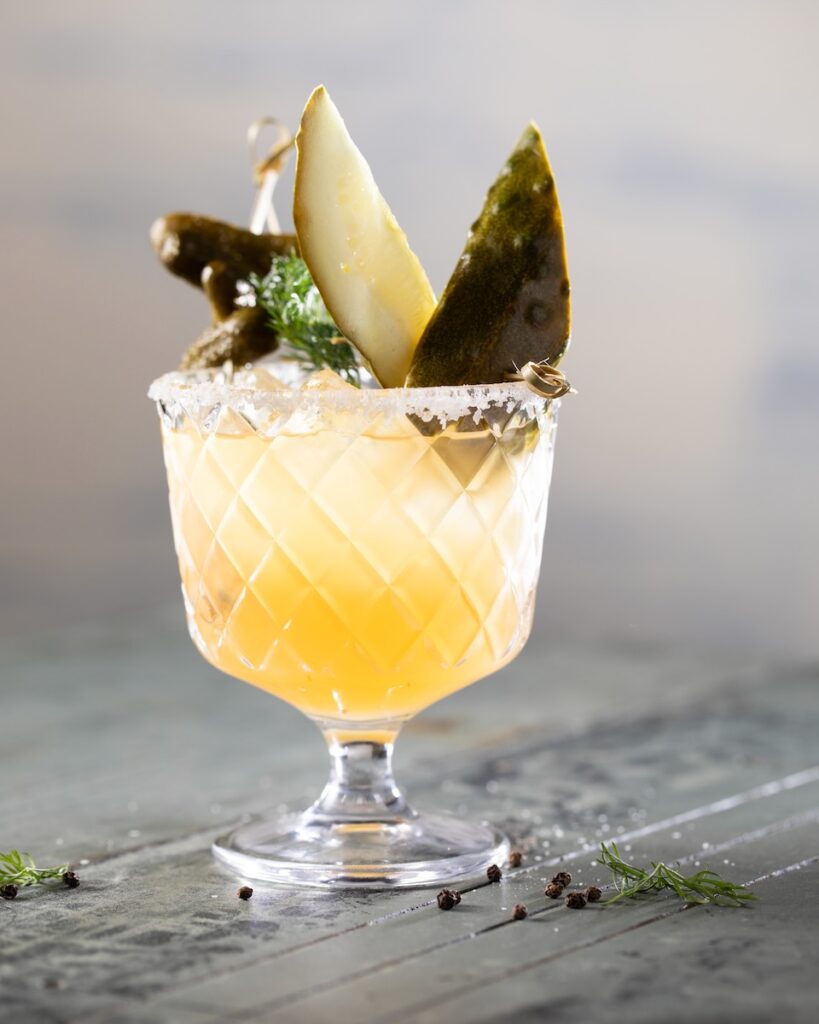
Lowball glass with a pickleback mocktail inside topped with pickle spears and kosher salt on the rim as it sits on a grey table.

In Dry January we’re mixing up some of our favorite drinks for a kickstart to the month! Mocktails don’t have to be basic mixes of fruit juice and soda: they can push the limits and incorporate flavors you’d find in a deluxe craft cocktail, but without the alcohol. For instance, why settle for a glass of cranberry juice when you can have a take on a martini with non-alcoholic spirits and fruity simple syrups? Take the first step in your creative mocktail process with the recipes below and then you’ll learn how to customize and craft your own. 

Mocktail Recipes for Dry January

Peach Basil Bellini Cocktail and Mocktail

A champagne flute with a peach cocktail garnished with a green basil leaf on a white surface with a champagne cork, basil leaves, and peach and orange flower petals for styling.

This Peach Basil Bellini Mocktail utilizes the delicate aroma of a homemade peach puree base with the balanced sweet and savory flavor of basil simple syrup for an overall sensation of comfort and welcome. Its mellow flavor and warm appearance are served in a champagne flute topped with your favorite sparkling, non-alcoholic white wine for a touch of classic elegance.

Wildberry Sparkler Mocktail

Wildberry Sparkler: A Refreshing Mocktail red in color, sits in a glass filled with berries and garnished with lemon.

Muddled berries form a flavorful explosion of fresh fruit in this Wildberry Sparkler Mocktail. The addition of lemon juice to this naturally sweet sip adds the perfect amount of tartness. This bubbly delight will not disappoint. 

Lavender Kombucha Mystic Mocktail

Finding creative ways to make drinks for those who are abstaining from alcohol might feel challenging. But using prepared beverages like kombucha, with interesting additions like the Mystic Mixture cordial, helps to take the guesswork out of the “mixology.” The zing of lemon, the tang of kombucha, and blueberries make this mocktail taste like a dream…and it’s great for you!

Spicy Orange NA-rgarita

A white man's arm and hand holds a Spicy Orange NA-rgarita (a Margarita Mocktail) on a black filled with mocktail mixing supplies.

Don’t feel like you have to miss out on the taste just because you’re opting for a mocktail. The Spicy Orange NA-rgarita is a margarita sans tequila but still carries an equal amount of flavor and liveliness thanks to spicy agave syrup made from jalapenos and agave nectar. 

Piña NO-lada

A piña colada mocktail, white in color, sits in a stemless wine glass next to a glass pitcher of the mixed drink.

Who doesn’t love sipping a Piña NO-lada by the beach? Coconut and pineapple are the stars of this tropical paradise in a glass. Learn how to make your own piña colada mix and muscovado syrup for a genuine handcrafted mocktail. Plus you get to garnish the drink with a cherry on top!

Tangy Lemon Ginger Shrub: Cocktail or Mocktail

A lemon ginger shrub cocktail sits in a triangle glass, the liquid is light yellow in color. Behind the drink are three oranges on a cloth napkin.

Citrus fruits are at their peak in winter, and their sunny tang does a body good. So does the bite of vinegar and the heat of ginger. They all come together in this easy and delicious Lemon Ginger Shrub. Just use sparkling water instead of sparkling wine for an elegant and refreshing mocktail. 

Dragonfruit Marti-NO

A martini mocktail light orange-y/pink in color sits in a martini glass next to sliced dragonfruit.

This martini mocktail utilizes dragon fruit — which is high in fiber, a good source of magnesium, and is packed with nutrients — resulting in a drink that not only tastes good but is also good for you. Leftover homemade dragon fruit and passion fruit simple syrups can be saved for future mocktail nights. 

Watermelon-Cucumber NO-jito

A white man's hand hold a bottle of ginger beer as it sits on a black table. Next to the soda sits a mojito mocktail orange in color.

Craving the tingly thirst-quenching goodness of a mojito? This Watermelon-Cucumber NO-jito uses slices of oh-so-fresh watermelon and cucumber. Add in your favorite non-alcoholic spirit, ginger beer, and lime juice to complete this crisp and vibrant beverage. 

Bloody Beet Red Mocktail

A blood beet red mocktail sits in a tall glass with black salt on the rim and a skull sitting in the background.

We’re swapping the classic Bloody Mary for something a bit more health-forward. Juicy beet and blood orange juices give this mocktail its deep ruby hue and an earthy, sweet flavor. We balance it all out with fresh lime, a touch of agave, and a coarse pink salt rim. This recipe was made with Halloween in mind, but rest assured that it’s good all year long.

Partridge in a Pear Tree Christmas Mocktail

An orange mocktail garnished with pear sits on a black bar cart, looking inviting and delicious

Regardless of this mocktail’s inspiration from the 12 Days of Christmas, it’s still a delicious mocktail for pear lovers any time of year. Crisp pear juice meets lime and a subtle touch of vanilla along with a non-alcoholic dark rum alternative and ginger beer.

Chateau Lobby #4 Mocktail

Two glasses sit on slabs of marble with deep red liquid at the bottom and topped with a red edible flower to represent the Chateau Lobby #4 Valentine's Day mocktail.

Tart cherry juice, zesty lemon, and a hint of fresh ginger match with a homemade vanilla honey syrup for a mix of sweet and tangy. Top it all with your favorite sparkling soda, kombucha, or probiotic drink to make this mocktail truly your own.

In the Butterfly Garden, a Mother’s Day  Gin and Tonic Mocktail

A coupe glass with a purple Mother's Day Gin and Tonic mocktail with crushed freeze-dried blueberries on the side and an edible pink butterfly on the rim. White flowers are scattered nearby.

This Gin and Tonic Mocktail is for more than just mothers! Pick our your favorite non-alcoholic gin alternative before mixing with lemon and tonic. A hint of butterfly pea flower syrup adds subtle floral notes as well as a beautiful color that make this feel far from your average mocktail.

Pickleback Mocktail

Lowball glass with a pickleback mocktail inside topped with pickle spears and kosher salt on the rim as it sits on a grey table.

Even though you may not be drinking this month doesn’t mean you can’t enjoy the simple deliciousness of a Pickleback. All you need to do is find your favorite non-alcoholic whiskey alternative, add in pickle juice of your choice, and finish with lime juice and simple syrup. All the fun of the Pickleback shot without the pain after.

S’mores Old Fashioned Mocktail

A short glass holds a S'mores Old Fashioned Mocktail featuring a skewer of toasted marshmallows on top and a rim of brown sugar.

This cozy, alcohol-free take on an Old Fashioned leans into rich, toasty flavors without feeling as heavy. We’re infusing notes of chocolate and toasted marshmallow with the depth of a non-alcoholic bourbon alternative. The finished product is a smooth, slightly smoky sip.

Healthy Mocktail Shots

4 glasses of different sizes almost filled with green, red, and orange-colored healthy shots. Best Mocktail Recipes

These Healthy Mocktail Shots offer a fun way to enjoy alcohol‑free drinks in small portions. Choose from a mix of nutrient‑rich ingredients like fresh greens, ginger, turmeric, and fruit juices. Each is bright, refreshing, and good for you too. Sip them on their own or serve all four as an edible rainbow.

Story by Kylie Thomas

Subscribe to TABLE Magazine’s print edition.
8 Pasta Recipes to Avoid the Grocery Store Inflation of 2026

0
A bowl of BLT pasta with golden spaghetti, bacon pieces, red and yellow halved cherry tomatoes, and fresh green basil leaves.

Feeling the pinch at the grocery store? With prices on the rise in 2026, finding meals that are both satisfying and budget-friendly can feel like a challenge. Pasta comes to the rescue. It’s versatile, filling, and pairs beautifully with simple, affordable ingredients. Not to mention, it’s one of the ingredients that is unlikely to face price inflation in 2026. Instead, it’s easy to make in bulk, simple to store, and has a long shelf life. We’re recommending eight delicious pasta recipes that allow you to still enjoy comforting and flavorful dinners without breaking the bank.

Pasta Recipes to Save Yourself from Grocery Inflation in 2026

Martha Stewart-Inspired One Pan Pasta

In a skillet pan sits a large servings of pasta with tomatoes, basil, and cheese on top. It all sits on a picnic table with forks and a small container of parmesan underneath the pan.

A simple, flavorful pasta made entirely in one pan. Inspired by Martha Stewart, this dish simmers pasta with tomatoes, garlic, onion, and basil to create a light, silky sauce with minimal effort and cleanup. Perfect for weeknights.

Bigoli in Salsa

A plate of whole-wheat spaghetti (bigoli in salsa) on a striped placemat.

This classic Venetian pasta that pairs whole-wheat bigoli with a savory sauce of slow cooked onions and rich sardines or anchovies. You can even use canned fish in this recipe which adds another layer for money-saving deliciousness.

Fettuccine Alfredo

A black dish filled with Fettucine Aldredo made by Victoria Sande.

Everyone needs to have a Fettuccine Alfredo recipe on hand. This particular recipe adds aromatic green onion and a hint of peperoncino for deeper flavor. It’s smooth, comforting, and far from ordinary.

BLT Pasta

A bowl of BLT pasta with golden spaghetti, bacon pieces, red and yellow halved cherry tomatoes, and fresh green basil leaves.

What if you could make your favorite sandwich into a pasta dish? This pasta captures all the best parts of a BLT like the crunch of bacon, juicy grape tomatoes, and fresh greens. We also toss it with cream and olive oil, turning everyday ingredients into a hearty meal.

Easy Pesto Pasta

A plate full of Easy Pesto Pasta with sausage, lemon slices, and asparagus all in a green sauce.

Make the most of herbaceous pesto by adding in savory Italian sausage, farm-fresh asparagus, and toasted pine nuts. A squeeze of lemon and a touch of cheese elevate these ingredients to luxury.

Bolognese Sauce (Ragù)

A plate of flat-noodle wide pasta with a meat bolognese ragu sauce on top, all sitting on a green plate.

Rather than buying sauce at the store, making your own is rewarding and endows you with plenty of leftovers for other days. All this sauce takes is ground beef, vegetables, wine, milk, and tomatoes to build layers of big flavor that put modest amounts of ground beef to great use.

Heirloom Tomato Tripoline

An above shot of a white plate that holds pasta, Heirloom Tomato Tripoline

An impressive pasta relies on simplicity rather than splurging. Heirloom tomatoes in butter and basil coat tender tripoline. This recipe is perfect for delivering deep flavor from just a few inexpensive ingredients.

Stanley Tucci Inspired Rigatoni with Salsiccia alla Maria Rosa

A plate of rigatoni with tomato sauce, inspired by Stanley Tucci

A rigatoni dish inspired by Stanley Tucci’s passion for Italian cuisine features spicy Italian sausage and a rich Maria Rosa tomato sauce. Every bite interacts with elements of freshness, making it a comforting yet sophisticated at the same time.

Save Your Dollars in 2026 with These Easy Canned Fish Recipes

8 Chicken Recipes to Help Keep Dinner Affordable in 2026

Budget-Friendly Bean Recipes to Save Money During 2026’s Inflation

Story by Kylie Thomas

Subscribe to TABLE Magazine‘s print edition.

Budget-Friendly Bean Recipes to Save Money During 2026’s Inflation

0
A blue bowl holdsbraised cabbage and beans topped with a lemon slice and accompanied by a fork, spoon, and glass of lemon water.

As grocery prices continue to rise in 2026, finding affordable, nutritious meals has never been more important. Beans are a versatile, protein-packed pantry staple that can stretch your budget without sacrificing flavor. These easy and delicious bean recipes help you save money while keeping mealtime as something you look forward to.

Budget-Friendly Bean Recipes

Crispy Butter Beans with Whipped Chevre

Crispy Butter Beans with Whipped Chèvre - a delectable side dish featuring Goat Rodeo’s fresh chèvre cheese

Golden, crunchy butter beans are roasted to perfection and served alongside a smooth, tangy whipped chèvre. This easy recipe transforms boring butter beans into something you’ll want to serve for a Sunday family meal.

Braised Cabbage and Beans

A blue bowl holdsbraised cabbage and beans topped with a lemon slice and accompanied by a fork, spoon, and glass of lemon water.

Cook up a one‑pot dish that transforms humble cabbage and beans into a deeply comforting meal you’ll crave on chilly nights. Tender cabbage simmers slowly with beans, onions, garlic, and a bright squeeze of lemon.

Steaming Pot of Beans and Greens

A large bowl of steaming white beans and chopped kale stew garnished with carrots and tomatoes, served with crusty bread/garlic knots and a side salad on a green wooden table.

Hearty cannellini beans and tender kale bathe in a bowl of garlic, carrots, sage, roasted tomatoes, and lemon. Try finishing your bowl with a sprinkle of Parmesan, lemon zest, and a drizzle of olive oil along with a side of crusty bread.

Stanley Tucci Inspired Cannellini Beans and Greens alla Maria Rosa

A Stanley Tucci inspired beans and greens recipe on a bright green background

We’re always finding new ways to use beans. We like to change up the flavors so that we can feast on this ingredient several days a week. This plant‑forward Italian dish pairs cannellini beans with Maria Rosa sauce and wilted Tuscan kale.

Wintertime Rice and Beans

Wintertime Rice and Beans served in a steel bowl

Hearty rice and two kinds of beans intermingle with warming Vindaloo curry spice, star anise, and a touch of saffron to create a bowl that’s perfect for cold days. Simple to make yet full of global flair, this dish takes classic rice and beans to new heights.

Giant Beans with Honey and Dill

On a white plate sits a mound of GIANT BEANS WITH HONEY AND DILL.

If you’ve never tried Greek giant beans, you’re missing out. These beans roast in a tomato-onion sauce with notes of honey and fresh dill. While this can make a quick lunch, try it along with a main dish like chicken for low-cost, big-reward.

Roasted Acorn Squash with Lemony Pinto Beans and Zhoug

A side dish of Roasted Acorn Squash with Lemony Pinto Beans and Zhoug in an orange bowl. A gold spoon sits to the left. Zhoug Recipe

This dish brings together sweet, caramelized acorn squash and lemon pinto beans with a punchy zhoug sauce for a finish that’s bold and balanced. Not to mention, the protein and other health benefits from this dish are a must.

Save Your Dollars in 2026 with These Easy Canned Fish Recipes

8 Pasta Recipes to Avoid the Grocery Store Inflation of 2026

8 Chicken Recipes to Help Keep Dinner Affordable in 2026

Story by Kylie Thomas

Subscribe to TABLE Magazine’s print edition.