Each November, a Roman nativity, the Pittsburgh Crèche takes its place at the foot of the U.S. Steel Tower. How it got there is a story of an architect, a pope, the courts, and a crew of union carpenters.
Pittsburgh leans deep into holiday lights and festivities. Light Up Night brings crowds and sparkle to Downtown. PPG Place welcomes skaters. Peoples Gas Holiday Market attracts shoppers. But it’s a stable roughly four stories tall standing at 600 Grant Street, with Mary and Joseph inside, that comes closest to observing the reason we celebrate in the first place.
That stable is the Pittsburgh Crèche. It is the only sanctioned copy of the nativity created for the Vatican, and it goes up each year thanks in large part to apprentices of the Eastern Atlantic States Regional Council of Carpenters (EASRCC), who have assembled and cared for it for over 25 years.
The Pittsburgh Crèche Brings the Vatican’s Manager to the City
Having lived in Italy, I know how seriously Italians take the presepe. Families build them at home. Every parish sets one up in a corner of their church, and welcomes visitors who want to see it. In Naples, an entire street is given over to the making of artisanal figurines to populate equally handmade miniature buildings meant to resemble towns Jesus might have known, but somehow look exactly like villages throughout Italy. So it makes sense that the idea for Pittsburgh’s crèche was born in Rome.
In 1993, architect Lou Astorino, head of L.D. Astorino Companies, stood in St. Peter’s Square in front of the Vatican nativity and couldn’t forget the impression it made. He came home wanting one just like it for Pittsburgh.
Astorino had the connections to make that happen. He designed a chapel in Vatican City for St. John Paul II. It is a space where cardinals pray when a conclave gathers to elect a pope. No other American is credited with designing a building in Vatican City. It didn’t take Astorino long to get things organized.
Out of the Courthouse, Onto the Plaza
Pittsburgh’s earlier nativities had a complicated legal life. In 1989, the U.S. Supreme Court decided County of Allegheny v. ACLU, finding that a crèche inside the Allegheny County Courthouse crossed the line between church and state. A few years later, a smaller nativity on city property came down after another such ruling.
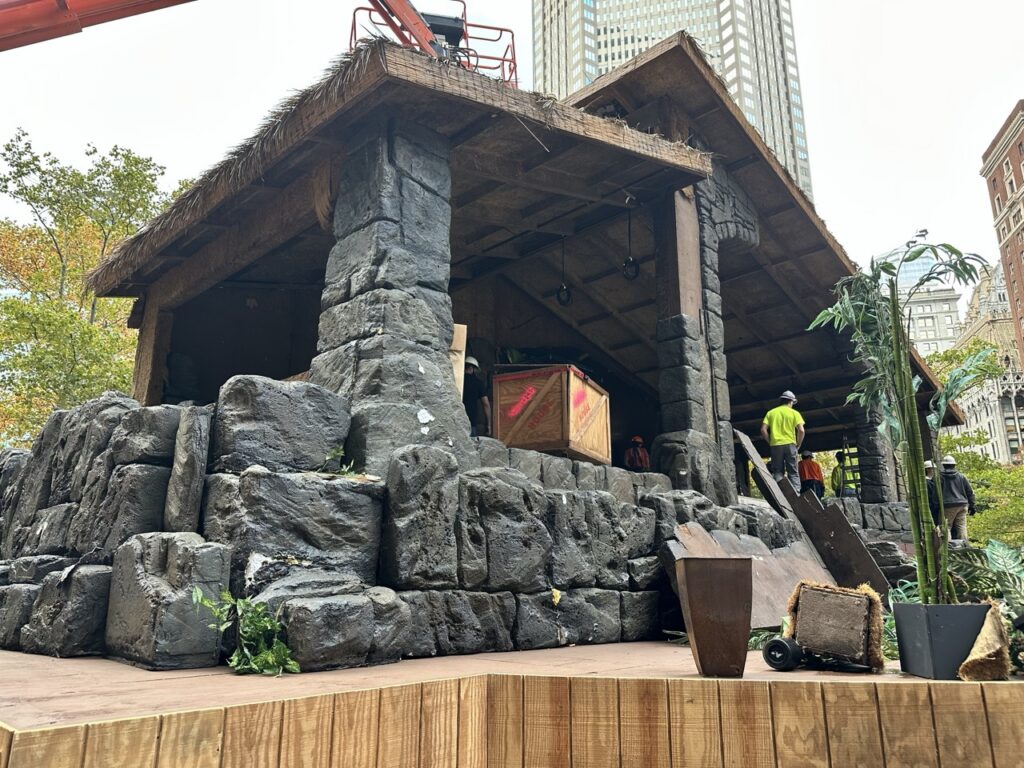
A new spot, and a new crèche, needed to be found. When the U.S. Steel Tower’s managers offered their privately owned plaza, the city’s manger had a high visible home that would satisfy the courts.
Rome, meanwhile, said yes to Astorino. Vatican architect Pietro Simonelli drew the plans and commissioned the first ten figures (though over the years the cast has doubled to 20 figures). At its installation in 1999, it was the biggest crèche of its type in the United States, boasting some 66,000 pounds of structure and statuary.
The Diocese of Pittsburgh owns it. The Christian Leaders Fellowship, an ecumenical group, sponsors it. Since 2006, an endowment through the Pittsburgh Foundation helps pay for its upkeep. Though the Vatican now presents a new nativity every year, each from a different country or region, Pittsburgh has held on to the tradition that Astorino fell in love with.
The Builders
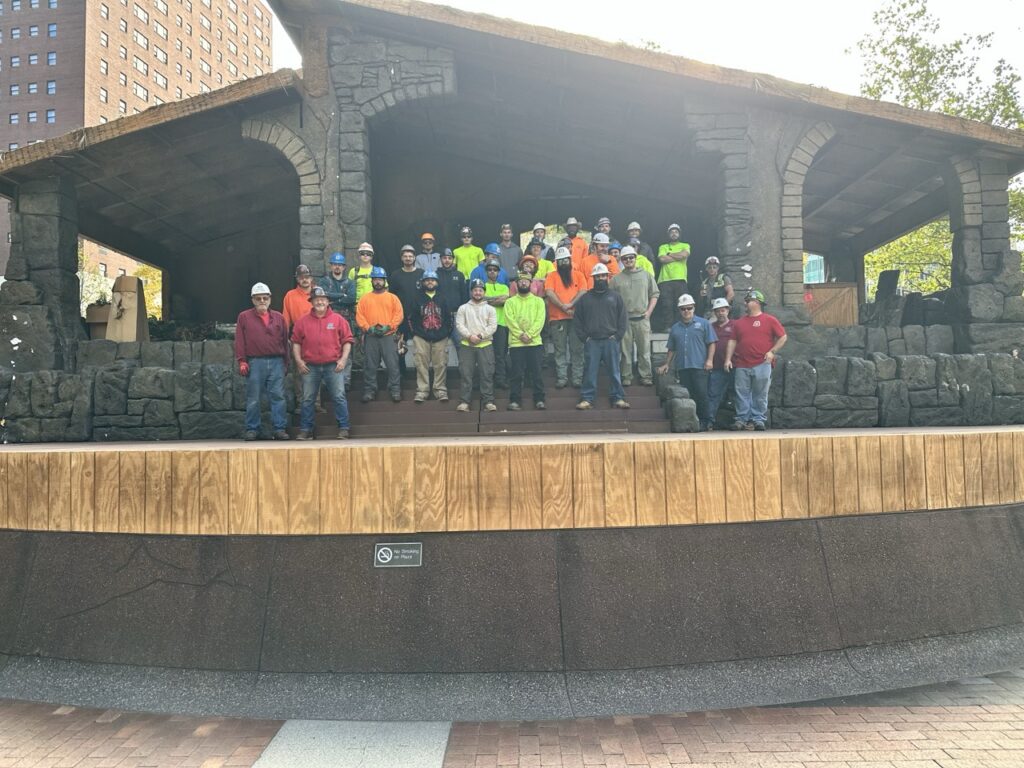
Plans from Rome are one thing. Replicating them on Grant Street every November is another, and that job belongs largely to the carpenters’ union.
For the EASRCC, the crèche is part of the training curriculum. Apprentices frame, fit and secure the structure alongside journeymen who have done it many times before.
Tom Bender, EASRCC council representative, was part of the build as an apprentice in 2007 and 2008. According to him, it’s something he’s been fortunate enough to stay involved with since.
“It’s the only one of its kind in the world and has become such a staple of Pittsburgh’s Light Up Night,” he said. “Over the years, so many things have changed, but this has remained a constant.”
The crèche is serious business: though just a temporary installation, the building must stand up to Pittsburgh weather and holiday crowds, live up to a standard set by Vatican masters, and then taken apart and stored until next year.
“It’s incredible to look back and know I helped build something that has become such an important tradition for the city,” he says. “There’s a lot of pride that comes with that, both for the apprentices who build it and for everyone who continues to make it happen each year.”
A Manger for Everyone
The crèche goes up for Light Up Night and stays up through Epiphany in early January. No tickets are needed: just walk by and appreciate the scale and detail of the crèche. Thirty-three years after Lou Astorino’s moment of inspiration in St. Peter’s Square, his crèche still endures.
Explore more of what’s happening during the city’s brightest night of the year with our guide to Light Up Night from parking to where to head to and much more.
About the Author
Keith Recker is Editor-in-Chief and Co-Owner of TABLE Magazine. A color and trend forecaster for nearly 20 years, his clients have included Pantone, WGSN, Stylus, and the Color Association of the United States. He is the author of three books on color, including Deep Color: The Shades That Shape Our Souls and True Colors: World Masters of Natural Dyes and Pigments, and PANTONE: The Twentieth Century in Color. He is co-founder of the Open Source Colour Association, a new organization devoted to inclusive and transparent color forecasting. Earlier in his career, he was a vice president of home merchandising at Saks Fifth Avenue, Bloomingdale’s and Gump’s San Francisco. Listen to his podcast appearances at The Color Authority and EcoFashion Hub.
Read more of his work here or contact him at keith@tablemagazine.com. Follow him on Instagram as @TheChromosapien.
Photos Courtesy of Eastern Atlantic States Carpenters Technical Centers (EASCTC)
Subscribe to TABLE Magazine‘s print edition.