Home Blog Page 129

New Mexico Biscochitos

0
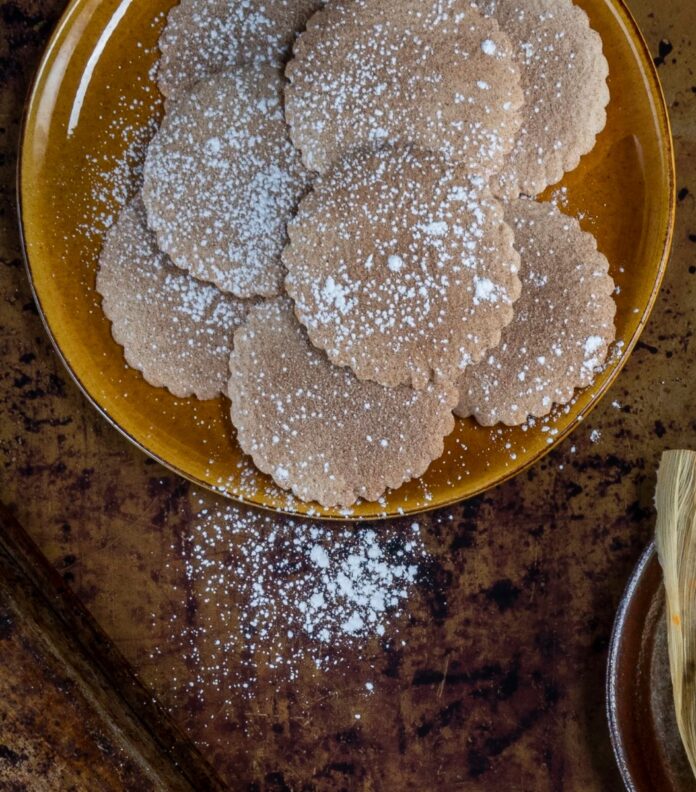
A brown platter of round, scalloped-edged biscochito cookies dusted with powdered sugar, with some sugar sprinkled on the wooden table beside the platter.
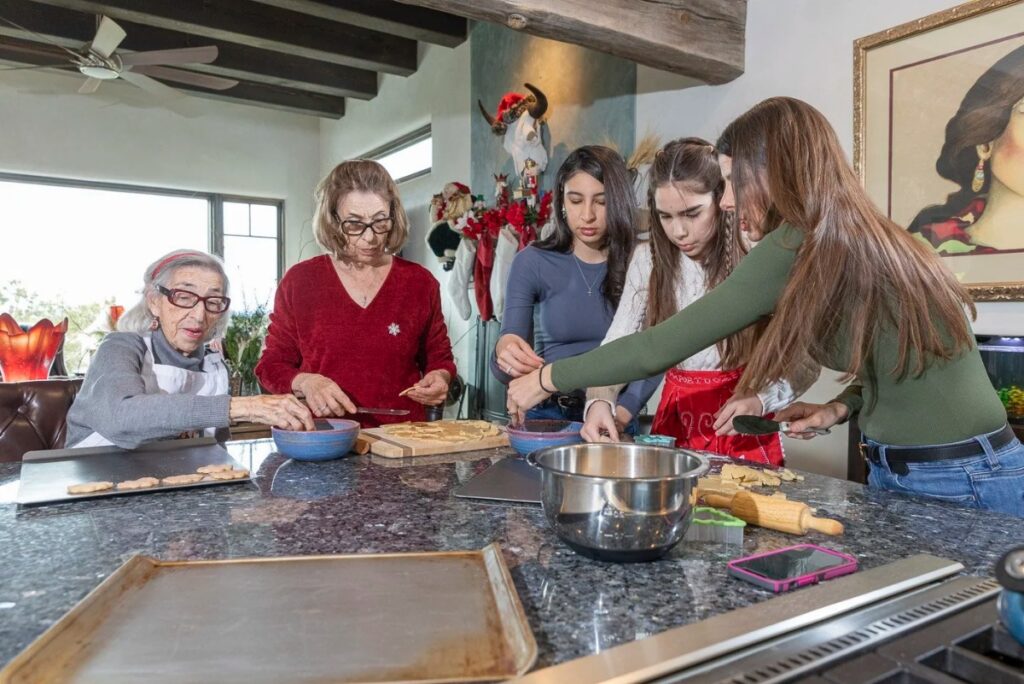
Five generations of the Martinez family gathered together to share their Christmas traditions with TABLE Magazine.

Biscochitos are the official state cookie of New Mexico, and for good reason. These light, crisp cookies are flavored with anise seed and then coated in cinnamon sugar, making them a favorite at holidays, weddings, and family gatherings. This traditional New Mexico biscochitos recipe, shared by Theresa Martinez and her family, shows how to make the cookies the way generations have enjoyed them—simple, sweet, as well as full of flavor.

What Are Biscochitos?

What makes biscochitos so special is their unique taste and texture. The dough uses lard, which gives the cookies a delicate, melt-in-your-mouth quality. The anise seed adds a warm, slightly licorice flavor that pairs perfectly with the cinnamon sugar coating. Together, these ingredients create a cookie that is unlike any other, and one that has become a symbol of New Mexican culture and tradition.

Whether you’re baking for Christmas, celebrating a family milestone, or just craving something sweet, homemade biscochitos are always a good choice. With just a few simple ingredients and easy steps, you can bring the taste of New Mexico into your own kitchen and share a piece of its history with the people you love.

Print
clock clock iconcutlery cutlery iconflag flag iconfolder folder iconinstagram instagram iconpinterest pinterest iconfacebook facebook iconprint print iconsquares squares iconheart heart iconheart solid heart solid icon
A brown platter of round, scalloped-edged biscochito cookies dusted with powdered sugar, with some sugar sprinkled on the wooden table beside the platter.

New Mexico Biscochitos


  • Author: Theresa Martinez

Description

This recipe for New Mexico biscochitos, the state’s official cookie, combines lard, sugar, eggs, and anise for a light, flavorful dough. The cookies are cut into shapes, coated in cinnamon sugar, and baked until golden for a crisp, sweet treat.


Ingredients

Scale
  • 2 cups lard
  • 1 1/2 cups sugar
  • 3 eggs
  • 1 tsp ground anise seed
  • 6 cups flour
  • 3 tsp baking powder
  • 1 tsp salt
  • 2 tsp vanilla extract

For dipping mixture:

  1. 1 cup sugar
  2. 1/4 cup cinnamon


Instructions

  1. Cream together 2 cups lard with 1 1/2 cup sugar and 3 eggs. Add each a bit at a time and beat for at least 15 minutes.
  2. Add 1 teaspoon ground aniseed .
  3. In a bowl put 6 cups flour, 3 teaspoons baking powder, 1 teaspoon salt, and mix well.
  4. Add to lard mixture, keep beating, and add 2 teaspoons vanilla.
  5. Mix on low until flour is completely mixed and texture feels light and fluffy.
  6. Roll out dough and cut shapes with desired cookie cutter.
  7. Mix 1cup sugar and 1/4 cup cinnamon in separate bowl.
  8. Dip each cookie in sugar-cinnamon mixture and bake at 350 degrees until brown, about 15 minutes.
Women from the Martinez family, gathered in a kitchen around a large island, making cookies and tamales.

The Martinez family in the kitchen together.

Story and Photography by Gabriella Marks
Styling by Robert Nachman
Food by Theresa Martinez and family

Subscribe to TABLE Magazine’s print edition.

Arroz con Pitu de Caleya (Chicken Paella)

0
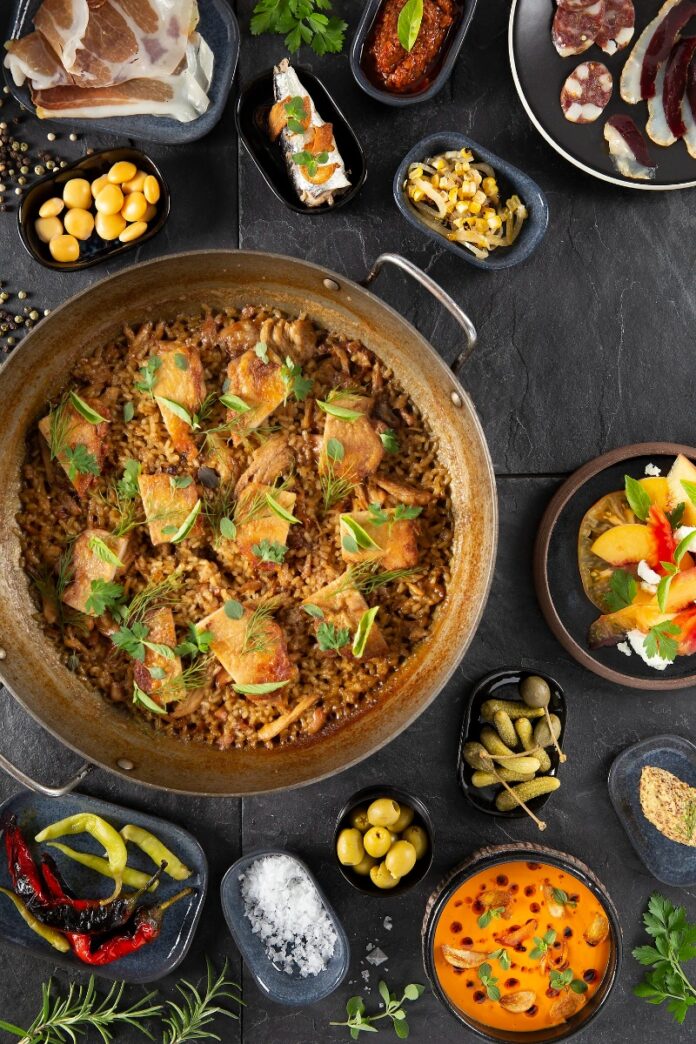
A Spanish paella dish with chicken, rice, and herbs, served in a large pan on a dark stone surface, surrounded by small bowls of various tapas and garnishes.

Justin Severino, the culinary force behind Morcilla, shares this cider-braised chicken paella with TABLE readers. It is a specialty of Asturias, the autonomous region in Spain whose cuisine inspired Morcilla’s menu, and it makes a terrific part of a tapas-style family meal.

Print
clock clock iconcutlery cutlery iconflag flag iconfolder folder iconinstagram instagram iconpinterest pinterest iconfacebook facebook iconprint print iconsquares squares iconheart heart iconheart solid heart solid icon
A Spanish paella dish with chicken, rice, and herbs, served in a large pan on a dark stone surface, surrounded by small bowls of various tapas and garnishes.

Arroz con Pitu de Caleya (Chicken Paella)


  • Author: Justin Severino
  • Yield: Serves 4

Description

A pot full of this homemade, Latin-inspired Chicken Paella makes anywhere feel like home. 


Ingredients

Scale
  • 4 chicken legs, bone-in, skin-on, separated into leg and thigh pieces
  • 3 tbsp salt
  • 1 ½ tbsp sugar
  • 10 sprigs thyme
  • 1 garlic head, cut in half
  • 2 bay leaves
  • 2 cups chicken stock or broth
  • 2 cups apple cider
  • 2 cups Sidra (Spanish cider)
  • 4 tbsp butter
  • 1 cup rice flour
  • 2 cups vegetable stock or broth
  • 100 g Calasparra rice
  • Mix of soft herbs (parsley, chervil, chives, dill)


Instructions

  1. In a shallow sauté/braising pan, season the chicken legs and thighs with the salt, sugar, thyme, garlic, and bay leaves, let sit overnight in the fridge.
  2. The next day preheat the oven to 350 degrees. Cover the chicken legs with the three liquids (chicken stock and the two ciders) and braise in the oven uncovered for about 1 hour. The chicken should be golden and caramelized on top and tender and the liquid should have reduced by about half. Let cool to room temperature.
  3. Pull the chicken legs and thighs out of the liquid and reserve and strain the liquid through a fine-mesh strainer. Pull all the meat and skin off of the bone while reserving the thigh pieces whole for later use.
  4. In a large sauté pan or paella pan begin browning the butter.
  5. Dredge the chicken leg meat and skin in the rice flour, shaking off any excess, and add to the browning butter. Cook until it becomes golden brown and crispy.
  6. Add the rice to the pan followed by the 2 cups of vegetable stock and the remaining braising liquid from the chicken.
  7. Cook over medium heat until the rice absorbs the liquid, and the bottom layer of rice begins to stick to the pan for about 30 minutes. Taste the rice and adjust for seasoning with salt.
  8. Place the chicken thighs reserved from earlier on top of the cooked rice in the pan and finish cooking in the oven at 350 degrees for ten minutes. Garnish with soft herbs.

Try Another Recipe by Justin Severino: Tomato Peach Salad.

Recipe by Justin Severino
Styling by Rafael Vencio
Photography by Dave Bryce

Subscribe to TABLE Magazine’s print edition.

Peregrine Falcons Find a New Home in East Liberty

0
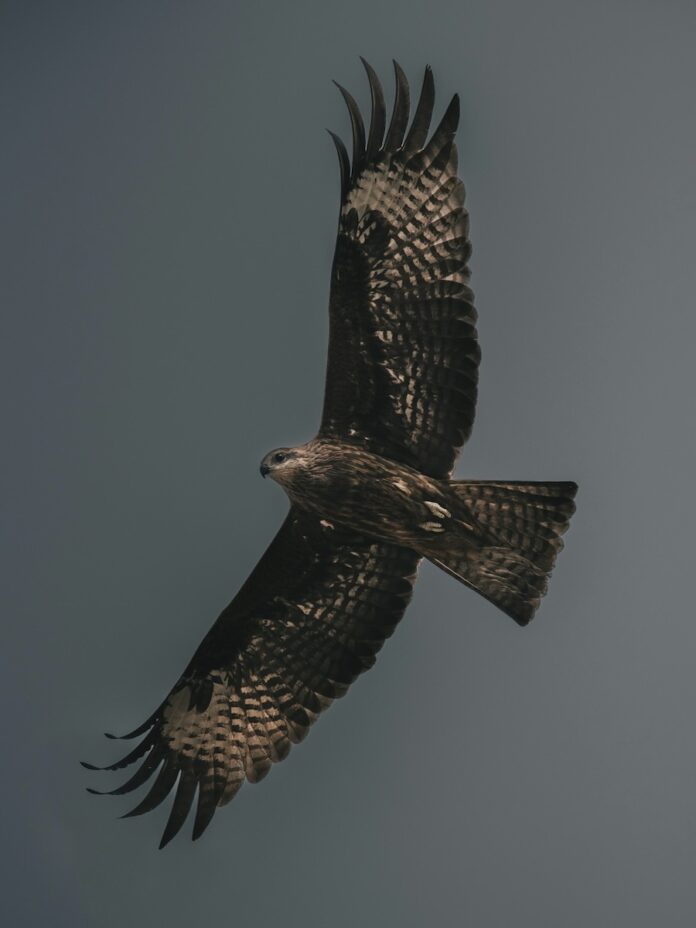
A peregrine falcon flies through the sky with its wings outstretched.

It was an uncharacteristically warm day in East Liberty during early February 2024, and I was desperately looking forward to a massage to distract me from a heavy workload and the inescapable seasonal depression that suffocates the city under its near-permanent gray, low clouds. Wanting to take advantage of the favorable conditions, I closed my laptop and decided to walk the 25 minutes to my appointment. 

While waiting for a stoplight to change, I took a moment to admire the East Liberty Presbyterian Church in typical fashion when, suddenly, a series of loud screeches came from the steeple and a bird rocketed from a light fixture into the sky. The rapid wingbeats propelled the raptor over the nearby AAA building, around the Walnut on Highland apartment high-rise across the street, and eventually to the cross atop the steeple where it came to a rest. As I got closer to the church, I noticed a second bird perched elsewhere on the structure, and I could not believe my eyes. A pair of peregrine falcons, which had never before been documented at the church, were claiming it as their new nest site. That’s a big deal.

What’s So Special About Peregrine Falcons in Pittsburgh?

You see, fewer than 100 years ago, peregrine falcons – the fastest animals on the planet, which clock in at over 240 miles per hour while diving in their signature stoop almost went extinct. The man-made pesticide, DDT, was commonly sprayed on fields starting in the mid-1900s to control insect populations.

An unforeseen consequence, however, was that birds that ate insects carried traces of DDT in their systems. The falcons that preyed on those same birds would then, in turn, ingest the DDT. The accumulated DDT weakened the falcons’ eggs, depleting them of the crucial calcium needed to maintain their shell strength. The falcons would cover the eggs to incubate them, but the shells, too weak under the weight of the parents, would crack. Peregrine numbers plummeted worldwide, and in the 1960s, there were no peregrine falcons remaining in the eastern United States, and their numbers out west collapsed by a staggering 90%.

Thankfully, in 1972, the United States Environmental Protection Agency – influenced in part by Pittsburgh native Rachel Carson’s book Silent Spring – banned the use of DDT, thus laying the groundwork for the peregrine’s recovery. Professor Tom Cade of Cornell University founded The Peregrine Fund to breed peregrines in captivity and release them into the wild in an effort to help populations rebound. The program works to successfully restore peregrine falcons to their historic range in the United States. In 1999, they were officially removed from the United States Endangered Species List.

How These Falcons Came to the Burgh

Peregrine falcons aren’t native to Pittsburgh – or to cities at all, in fact. Their traditional habitats are typically on cliff-sides or along coastlines, as well as mountains and river valleys where they’re able to find high perches to catch the wind and hunt their prey on the wing. Peregrine comes from the Latin for pilgrim or traveler. Thus it’s fitting that they wander from their birth sites to find new territories with similar suitable environs to raise their own offspring, sometimes traveling thousands of miles.

As part of the rehabilitation efforts, conservationists put nest boxes atop skyscrapers and bridges, which mimic the conditions in which the raptors evolved. As it turns out, peregrine falcons have adapted very quickly to their new urban environments and now, within roughly 40 years, fare better than their counterparts in non-urban settings. In fact, New York City, with its endless skyscrapers boasting manmade cliffs and ledges and abundant supply of pigeon meat, boasts the highest density of nesting peregrines anywhere on earth.

Early Conservation Efforts

According to Kate St. John, Pittsburgh’s peregrine authority who documents her avian observations on her blog, Outside My Window, these falcons were first spotted nesting in downtown Pittsburgh in the winter of 1989-1990. With the approval of the Pennsylvania Game Commission, nest boxes were installed at the Gulf Tower by the Western Pennsylvania Conservancy. Peregrines have continuously nested there and at other downtown sites ever since, and in 2002, peregrines also began nesting atop the University of Pittsburgh’s Cathedral of Learning. Numerous other nest sites have popped up in the region, primarily on bridges over the city’s three rivers, and numbers locally have steadily increased.

Programs here and elsewhere have allowed researchers to band chicks that are born at some known sites and track their movements. In fact, the newest female resident at Pitt’s Cathedral of Learning can be tracked back to a skyscraper in Fort Wayne, Indiana, where she hatched in 2020 and was named Carla after a prominent employee in the building.

When I contacted St. John about this newly-spotted pair, she indicated this might be the first known nesting attempt by peregrines at the East Liberty Presbyterian Church. And with peregrines being notoriously territorial, the existing nest at the University of Pittsburgh, roughly 2 miles away as the peregrine flies, might prove to be an issue.

The Problem with Falcons in the City

Where was the dividing line between territories, we wondered. Would these new falcons be treated as invaders, or could peaceful coexistence be achieved? With this new potential site being a quick 10-minute walk from home, I volunteered to keep an eye on their progress and report back regularly. As luck would have it, one of the local establishments had some outdoor picnic tables perfectly positioned for monitoring the new couple (peregrines mate for life), and after purchasing some binoculars, I set out to observe – but, as is often the case, I was witness to so much more.

In the northern hemisphere, peregrine falcons typically lay their clutch of 2 to 4 eggs sometime between late February and the end of March, and incubation generally lasts around 30 to 35 days. This meant a lot of time spent freezing my ass off while seated on a wooden bench on the corner of Baum Boulevard and Highland Avenue with my neck craned toward the sky. 

How Peregrine Falcons Nest

The female eventually settled on a former red tailed hawk nest under a buttress toward the top of the steeple as the ideal spot to try her hand at raising a family. Peregrine falcons prefer flat ledges with dirt or gravel so they can dig a depression into which they lay their eggs, but on the East Liberty Presbyterian Church, some of the most prime real estate in the city for these elevation-loving birds of prey, no such flat surfaces exist. The hawks that once occupied the site built a nest of sticks, and those sticks provided the necessary security for the eggs – they wouldn’t roll off the surface of the church, and the falcons recognized this as their best shot at success. Those who came before helped pave their way, despite it being non-traditional for peregrine falcons.

During courtship, the falcons stay close to home to protect their turf. The more agile male, about a third smaller than the female, hunts prey to feed the pair as they share incubation duties. Yes, males do assist in the incubation process, although the amount of time they spend on the eggs will vary by pair (sounds familiar to many of us at ground-level, doesn’t it?). 

Come mid-April, I could assume there were eggs in the nest since the female was spending her time crouched therein with only the tips of her tail feathers visible. Unfortunately, from my street-level perch, there was no way to know how many eggs there might be. Unlike the University of Pittsburgh’s nest site, there is not an National Aviary-run “falcon cam” here where folks can tune in online and keep tabs on the birds and their little ones as they hatch and eventually fledge. 

The Beauty of Bird Watching

While trying to spot any evidence of successful hatching, I had plenty of time to soak in my surroundings without rushing somewhere else. The unforeseen beauty of bird watching, as it turns out, is ample down time. In my line of sight from the picnic bench is a branch of Pittsburgh’s magnificent Carnegie Library system, yet another legacy of one of Pittsburgh’s industrial barons who, unlike those in a similar position today, saw philanthropy as an essential responsibility that comes with such enormous wealth. I couldn’t help but wonder what Andrew Carnegie might think of the current scenery, the current state of the world – and the contrast that I’m sure he’d notice when it came to his ilk in the modern era, something impossible to ignore when a Tesla driver honks impatiently as an elderly woman crosses the street on her way to mass.

The Unexpected Effects of These Falcons

As the temperatures rose, so did the number of passers-by curious about what I was staring at in the heavens. A steady stream of Uber and Doordash drivers would pop on their hazards and leave their cars as they fetched Nashville hot chicken and poké bowls for my neighbors, chatting on their phones in Turkish, Arabic, and Uzbek. Open windows from other passing vehicles emitted an endless sensory tapestry of news radio, thundering bass, cigarette smoke, and the heady, unmistakable aroma of the stickiest and ickiest of marijuana. The odor of car exhaust added a familiar top note to the aromatic profile of the corner, particularly during the evening rush hour.

The bar whose tables I’d been using to observe the falcons inquired about my activities. They even ended up naming a cocktail after the new residents (it is going back on the menu this year, too, I’m told). A local woman, infamous for asking anyone within earshot if they can spare a dollar, took note of my repeat appearances and started to engage in friendly banter. After a few weeks, I, too, became something of a neighborhood fixture as “the bird guy,” and what started as a chance encounter became a near-daily routine.

Read More about East Liberty’s evolution in part one and East Liberty’s future in part three.

Story by Adam Knoerzer
Photo Courtesy of Nijwam Swargiary

Subscribe to TABLE Magazine’s print edition.

The Evolving City of East Liberty in Pittsburgh, From Churches to Falcons

0
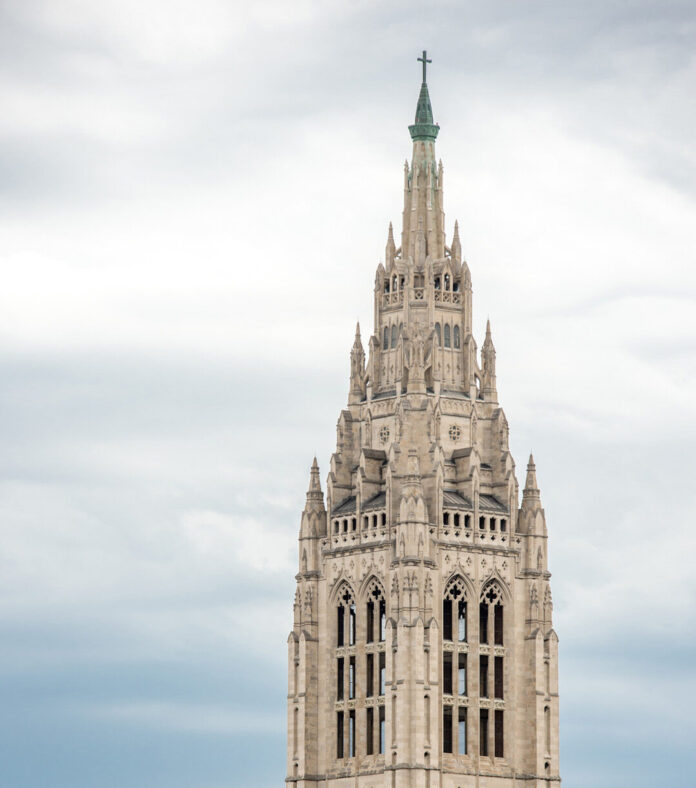
The outside of East Liberty Presbyterian Church in Pittsburgh stretching into a blue and cloud sky.

The East Liberty Presbyterian Church is impossible to miss. The current structure, completed in 1935, is a soaring Gothic masterpiece that occupies an entire city block at the intersection of Penn Avenue and Highland Avenue in Pittsburgh’s East Liberty neighborhood. Its $4 million construction costs were fully funded by the famed Pittsburgh industrialist and philanthropist Mellon family, and the land on which it stands was donated in 1819 by the Negley family, another titan clan from the city’s storied industrial past. Its architect, Ralph Adams Cram, designed New York City’s St. John the Divine Cathedral and Princeton University’s chapel, but he was quoted in March of 1935 saying, “of all the cathedrals and churches I have built this is my masterpiece. This church has been the most profound spiritual experience of my life.” 

East Liberty’s Continuing Renovations

The church’s website – a necessary evangelical tool in today’s world – describes the congregation as “a diverse community of believers extending Christ’s radical hospitality to all,” and you’ll find pages dedicated to racial justice and full inclusion, community events, summer concerts and film series, and Taizé prayer services, which date back to France in the 1940s as a means of reconciling divisions among different Christian denominations, Catholic and Protestant alike. Regular tours of the space are on offer, and, perhaps unsurprisingly with the above programming in mind, there are several yoga classes from which one can choose, too.

Across from the church on Highland Avenue and the south side of Penn Avenue, newly arrived commercial tenants hawk high-end salads and French pâtisseries alongside sushi and designer spectacles. On Baum Boulevard, which borders the southern edge of the structure, artisanal brick oven pizzas (vegan options available, naturally) come out alongside craft cocktails and Alpine-inspired beers and wines. A block to the east of the church is language-learning app Duolingo’s headquarters, complete with its very own taqueria that is open to the public. An Ace Hotel, emblematic of the neighborhood’s cachet, even enjoyed a brief tenure in the old YMCA across from the church on Whitfield Street before changing hands and becoming part of the Kasa portfolio of properties post-COVID.

A Hint of the Past on the Other Side

But on the north side of Penn Avenue –  a mere 8 or 9 steps away – you see the neighborhood as it was pre-“revitalization” programs in recent decades. The local pizza joint on the corner buzzes as residents meet and greet, and a stroll down the block reveals wig shops and inexpensive clothing stores separated by boarded-up storefronts. Students from the nearby Obama Academy chatter after school while walking home, their conversations punctuated by the vocabulary of youth. The Kelly Strayhorn Theater, named after neighborhood legends Gene Kelly and Billy Strayhorn, focuses its services on black women, members of the queer community, and, per their website, “will continue centering historically resilient folks.” Its neighbors are an AIDS task force office and an outpost of Pennsylvania’s Department of Human Services, as well as a trendy café that seems unique in the area for its broad cross-section of clientele. 

Combining the New and Old of East Liberty

I’ve walked through and around this intersection – these intersections, really, in all of their forms – in the church’s shadow countless times since moving to Pittsburgh nearly 15 years ago. From errands to groceries to social gatherings, this city block has become a central pole in my Pittsburgh experience. In the time since my arrival, the transformation has been swift and significant; when the Target down the block from the church opened in the summer of 2011, it was abundantly clear that the neighborhood had, indeed, shifted. But for all that was changing in front of my eyes, it was in looking skyward toward the East Liberty Presbyterian Church’s soaring 300-foot reinforced concrete steeple last February that I discovered the neighborhood’s newest residents, a pair of peregrine falcons, and, in turn, the perfect metaphor for the neighborhood: flight.

Read More about the city’s peregrine falcons in part two and East Liberty’s future in part three.

Story by Adam Knoerzer
Photo Courtesy of East Liberty Presbyterian Church

Subscribe to TABLE Magazine’s print edition.

The Future of East Liberty in Pittsburgh

0
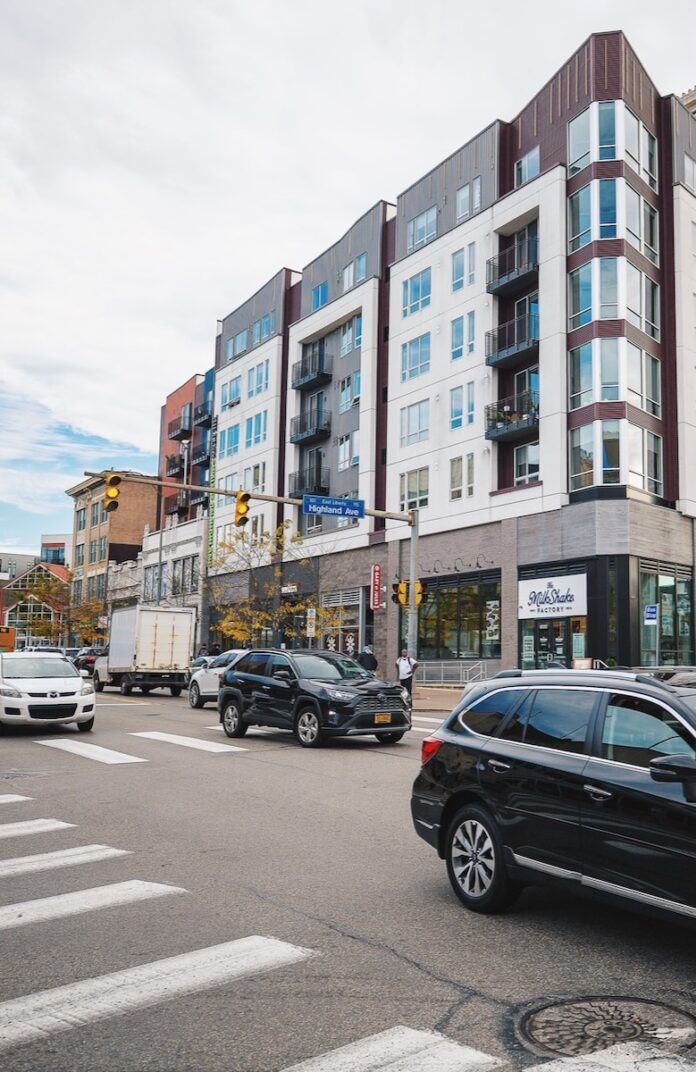
A busy street in East Liberty with cars going down it and a large building on the other side.

As I saw peregrine falcons set up new digs at the East Liberty Presbyterian Church, I contemplated the neighborhood. The area was originally farmland around the time of the American revolution. “Liberty” was the name given to areas on the outskirts of cities in those days. East Liberty was developed as orchards by the end of the 1780s.

The Negley family that donated the land for the Presbyterian Church were the first permanent European settlers in the area. By the late 1800s, East Liberty was, according to the East Liberty Development, Inc., “the richest suburb in America.” The Heinz, Westinghouse, Carnegie, and Mellon families counted among its residents. 

Gentrification’s Impact on the Future of East Liberty’s Community

The early 1900s saw continued neighborhood growth with the addition of theatres graced by itinerant and local talents. Regent Theatre, the oldest, is now named after local legends Gene Kelly and Billy Strayhorn). The area entered a period of peak prosperity after the Great Depression. The city built numerous churches, synagogues, and community establishments to support the population boom. This would continue until nearly 1960, when a suburbanization program, something akin to neighborhood DDT, destroyed the urban fabric. Single-family housing was demolished in favor of the highway-style Penn Circle that was installed in the district’s center. High-rise apartments were also constructed in their place. The commercial life of the district was disrupted, triggering a period of decline. As seen in so many other parts of the United States, white residents left for the suburbs. East Liberty was all but forgotten.

In 1979, the East Liberty Chamber of Commerce formed East Liberty Development, Inc. (ELDI), a non-profit intended to focus on redevelopment of the neighborhood with a special focus on Penn and Highland Avenues. Despite their initial efforts, the neighborhood suffered. East Liberty had a dangerous reputation, and the chasm between those with and without continued to grow.

Revitalization and Its Realities 

Large-scale shifts took place starting in 2000. A Home Depot was constructed on Highland Avenue a few blocks north of the East Liberty Presbyterian Church. Whole Foods followed nearby in 2002. Around the same time, a pedestrian bridge crossed the busway and train tracks that kept Shadyside and East Liberty apart for so long. The dour and dreary apartment buildings came down. Trader Joe’s, Walgreen’s, and other banking and retail outlets established themselves. Google leased office space in nearby Bakery Square in 2010. Target opened its doors to the community a year later. By some accounts, the neighborhood was on an upward trajectory with hundreds of jobs, many reportedly filled by local residents.

Displacement in East Liberty

But, as with all things, it’s a matter of perspective. In their 2016 “Black Homes Matter” report, the Pittsburgh Fair Development Action Group described how recent development targeted a “new demographic.” The reality is easy to see. The “transformation” of the neighborhood is depends on the removal and displacement of lower-income black residents – forced flight. This phenomenon is not, of course, unique to East Liberty. Rather, this is another example to be cited in the growing anthology of gentrified neighborhoods across the United States. From the same report, the numbers make it clear:

“In the late 1990s, the neighborhood CDC (ELDI) developed a plan to replace the largest subsidized housing community (Federal American Properties or FAP) with less dense mixed-income housing owned by a more responsible set of landlords. Hundreds of low-income people were uprooted and displaced. Of the 546 original households, only about 150 were able to remain in East Liberty. Street vendors were chased from the commercial core. At least 14 locally owned businesses were displaced or lost their clientele and were forced to close.”

Words from the Residents Themselves

As of the report’s publication, only 1.6% of all jobs in East Liberty are by residents of the neighborhood. Some quotes from community residents in the report reflect the tenuous nature of its contemporary state:

“I live here. I’m from here. My whole family is here … We try to stay close together. This is America. I’m a Marine. I went to war three times. I served my country. It feels crazy not to be able to live...where I grew up.” — Jaquaie Macatee, East Liberty resident

“There are people looking at me like ‘what are you doing here?’ I had my first kiss on that street. I had to get stitches over there.” — Deion “1.2” Hardy,  East Liberty resident

“I grew up around here…I’ve always wanted to live here…But now we have four kids – we need a bigger place. We wasted six months looking for something affordable around here so we finally moved out to Millvale. I had to buy a car to commute back here to my job, and then I had to take another job to pay for the car. I work 48 hours at one job, 32 at the other so I get very little sleep. And I miss my neighborhood.” — Aaron Vire, former East Liberty resident

Micro-Encounters and Hidden Realities

As I spent time at the picnic table and around the neighborhood through the remainder of spring and summer – the young falcons I was watching leave the nest roughly 6 weeks after hatching – I talked to more and more people. These encounters illustrated the complicated dynamics of the falcons’ new eighborhood some 25 stories below. What weren’t they noticing while plucking feathers off of doves and starlings to then feed to their new addition?

On a Wednesday evening at the intersection, I took off my headphones and glanced upward at the church steeple just in time to hear a conversation between two women crossing the street in front of me. One remarked to her companion that she liked my shoes and that she was planning on picking up something similar; I casually let her know in that neighborly Pittsburgh way where I’d just grabbed them on sale before we enjoyed a brief chat and went on our respective ways. After scanning the skies from my spot for around an hour, the two women returned and were happy to find me still there – and I asked if they wanted to sit down and join me for a drink. 

An Unlikely Meeting of New Friends

The pair – I’ll call them Mimi and Jo here – were a woman and her auntie. These two are residents of East Liberty and were out for the afternoon having just gotten their nails done at a nearby salon. Mimi, the younger of the two, said she was so glad I told her where to get the shoes because she wanted to wear them for an upcoming court appearance. Her auntie asked why I was looking at the church, and after my usual spiel, she recounted a story of her nephew who once crashed a car while watching birds. Turns out we had more than a few things in common, the three of us.

Discovering a Pattern, Even in 2025

After a round of rosés, Mimi let me know she was preparing to go back to prison. She was in a gang as a drug queenpin, she said. She finally got caught. Her auntie quickly chimed in to note that her niece was one of the best in the business, but Mimi was a little worried about her upcoming stint in jail since it coincided with the release of her boyfriend. Would they remain a pair once the roles reversed? Were they, too, mates for life? We wondered aloud as we lamented the bad timing of it all, and I offered to grab another round to calm Mimi’s growing nerves.

When I got back to the table, Mimi verbalized something that I could sense from the moment I invited them to my perch. She was surprised that I asked her to sit because she and her auntie said they never felt particularly welcomed at this establishment. I did not need no further explanation; the clientele here has, since the bar’s inception, been overwhelmingly white. The kind of white-collar, Carnegie Mellon-graduate (there are those names again) playground that can only be in the beautiful bones of a building that once served a different customer base in a bygone era. I could see management inside shooting glances our way through the pristinely polished large windows, and although I’d become a familiar face, it was obvious that my new friends posed something of a problem.

A Hard Lesson to Learn in Person

Over the course of the previous weeks, I can’t tell you how many times I watched white patrons – myself included – smoke their electronic cigarettes or enjoy weed vapes at the tables without incident as they boisterously caught up with friends, had drinks, and chowed down on $22 personal pizzas (that kind of money buys you a “Monster”-size pizza at the place across the intersection, by the way, which serves 4-6 hungry humans). But when my new friends did the same, a member of the bar staff meekly emerged to inform us, her voice faintly trembling, that smoking was not permitted on the premises. The three of us shared a knowing glance, and Mimi got up and walked two steps to the street corner to finish her cigarette.

During those same weeks, as I peered up toward the church steeple looking for signs of new life, comments from passers-by told me the same story. I’d hear groups of men strolling by and making comments about how that was a “whites-only” place, how it wasn’t for them. And based on who was there – every time I was there – were they wrong? Was this, indeed, on the wrong side of the invisible divide that serves to keep everyone in “their” respective territories?

Diversity Slowly Grows in Certain Parts of East Liberty

For a change of scenery, and to test that theory, I’d sometimes cross Penn Avenue to the café on the northwest corner of the intersection, the newer kid on the block. When the weather got warm enough, they’d put a couple tables out front – not quite as ideal for spotting the peregrine nest, but it afforded me the chance to see things, quite literally, from the other side.

The difference in dynamic was, with each visit, immediately perceptible, and the demographics were approaching something more reflective of the community. The French-themed all-day café proved to be something of a hub for all segments of society, from high school kids grabbing an after-school drink to tech bros working on projects and locals taking a break from their daily errands.

At those outdoor tables, I bought candy for school fundraisers (turns out they take Apple Pay these days) and met a very vocal Scorpio bemoaning the dating scene in this hostile climate – men just want another mother, she said, and I couldn’t argue with that. Neighborhood fixtures shot the shit at the other table, and, soaking in what remained of the sun’s rays, I immediately felt drawn into the community – not an entity separate from it. Taking 8 or 9 steps was like walking into a different world. Maybe, just like Negley Avenue appeared to be for Pittsburgh’s peregrine pairs, this was, indeed, an unseen territorial divide after all.

Nature’s Resilience in a Changing City

At the end of May, my patience found its reward. I spotted the first known peregrine falcon chick hatched on the East Liberty Presbyterian Church. Truth be told, I had become concerned the nest might have been a failure due to no signs of life. But, Kate St. John, our sage local peregrine expert, reassured me that falcons often attempt a second clutch of eggs if the first fails for whatever reason. If the nest did fail, they might not return. If, however, even one egg successfully was to hatch, there was a strong likelihood of them returning next February to once again commence courtship ceremonies.

When, on that afternoon, I noticed a fluffy white ball of feathers peak its head over the stick nest onto Highland Avenue, I knew I was witnessing history – but no one else at street level was any the wiser. Something akin to a miracle was happening at the East Liberty Presbyterian Church, but you wouldn’t find it inside among the yoga mats or the tour groups. You had to know where to look to understand the implications of the events transpiring in the first half of 2024. A species that now calls East Liberty home. Even though it quite literally did not exist here during the redevelopment plans of the 1960s. This would have been unthinkable just a few decades ago. Man-made problems and man-made solutions were, as always, coexisting. Life was again finding a way.

Looking Into a Brighter Future for All, Even the Falcons

In June, I watched the chick take its first hops around its new home, its first frantic, flappy flights, and its first forays into its new neighborhood. Mom and dad would show it how to carve through the sky, swooping swiftly around and above the streets that had seen so much change in so little time. The juvenile’s first flight away from the nest found him in fittingly familiar territory for those of us terrestrial creatures – atop the Whole Foods on Penn Avenue, built in place of a 519-unit affordable housing complex.

By the time the end of July came around, the new peregrine was off to explore on his own. The numbers aren’t exactly encouraging; around 60% of peregrine falcon chicks never survive past their first birthday. I wondered, and still wonder, what might become of him and if he might find a way to succeed against the odds, much like the neighborhood in which he was born. No one officially monitors the church’s nest so the chick is without a band. We’ll never know what ultimately will become of him. Neither of his parents have bands, either. We don’t where they came from, how old they are, or how far they had to fly to call East Liberty home. But we do know this: they saw potential in it, built a nest, and were able to successfully rear a chick. 

Learning a Lesson From These Birds

And here’s what else I know: as of writing in March 2025, these same peregrine parents are back at the East Liberty Presbyterian Church to try it again. Because for them, it’s home now, too. Flight and finding a home are constants in this world, and I’ll be watching it all unfold from my perch, from my perspective, at the intersection.

Read More about East Liberty’s evolution in part one and the city’s peregrine falcons in part two.

Story by Adam Knoerzer
Photo Courtesy of East Liberty

Subscribe to TABLE Magazine’s print edition.
Timeless Romance at a Duquesne Club Wedding

0
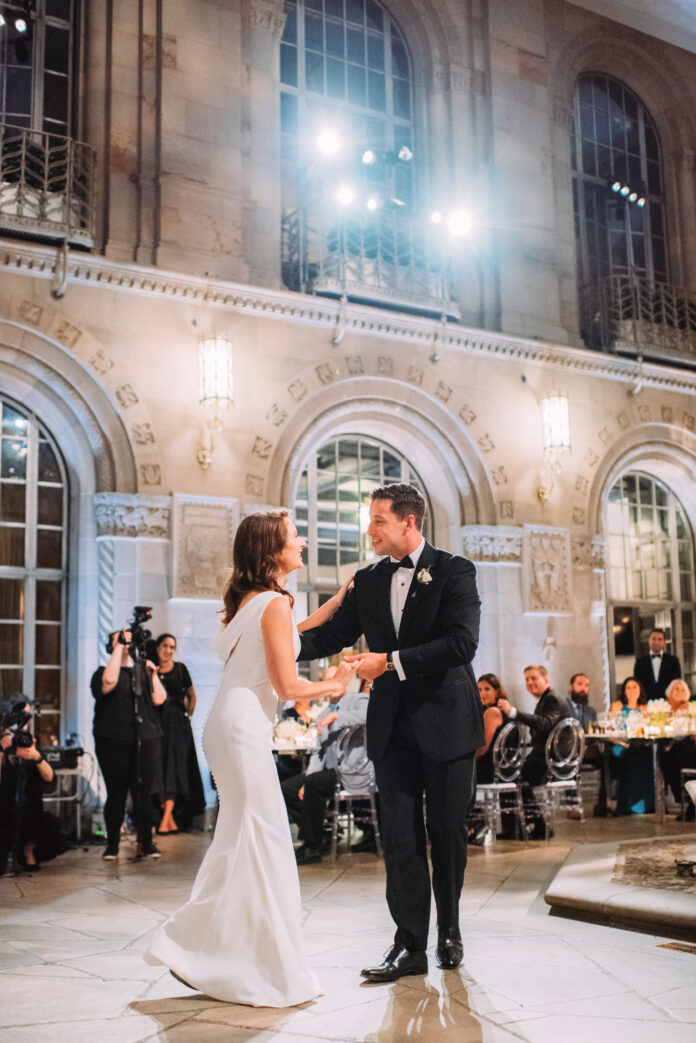
bride and groom first dance in duquense club
Trinity Kronk and Austin Samson’s wedding day was as smooth and lovely as their courtship.

Becoming a couple was an easy decision for Trinity Kronk and Austin Samson. “After our first date, Austin asked me to be his girlfriend, and I said yes. We just kind of knew from the beginning it was going to be us forever,” says Trinity. The couple’s ability to personalize a timeless wedding reception at the Duquesne Club showcases their similarly apparent connection.

A Wedding at Pittsburgh’s Duquesne Club

They carried that sense of ease and certainty into planning their wedding, putting together the love-centered celebration in just two months with the expert help of Martin Potoczny, founder of LUXE Creative.

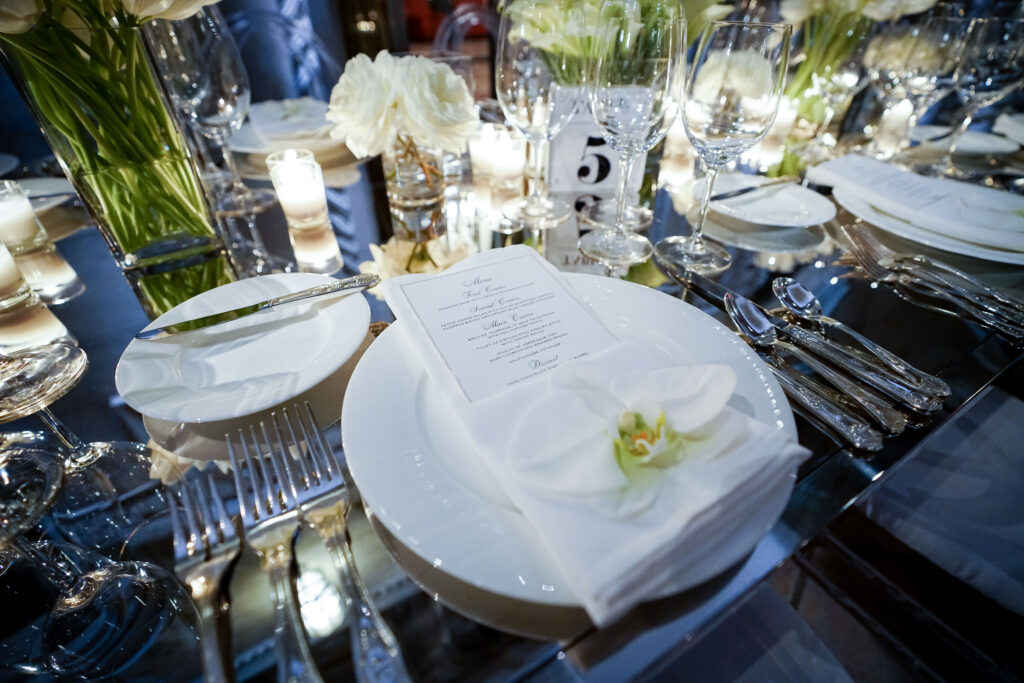
table with dining set up with white flowers and silverware

“Trinity and Austin are incredibly kind and sincere, and we became completely in sync during the design process. Once the full vision of the wedding was conveyed, they were gracious enough to give us their complete trust. Our team worked to coordinate every last detail, and the evening was simply perfect.”

overview of white glowing flowers above water pool

A Venue of Beauty and Simplicity

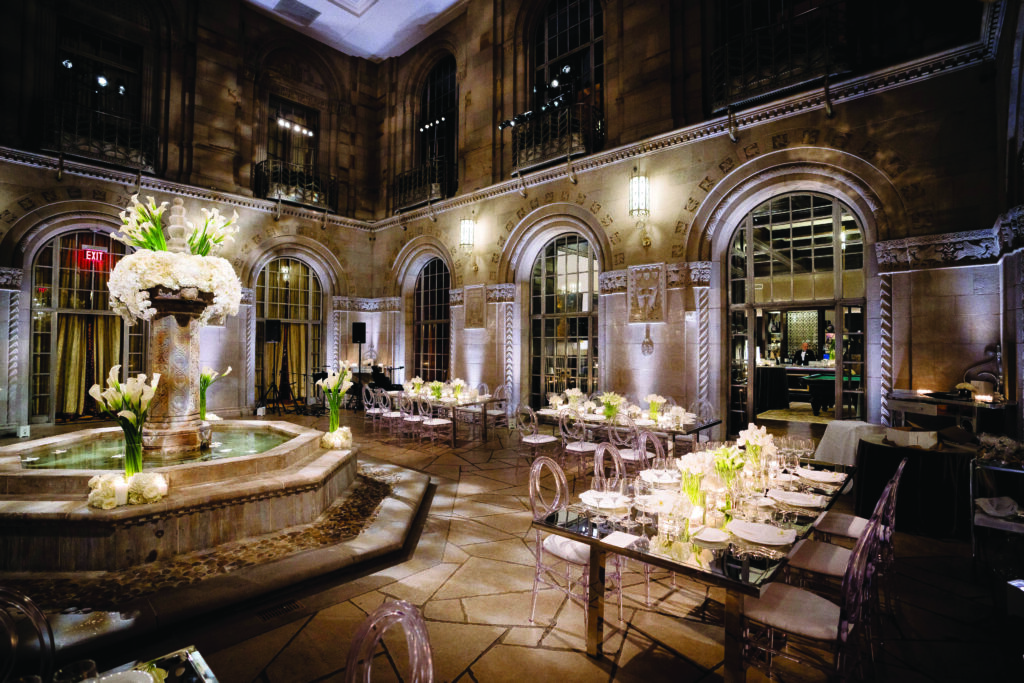
Most notably, the couple chose stunning florals that were visually impressive while being complementary to the historic space. The floral design was similar throughout the venue to maintain the cohesive feel in every corner.

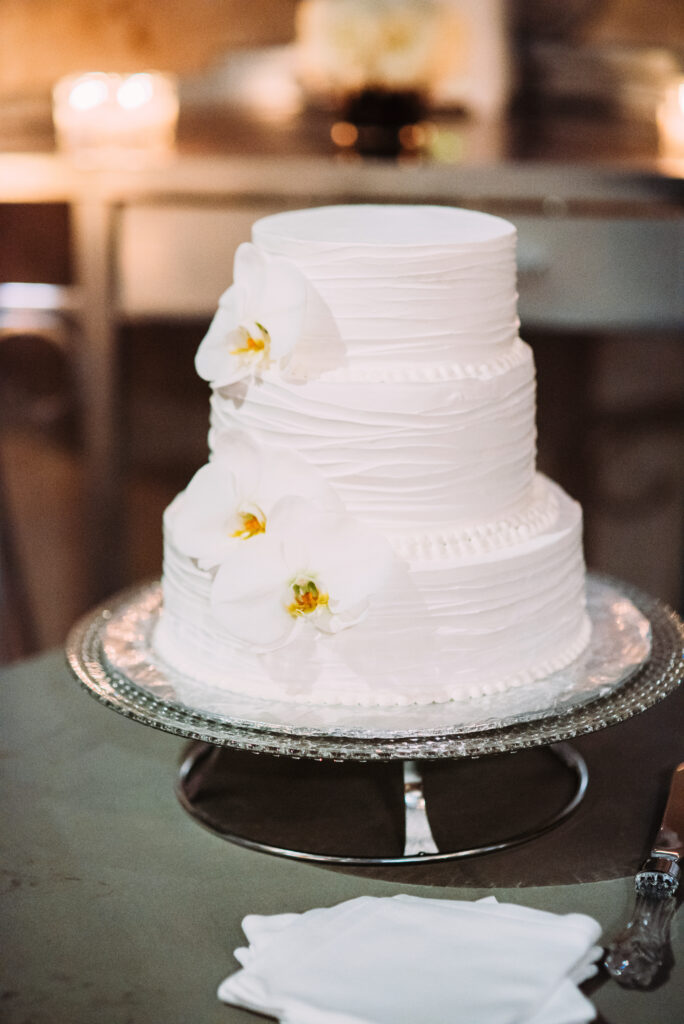
white cake with yellow flowers on top of silver tray

Austin’s Uncle Ed made the simply delicious almond cake with raspberry filling.

Keeping the reception to just 47 guests allowed the couple to focus on what was most important to them and make “everything as personal, intimate, and meaningful as possible. The party was just an additional excitement to the whole purpose of the day,” remembers Trinity.

bride and groom in front of water design

Trinity wore a simple, striking gown from Bridal Beginning.

More than anything, she says, “We had an amazing time, and we got to spend it with the people we love.”

Additionally, The newlyweds shared a first dance to Frank Sinatra’s Fly Me to the Moon. The bride and groom took up lessons with James Page, professional instructor with Night and Day Dance Studio. This put the cherry on top of their beautiful celebration of love.

duquense club view with water and tables

“This wedding was a flawless experience for the guests, the family, and the bride and groom. We were able to deliver due in large part to the confidence that the bride and groom had in our team,” says Potoczny. 

Acknowledgements

Event Design and Planning: Martin Potoczny, LUXE Creative
Venue + Catering: Duquesne Club
Floral Design + Lighting: LUXE Creative
Wedding Photographer: Veronica Varos
Event Photographer: Ben Petchel
Rentals: All Occasions Party Rental and Marbella Rentals 
Stationery: Papier
Music: Gerra Gembarosky and Rick Butler

Story by Nicole Barley
Photography by Veronica Varos and Ben Petchel

Subscribe to TABLE Magazine’s print edition.
A Pittsburgh Wedding Beautifully Blending Two Cultures

0
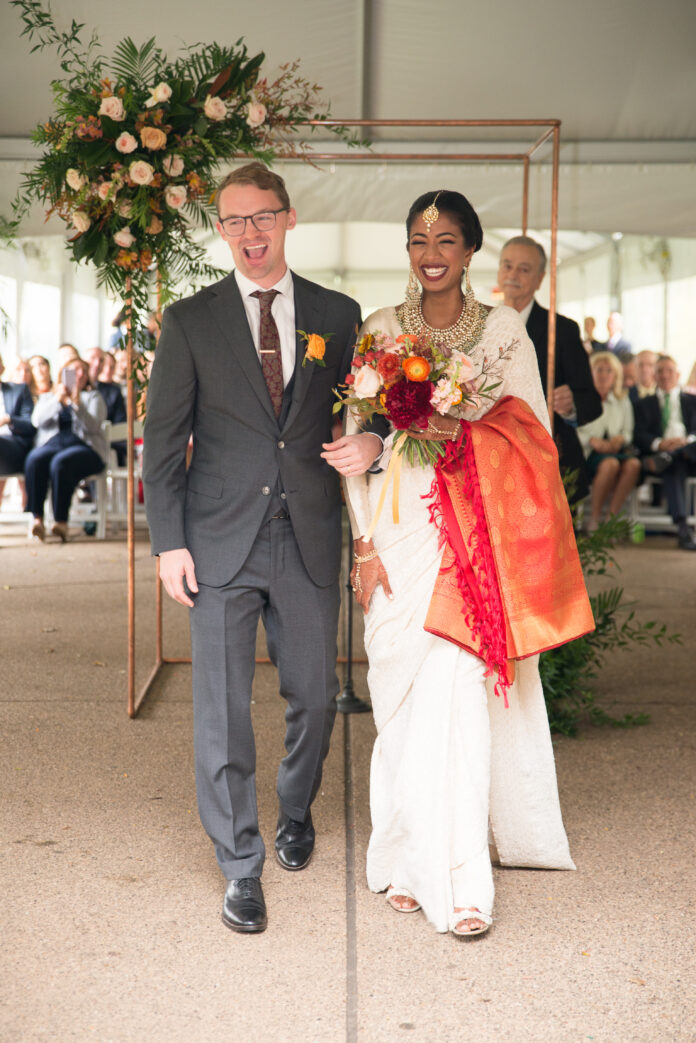
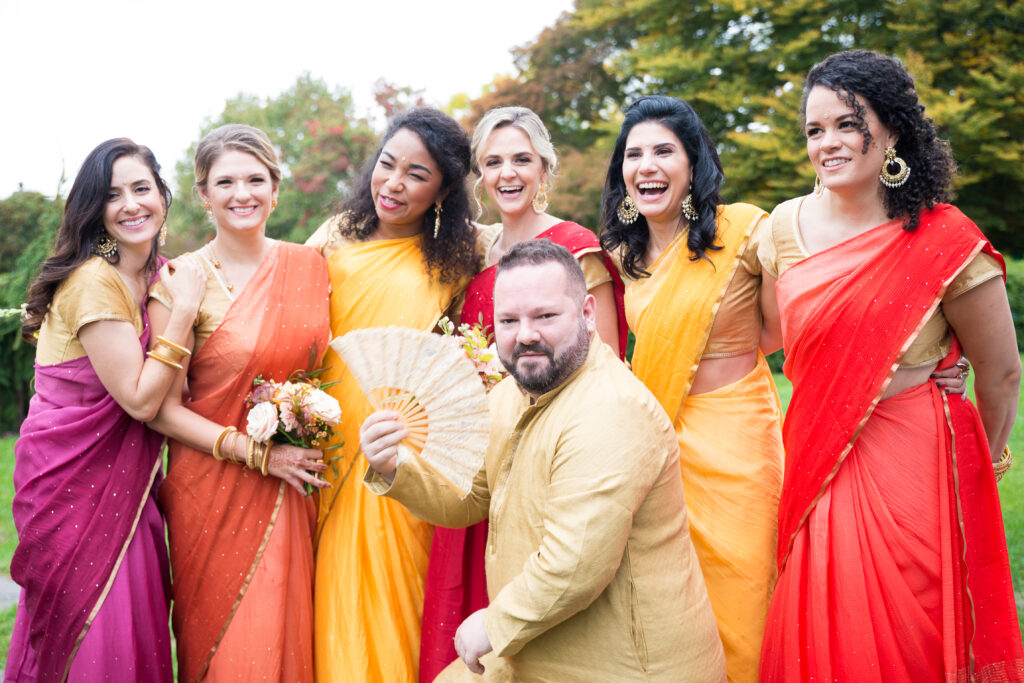
bride and groom standing together facing camera after wedding
Sarah Thomas and Tyler Haak get married in Pittsburgh, the city where they fell in love

As the former wine director at Bar Marco, “I had a rule of never dating guests,” says Sarah Thomas. After meeting Tyler Haak, however, “that ultimately proved to be a silly rule.” 

Beautifully Blending Two Cultures Into One Wedding

Tyler was a regular at the bar, “always ordering cocktails, never ordering wine, so I didn’t really have a reason to talk to him. He eventually asked me out after months, and that was it!” says Sarah.

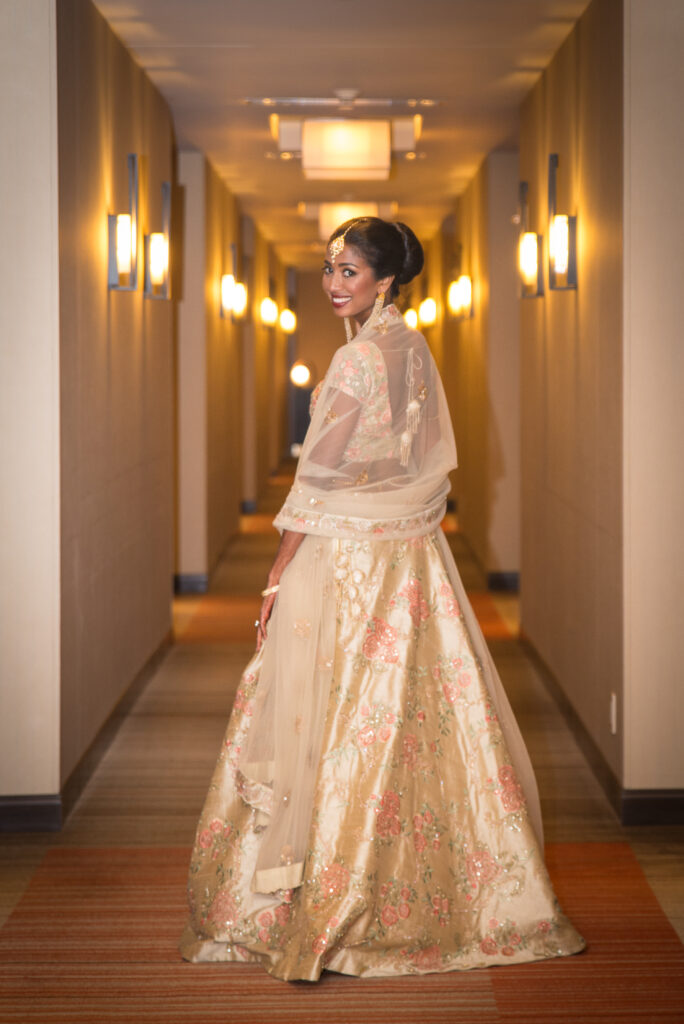
hlad wedding dress with bride in it looking back

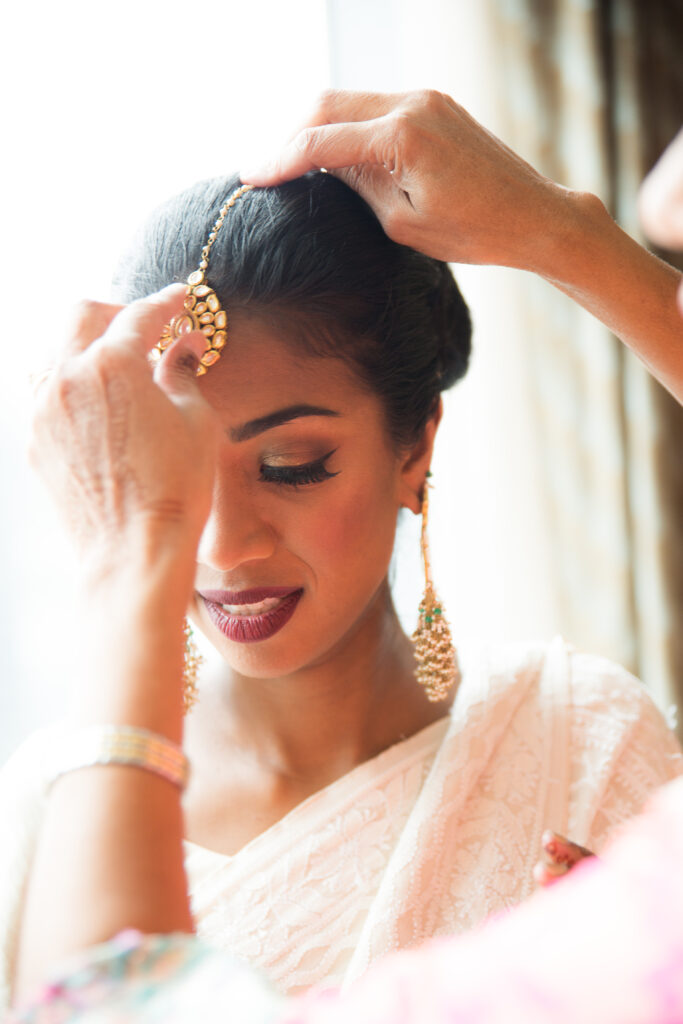
“A dear, dear family friend of ours saw my wedding sari when she was in India.”

Returning Home for a Wedding

After two years of dating, Sarah and Tyler relocated to New York City, where Thomas is now a sommelier at Le Bernardin. Thomas is additionally the co-founder and Chief Imaginator of Kalamata’s Kitchen. The couple returned home for their wedding because “Pittsburgh is a big part of our story. There was never a question that we were definitely going to get married there,” she says.

Beautifully Blending Two Cultures Into One Wedding

While they had planned to wed in the garden at Phipps Conservatory, rain serendipitously drove the ceremony under a tent. There, Sarah and Tyler said their vows in the center of the space, with friends and family gathered around them in a circle. “We were literally surrounded by everyone we love,” she says.

Tradition to Cherish and Remember

Tradition to Cherish and Remember

Additionally, the beautifully personal, non-religious ceremony incorporated traditions from the bride’s family’s Suriyani Christian faith. These included the Blessing of the Minnu, in which the groom gifts the bride a gold leaf pendant on seven symbolic threads.

Furthermore, the Manthrakodi, in which the groom places a blessed sari on the bride’s head. The bride changed into a Shyamal & Bhumika lehenga for the reception.

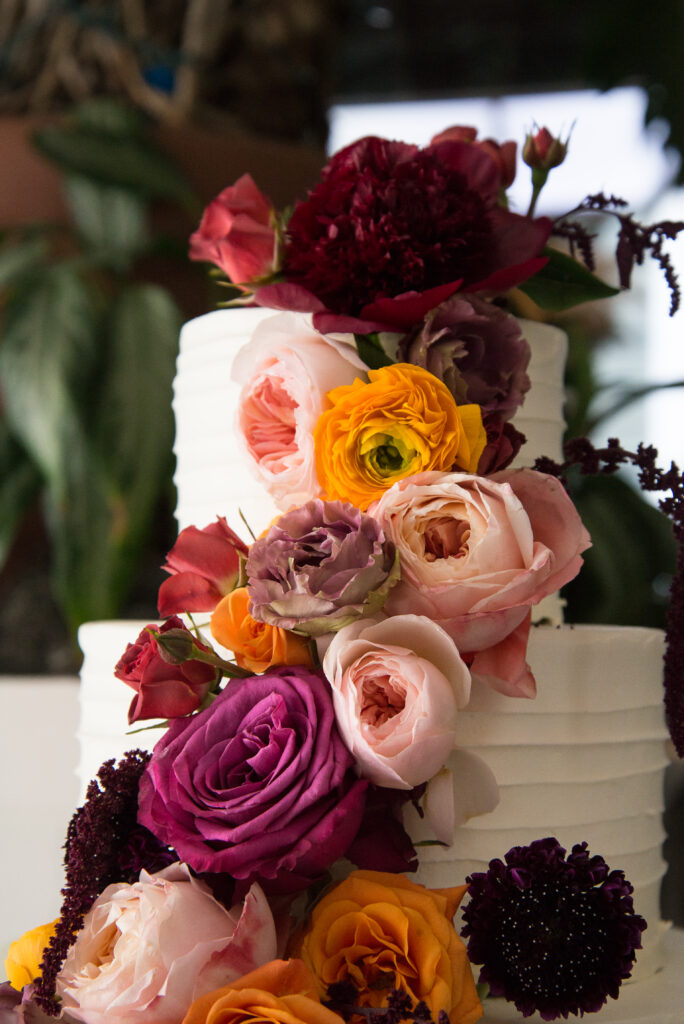
hlad wedding cake white with purple and orange flowers

April Simpson of Oakmont Bakery created this brown butter cake with lavender brown butter buttercream frosting — oh my!

The flowers were inspired by the bridal party’s richly hued gold, rust, fuchsia and crimson saris. The design also featured red charm peonies, Juliet garden roses, ranunculus, quicksand roses, nandina foliage, peach stock, terra cotta spray roses, and greenery. 

“To achieve your aesthetic and vibe for your big day, have descriptors, such as fun, whimsical, modern, garden, retro, art deco, Dutch masters…this will help your floral designer create ideas specifically for you, as well as flex their creative muscles,” says Janessa Walter, owner of Gold Dust Floral.

Tradition to Cherish and Remember

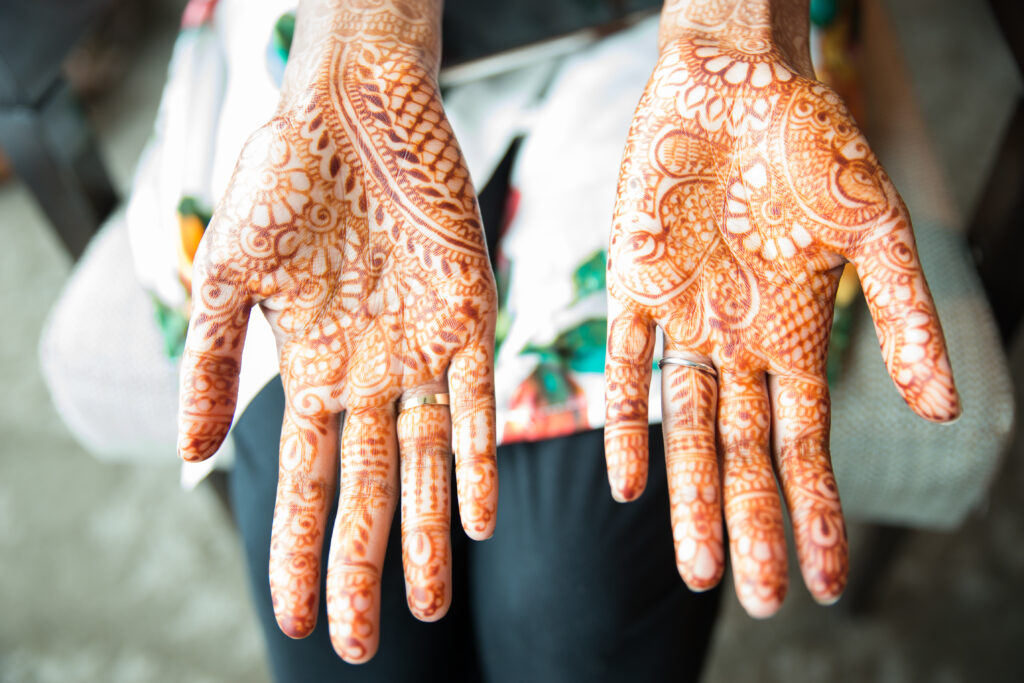
“Henna is a way of beautifying a bride before her wedding, and it’s associated with luck and prosperity.”

“Our officiant, a dear family friend, did an incredible job of letting us share our true selves with our guests, and we were able to showcase some meaningful traditions,” says Tyler, who remembers the ceremony as “a perfect mix of heartwarming, moving, and funny that I will never forget.”

For the reception at The Wintergarden at PPG Place, Sarah and Tyler named the tables after “restaurants and bars where we’d shared exceptional dates.” The bars included Bar Marco, Spoon and Le Bernardin. Then, Tyler took it to a whole other level and wrote notes about each of the dates as a conversation starter for the guests.

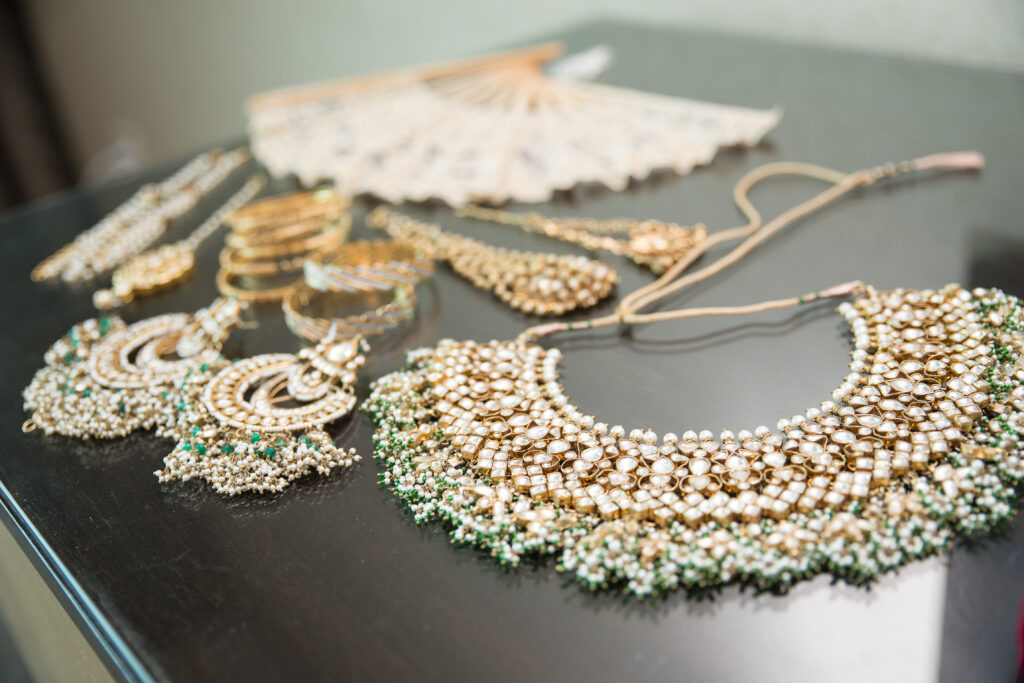
hlad wedding jewelry assortment on table

Sarah wore a mix of jewelry from her mother and aunts’ personal collections. She also wore new pieces found in boutiques in India.

A Celebration with a Variety of Taste

The delicious menu featured Caesar salad, salmon au poivre with wild mushrooms and truffle beurre blanc. There was a petite NY strip steak with peppercorns and brandy sauce, while more options for a crispy lentil cake with zucchini and coconut green curry. The reception menu also showcased glazed root vegetables and whipped potato puree.

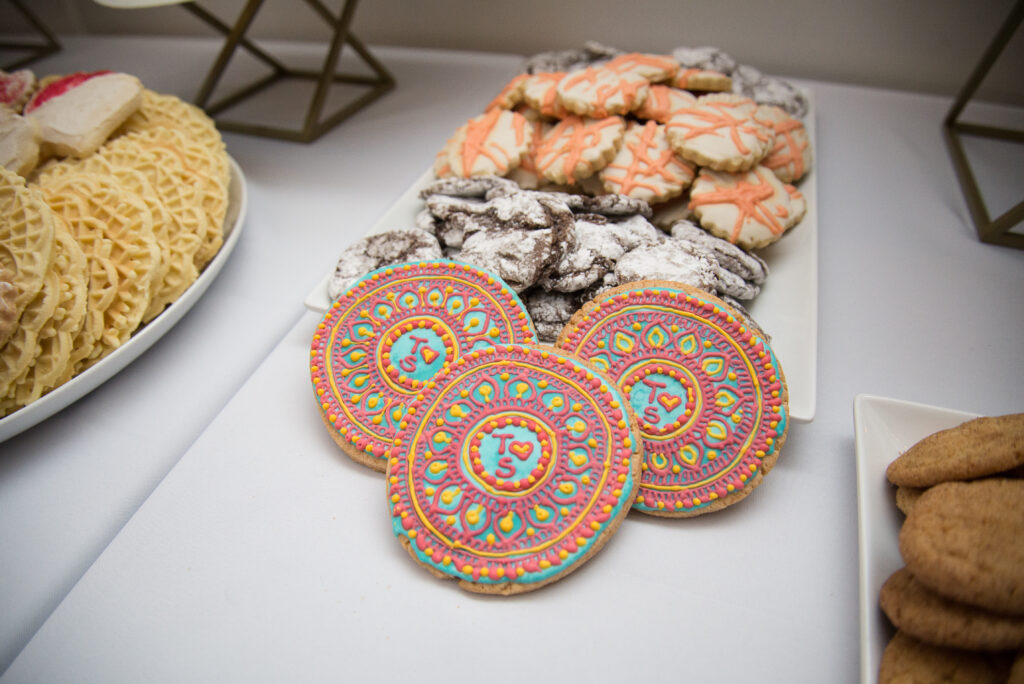
hlad wedding cookie table with orange and blue frosting

Tyler’s mom, along with a baking crew of family and friends, created nearly 2,500 treats.

Of course, Sarah selected the evening’s wine: Juvé y Camps Cava Gran Reserva de la Familia 2013, Bründlmayer Kamptal Terrassen Riesling 2015, and Raul Pérez Bierzo Ultreia Saint Jacques 2017. Cheers!

Acknowledgments

Food: Chef Scott Walton of Acorn Pittsburgh for The Wintergarden at PPG Place
Florist: Janessa Walter of Gold Dust Floral 
Rehearsal Dinner: Ace Hotel Pittsburgh
Event Planner: Susan Kinser
Music: Pittsburgh DJ Company & Three Rivers String Quartet  
Hair and Makeup: JL Makeup Studio 

Story By Nicole Barley
Photography By Christine Hlad

Subscribe to TABLE Magazine’s print edition.
Love Designs a Rustic Wedding Inside and Out

0
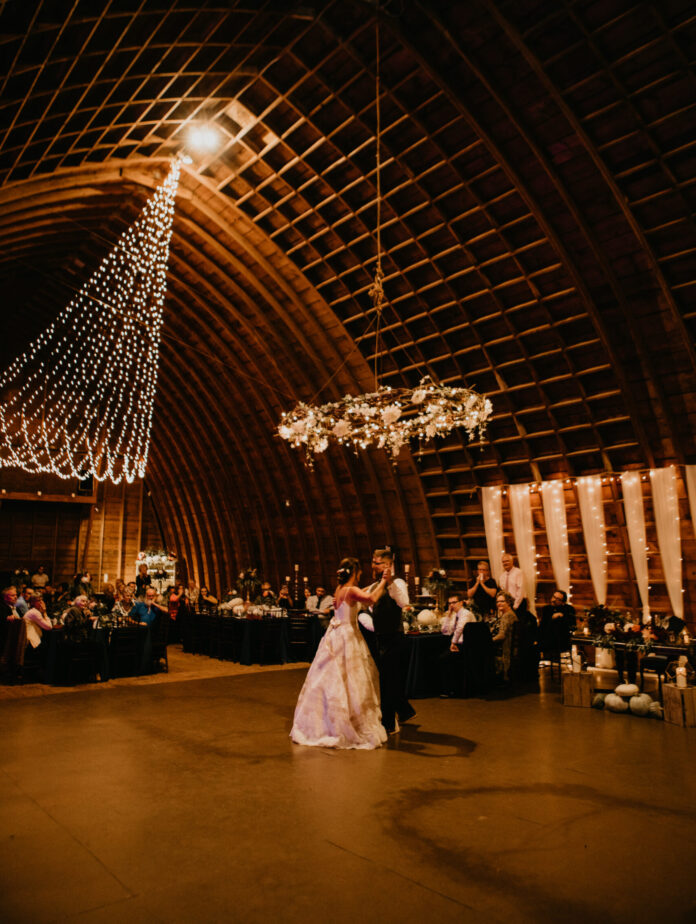
bride and groom dance in rustic ball room with fairy lights

You always know when you’ve found “the one.” Whether it’s something as trifling as a great shoe to wear or as pivotal as a life partner. And it’s usually the same sentiment experienced when you find a wedding venue that just feels like home.

Building a Rustic Wedding

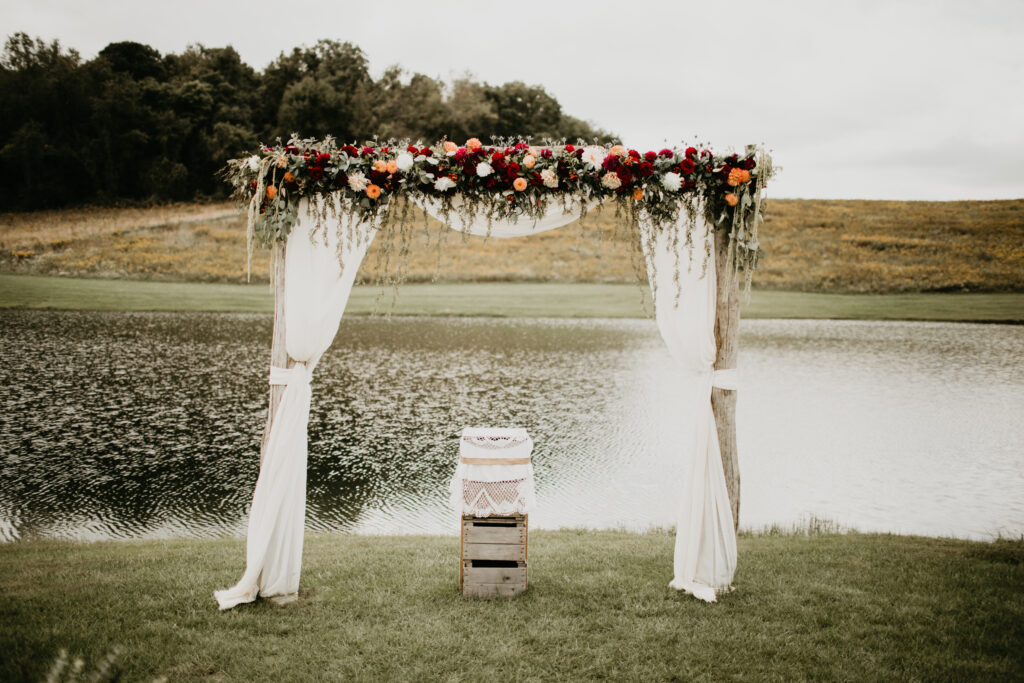
wedding tapestry with flowers in front of water

Sometimes, literally. As is the case when four generations of your family have been farming 160 acres nestled in rolling hills just southwest of Pittsburgh. When your sister gets engaged, looks at the old dairy barn being used for storage, and feels her heart sing. Then comes the year-long effort to clean it up, decorate it.

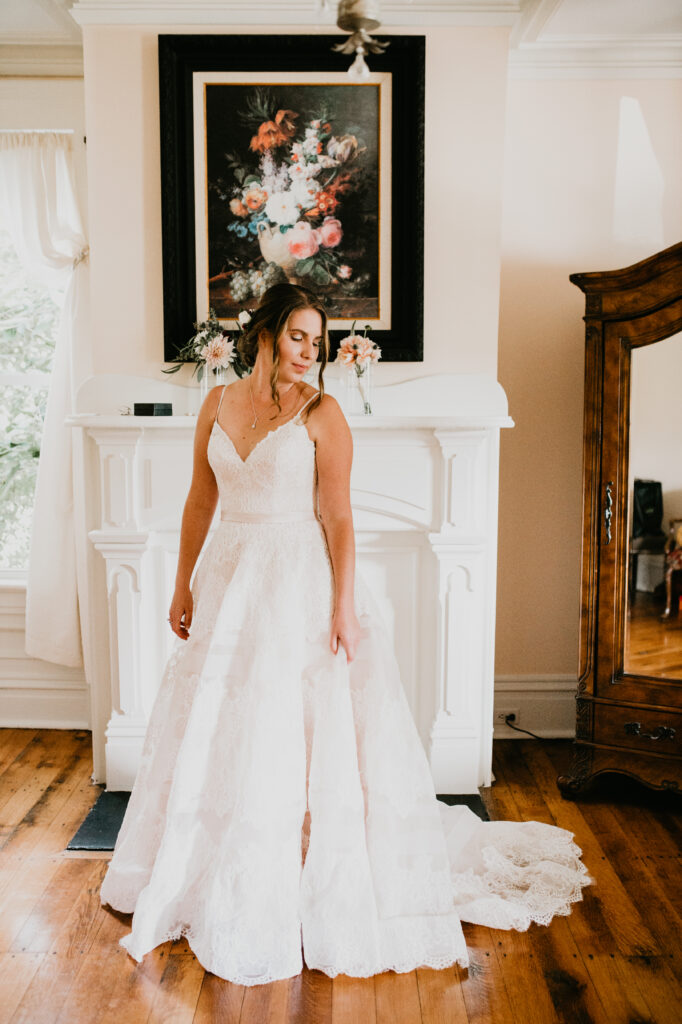
brides white dress in front of white fireplace and black flower painting

A Farm Built for Elegance and Charm

A soaring, 30-foot ceiling, perfectly weathered timber beams, string lights and soft glows. The ceremony is held by a small lake where 20 white church pews are filled with dear ones. One wedding that inspires the idea to offer Bramblewood Farm to others who want to exchange their vows in a natural setting. This farm showcases the wide sky and sweet air.

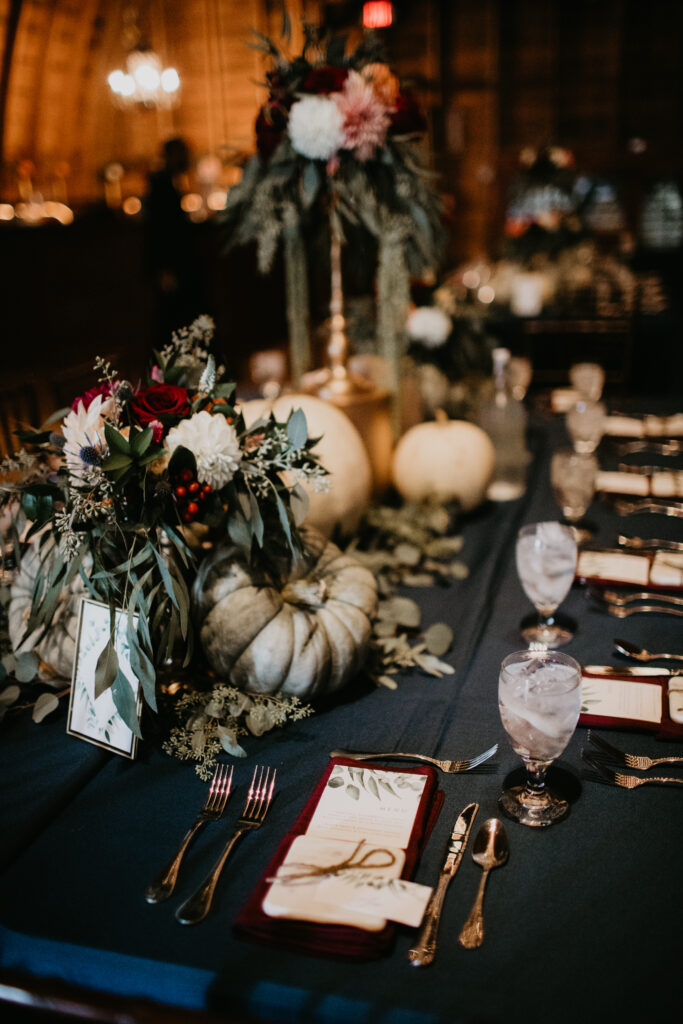
table set up with greens and dark red with white pumpkins

“We thought we might book three weddings that first season, but we ended up booking 10! We’ve been fully booked ever since, doing between 22 to 26 events from May to October every year,” says Emma. “Bramblewood is my childhood home and I always knew I wanted to get married on the farm even before my sister had her reception there and it became a full-fledge wedding venue.”

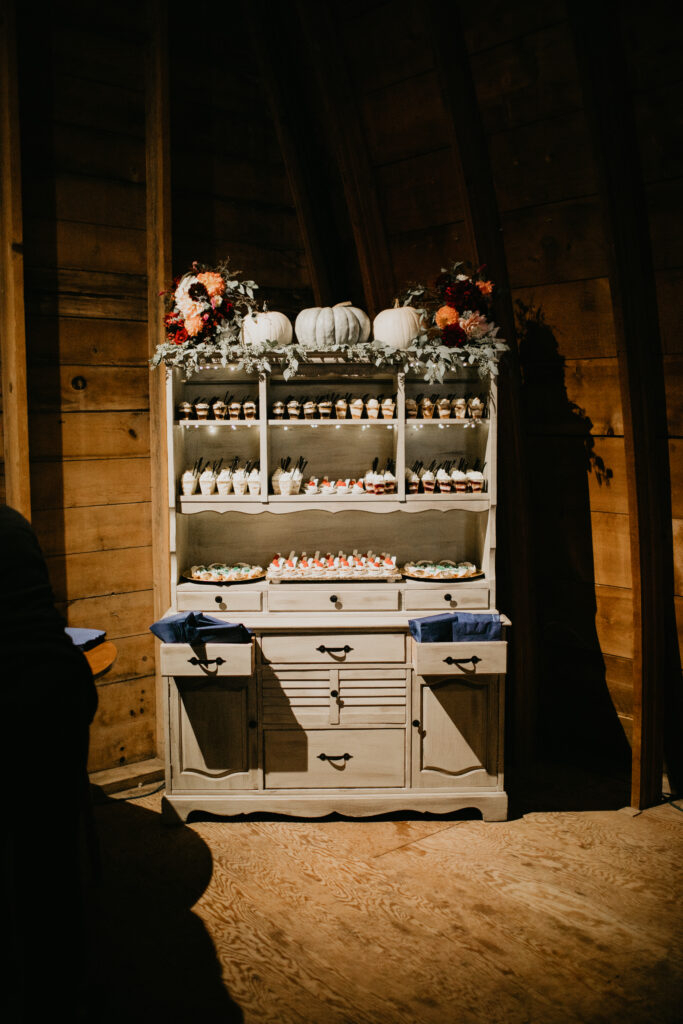
green rustic shelf with pumpkins on top

Additionally, with fall being her favorite time of the year, Emma and Tyler set the date for September 28. The couple wanted a vintage romance vibe: old-world charm that felt like a fairy tale.

rustic brown barn ceiling with hanging white fairy lights

From Farm to Reception

For the reception, Emma and her father grew specialty pumpkin varieties, Jarrahdale and New Moon. Their muted, wistful colors of greenish gray and whites were perfectly arranged on each guest table. Fresh-cut dahlia’s grown on-site and fragrant, red roses are set up for an extra visual pow. To capture the memorable moments, cameras clicked during the golden hour, when the sun hangs low and magic fills the air. 

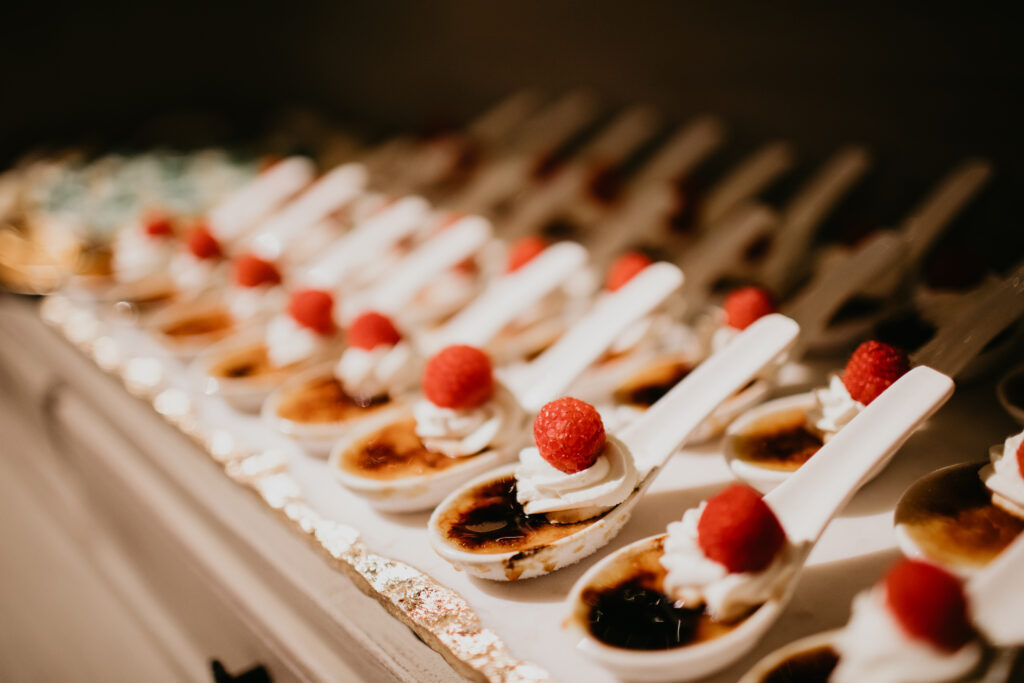
wedding dessert spread out with red cherries

“We wanted our guests to be surrounded by and immersed in the beauty and bounty of the farm,” she says. “When we look back at our wedding day, we feel overwhelming love. Not just the love that Tyler and I have for each other… but also the love that we have for our friends and family and love they have for us in return.”

bride and groom holding each other in flower field

Details

Venue: Bramblewood at Simmons Hickory Farm
Cake: Bella Christie, A Sweet Boutique
Caterer: Fish Hawk Acres
Flowers: Bramblewood at Simmons Hickory Farm
Dress Designer/Store: Allure Brides/Sorelle Bridal Salon
Groom and Groomsmen: Macy’s
Rings: Jared
Hair and Makeup: Friends and family
Wedding Planner: Emma Davidson, née Simmons

Reception décor designed by Windswept Entertainment & Event Rentals for flatware, glassware, and linens, Bramblewood supplied some of the décor and antique furniture.

Story by Kate Benz
Photography by Talia Nelson

Subscribe to TABLE Magazine’s print edition.
East Liberty Restaurant Palm Palm is Your Ticket to Paradise in Pittsburgh

0
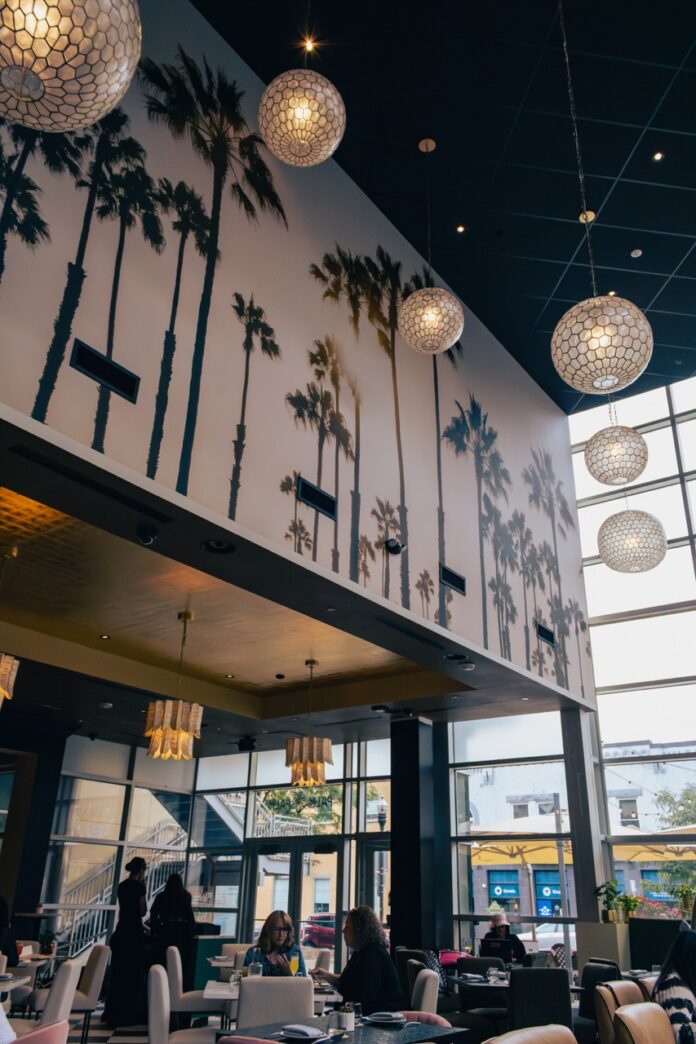
A wall of palm tree art with glowing orb lights hanging from the ceiling of the Palm Palm dining room.

A sunny day with the perfect temperature and a vibrant blue sky is a rarity in Pittsburgh. But, at the new restaurant Palm Palm in East Liberty, it’s an everyday experience. 

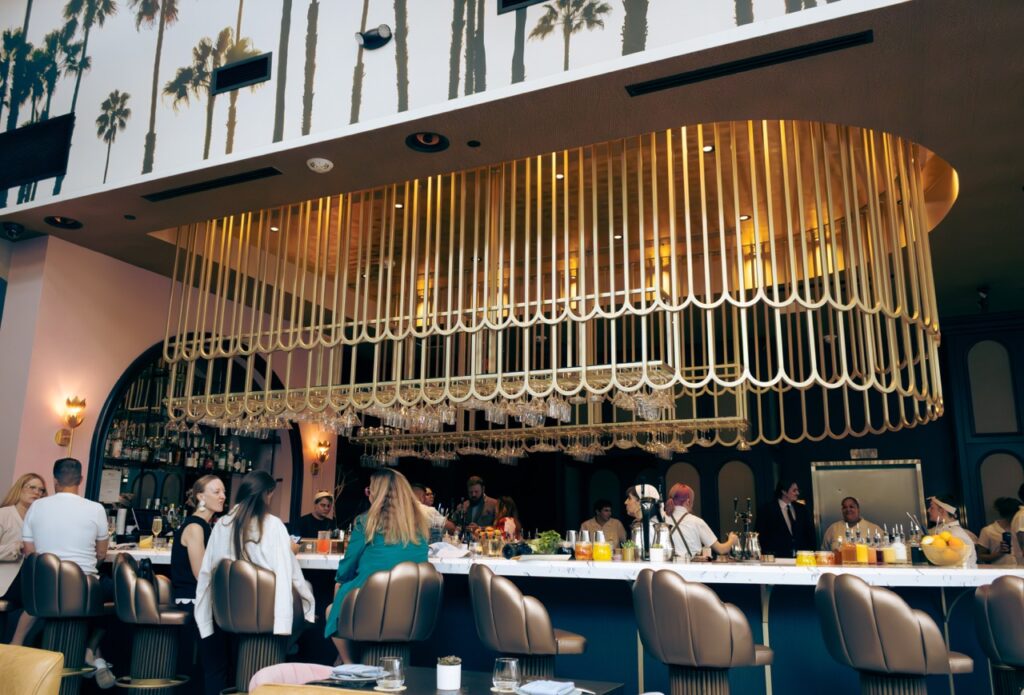
A long bar with people sitting in chairs with a mural of palm trees above it.

Palm Palm Paradise

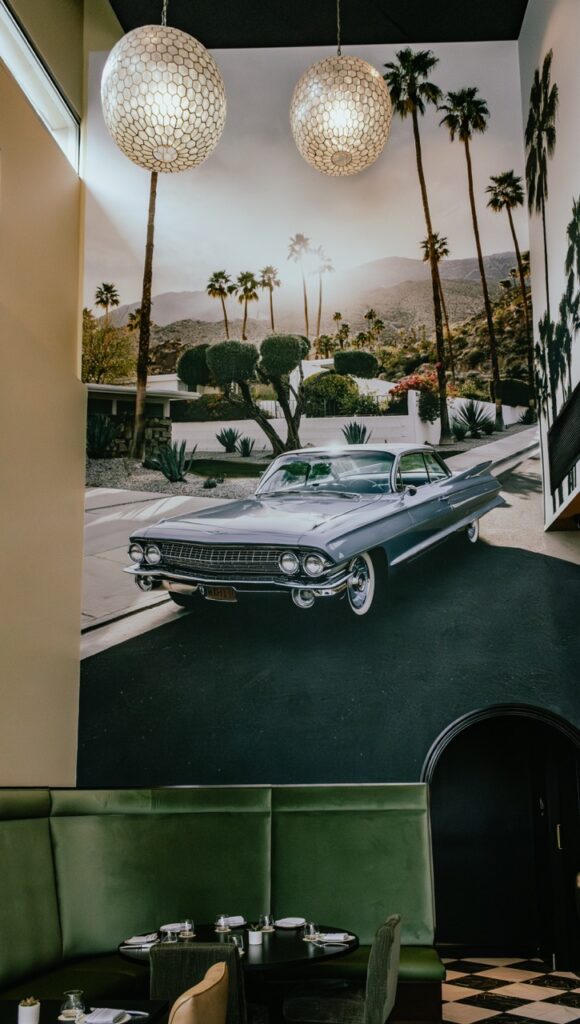
A concept by Herky and Lisa Pollock along with Chef Ed and Amanda Smith, Palm Palm brings a Palm Springs attitude to the Northeast. Think large, waving palm trees, shades of emerald green, gold embellishments, and an overall commitment to all things California. With their official opening on July 6, Palm Palm extended an invitation to TABLE Magazine to take a tour, to try the best and brightest on their menu, and have our own little escape to the West Coast. 

Travel to the Coast

When you walk into the large glass doors of Palm Palm on the corner of South Highland and Center Avenue, it feels like you’ve taken a plane ride to somewhere special. Natural light floods the lofty, open space with high ceilings and contemporary pendant lamps shedding copious light.

Palm Palm's red lounge area with a long couch, chairs and frills over top.

The lounge at Palm Palm.

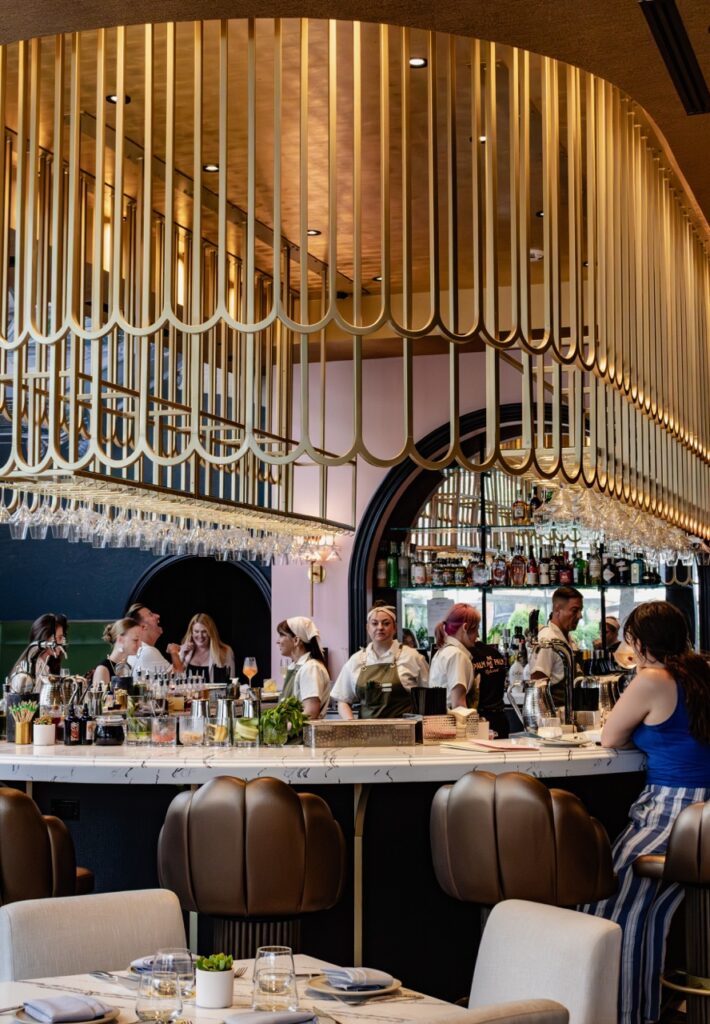
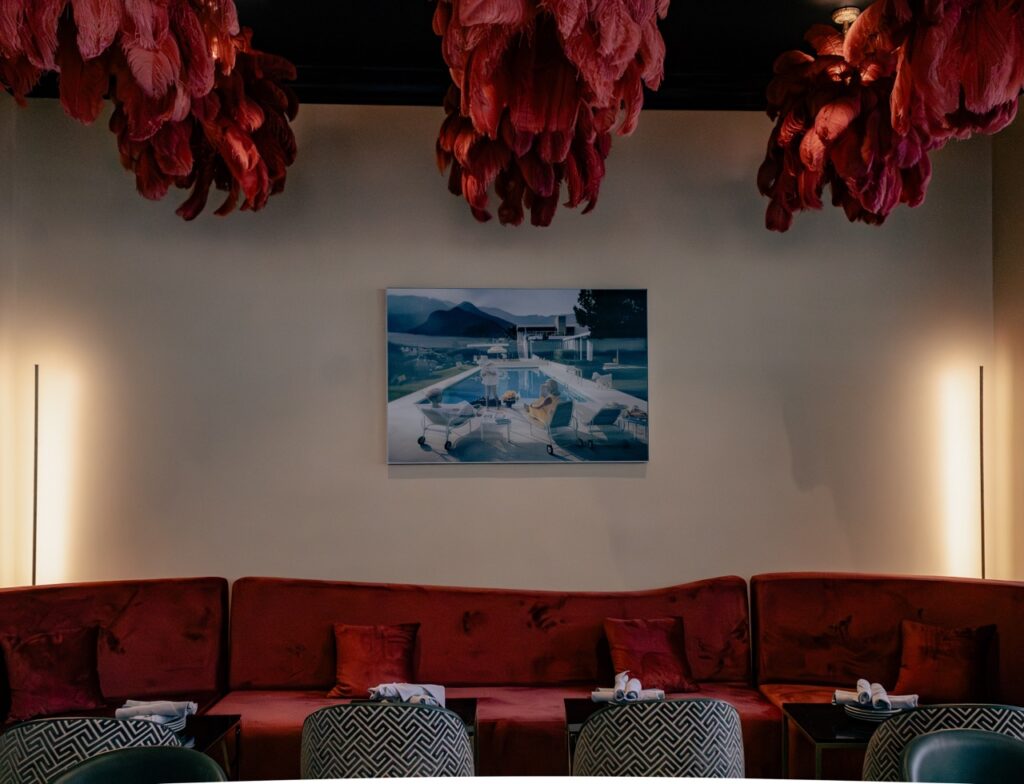
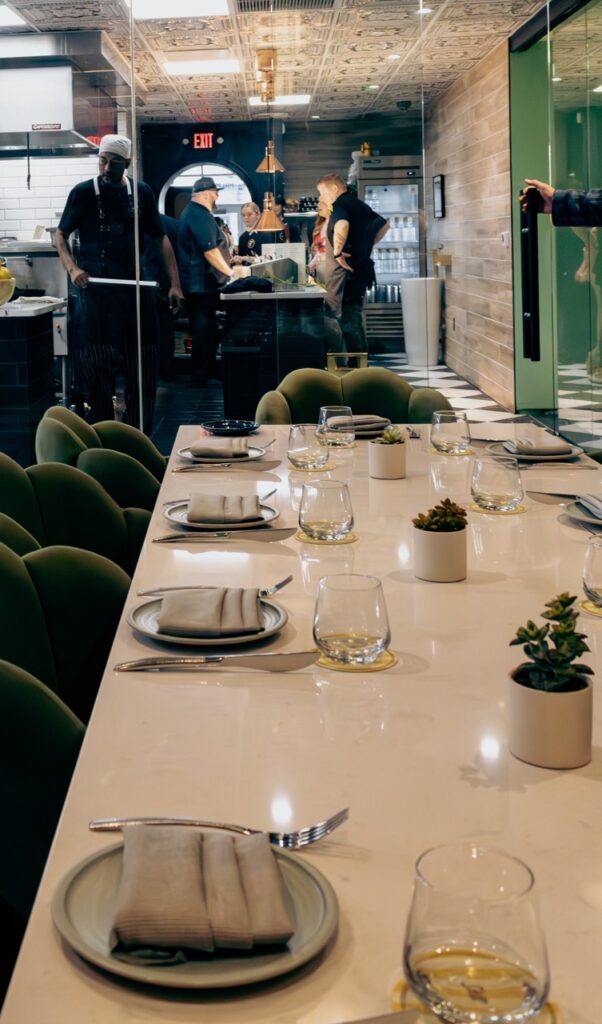
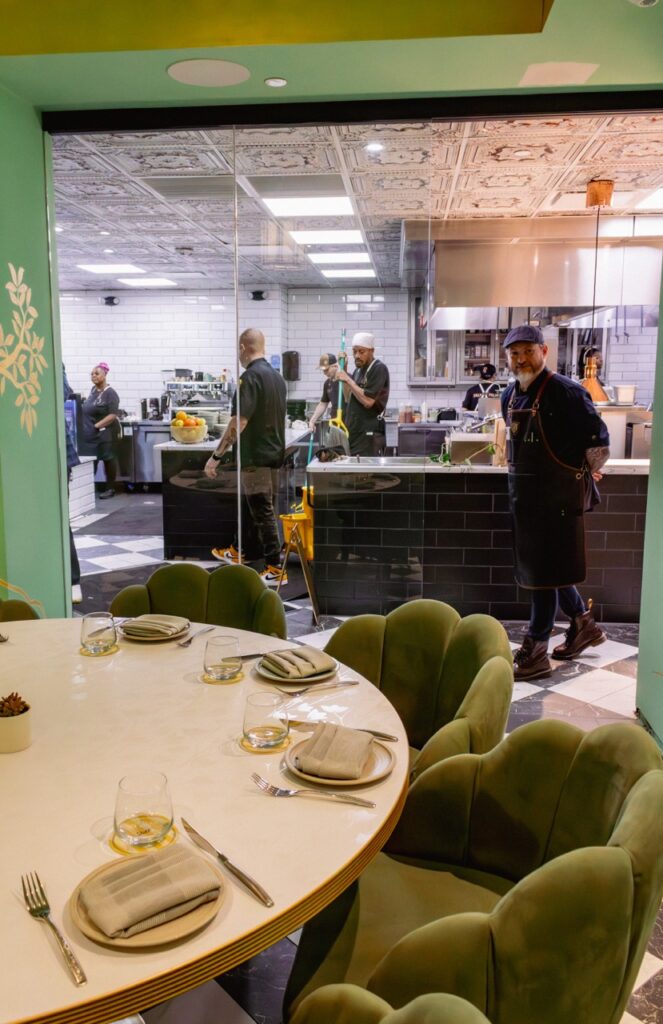
A huge, horseshoe-shaped bar wraps around one end of the restaurant while a stylish lounge sits off to the right, full of vintage Palm Springs photographs. The kitchen awaits in the back, just a short walk from the entrance. Just inside the kitchen are two private dining rooms which look directly into the action of the kitchen but maintain an element of intimate privacy. These rooms feature custom-painted murals of cooling greens with gold leaf details, and scalloped velvet chairs. 

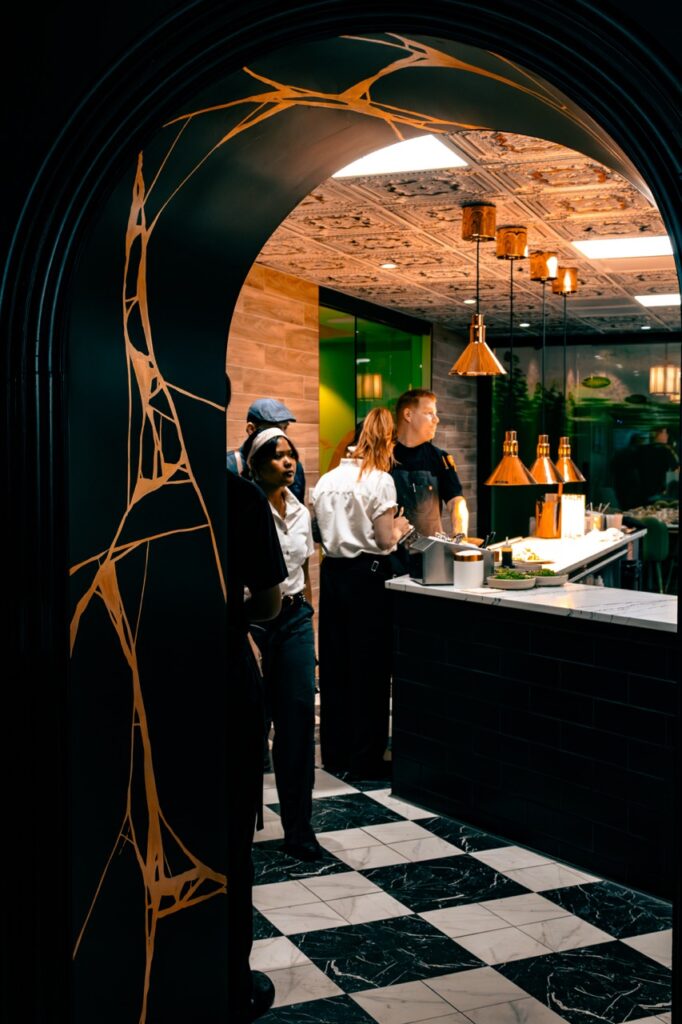
Inside the kitchen. “Green returns as the focal color of two private chef’s tables. These are separated by walls of glass from the busy (and immaculate) kitchen,” Recker explains. “One is decorated with stylish hand-painted gold foliage inspired by classic Degournay patterns. The other immerses you in watery, cool green brushtrokes and references to lily pads. Both elegant spaces would be fantastic spots for private parties. They’re shielded from the din of the kitchen but not its graceful dance of waiters, chefs, and sous-cooks.”

An Adventure Through Decor

TABLE Magazine Editor-in-Chief Keith Recker found a fondness for the space almost immediately. 

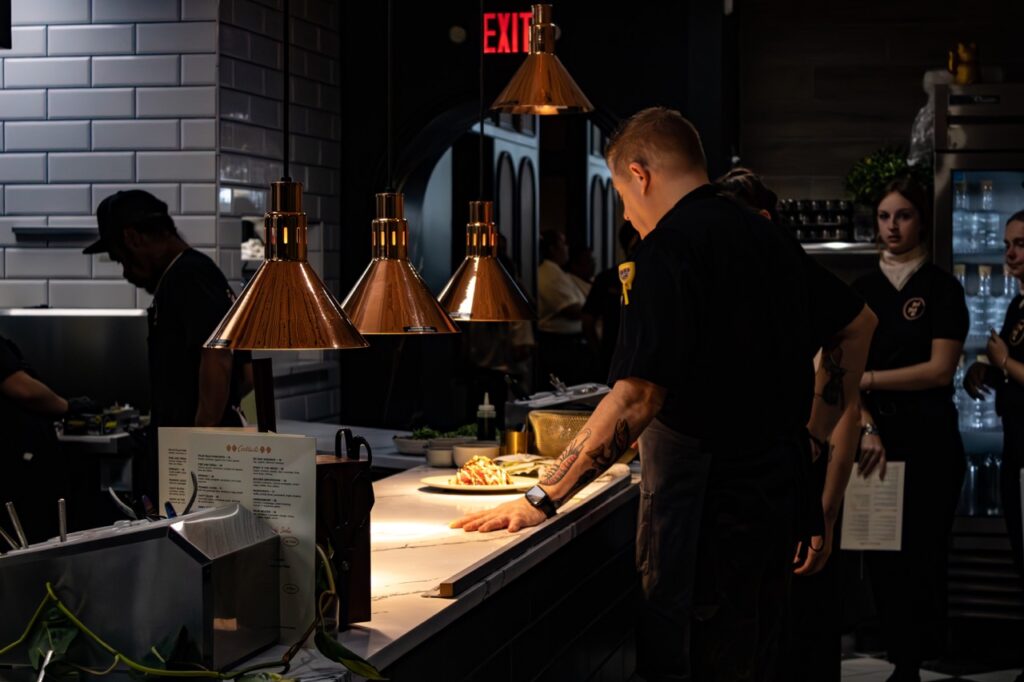
A chef looks over a dish in front of him in the Palm Palm kitche.

“A lovely and lively sense of style creates an atmosphere that provokes a smile, and invites you to linger,” Recker says. “Slim Aaron’s elegant photographs of Palm Springs from the 1970s set the tone: swanky, suave, and unafraid of glamour. References to palm trees, swimming pools, and sun-drenched swimmers clad entirely in white simultaneously lighten the mood and put a little pep in your step.”

An arch doorway with gold embellishments that looks into the kitchen.

“A scalloped architectural grill made of gold-tone metal defines the glamorous bar. A green velveteen banquette anchors the longest wall with a comfortably optimistic appeal. Though we’re seeing the space for the first time in the heat of summer, it promises to be a much-needed anti-depressant during our winter months, when massive doses of sunny color and breezy style are absolutely required.”

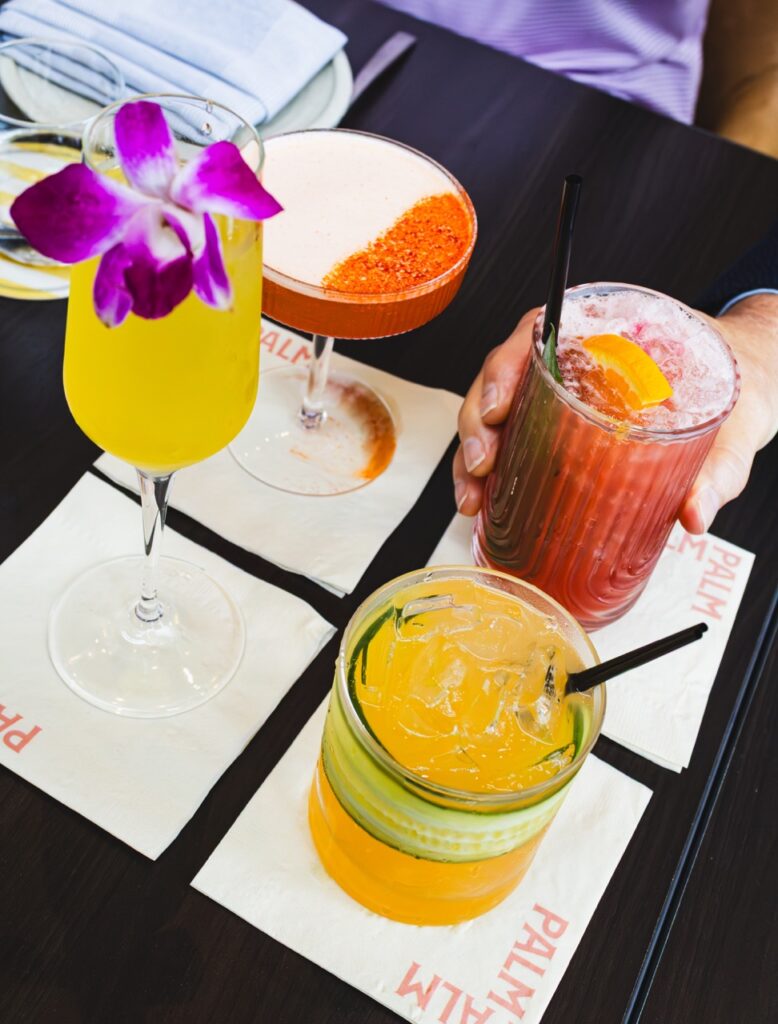
Four cocktails in yellow and red colors sit on individual square white cocktail napkins.

Clockwise from top left: Frankie Louise, Palm Reader, Can’t Elope, and Passionista.

The Lively Menu of Palm Palm

Besides the cultivated setting, it’s the warm, friendly waitstaff and what they bring to your table that makes Palm Palm a success. The menu unfolds to reveal tropical cocktails that carry a mature confidence. Our group sipped four different quaffs. Their flavors range from refreshing, bubbly passionfruit in the Passionista to a Frankie Louise with dark rum, pineapple, as well as a red li hing powder. But the selections only expand from there to include a long list of wines from various regions, brunch cocktails, coffee, and homemade sodas. 

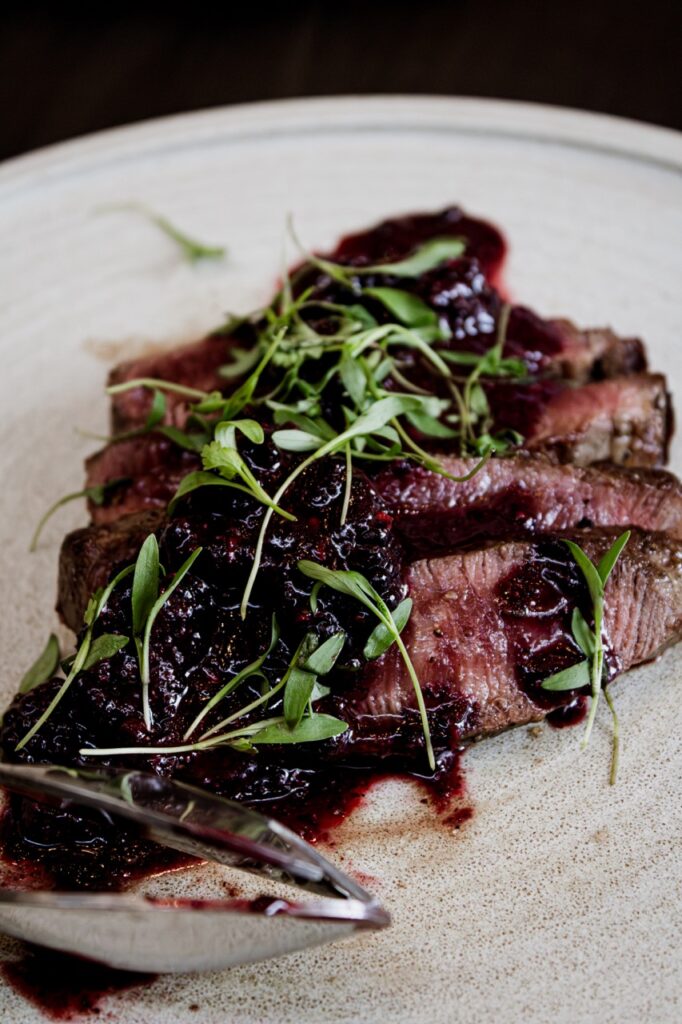
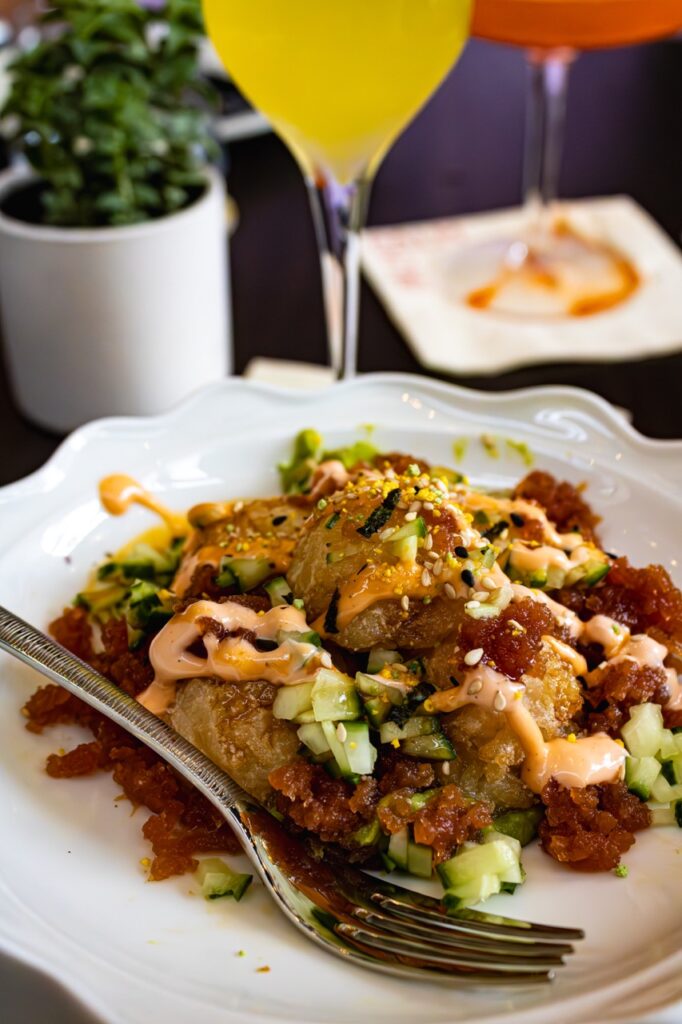
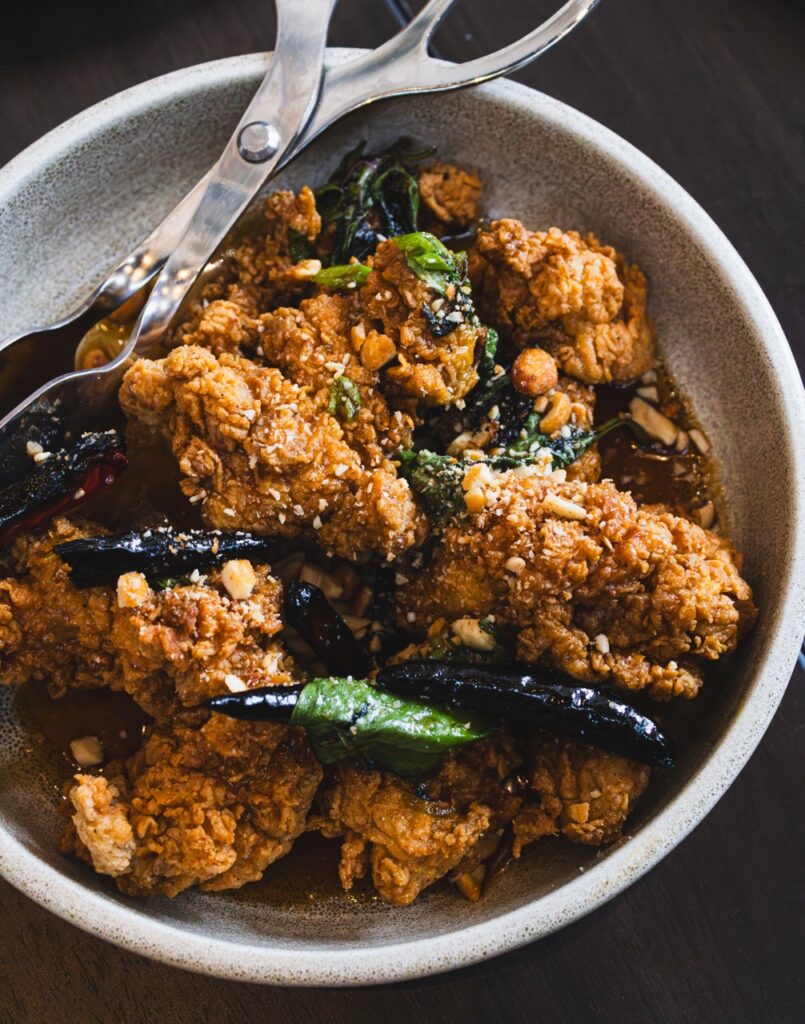
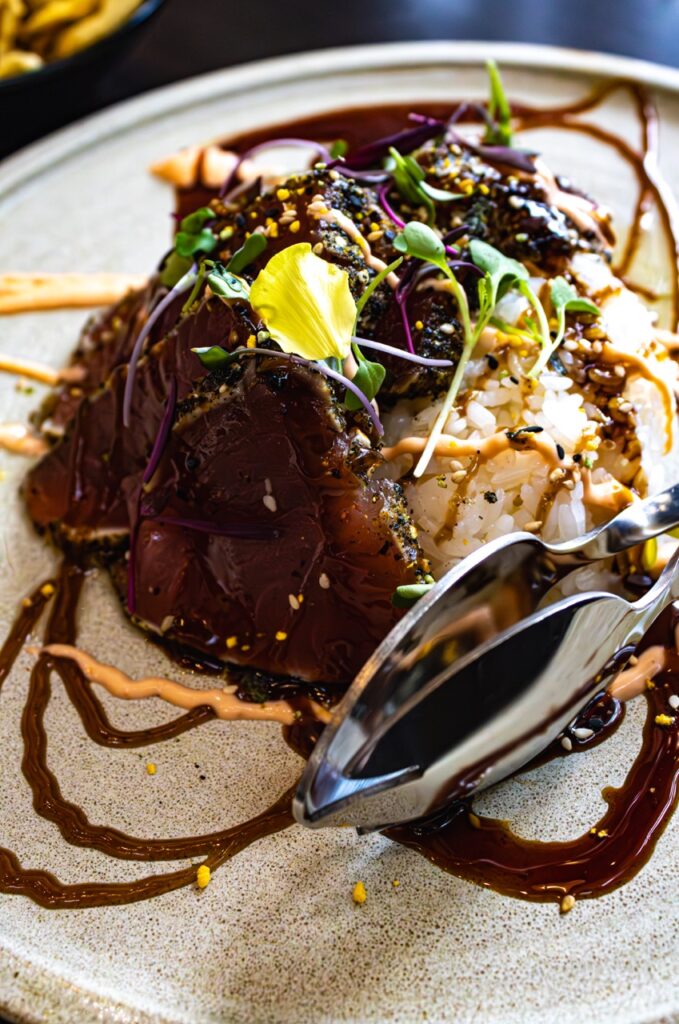
Left: Flat Iron Wagyu. Right: Tuna Sushi Tots.

Each of these beverages lines you up for a menu of small and large plates from Chef Ed to share with your whole table. The point here is to inspire you to be as present as possible during your stay at Palm Palm. You’re talking with those around you, you’re engaging with the dishes you’re diving into, and you’re immersing yourself in the “total package” of atmosphere that the interior, the team, and the menu present. 

Left: Korean Fried Chicken. Right: Bluefin Tuna Steak.

Bite Into a Taste of Palm Springs

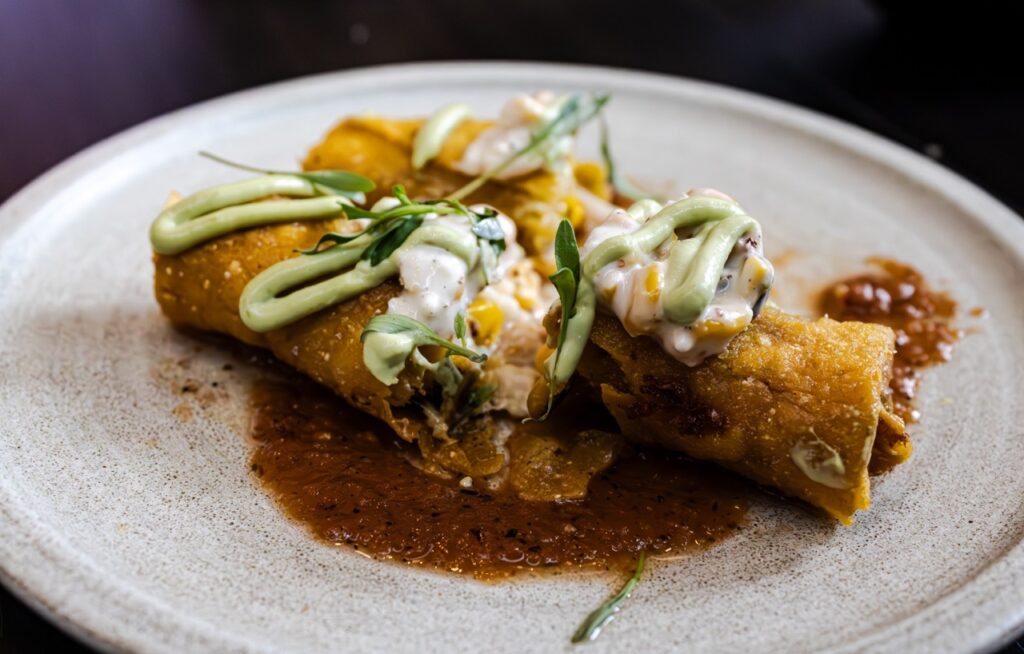
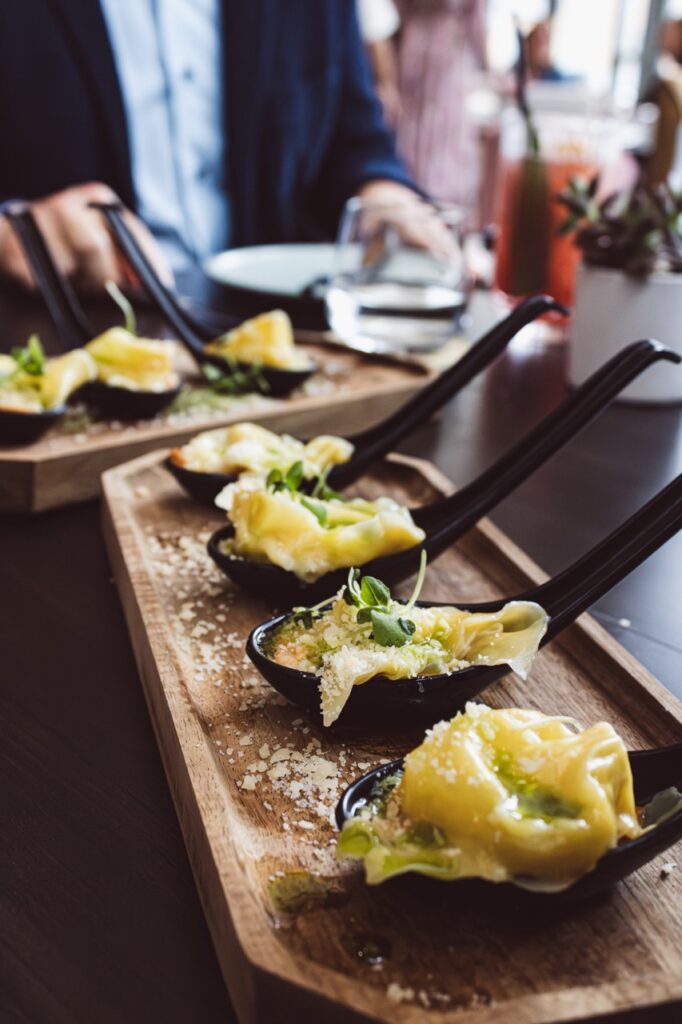
On the small plates end of things, nostalgia meets elevated cuisine. Grilled Cheese and Tomato Soup Dumplings take wontons full of cheese and place them over a savory, freshly made tomato soup. Tuna Sushi Tots change up the sushi roll concept by frying the rice into balls and topping them with cucumber, Yum Yum sauce, sesame seeds, scallions, avocado, as well as tiny bites of tuna. Even Street Corn Taquitos upgrade this classic street food into a crunchy shell in a creamy avocado drizzle. 

A street corn taquito cut in two to show the filling.

Street Corn Taquitos

If you’re opting to share a larger meal, you cannot go wrong with Korean Fried Chicken, Flat Iron Wagyu, Wagyu Ragu, and Bluefin Tuna Steak. The fried chicken has one of the crunchiest coatings with a sweet and spicy Szechuan syrup. Then, the Flat Iron Wagyu gets doused in a blackberry chimichurri that mixes sweet and herbaceous notes in intriguing ways. The Wagyu Ragu, a riff on the traditional Neapolitan Genovese Classico, is a dish for pasta lovers, featuring a veal demi-glace. Plus, the Bluefin Tuna Steak simply melts in your mouth with a sesame and pistachio coating. 

Right: Grilled Cheese and Tomato Soup Dumplings. Left: Pommes Frites & Caviar.

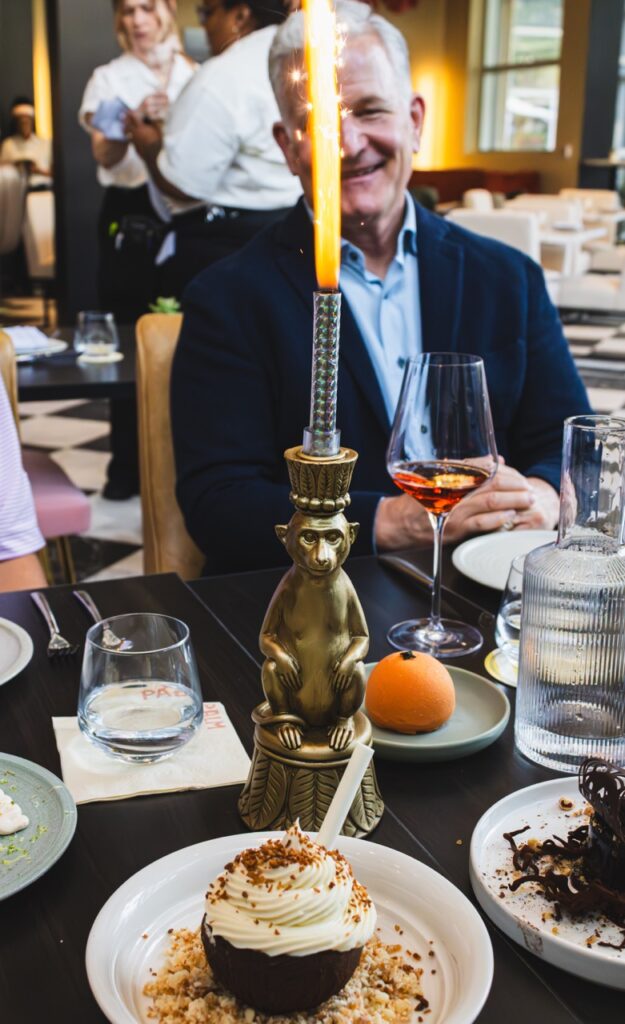
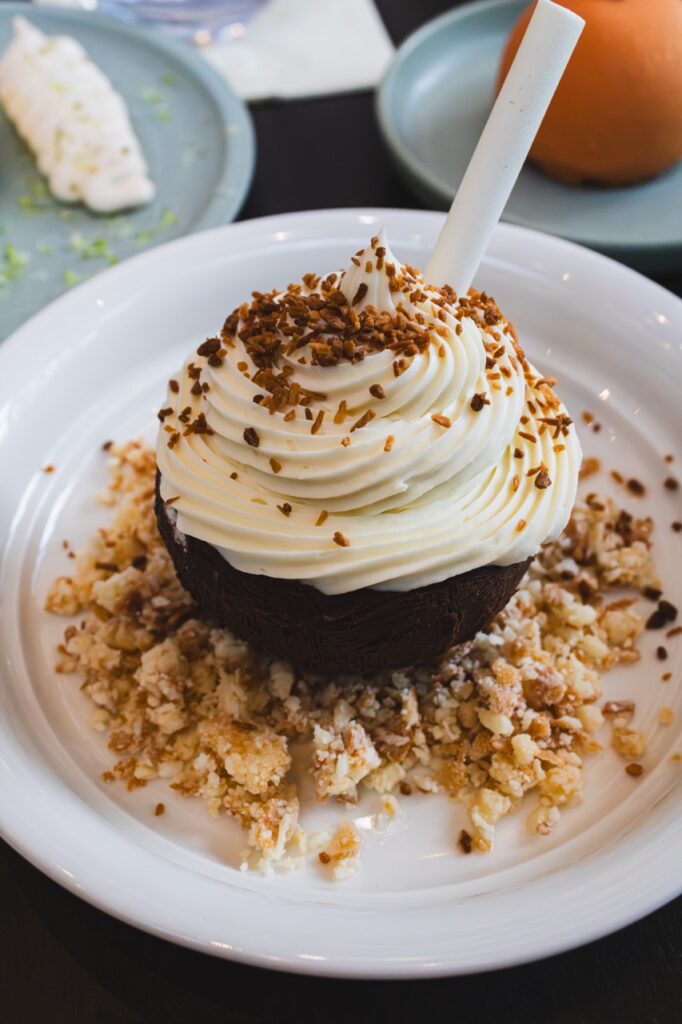
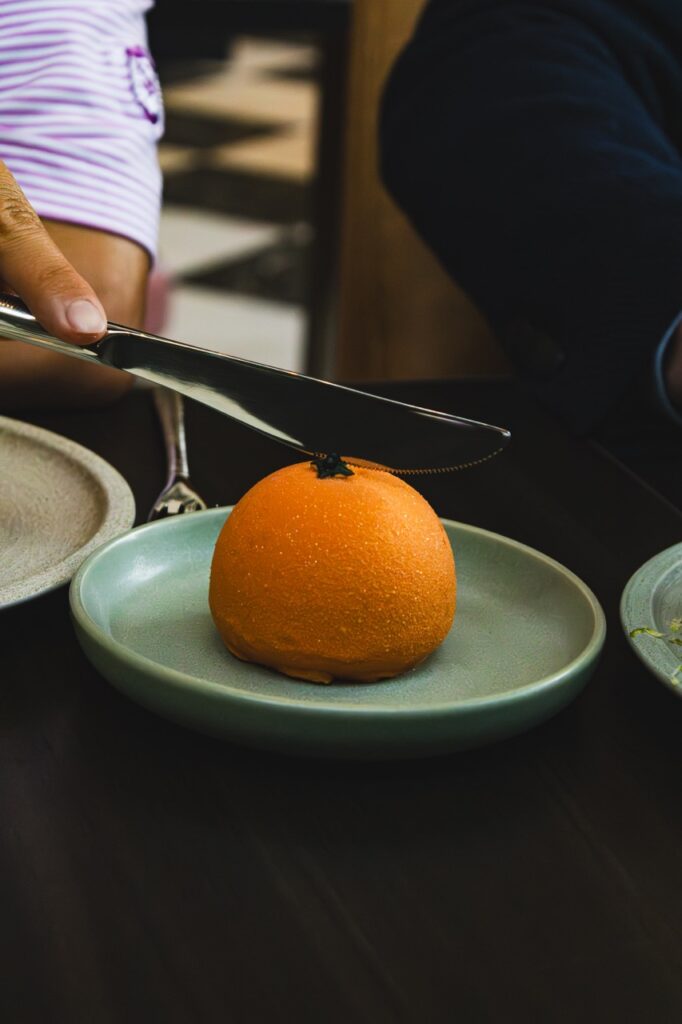
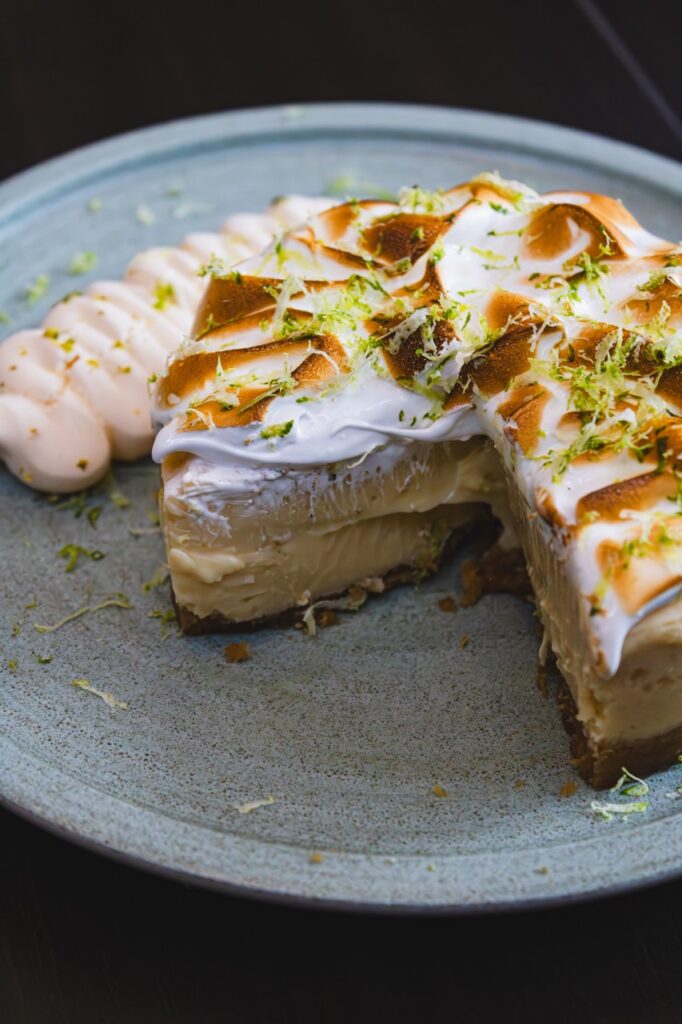
For dessert, look forward to a pastry case full of small cakes, pies, bonbons, and macarons. We ordered the Coconut Mirage, Dark Desire, Key Lime Pie, and The Orange. Each is utterly unique, finishing with beautiful garnishes. Various mousses, ganache, creams, and jellies. Even those who don’t normally find themselves with a sweet tooth will have to indulge in these decadent desserts. (Note: the Key Lime Pie is outstanding.)

See You on the Sunny Side of Life

From the moment you walk through the door to the moment you say arrivederci, Palm Palm is the place you’re going to want to celebrate the summer and stay happy in the cold of winter. The luminous personality of this restaurant perfectly complements the luxurious dishes that adorn the menu. So, meet us where the sun really does shine each day at Palm Palm in East Liberty. 

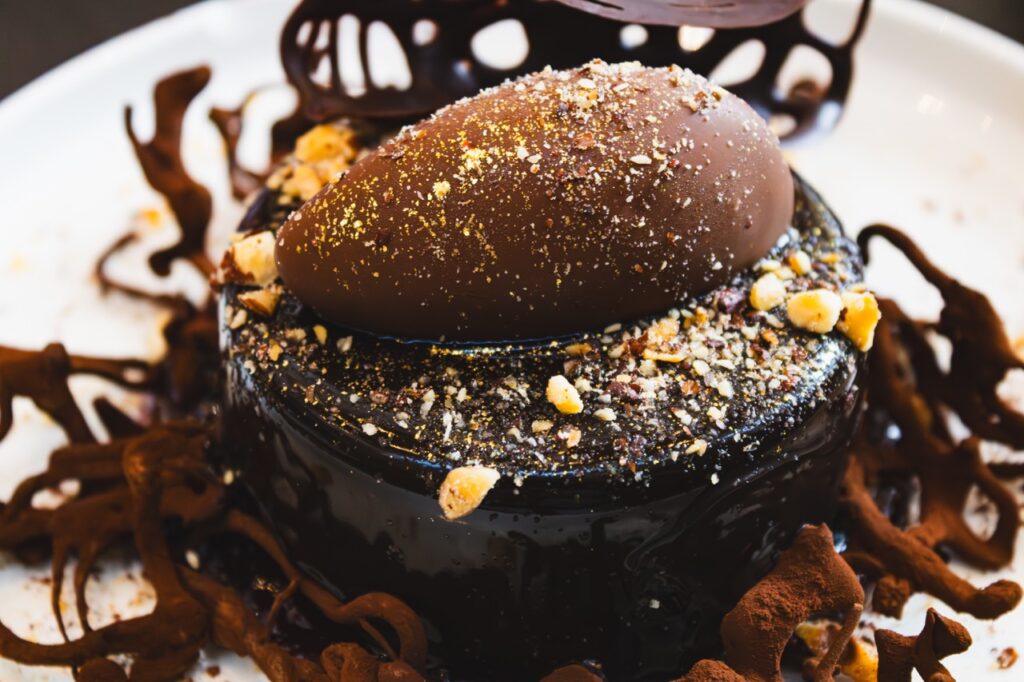
A chocolate dessert with a ganache cake, mouse, and nuts.

Clockwise from top left: The Orange, Key Lime Pie, and Dark Desire.

Story and Photography by Kylie Thomas

Subscribe to TABLE Magazine’s print edition.
Market Square Restaurants to Support During Construction

0
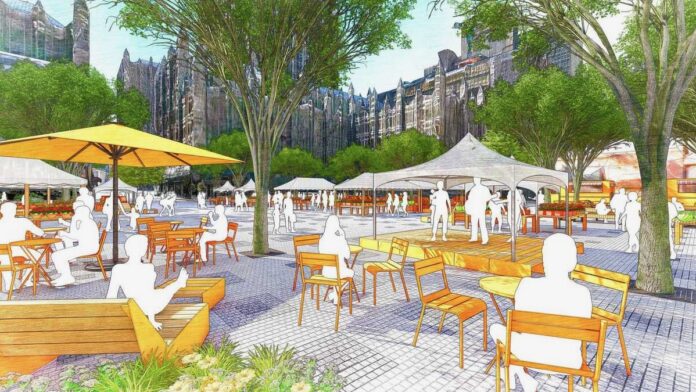
Outdoor seating that makes up the Market Square Modernization project.

When I moved to Pittsburgh, someone warned me “Pennsylvania is one giant construction zone.” This summer, the warning certainly seems justified, often to the chagrin of businesses all over the city. 2025 is a particularly intense construction summer because of the upcoming NFL draft in 2026: the city wants things to be in tip-top shape, with a special focus on Downtown. One of the construction initiatives is the Market Square Modernization project, which began in April. Though the results of the $1.5 million renovation, on track to finish by April 2026, will be positive when it’s finished, surrounding businesses are suffering right now because of the noise, air pollution, lack of street parking, and decreased foot traffic.

This means it’s time to give Market Square restaurants some extra love.

Keep in mind, first of all, that Market Square has its own valet parking service, so for only $10 per vehicle you don’t have to worry about street parking. Second, consider this list of Market Square mainstays and plan an evening visit, after construction hours.

Market Square Restaurants to Support During Construction

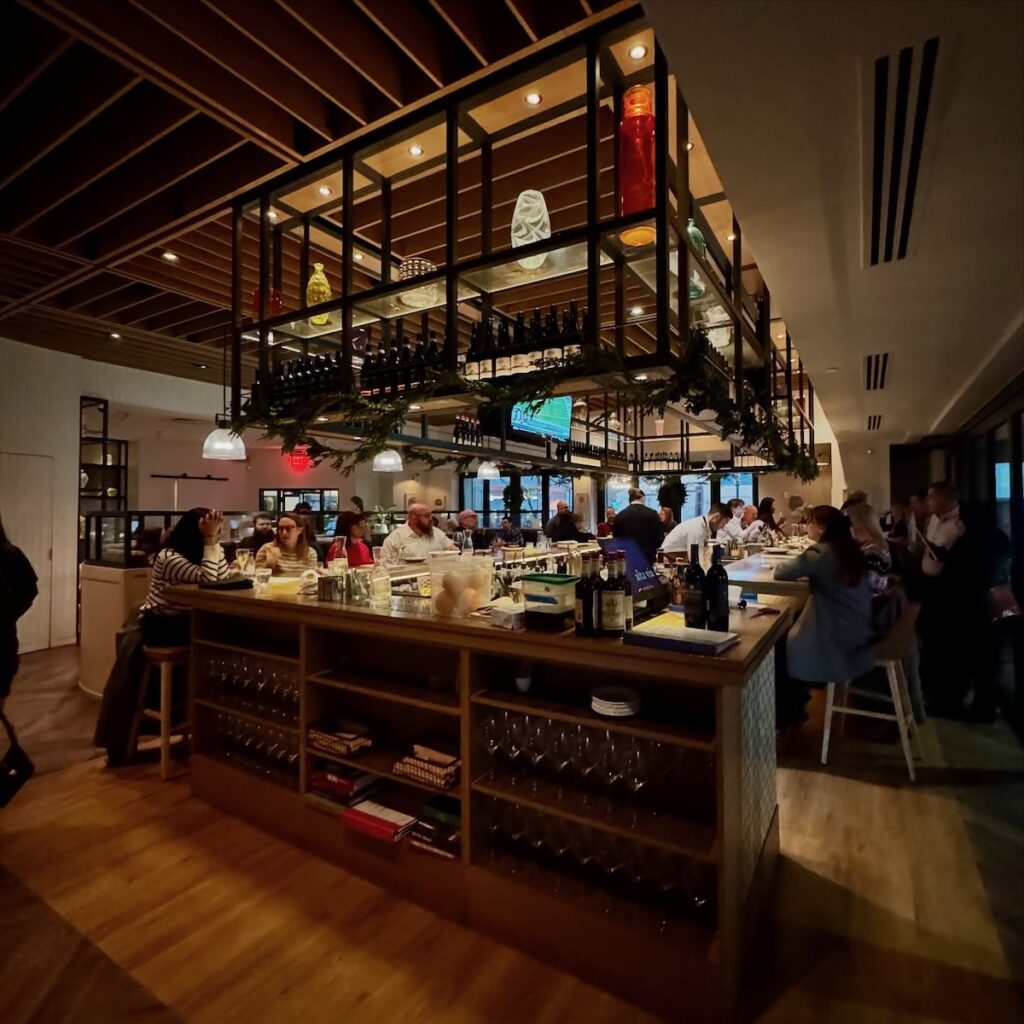
The interior of Alta Via, a restaurant in Market Square.

Alta Via

PPG Place 2, #150

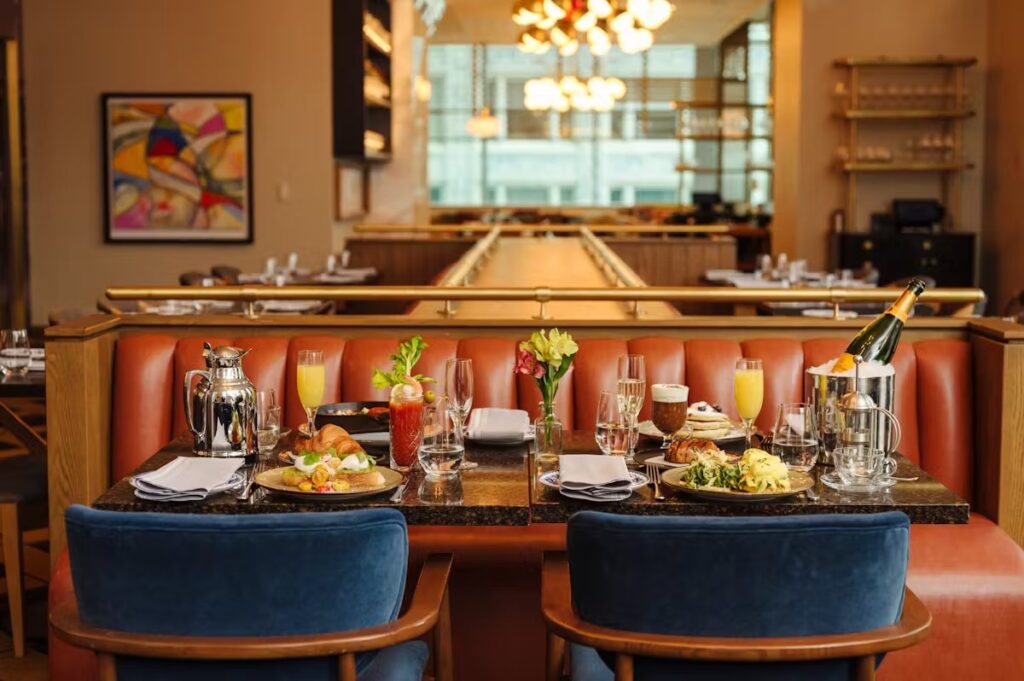
This modern Italian restaurant from Big Burrito (also the parent company of Kaya, Soba, Casbah, and Eleven) has another location in Fox Chapel, but valet parking Downtown beats sitting in traffic on Rte. 28. Alta Via’s Market Square happy hour from 4PM-6PM means $9 cocktails and wine specials, perfect for 9-5’ers in nearby PPG Place or other downtown businesses. Plus, their pasta is always handmade, so you know it’s legit.

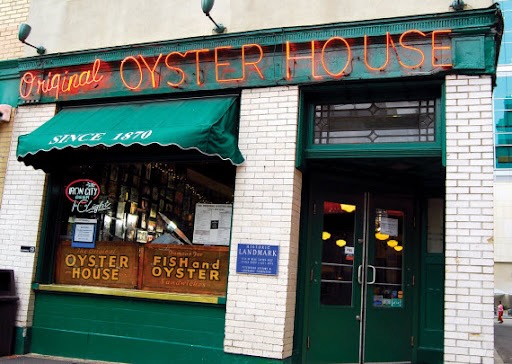
The façade of Oyster House in downtown Pittsburgh.

The Original Oyster House

20 Market Square

Even in the event of a nuclear apocalypse, Oyster House would still probably serve their traditional fish sandwich. It’s one of Pittsburgh’s very oldest restaurants, at 154 years old. “We still get a lot of people because we’re a known place, but [construction] does affect the foot traffic,” a front of house staffer at Oyster House told TABLE. It’s a classic Pittsburgh experience, no frills and delicious even occluded a bit by construction.

The lit interior of fl.2, a bar in the Fairmont in downtown Pittsburgh.

fl.2

510 Market Street

Though fl.2 isn’t directly inside of the square, it still misses out on foot traffic when there’s an overall decrease. We love fl.2 for their luxurious small plates and excellent bar service. All you have to do is go up to the second floor of the Fairmont, and you have a little oasis from the hustle and bustle of the street. The Fairmont is also a great choice if you have someone visiting from out of town (or when you have someone visiting for that storied 2026 NFL draft).

A dish of pasta with shrimp from Vallozzi's.

Vallozzi’s

220 Fifth Avenue

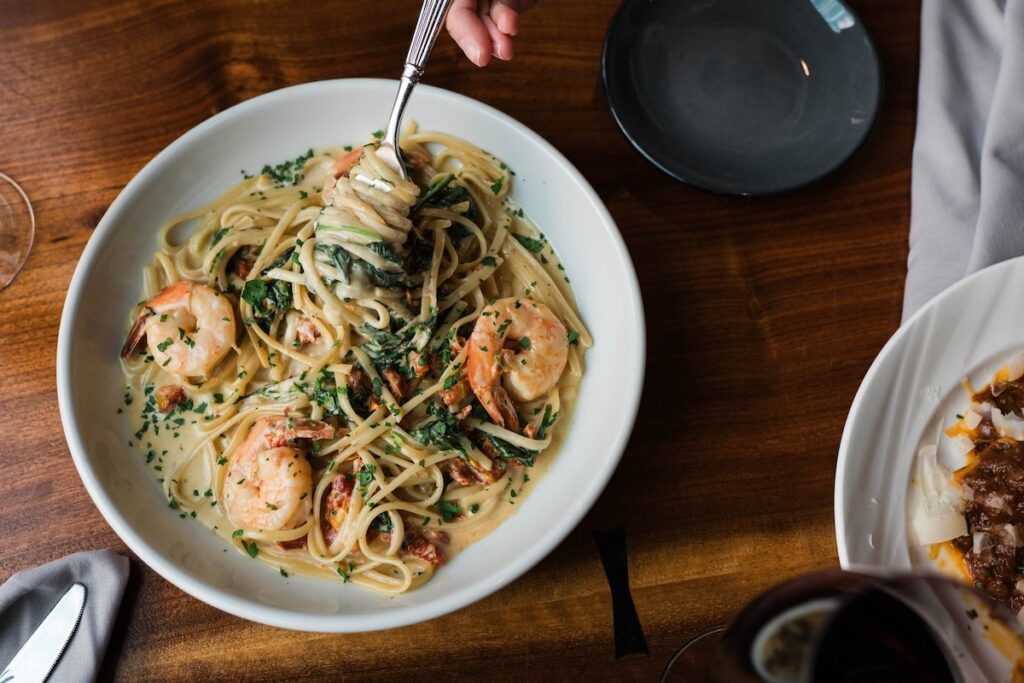
Each of the Italian restaurants in Market Square has something a little different to offer, including Vallozzi’s on the stretch of Fifth Avenue just outside of the square. Vallozzi’s is a fine dining destination that’s both classic and homey. While Helen Vallozzi’s first restaurant was in Latrobe, the family’s downtown location has been open since 2012. It’s the perfect combination of lowkey and lively, with delicious pasta and a diverse Italian wine list.

The exterior of City Works at PPG place.

City Works

2 PPG Place

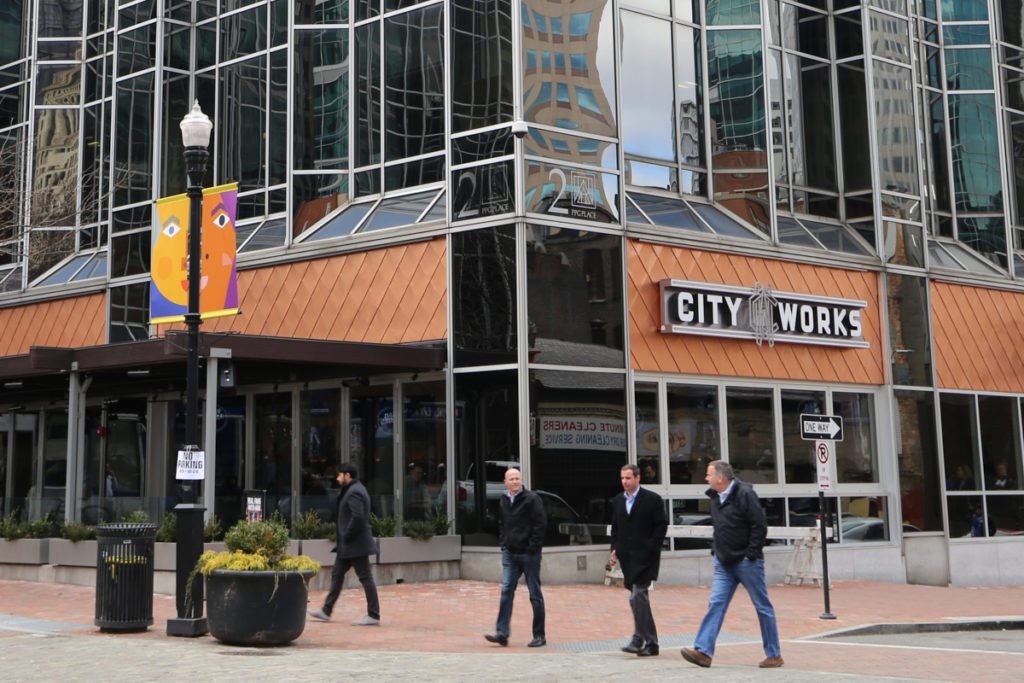
cOne of downtown Pittsburgh’s best offerings is the plethora of happy hours at local restaurants. City Works is one of the best, especially for those working in the PPG Place building. All you have to do is go down to the ground floor! Though City Works is an outpost of a national chain, it still has local flavor through themed brews and events like live watch parties for the Penguins draft. They also have a surprisingly detailed NA program if you’re looking to order a mocktail.

The exterior of classic Pittsburgh restaurant Primanti Bro's
Courtesy of Only in Your State.

Primanti’s

2 Market Square

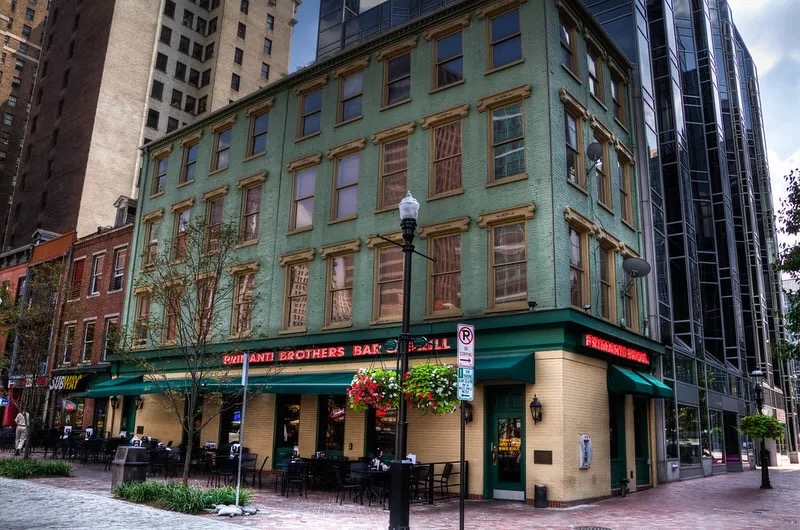
The Market Square Primanti’s is physically closest to the original Primanti’s location in the Strip, founded in 1933. While it’s hard to recapture the nostalgia of Primanti’s over the years, this location is a lot of fun for people-watching. Even with construction around it, it has a slightly cozier feel than some of the other locations. Grab your sandwich with fries on it and affirm your status as a true Pittsburgher!

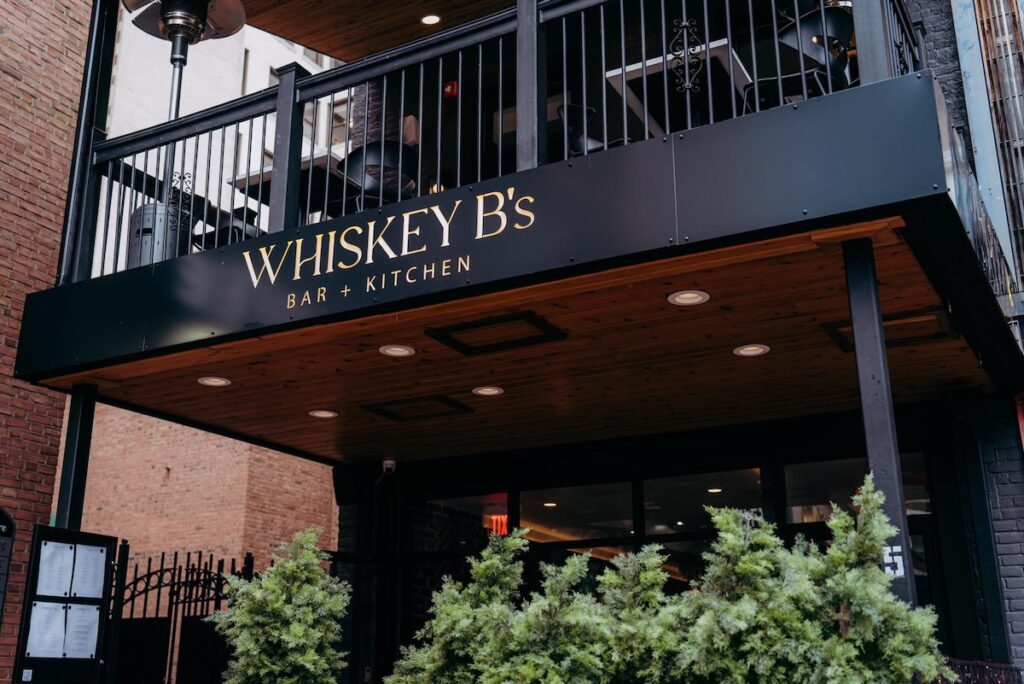
The terrace of Whiskey B's in Market Square.
Courtesy of Whiskey B’s.

Whiskey B’s

5 Market Square

This unassuming burger joint is known for its stellar service—a quick look at the Google Reviews will show you how much customers appreciate the care and attention they get there. You can get Pittsburgh classics like pierogis and the sandwich with fries, but they also do a great brunch. The bar menu specializes in whiskies, but you can also get bottomless mimosa if you’re passing through downtown on the weekend.

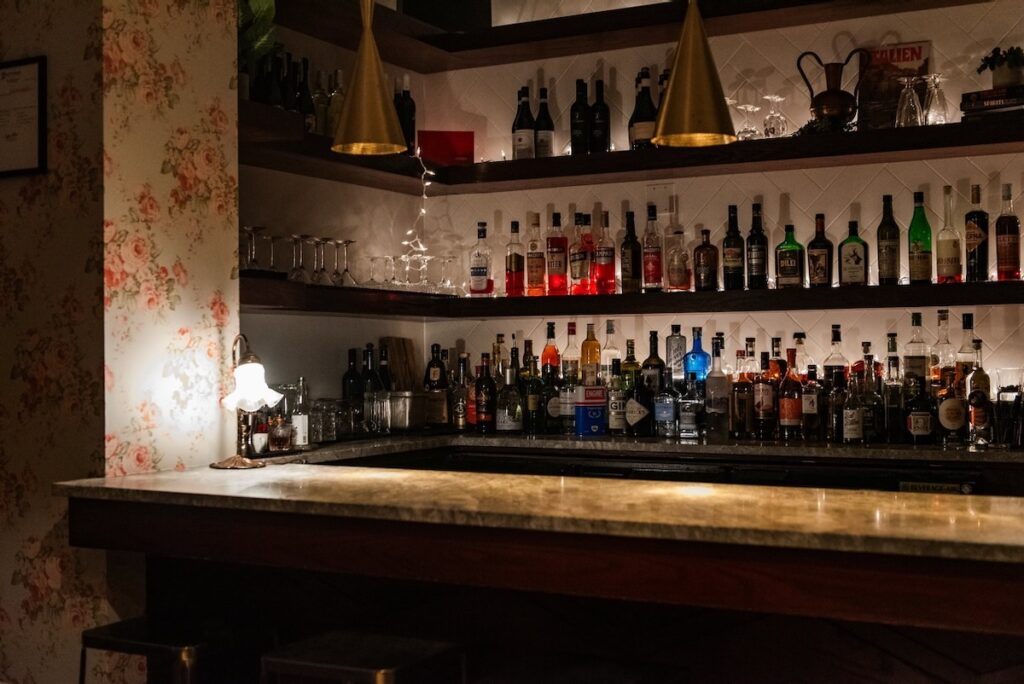
The dimly lit bar of The Aperitivo Club in Market Square.
Courtesy of the Aperitivo Club.

The Aperitivo Club

435 Market Street

The Aperitivo Club is an under the radar spot just on the outskirts of Market Square. Think of it as a slightly more authentic Spritzery, with a curated selection of Italian wines and spirits. It’s a chill, mood-lit nook in the chaos of downtown that’s ideal for pre-meal cocktails with friends before heading to a bigger meal at one of the nearby restaurants, construction or not.  

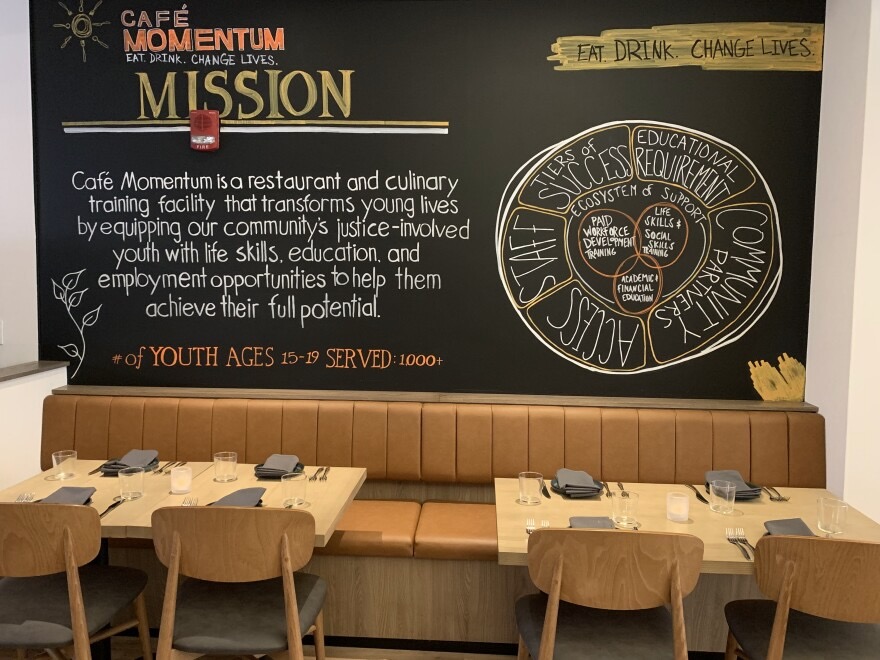
The mission of Café Momentum in downtown Pittsburgh.

Café Momentum

268 Forbes Avenue

The James Beard Awards accoladed Café Momentum founder Chad Houser with the “Humanitarian of the Year” Award in 2025 for his restaurant’s commitment to social change through food. Though it started in Dallas, Café Momentum brought its mission of employing justice-involved youth to Pittsburgh in 2023. Don’t let downtown construction keep you from enjoying good food for a good cause!

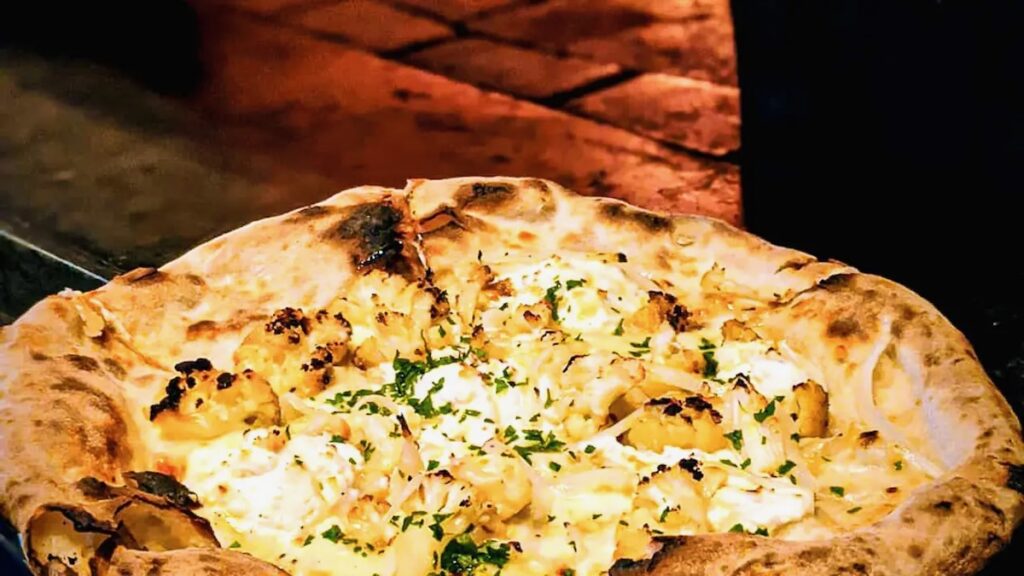
A large, luscious pizza from Pizzaiolo Primo.

Pizzaiolo Primo

8 Market Square

The original Pizzaiolo Primo in Mt. Lebanon requires braving the Liberty tunnel and the South Hills traffic. Why bother with all of that when you can come to the Market Square location and get the same high-quality pizza you know and love, while supporting a business that needs the extra push? “The construction hasn’t been as bad as we thought it would be. We have a good lunch rush,” a server at Pizzaiolo Primo told TABLE. “But what will be really tough is not having the Christmas market in the winter.” Whatever the season, now is a great time to grab a pizza and a glass of wine while supporting the restaurants you know and love.

Story by Emma Riva
Cover image of projected Market Square seating courtesy of Pittsburgh Downtown Partnership

Subscribe to TABLE Magazine’s print edition.
Don't Miss