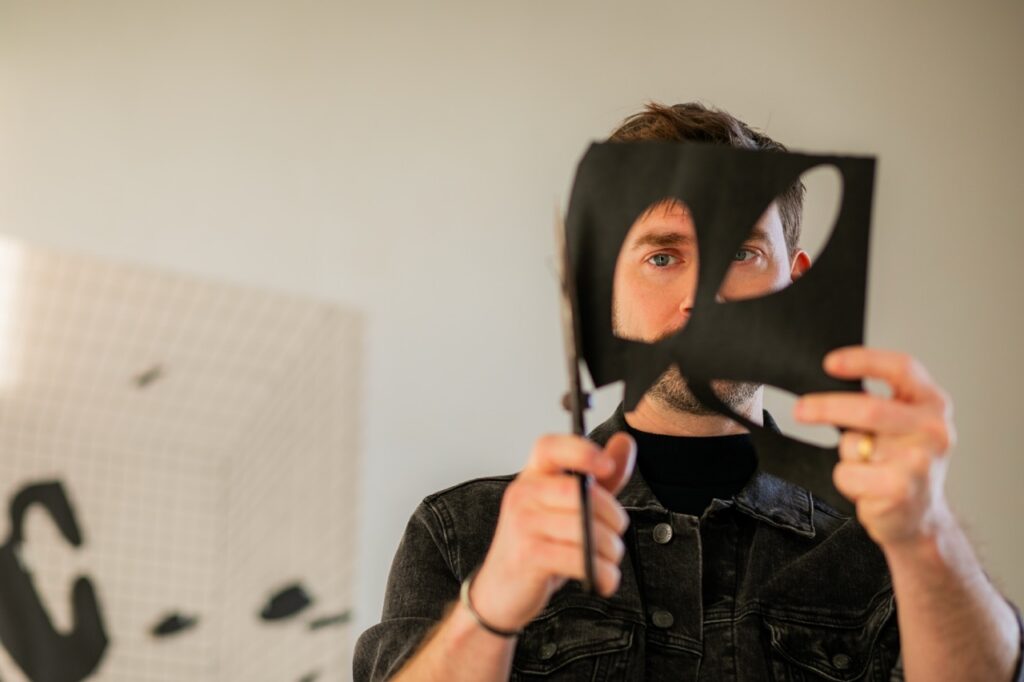
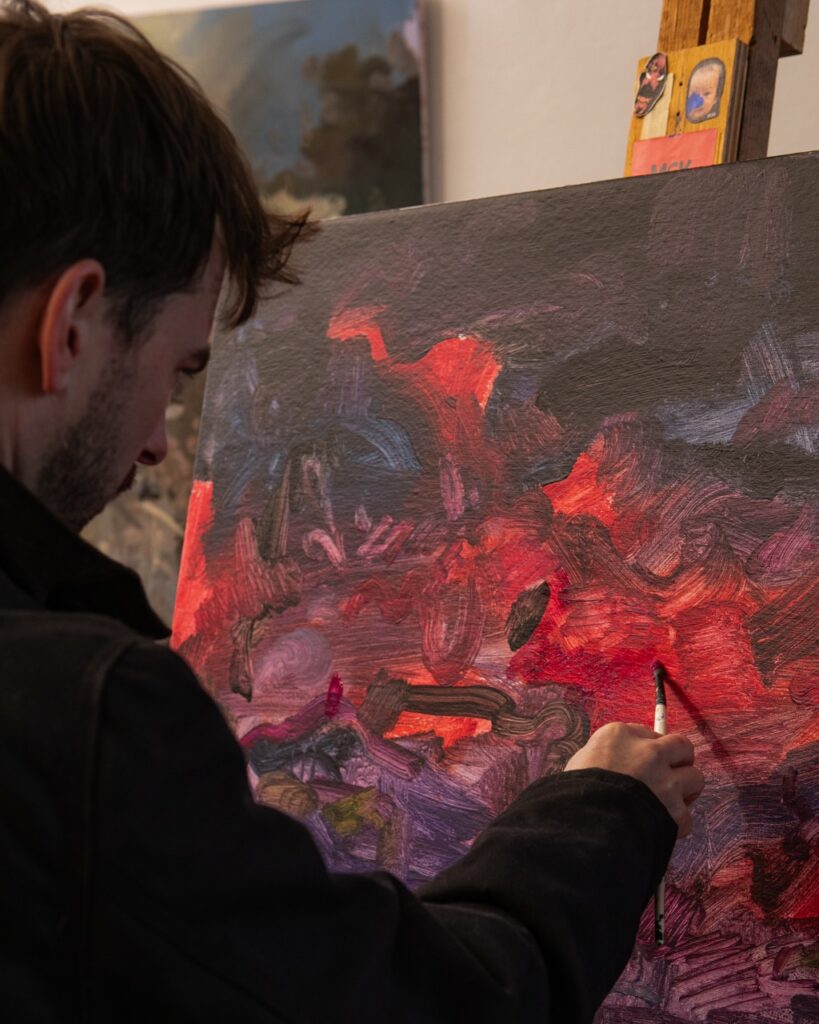
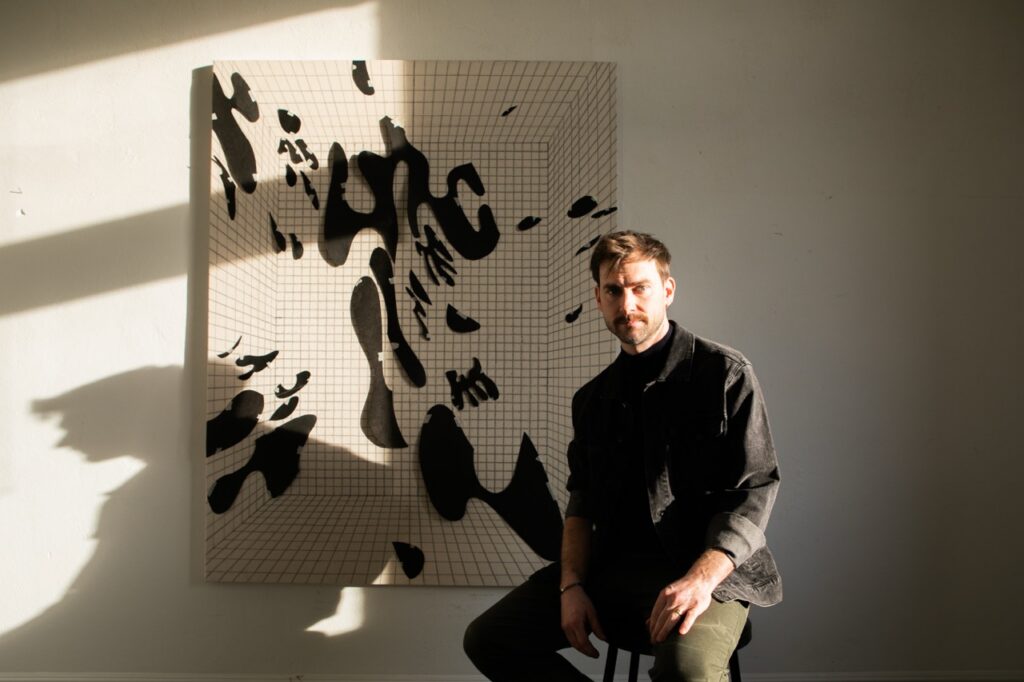
John Burt Sanders’s shifting fields of color and texture catch and keep the viewer’s gaze, reaching from retina to mind to body.
Artist John Burt Sanders and His Perspective
John Burt Sanders has spent more than a decade living and working in Wilkinsburg, but his paintings resist the idea of settling into a fixed visual language. They operate in a state of productive instability, insisting on looking as an active, physical process rather than a simple act of recognition. His paintings do not present images so much as they generate conditions: fields of color and texture that oscillate between subtle modulation and sensory overload, holding the viewer in a prolonged encounter that is felt in the body as much as in the mind.
Sanders grew up in Western New York and studied painting and art history at SUNY Fredonia before pursuing an MFA in painting and drawing at Ohio University. It was during that period, through friends and mentors, that he began spending time in Pittsburgh, drawn by the possibility of sustaining a life as an artist over the long term. Fourteen years later, that possibility has taken concrete form in a studio he has occupied for the past five years: a cavernous upper floor in a late-nineteenth-century building, its soaring ceilings and arched windows providing the scale and light his work requires.
Before it became his studio five years ago, Sanders had long admired the building from the outside. He gestures to a used flat file in the corner, recalling that when he went to pick it up, he realized the address matched the same vacant Wilkinsburg building he had passed for years. Soon after, the upper floor became his studio.
His New Style of Painting
The paintings lining Sanders’s walls mark a noticeable shift from earlier work. He describes them as “unformed,” and the word feels precise. Inspired by the pastel excess of rococo painting—think Watteau or Fragonard—these new works combine that elegance with the glitchy violence of early video games. He notes that in the graphics of games like Mortal Kombat, blood splatters often resemble Rorschach inkblots, abstract forms loaded with projection. The result is a kind of visual embrace of excess and saturation.
Sanders connects these themes to growing up queer and playing video games, noting that he always spent extra time on character selection screens—spaces of fantasy where identities are tried on rather than resolved. For him, the appeal of gaming centers on multiplicity, with new characters continually opening new possibilities. “Abstraction is by its very nature indeterminant,” he says. “That’s why I come back to it.” In painting, as in queerness, formlessness becomes a site of freedom. It holds the capacity for competing impulses without forcing resolution.
That same logic shapes the making of the work. In Sanders’s practice, influences loop back, recur, mutate. Knowing when a painting is finished is intuitive, he explains, and he is careful not to overwork a surface: “Process should never be debilitating.” What matters, in the end, is keeping the work from ever fully settling.
Story by Shawn Simmons Photography by Laura Petrilla
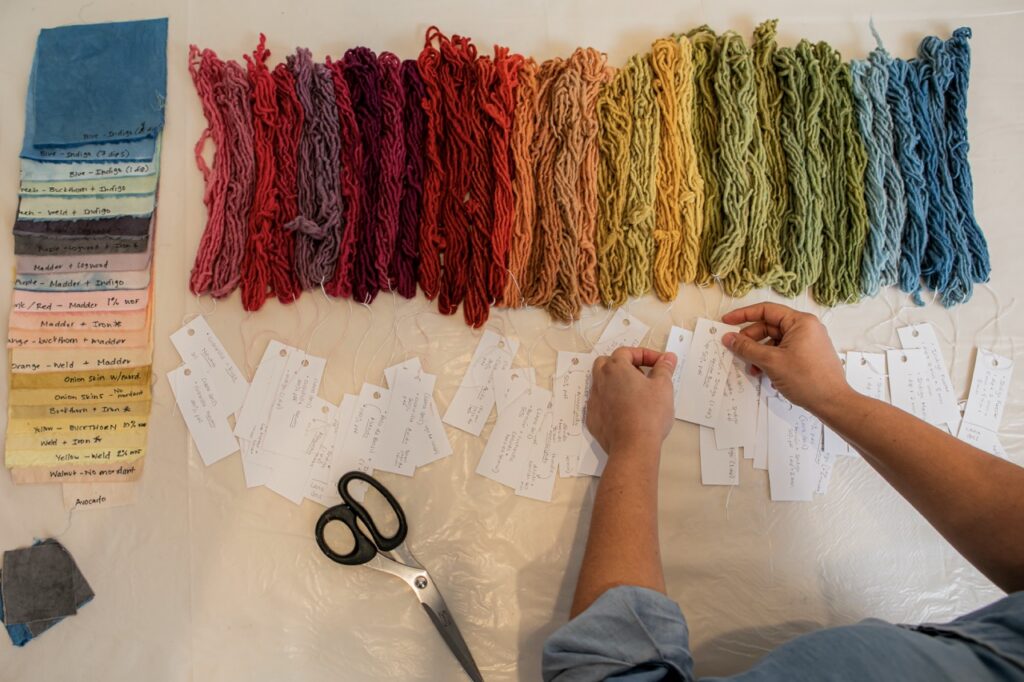
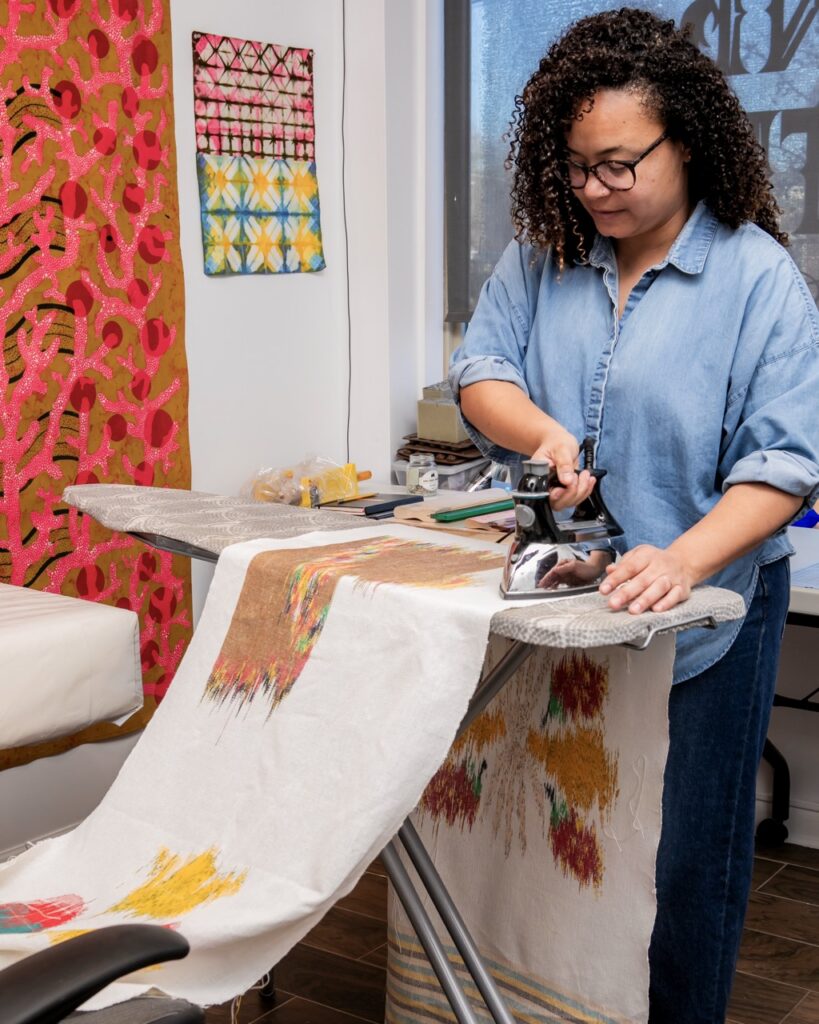
Addoley Dzegede often identifies as a textile artist, though her practice continues to expand from that base through inquiry rather than medium. What holds her body of work together is a sustained attention to the histories remembered by and through materials, and what they continue to disclose through use.
Addoley Dzegede Showcases the Art of Textiles
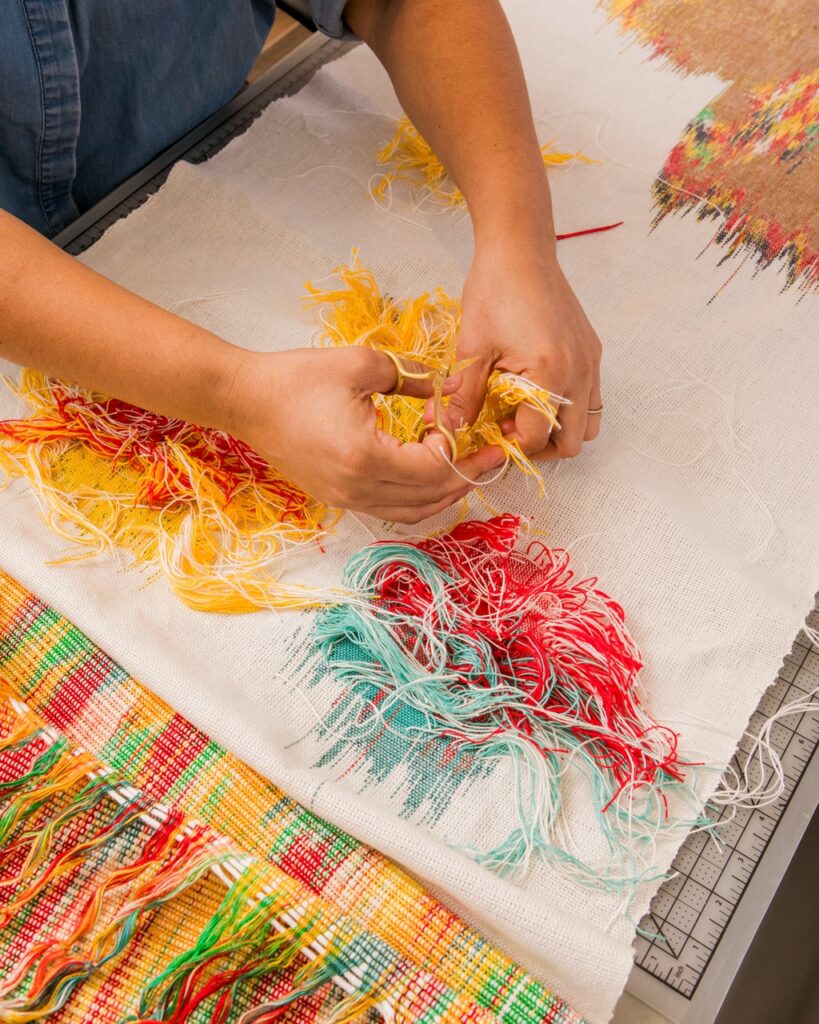
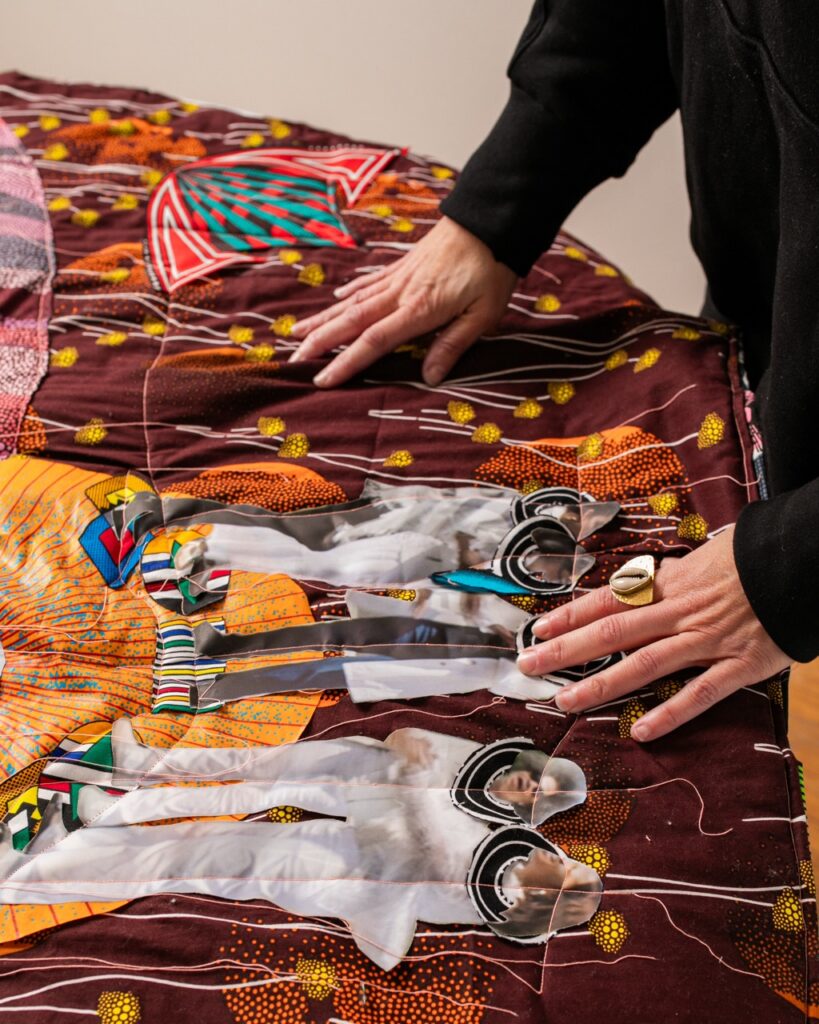
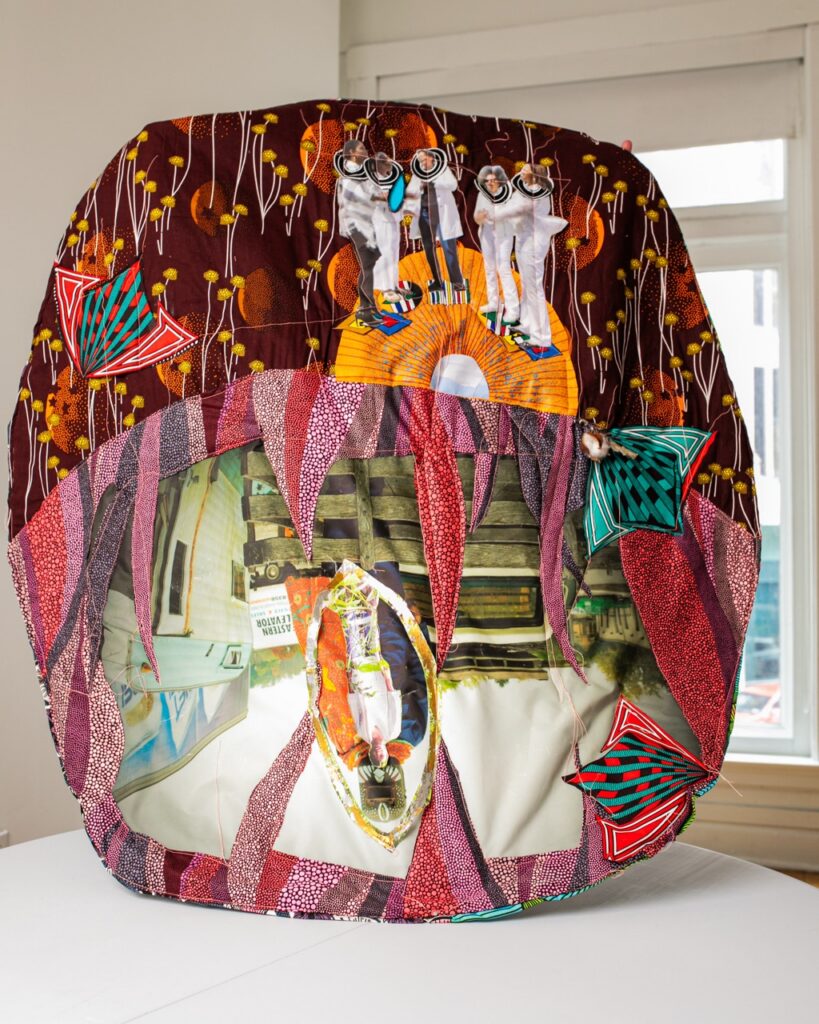
Addoley Dzegede’s work unfolds through close attention to material histories and the ways they travel. Through processes of batik, weaving, dye, and print, the Ghanaian-American artist works with textile processes that already carry cultural and economic weight, allowing those histories to remain active within the work. Her work brings personal memory into contact with histories embedded in cloth.
Pittsburgh audiences recently encountered Dzegede’s work through Nearing Each Other at the Carnegie Museum of Art, where her series Family Album brought together batik portraits drawn from her father’s photographs. The figures emerge through wax-resist dyeing, a technique now closely associated with Ghanaian textiles but shaped by colonial trade routes that carried industrialized craft processes between Indonesia, West Africa, and the Netherlands. In Dzegede’s hands, batik becomes a way to hold layered histories. Family stories surface alongside larger questions about authenticity, inheritance, and how materials come to signify place.
Dzegede arrived in Pittsburgh in 2020, with subsequent years shaped by fellowships and residencies that extended her practice across multiple sites, including a Fulbright fellowship in Rotterdam as an artist-researcher at the Piet Zwart Institute. Since returning full-time in mid-2023, she has continued to work across geographies, bringing that experience into a studio practice grounded in sustained, labor-intensive processes.
Her practice continues to push those questions through technical rigor. The technically complex “warp paintings” in her studio draw from weaving traditions associated with kente cloth, reinforcing blocks of color through tightly controlled structures. Color, for Dzegede, is never neutral. Increasingly, her research has expanded to include the chemical histories of dyes, tracing connections between industrial pigments and extractive colonial practices, as well how chemical components developed for synthetic dyes were later adapted for use in chemical weapons. The research allows material histories to collide, their tensions made visible in the work.
Collaboration Can Lead to New Ideas
Working with others creates space for the artist to move beyond the boundaries of her individual studio practice. Dzegede is one half of LAB-D, her ongoing partnership with artist Lyndon Barrois Jr. Their forthcoming exhibition Twofold presents parallel responses to shared visual prompts drawn from museum collections, each artist working at an agreed scale while allowing difference to remain visible. “We’re interested in seeing what things look like from two perspectives,” she notes. The exchange depends on a level of trust and attentiveness shaped over time.
That openness extends into other shared platforms, including Ask Addoley + Anna, an advice podcast for emerging artists produced with artist Anna Ihle, and her ongoing mentorship with artists in the Brew House Arts residency program. Dzegede describes collaboration as freeing, a way to explore ideas still in formation. Recent work includes an oral history project with her father in Ghana, unfolding through video and pointing toward new modes of documentation.
While Dzegede often identifies as a textile artist, her practice continues to expand through inquiry rather than medium. What holds it together is a sustained attention to what materials remember, and what they continue to disclose through use.
Story by Shawn Simmons Photography by Laura Petrilla
Ceramist Jeff Schwarz’s current work questions what constitutes value in our modern-day eyes.
Ceramist Jeff Schwarz Thinks Beyond the Vessel
Jeff Schwarz’s practice is grounded in the accumulation of time. Trained as a ceramicist, he treats clay as a working material shaped through use as well as sustained engagement. His studio and home, located in a long-vacant building in Pittsburgh’s Four Mile Run neighborhood, reflects that ethic. Since moving into the building, Schwarz has been slowly restoring it, uncovering layers of architectural history while making space for work that carries its own sense of accumulation and wear.
Schwarz received his MFA from Syracuse University and his BFA from Slippery Rock University, where the program was modeled on Black Mountain College’s hands-on, interdisciplinary learning. As an undergraduate, he recalls digging for natural clay near campus and forming a lasting connection to material and its histories. That orientation toward learning by doing continued in graduate school, where he worked with the Everson Museum of Art. Access to a small museum’s collection shaped his interest in institutional history as well as the ways objects circulate through time.
After graduate school, Schwarz established a studio in Pittsburgh and ran a community-based ceramics center at the Carnegie Library in Braddock. There, he helped develop North America’s first ceramic water filter research center, producing low-tech filtration systems later used internationally to reduce waterborne disease. Testing those systems grounded his work in contexts where material choices then unfolded over time and carried real consequence.
Considering What Art and Creation Are Truly About
Schwarz eventually stepped away from academia after a decade of teaching, frustrated by a broader shift toward efficiency-driven education that left little room for curiosity. Since then, his studio practice has continued to expand, shaped in part by a supportive local network. He points to the work of Brenda Friday, owner of Shoppe B in Lawrenceville, whose holistic approach to curating has provided an important local context for his work. Recent works include amphora-style vessels adorned with inverted luxury fashion logos, objects that hover between historical form and contemporary critique. The work draws on his interest in mimicry and myth to question what constitutes value.
That sensibility extends into the surface of the work itself. Schwarz has described his interest in the scrawled texts and images that layer city walls over time, likening them to wheat-pasted posters that accumulate and obscure meaning. He sees this as a form of making that unfolds across time, where one mark invites another and vitality emerges through exchange. This thinking carried into Burning From the Inside Out, a window-based work shown at Concept Art Gallery in 2020. Built through layered compositions and also activated by changing light, the work transformed between day and night, mirroring a moment defined by suspended time.
For years, Schwarz admits, the act of making felt intimidating. Standing before ancient amphorae, he wondered what could still be added. Letting go of that hesitation opened new ground. Realizing he had nothing to lose by trying, experimentation followed. The response to in-progress work has surprised him, reinforcing a belief he has carried for years: “the reward for good work is more work.”
Story by Shawn Simmons Photography by Laura Petrilla
Native Pittsburgher and artist Alisha B. Wormsley’s socially engaged work practice embraces a range of mediums while staying rooted in community.
Artist Alisha B. Wormsley Creates to Enact Social Change
Alisha B. Wormsley’s work is shaped by movement, but it begins with staying put. Her studio space in Pittsburgh’s Cultural District also serves as the primary site for Sibyls Shrine, the residency and collective she founded for Black artists who mother. The space supports making, gathering, and rest as interconnected forms of labor. For Wormsley, this proximity is essential.
Although she grew up in the Pittsburgh area, Wormsley left immediately after high school, moving between New York, the Bay Area, and Cuba before returning to New York for a decade. There, she worked as an educator across several institutions including the Romare Bearden Foundation and the Studio Museum in Harlem, committed to building a life as an artist. When she returned to Pittsburgh fifteen years ago for a residency at the Andy Warhol Museum, it was not out of nostalgia, but the possibility of building something enduring. “Rooting yourself in a socially engaged practice means actually being here,” she says. Place, for Wormsley, is not a backdrop. It is a responsibility.
That ethic runs through a socially engaged body of work that moves fluidly across installation, film, textile, and public art, to name just a few. Her ongoing project There Are Black People In The Future has appeared in museums and public sites internationally while also functioning as a grant-giving platform that supports conversations around displacement and gentrification. The project exemplifies Wormsley’s approach: art that circulates widely while remaining accountable to specific communities. She has no interest in projects that arrive, extract, and leave. Staying allows for consequence.
Drawing From Her Roots
Her work draws from ancestral and speculative frameworks at once. Quilts, tapestries, and glass vessels operate as access points to an archive that understands Black femmes as agents of transmission, care, and continuity. Weaving recurs throughout her practice, both materially and conceptually. Wormsley describes it as an origin point for circuitry, a way of imagining the world brought into being through interlacing.
Medium choice emerges through experimentation rather than prescription. Wormsley explores and rearranges materials until a form asserts itself. She traces this impulse back to her parents, whose skill at fixing and reconfiguring shaped her from the start. That adaptability extends into her role as an educator at Carnegie Mellon University. Faced with intensifying censorship and students searching for new modes of expression, Wormsley understands teaching as inseparable from the ways she shows up in her community. “I’m a very holistic person,” she says. “All of these elements are a part of my practice.”
Current projects, including a forthcoming Boston chapter of Cosmologyscape, a collaborative installation exploring cosmology, place, and Indigenous and Black futurity developed with Suzanne Kite, extend this worldview into new registers. Wormsley’s work resists rushing toward resolution. It builds frameworks that can hold people, ideas, and futures in common. Above all, it is grounded in the conviction that imagining what comes next begins with where—and how—one chooses to remain.
Story by Shawn Simmons Photography by Laura Petrilla
Calling all Yinzers! The NFL Draft is officially over and gone, which means this next week is for the everyday city goers. If you stayed inside during the Draft, now you can get out and about all over Pittsburgh. These events from April 27-May 3 introduce us back into weekdays and weekends that leave us with memories (and a little less traffic along the way). Make the most of the start of May and plan your week ahead below.
You may have heard of the Epic of Gilgamesh but you’re about to learn its verses in a new way. The International Poetry Forum welcomes UK Poet Laureate Simon Armitage to Pittsburgh for a reading and commentary on his forthcoming verse translation of the Epic of Gilgamesh. Translations are not new to Armitage who also released his translation of The Odyssey previously. City of Asylum Bookstore will also be on site for those wishing to purchase a copy for signing.
With spring flowers coming into bloom, now is the perfect time to make your own wooden bud vase for displaying dried flowers. Through instruction with Hanna Dausch, you’ll learn how to turn a bud vase on the lathe. Become a pro in the woodshop and take in basic safety procedures as you learn how to work a wood lathe. All materials are provided so you just need to bring yourself and a creative attitude.
Help support Humane Action Pennsylvania through a delicious and all plant-based meal. Bistro To Go and Chef Stanley prepare a four‑course Italian dinner with thought and care. As he leads you through the courses, you can also enjoy an inclusive open bar with beer, wine, and a signature cocktail. It’s a way to transport yourself to the coast and put money towards a good cause.
116 years is a long time for a library to be serving its community. To celebrate such a long string of success, the Homewood Library invites all to join together in the spirit of public service. You’ll learn the history of the library, take exclusive tours, enjoy live music, snack on light refreshments, and even participate in a silent auction. Plus, it’s a chance to share your own stories at this historic library with other guests and staff.
Bridging past and present through movement and music, this performance explores the paths of early immigrants inspired by the Lewis Hine Pictures America exhibition at The Frick Pittsburgh. Allegro Dance Company, Grecian Odyssey Dancers, and the Shovlin Academy of Irish Dance convey heritage, identity, and the enduring human spirit. The outstanding performance is followed by a Q&A with performers after.
Story by Kylie Thomas Featured Photo Courtesy of Mae Mu
There’s a shift that happens in Pittsburgh once late April rolls around. It’s the kind you can feel in longer evenings, busier sidewalks, and that first real stretch of comfortable, stay-out-late weather. During this time, the city starts to feel more spontaneous, more alive, and the thrill of going outdoors excites us all. The week of April 20–26 captures that energy, offering plenty of events to help you lean into the season, whether that means rediscovering a favorite neighborhood or trying something entirely new.
Various regional craft breweries around Pittsburgh compete for best beer while celebrating local ingredients, sustainable brewing, and community. Held on the eve of the NFL Draft, the Sip‑Off invites fans to warm up for football’s biggest selection night by drafting their own favorites. Each participating brewery creates a unique beer featuring locally and regeneratively grown Allegheny Mountain Malt. Plus, enjoy live entertainment as you sip and vote.
Let’s be honest, one of the reasons we get so excited for the Super Bowl is for the Puppy Bowl that takes place earlier in the day. In honor of the NFL Draft, Woofles Premier Pet Resort is putting on their own Puppy Bowl with adoptable dogs on site and plenty of activities for the dogs registered to participate. Plus, humans can also enjoy food trucks, live performances from Dancing Queen and other musicians, making custom dog treats, and more.
Not only is this the first big opening event for Arts Landing Downtown, it’s also a celebration of Pittsburgh and the NFL Draft. For three days, this block of Downtown puts you straight into the action with a Pitt Football museum interactive draft showcase focusing on some of the best Panthers athletes, live entertainment, food trucks, activity zones for the kids, and drinks on-hand for parents. It’s a great way to enjoy the fun of the Draft without being too overwhelmed by the North Side.
Need to revamp your home for spring but aren’t sure where to start? California Closets teams up with Crate & Barrel for an inspiring afternoon of stylish storage solutions and chic home decor. You can stop in to get ideas from these two crews and talk to experts with any of your questions. Get to making your home beautiful and functional because the busy spring season takes over.
In case you need a break from the chaos of NFL Draft week, the acclaimed Czech vocal ensemble Tiburtina, led by Barbora Kabátková and featuring soprano Hana Blažíková, performs the transcendent music of female composer Hildegard von Bingen. Experience the mystical and visionary works of the medieval times and the visions of Bingen in this a cappella performance by an all-female singing group.
Chief Marketing Officer Jenny Olsen from DWR, Chief Executive Officer Ginny Rothschild from Workscape, Creative Director Omar Nobil from DWR, and President of Global Retail Debbie Propst from DWR
Across an evening where stunning stylistic ideas unfolded in great company, the Design Within Reach x TABLE Magazine Spring Design Launch Party on April 2, 2026 celebrated Pittsburgh’s growth in the design sector.
Design Within Reach x TABLE Magazine Spring Design Launch Party, April 2, 2026
Chief Executive Officer Ginny Rothschild from Workscape, Creative Director Omar Nobil from DWR, President of Global Retail Debbie Propst from DWR, and Chief Marketing Officer Jenny Olsen from DWRChief Marketing Officer Jenny Olsen from DWR, Corporate Marketing Katie Bath from DWR, and General Manager Jennifer Moore from DWR Pittsburgh
The event marked two design moments. TABLE Magazine’s Spring Design issue had just debuted, and the highly anticipated opening of Design Within Reach’s Pittsburgh showroom had just taken place.
Riley King and Director of Operations Francesca Ritchie King from Medici Importers GlobalTABLE Magazine Associate Publisher Mark Chutko and Alex Honeywill of the Berkshire Hathaway Honeywill Team
In attendance: a dynamic mix of designers, tastemakers, and business leaders, as well as nonprofit voices. All shared a passion for beauty and creativity.
Ashley King-Riggs, Jess Nardelli, Kate SabolcikDr. Danny Grey, Publisher Justin Matase from TABLE Magazine, Peggy and Doug BarrantMiddle: Elvira Eichleay, Right: Chief Executive Officer Jennifer Marino from Flourish Beaver County
Set within Design Within Reach’s showroom, filled with the best of modern design, guests moved through the space, connected with the stories of the magazine, and engaged in conversations inspired by the beautifully crafted furniture.
SelectaSales/Design Specialist Christopher McManus from DWRDr. Danny Grey and Dr. Elie AounChuck Chelecki and Dylan Martin
Food and beverage from Balvanera (Design Within Reach’s new neighbor) nourished the group. SELECTA (James Scoglietti) spun tunes. The combination set an energetic, yet refined, tone for the night. Artful florals by Studio Fleuraison brought a sense of spring inside to keep the evening on theme.
Kelsey Myers from Children’s Home of Pittsburgh and Director of Development Taylor Dozier from Children’s Home of PittsburghLeft: Chief Executive Officer Jennifer Marino from Flourish Beaver CountyAssistant Store Manager Ryan Gayman from DWR PittsburghVice President of Brokerage at NAI Burns Scalo Pam Austin and TABLE Magazine Publisher Justin MataseKelsey Myers from Children’s Home of Pittsburgh and Director of Development Taylor Dozier from Children’s Home of PittsburghOwner Seashal Belldina from Interiors by Seashal, Corporate Marketing Katie Bath from DWR, Chelsea Johnson from Interiors by SeashalMiddle: Owner Seashal Belldina from Interiors by Seashal, Right: Chelsea Johnson from Interiors by SeashalSecond from Right: Kacie Cope from Kacie Cope Interiors Far Right: General Manager Jennifer Moore from DWR PittsburghGlobal Real Estate Advisor Rachaelle Lacek from Sotheby’s International Realty, Vice President of Brokerage Pam Austin from NAI Burns Scalo, and Development Director Courtney List from Special Olympics PASecond from Left: Chelsea Johnson from Interiors by Seashal, Owner Seashal Belldina from Interiors by Seashal, and Owner Chris Koziarski from Kozi MediaFar Right: Senior Director of Regional Engagement Wendy Koch from United Way of Southwestern Pennsylvania,Middle: Ali Kamboh from Paris Baguette
Food and Beverage by Balvanera DJ by SELECTA (James Scoglietti) Florals by Studio Fleuraison Photography by Cody Baker and Henry Maline Dinkins
Twenty-four years after their first project together, designer Stan Adamik from Weisshouse designs a new home for his client in Fox Chapel.
Stan Adamik of Weisshouse Uses Modern Designs in a Fox Chapel Residence
“He certainly understands what it takes to do a project like this,” says Weisshouse Senior Interior Designer Stan Adamik about his repeat client, an anesthesiologist. “And he knows good design, but needs help putting it together.”
Balanced, Warm, and Gentle
The light-filled living area sets the tone with balanced proportions, warm hues, and a gentle masculine energy. A deep sofa is faced with a pair of vintage de Sede leather armchairs that Adamik found in mint condition at High Point. “I immediately envisioned them in his living room—the scale and unique tailoring of the chairs were precisely what the room needed. However, when Mike first saw them, he wasn’t quite as smitten as I was.” But once the chairs were placed in the room, Mike sat down, and it was love at first sit. (His dogs, Millie and Chica, had no doubts—and each has claimed one as their own.) A pair of oak stools upholstered in white bouclé, a vintage chrome and glass table, and a tall white light fixture from Moooi complete the look. Sconces from Flos wash the cathedral ceiling, bouncing light back into the room.
Further on, the den employs deep red walls to introduce a dramatic, more cocoon-like layer, complementing the rich brown velvet sofa and vintage console. (It’s accessible directly from the living room, making the spaces feel both part of and separate from one another. “I’m all about making each room feel different.”)
Kitchen Perfection
The original kitchen was less than optimal, according to all accounts, but it has been transformed into an efficient and visually striking space in black, white, and wood. Colorful area rugs add softness and texture, while Flos and Moooi fixtures bring in drama. “Poliform kitchens are thoughtfully designed in Italy with attention to detail. It’s a nice balance between aesthetics and functionality, with durable materials.” The homeowner aspires to entertain more and is excited to jump in and use it.
“Throughout the home, modern art pieces bring in saturated tones, setting the mood and infusing the space with vibrant energy.” Notable works include a large-scale Abstract Expressionist piece in the primary bedroom, and a Frank Stella in the entryway. The latter works with a geometric rug to contrast with the asymmetrical, organic wood console.
Patterns and Textures Are Key
In the primary bedroom, a vintage area rug helps break up the large space and make it feel more intimate. In the primary bath, wood-look porcelain shower tiles and the mosaic lava stone floor bring organic texture. The large scale of the tiles and frameless shower help make the small space look larger than it is, while the concrete sink adds understated industrial glamour.
The home’s palette was designed to create a calm foundation, paired with color and texture drawn from both natural materials and graphic art pieces. High-contrast combinations bring energy to the kitchen and entryway, while a harmonious feeling permeates spaces like the living room. Adamik, of course, has his favorites, such how the sculptural grey B&B Italia dining chairs stand out against the clean lines of the elm table and cabinets in the kitchen, and the warm neutral scheme that flows seamlessly into the living room, where accents of copper, rust, and brown provide a contrast to the white walls and light French oak floors. For Millie and Chica, however, it’s all about the chairs.
Story by Stephen Treffinger Photography by Erin Kelly
Everyone, it seems, is coming to Pittsburgh for the NFL Draft. That isn’t just limited to football fans and celebrities, either: We will soon be graced with the presence of an exceptionally large rubber duck.
The World’s Largest Rubber Duck Flaps Into the Pittsburgh Area This Friday
The world’s largest rubber duck — as declared by its owners, Big Duck LLC — will nest at 10 Foster Plaza beginning this Friday, April 17.
The inflatable waterfowl, which stands 61 feet tall, recently appeared in Westmoreland County at Idlewild & Soakzone. Back in 2013, the Allegheny River held a similar duck for several weeks in 2013; that bird, however, was only half the size of the duck that will arrive this Friday.
Local company Wolfe LLC funds and presents the appearance of the duck which will also feature a pair of pre-draft tailgate parties.
Leave Your Nest, Come to a Party
The rubber duck, which will be visible from the parkway approaching the city, will reach its full height sometime Friday morning. Public Rubber Duck Tailgate Parties are from 11 a.m.-4 p.m. Saturday and Sunday, featuring food trucks, giveaways, photo opportunities (presumably duck-focused) and more.
The duck will remain in place through Wednesday, greeting visitors coming in for the NFL Draft. It will fly off before the football-focused events actually begin, with the official “duck deflation” scheduled for approximately 6 p.m. on April 22.
The tailgate parties and continual duck access from Friday through Wednesday are free to the public (with the exception of limited private events, including a special reception for children at Tender Care Learning Center, scheduled for Monday and Tuesday).
Story by Sean Collier Photo Courtesy of Markowitz Communications
Florence is a city that can wear out even its most ardent admirers. By late afternoon on a chilly day just after the New Year, my family of three was footsore and frazzled, having spent hours in long, disorganized lines and crowds that seemed to multiply around every revered masterpiece in nearly every church and museum.
Taking in a Florence Sunset Food and Wine Tour to Escape the Busy Tourists
We had started ambitiously. We stood in long lines for a glimpse of the luminous Fra Angelico works then on display at Palazzo Strozzi. Just after, we abandoned the endless queue at the Duomo to see, instead, Giotto’s frescos at Santa Croce, slipping next door to admire Brunelleschi’s perfectly conceived Cappella dei Pazzi and its Della Robbia sculptures. We were hardly alone at any point, but at least we could move.
Our afternoon plan—to glide gracefully into the totally overcrowded Uffizi with pre-booked tickets—collapsed in an unceremonious rejection at the entrance because we missed our time slot. We salvaged the day with a detour to San Lorenzo and the Medici Chapel, where Michelangelo’s sculptures brood magnificently over the tombs of two powerful princes. It was all glorious, but by late afternoon we were more than ready to leave the bottlenecked heart of Florence behind.
The tour focuses on the Oltrarno, the “other side” of the Arno—still central, but more “neighborhoody” in feel than the gridlocked streets around the monumental duomo and Uffizi. Just before the tour’s start time, we arrived at Piazza Santa Croce with a few minutes to spare. We took the chance to duck into the Chiesa di Santo Spirito.
Inside, the calm geometry of Brunelleschi’s architecture—those pietra serena columns, arches, and porticos—felt like a harmonious antidote to our day of crowd management. The proportions are so quietly perfect they lower your blood pressure on sight.
Ellie, our guide
By the time we stepped back into the square, the sky was dimming. Our guide, Ellie, appeared. Warm, lively, and impeccably prepared, she radiated enthusiasm. Within minutes, our group of 10 Americans—strangers until that moment—felt like a small dinner party circulating through six stops in this lovely, mostly residential, part of Florence.
A Wine Window into History
DiVin Boccone, a family-run wine cellar and salumeria, sits behind a feature that’s typically Florentine: a tiny wine window, or buchetta del vino, set into the street-level facade. These stone-framed portals date back to the plague years, when wine merchants handed flasks and coins through the opening to minimize contact—an early form of social distancing. Even today, you can walk up to that same little window and order a glass of wine with almost zero human interaction.
Ellie introduces us to a wine window
Inside, we descended into a cellar carved out of the earth by nuns in the 12th century. It felt timeless: cool air, stone walls, and rows of bottles resting in the half-light. Waiting for us: individual plates of charcuterie—silky prosciutto, housemade finocchiona (cured sausage scented with fennel), and a goat cheese and fig “tartare”—along with slices of schiacciata, the Florentine cousin of focaccia.
Our wine glasses filled up with Greco di Puglia, a bright and structured white wine that matched the food beautifully, lifting the richness of the meats and the sweetness of the figs. We no longer felt like tourists, but rather like guests at a neighborhood table.
We Met the “King of Cheese”
Our second stop was a few minutes’ walk away at Sandro and Ivana’s cheese shop, where cheese is not merely sold—it is presided over. Sandro introduced himself as the “King of Cheese,” and then proved it with a crown, donned with sincerity and considerable charm. He and Ivana greeted Ellie like an old friend, and by extension welcomed all of us as if we were regulars.
The tasting was simple but brilliantly instructive:
A 36-month DOP Parmigiano Reggiano, whose crystals, salinity, and long, nutty finish reminded us why it’s truly Italy’s “king of cheeses.”
A one-month-old Pecorino Maremmano, younger, softer, milder, and almost creamy in its delicacy.
Side by side, they told a story of time, salinity, aroma, and texture—with just two cheeses, you understand something essential about Italian dairy culture. Many in our group bought wedges to take home.
Ribollita and a Proper Negroni
Just a few doors away, at Fiaschetteria Fantappié, the evening took a decidedly Tuscan turn.
We started with a sip of Vermentino from Maremma, bright with green apple notes and a clean, saline edge. It cut straight through the chill in the air. Then came a Rosso di Montepulciano, made from Sangiovese Gentile—just a year old, and fresh, fruity, and open on the palate.
They paired both with ribollita, a deeply traditional Tuscan dish and ideal winter comfort food. Yes, it’s “just” a vegetable-and-bean stew, “reboiled” with stale bread folded into it. But you cannot deny its depth of flavor. It is the definition of restorative—thick, hearty, a bit rustic, infused with the long, slow cooking of a cold-weather kitchen. On a damp Florentine night, it warmed us all to the core.
Then Comes a Bonus: Negronis.
The team at Fiaschetteria Fantappié mixed up a batch of their signature Negroni while Ellie told the origin story of Count Camillo Negroni and his namesake cocktail. He always insisted on the correct formula:
Equal parts gin, Campari, and red vermouth
Garnished with orange
Finished with the fragrant oils from a freshly peeled strip of orange zest
For contrast, we also tried a Negroni Sbagliato, in which prosecco replaces gin. Its lighter, sparkling personality was charming, but the classic Negroni—with its precise balance of bitter, sweet, and botanical—is impossible to beat.
Light-as-Air Gnudi and Sun-Soaked Sangiovese
At Trattoria da Ginone, the atmosphere shifted from wine bar to old-school trattoria. Ellie warned us in hushed tones about the formidable grandmother in the kitchen—a real culinary matriarch. However, a very friendly chef named Marco emerged, pan in hand, to cook our dish tableside: spinach and ricotta gnudi. These are, essentially, the filling of ravioli without the pasta—delicate dumplings of ricotta and spinach, rolled swiftly and lightly in flour, then sautéed gently in butter and sage.
They arrived on our plates like little clouds: soft, tender, and barely held together, coated in sage-infused butter and finished with grated Parmigiano. Utterly delicious.
To drink, a Chianti DOCG made from Sangiovese grapes grown under the hot Tuscan sun without irrigation. The wine showed fig and raisin notes, with the warm, full body that makes Sangiovese so satisfying when served alongside rich, buttery dishes. It was another place we bookmarked for a long, unhurried return visit.
Peposo and a Big Tuscan Red
By this point, one might imagine we’d reached our limit. Assolutamente no.
In the large back room of Trattoria Sant’Agostino, we gathered over bowls of peposo—a Tuscan classic said to have originated in nearby Impruneta, the town known for its terracotta. Traditionally, peposo is said to have fortified the brickmakers who fired tiles for the dome Brunelleschi designed for the Duomo.
The dish is spare in ingredients but generous in flavor: beef shank or chuck slowly braised all day in red wine with garlic and lots of cracked black pepper. What arrives at table is dark, silky, and aromatic, the meat yielding to the slightest nudge of a fork.
The wine pairing, a Ciliegiolo, was as memorable as the stew. Big-fruited and open, it hinted at cherries and red berries, with a subtle leather aroma that gave it complexity. Together, the peposo and the wine felt like a master class in wintery Tuscan robustness—hearty, bold, and memorable.
A Sweet (and Storied) Finale
After five stops, logic might suggest that dessert would be unnecessary. Ma no.
Ellie led us back toward the river, to Gelateria Buontalenti near the Ponte Vecchio, just off historic Via Guicciardini. There, among the gleaming pans of gelato, she told us the story of Catherine de’ Medici, who is often credited with bringing Florentine gelato to France when she married Henry II.
Gelato, as it turned out, did nothing to prevent Henry falling madly in love with Diane de Poitiers, but Catherine outlived him by three decades. It’s tempting, despite all medical evidence, to imagine that gelato may have contributed to her longevity. A spoonful of Buontalenti’s cool, creamy flavors certainly made a convincing argument.
It was a simple ending and a perfect one: gelato in hand, the night settling over Florence, and the slightest hint of rain beginning to fall.
Why You Should Try an Eating Europe Florence Sunset Tour
We didn’t linger long in the drizzle to say our goodbyes, but we remember our guide and our small group with fondness. The Eating Europe Florence Sunset Food and Wine Tour did more than feed us well—though it did that, superbly. It reframed the city.
After a day defined by crowds and missed entry times, the tour gave us an entirely different Florence:
A Florence of family-run wine cellars and centuries-old cellars carved by nuns.
Of cheesemongers who wear crowns and treat DOP labels like living documents
Of trattorie where gnudi are still sautéed in butter and sage at the table, and stews simmer all day in red wine.
Of neighborhood bars where a Negroni is not a trend, but a tradition.
On our next trip to Italy, we plan to book with Eating Europe again—whether in Florence or another city. For travelers who crave not just the sights but the flavors and stories of a place, this kind of curated, neighborhood-focused, small-group tour is an invaluable relief from museum lines and jam-packed must-see landmarks.
For us, Florence is still about Brunelleschi’s domes, Giotto’s frescos, and Michelangelo’s marbles. But now it is also about ribollita thickened with yesterday’s bread, Sangiovese ripened under a dry Tuscan sun, and gelato melting just a little too fast as the rain begins to fall on the stones of Oltrarno.
If your next journey to Florence leaves you hungry—for context, for connection, for something more than another crowded piazza—cross the Arno at sunset and let the city feed you. We wholeheartedly recommend that you let Eating Europe lead the way how.