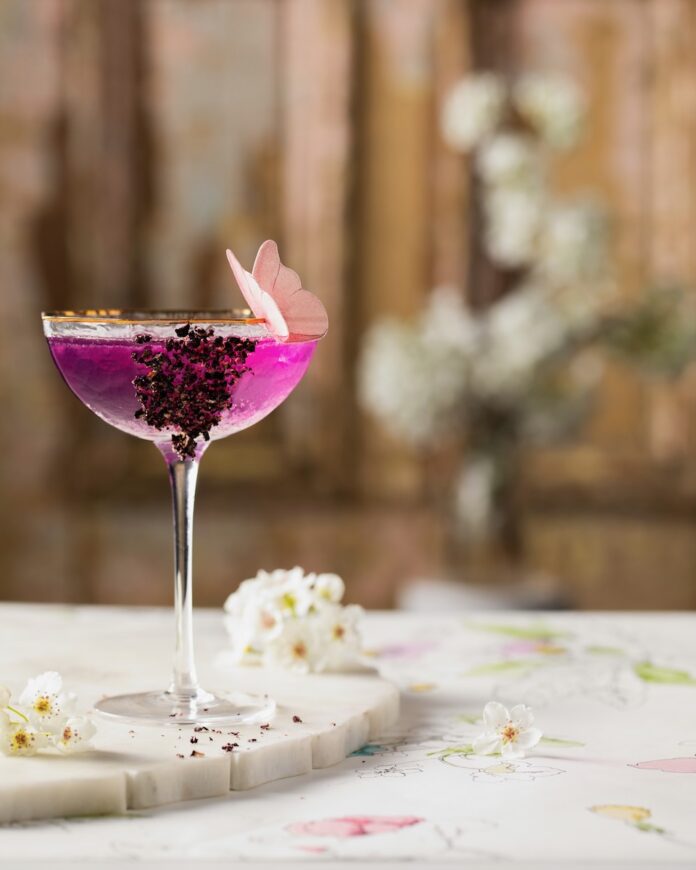
As a mom of three, the In the Butterfly Gin and Tonic is my dream non-alcoholic cocktail/mocktail for Mother’s Day. With a vibrant, enchanting purple hue and an imaginative garnish, this gives the classic G&T cocktail (my fav by the way!) the sophisticated twist mom deserves. Trust us, you’ll want to make sure you pick up the edible butterflies as well as freeze-dried blueberries to make your drinkable garden come to life.
What is the Monday Zero-Alcohol Gin in our Mother’s Day Mocktail?
You can really use any zero-alcohol gin as an alternative to the traditional. But, we recommend Monday Zero-Alcohol Gin for its smooth texture and perfect taste. It’s basically meant to mimic the flavors of a classic London Dry gin. You’ll find a bold, juniper-forward taste featuring lingering notes of bitter lemon, grapefruit, and then a little coriander. This way, you and mom can enjoy the familiar botanical characteristics of a gin and tonic without any of the alcohol content. Plus, Monday Zero-Alcohol Gin uses natural ingredients and has zero carbs, sugars, and calories, so you can feel good about what you’re drinking.
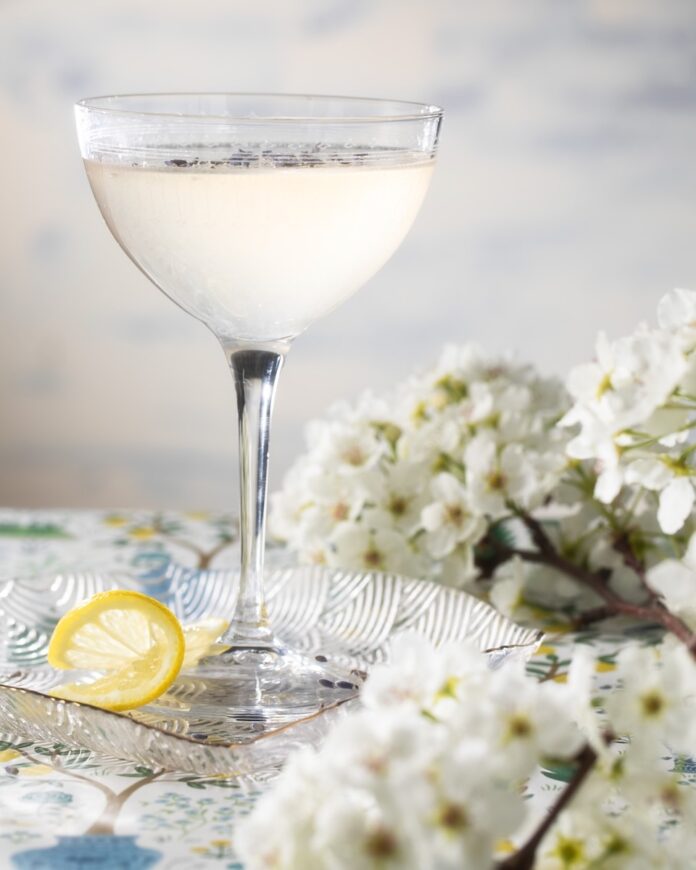
The Lemon Drop’s blend of lemon and orange flavors make it a natural fit to mix with lavender, which we consider to be a great representation of Mother’s Day. Lavender is calming, soothing, much like a mother’s love. All you have to do is replace the drink’s simple syrup with lavender simple syrup and you have a knock out citrus-lavender-vodka cocktail. You can even dress up the simple presentation by garnishing with a lemon twist or a lavender sprig. Just don’t forget to thank mom for all those years taking care of you as you mix this cocktail up for her.
How to Make Homemade Lavender Simple Syrup
Making any type of simple syrup is as easy as including the flavor you want to infuse. For our Lavender Lemon Drop, that means including dried lavender buds or lavender extract in your simple syrup recipe. All you have to do is dissolve sugar into water in equal parts before adding in the lavender. It is important to note that lavender on its own can be very strong, especially in an extract. You’re only going to want to add 1-2 tablespoons of dried buds or a 1/4 teaspoon of extract. It’s better to start with less flavoring and work up to what you like rather than adding too much immediately and running the risk of ruining the syrup.
While everyone else is gifting flowers for the holiday (florals for spring? Groundbreaking, indeed…), consider instead sharing one of these 5 best rosés with the wine-loving matriarch in your life for Mother’s Day. They’ll smell just as good as the flowers, and they’ll taste even better.
This gorgeous bubbly is a blend of the three Champagne varieties (Chardonnay, Pinot Noir, and Pinot Meunier). It doles out rich aromas of red raspberry, strawberry, cream, and a hint of toast and chalky minerality. A consistent stunner worthy of any occasion.
This bright pink standout from Austria is full of sour cherry and red fruit flavors and aromas, and it’s the perfect light and crisp sip for appetizers, charcuterie, or enjoyment outside in the spring sunshine. Affordable and also high-quality.
Made from the heat-loving Mourvèdre grape, this rosé is a delightful watermelon pink shade and offers flavors in the same vein with a kick of rhubarb, something slightly savory, and also something earthy on the finish. For lovers of Bandol in France, give this bargain buy a look.
The little-planted local Grolleau grape is blended with Gamay to offer up this bubblegum pink beauty. Luscious, ripe cherry and red fruits emerge from the glass, and the wine finishes with a dollop of sweetness to help cool down the spicy dishes that also make the perfect accompaniment. Perhaps this Romanesco recipe with chorizo would be something to try?
For the mom who likes her rosé with a little more oomph, this drinks more like a light red, which is typical of the region. Darker in the glass than the others in this lineup, it still offers deep red raspberry and blood orange flavors, and it has a little tannic grip on the finish to help pair fabulously with hard cheeses and cured meats.
Story by Adam Knoerzer Photo Courtesy of Corina Rainer
Grappa is in Dom Branduzzi’s blood. His family runs a bar just outside of Lucca, in the small Italian town where he was born, so hospitality was a part of his upbringing. His parents were bakers and came to Pittsburgh (where his mother was from) with four-year-old Branduzzi to start their business. But the bar remained a part of the family identity, as his uncles and aunts still operated it. “My dad enjoyed wine, but he wasn’t a big drinker. What he enjoyed most was grappa,” Branduzzi said. “Grappa lingered in the background of my life. I heard stories from him about long nights of drinking in what seemed to be a shed of some kind in rural Italy. There were lots of mentions of grappa in these situations. They even went as far as to call the shed they drank at a ‘Grapperia.’”
When the bar space beside Branduzzi’s restaurant Piccolo Forno opened up and he started his own bar there, he knew what he wanted to call it. 10 years on, Grapperia is still going strong, even with its focus on an esoteric, high-proof liqueur.
Ten Years In, Grapperia Lives the Good Life
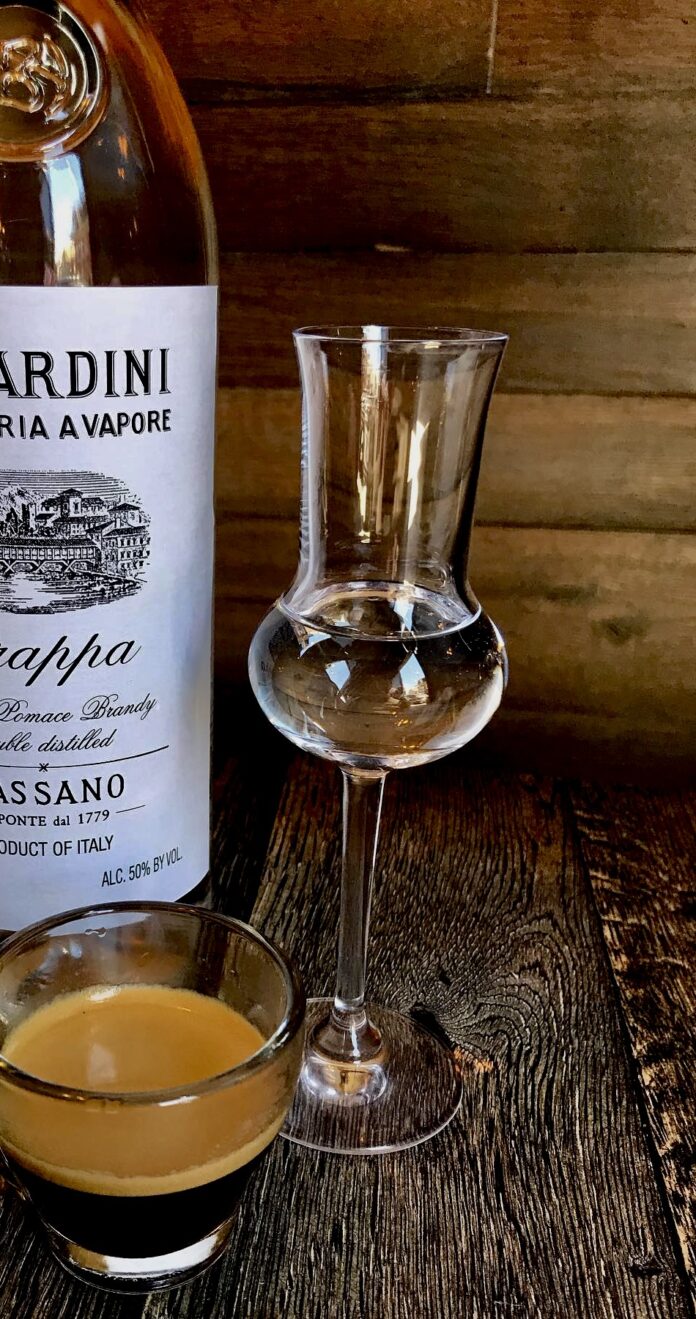
If you aren’t hip to it, grappa is a high-proof spirit that comes from pomace, the grapes left over from winemaking. It’s typically a digestivo, or an after-dinner drink to stimulate your stomach. After a big Italian meal, it’s a necessity. But grappa is strong, often jokingly called “lighter fluid” or “rocket fuel.” Most consumers don’t have the familiarity with it that Branduzzi does.
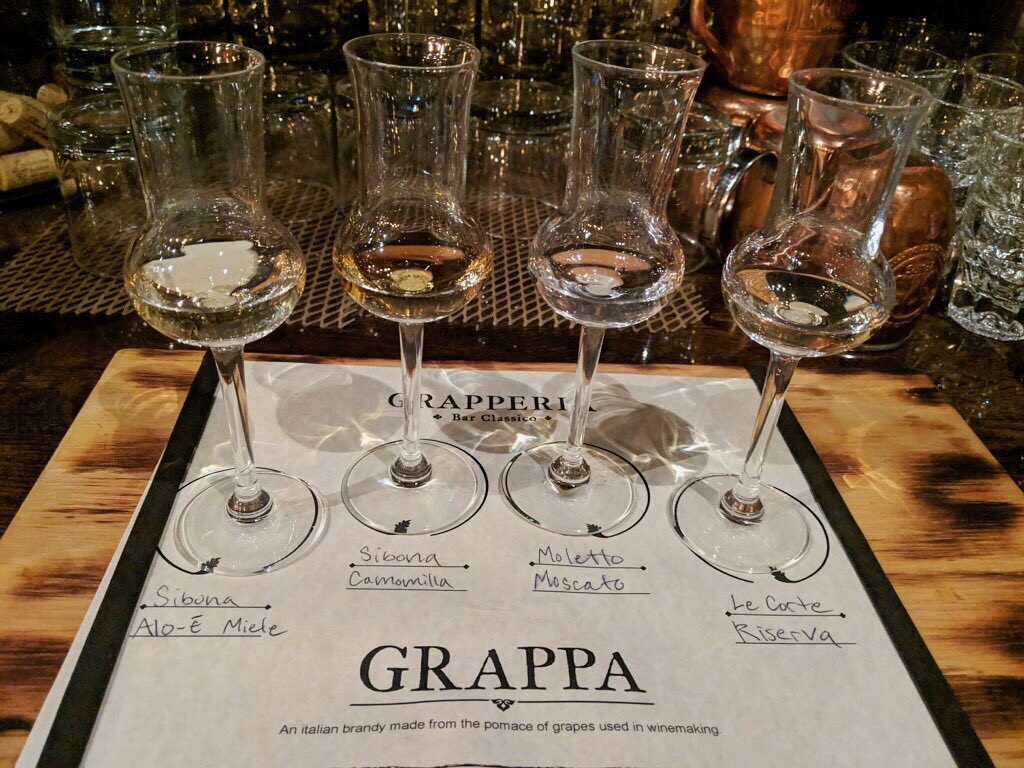
“I could remember back to being a kid and my dad handing me the grappa glass. He always had the proper glassware for it. I was 14 or so. As a kid, you’re like ‘this is like rocket fuel.’ But I really came to appreciate it.” If people have any association with grappa, it’s usually that it’s closer to Everclear than wine. But Branduzzi serves all kinds of distillers’ visions of grappa, including Poli and Nonino, as well as sweeter varieties like Grappa Camomille, infused with herbs.
A flight of grappa glasses at Grapperia, showing different grape varietals. Courtesy of Grapperia.
A BYOF Bar
Piccolo Forno is BYOB, and Grapperia operates as the opposite—BYOF from Piccolo Forno. Branduzzi holds late hours and wants his bar to be a place people can relax after a night out at nearby restaurants. A takeout pizza from Piccolo Forno with a glass of Tuscan wine, then a grappa (or two) is my version of a perfect night. But if you’re coming from nearby Umami or Pita My Shawarma, Grapperia can also be the next stop to round out the night. I grew up drinking grappa and schnapps with my Swiss relatives, or the “caffe corretto” espresso with a dash of grappa or sambuca in it. When I moved to Pittsburgh and saw a whole bar dedicated to grappa, I felt like I found a kindred spirit in a new place.
“Spending so much time in Italy, I grew up behind my uncle’s bar. I would see bottles of grappa and bottles of amaro we had never even had in the States,” Branduzzi remembered. “A bar in Italy is different than a bar as we know it. It’s a bit more like a quick reprieve, not a place to just get drunk at. In my dream scenario, I wanted to create an atmosphere like that. And while it couldn’t really be the classic Italian all-day bar where old men are playing cards and smoking cigarettes outside, it’s my own corner of the world here in Lawrenceville.”
Not Just Grappa at Grapperia
To be clear, Branduzzi does not just serve grappa at Grapperia. You can order a beer, or a glass of Tuscan wine, or almost any craft cocktail you can imagine. He’s also observed an uptick in interest in amaro, the darker, more herbal cousin of grappa in the digestivo family. “The funny thing about amaro is I often ended up drinking it as a kid. It was almost medicinal. If I had a cold, my family would poor me a little bit of Ramazzotti Caldo—hot Ramazzotti,” he said. But many healthy adults enjoy amaro, too. Over the past decade, he’s seen people come into his bar and take notes about amaro as they try new things. Popular brands like Averna, Montenegro, Fernet Branca, and Cynar are available at the state store, but Branduzzi stocks lesser-known varieties like Sfumato, Cardamaro, and Spirito delle Dolomiti.
Amaro is perhaps a little more accessible than grappa, with less subtle, more herbaceous flavors. Branduzzi is happy people are embracing the digestivo in any form. “People might have an initial negative connotation [about grappa],” he said. “Maybe their grandfather or their great grandfather drank it. Everybody considers it moonshine. But there’s more to it. Recently, guests come in to see if we have anything new on the shelf. They’ll just stare at the bottles and take mental or literal notes on what they’ve had and what they haven’t had. It becomes almost like a fully educational situation.”
Indulging in a Digestivo
Though Americans are drinking less, that might mean that those that do drink are leaning into the enjoyment and fulfillment of it more. Branduzzi doesn’t want people to think of bars as places where grizzled, miserable ne’er-do-wells smoke in a dimly lit room after a long day of work. There’s a connotation in American culture that drinking is a way to let off steam or numb your feelings. But digestivos are a way to use drinking to enjoy your meal and your time with friends and loved ones more. After a long meal, a digestivo lets you sip on something and decompress, instead of just rushing to the next part of the evening.
Just as it helps you digest your meal, it also helps you take a moment to appreciate the experience more. Branduzzi sees the same philosophy with an after-dinner espresso, which he also serves at Grapperia. Looking at the way Italians drink can help us reframe how we think about drinking for ourselves, as not a maladaptive coping mechanism but an enhancement to our lives.
A drink at Grapperia is a toast to abundance and good times. After all, you only need a digestivo if you’ve had a decadent meal. To Branduzzi, and to me, the digestivo is a symbol of the abundance mindset, that you have everything you need around you. When we’re told to consume and consume yet still feel empty, couldn’t we all use a bit more of an abundance mindset right now? “To me, a digestivo completes a meal. After a nice big meal shared with friends and full of good times, my brain just automatically goes to what amaro will I have. It’s the perfect nightcap,” Branduzzi said.
Betsy Wentz breathes new life into a historical house for a couple and their three children, introducing modern elements while also honoring the past.
Sewickley Designer Betsy Wentz Makes a Historic Home Family-Friendly
Designing a serious home for a young family is always a bit of a juggling act between livability and style. The house in question is a 1903 Pittsburgh landmark by MacClure and Spahr, who also built the Keystone and Union Nation Bank Buildings. Updating it meant deciding when to modify and when to maintain what was there. The couple is also passionate about collecting art, so striking and important pieces hang throughout the house. Designing backdrops to complement them was an important part of the equation.
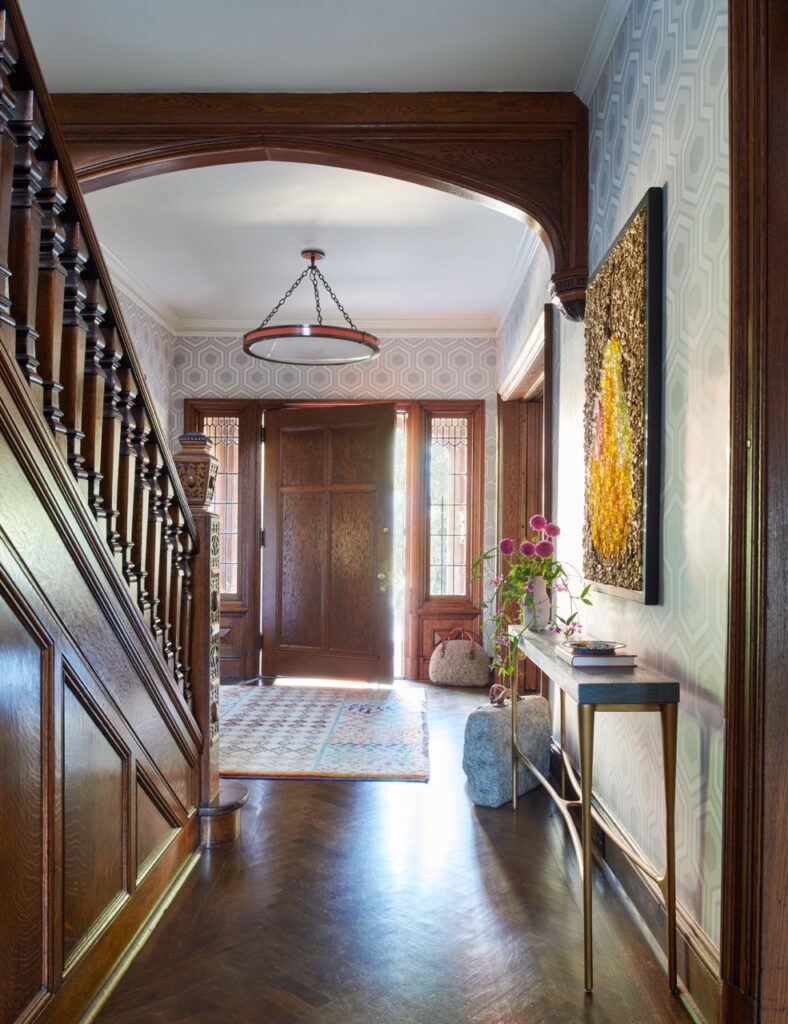
Sewickley-based interior designer Betsy Wentz met the challenges by using varying intensities of pattern and color, at times pulling back—up to a point—to allow art to shine, and at others turning up the volume to create high-impact moments. Her clients wanted to make everything feel less serious, “but they also wanted to respect the bones of the house and make sure that we maintained the majority of the woodwork.” (The carpet in the foyer is by Rug and Kilim.)
Starting With the Color Palette
Wentz incorporated a rich palette of gold, deep blues, reds—and a fair amount of lilac. Even in places that are more subdued, flashes of bright hues catch and delight the eye. At the same time, an abundance of rich woodwork contrasts with the more updated elements, creating a delightful conversation between old and new. “There’s a lot of push and pull. It’s fun, it’s young, and it’s fresh.”
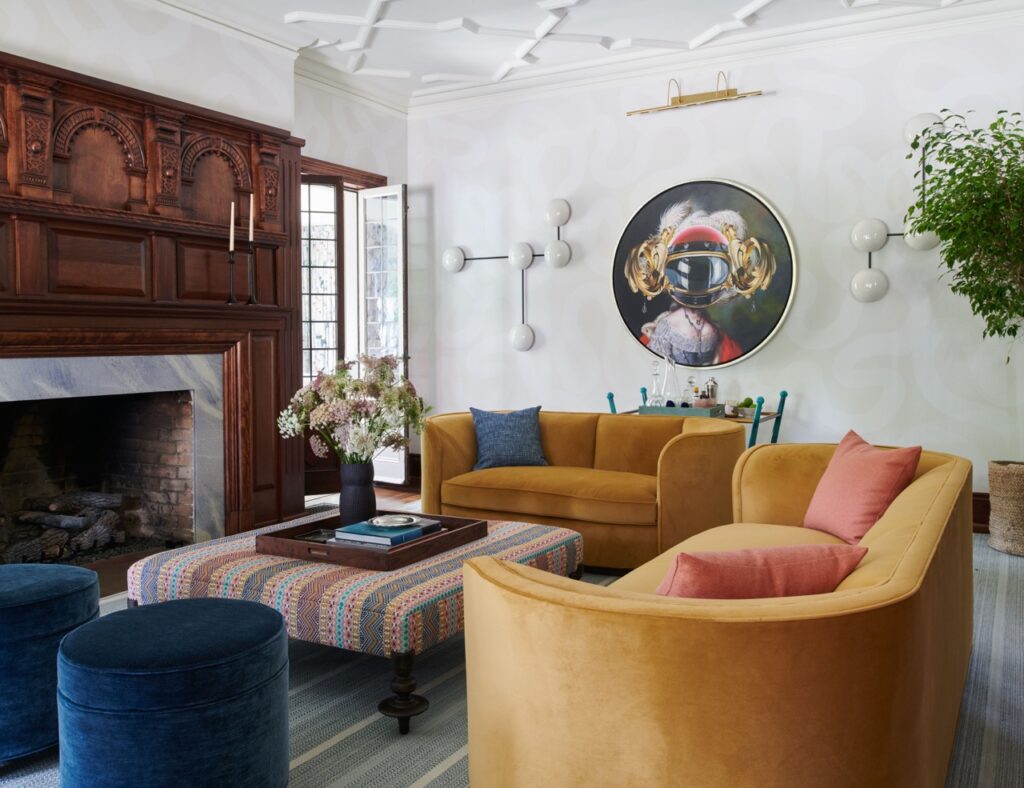
Painting: Never alone (2022) by Lucio Carvalho.
A large sofa and loveseat in gold Kravet fabric anchors the living room, creating a cozy seating area presided over by an incredible painting, Never alone, 2022, by Lucio Carvalho. A subtly striped Stark rug plays off the Schumacher drapery and wallpaper and a Century Furniture ottoman in a sort of modern patchwork pattern.
Combining Bold and Comforting Designs
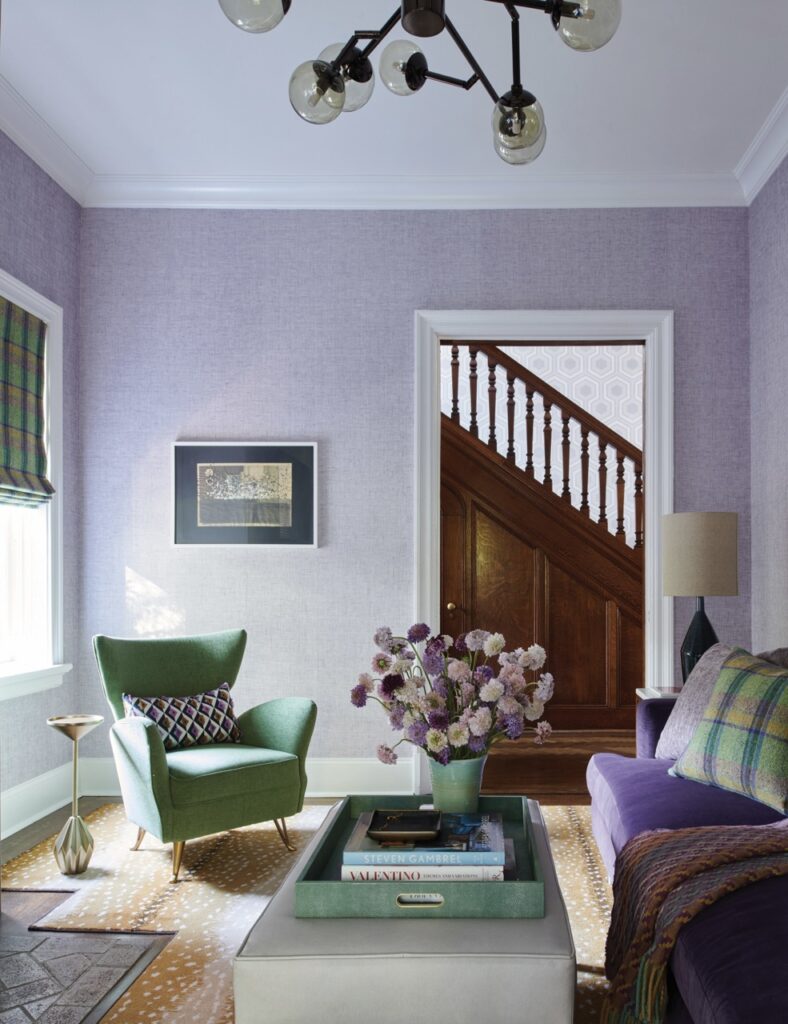
One of Wentz’s favorite spaces is an intimate sitting room, clad in lavender Phillip Jeffries grasscloth and a playful Stark rug, the latter strategically cut to work with the existing hearth. The mismatched chairs were the husband’s idea, and add to the casual vibe, even though they are quite tony in and of themselves. (The blue one sits in front of Untitled, 2022 (Lens) by Fabrizio Gerbino.)
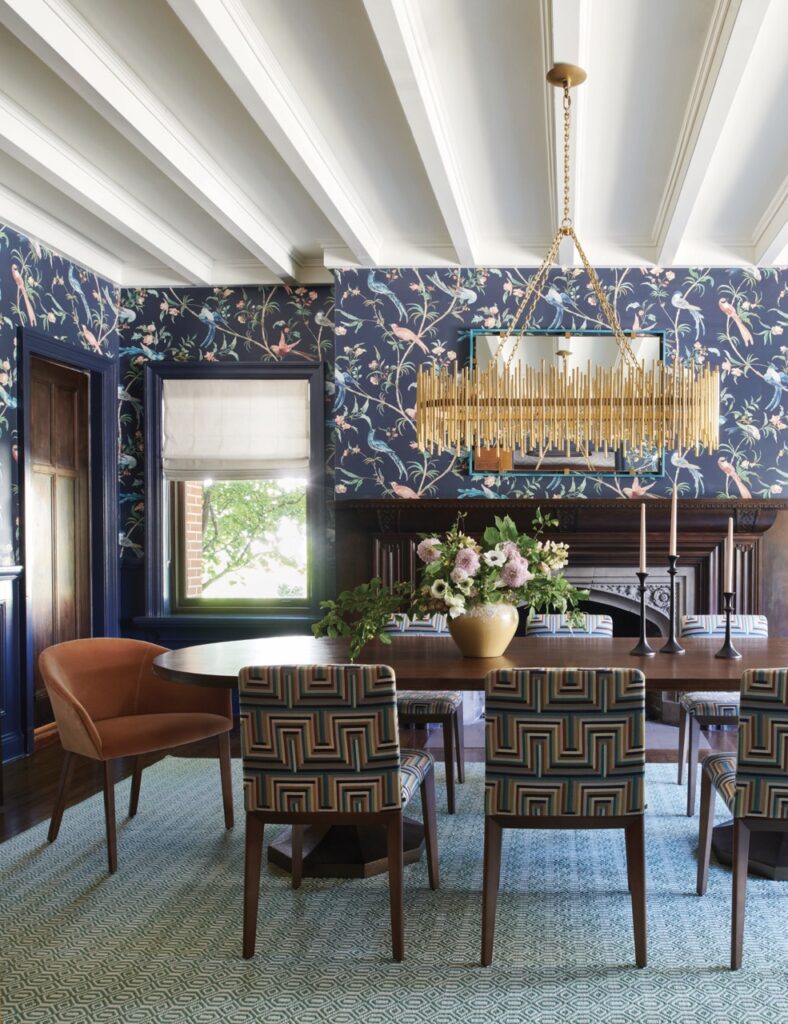
Wentz combined several strong patterns with plenty of color in the dining room, but it never goes too far. The Romo wallpaper is decidedly bold, but works beautifully with the Andreu World dining chairs and a From Jaipur with Love rug. She painted the molding but left the fireplace as it was, again striking that essential balance.
Keeping Things Functional
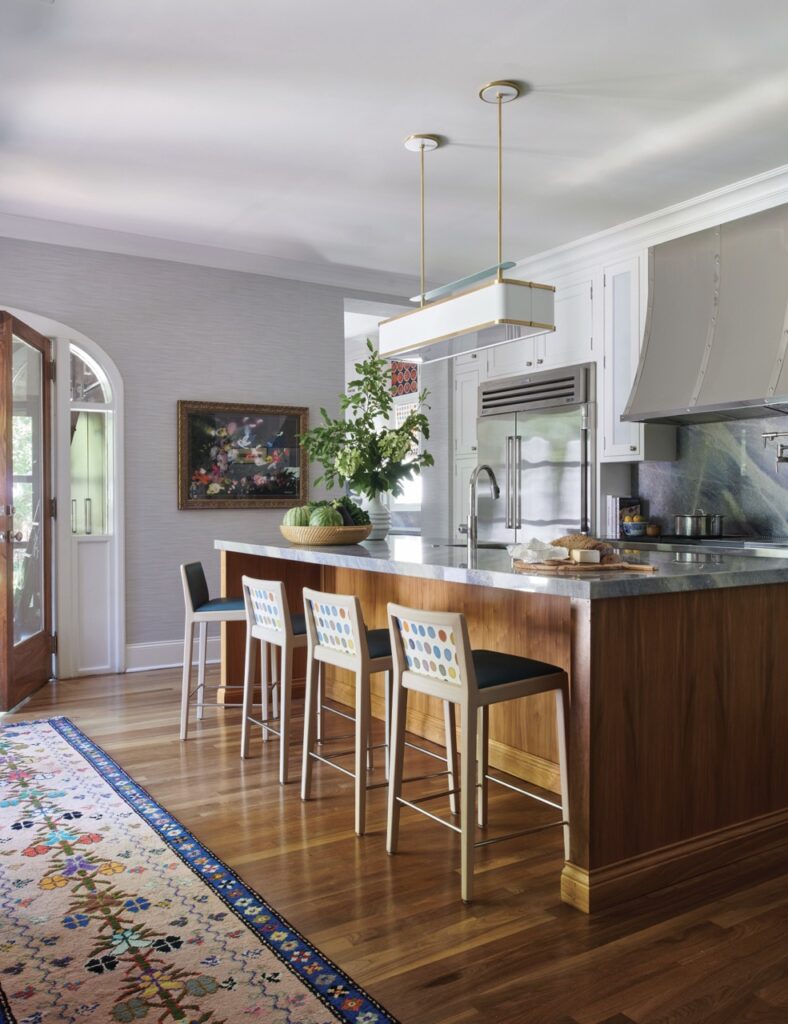
The kitchen had to be highly functional, with the three children running in and out, sometimes with wet feet or bathing suits. The Andreu World stools are upholstered in vinyl and can be wiped down. (For extra fun, she put polkadot fabric on the backs.) A vintage runner is both intriguing and practical. Off to the side is a walk-in pantry, its eye-catching Cole & Son wallpaper providing more circles, here cross-sections of bright citrus on a dark background. In the nearby sunroom, chair backs each have their own color in another less-serious element.
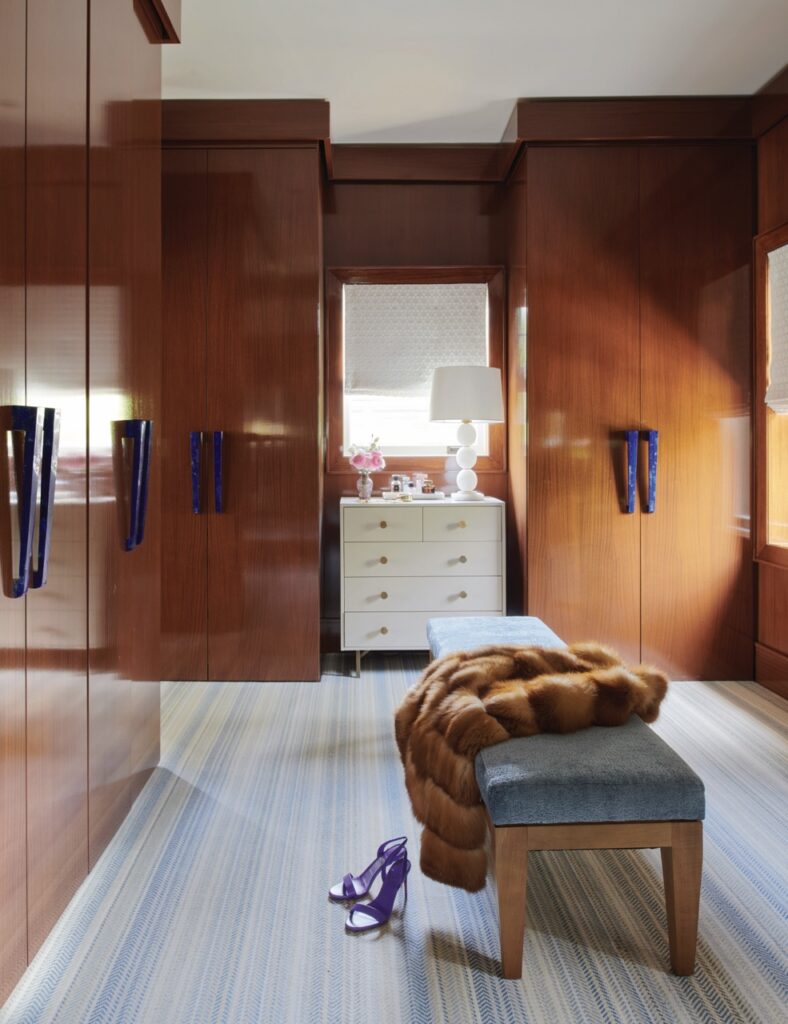
At the top of the stairs is another favorite of Wentz’s, a vintage rainbow glass chandelier hung over some heavily-carved woodwork and Juliette leaded glass windows. Another important piece of art, Our collective beauty, 2022, by Thandiwe Muriu, presides. The master suite is a serene space, but is nonetheless punctuated with rich accents, including a bench from Century covered in Missoni fabric and quietly textured Philip Jeffries grasscloth wallpaper. A moody, wood-clad dressing room is accented with striking lapis handles on the doors and a striped Stark rug.
Meeting Somewhere Between Fun and Sophistication
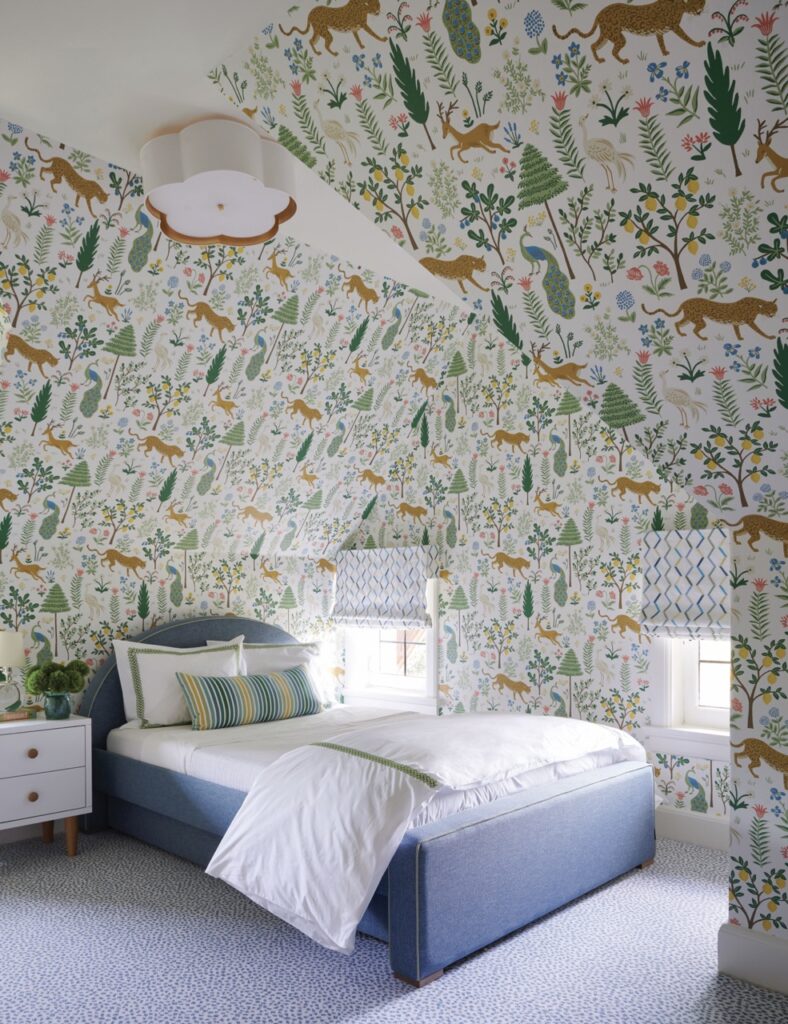
The children’s spaces are each clad in a different wallpaper, including a tiger and tree pattern from Rifle Paper Company in one daughter’s room, which also features a pin-up wall covered in green mica paper, forming a workspace area with desk and chair.
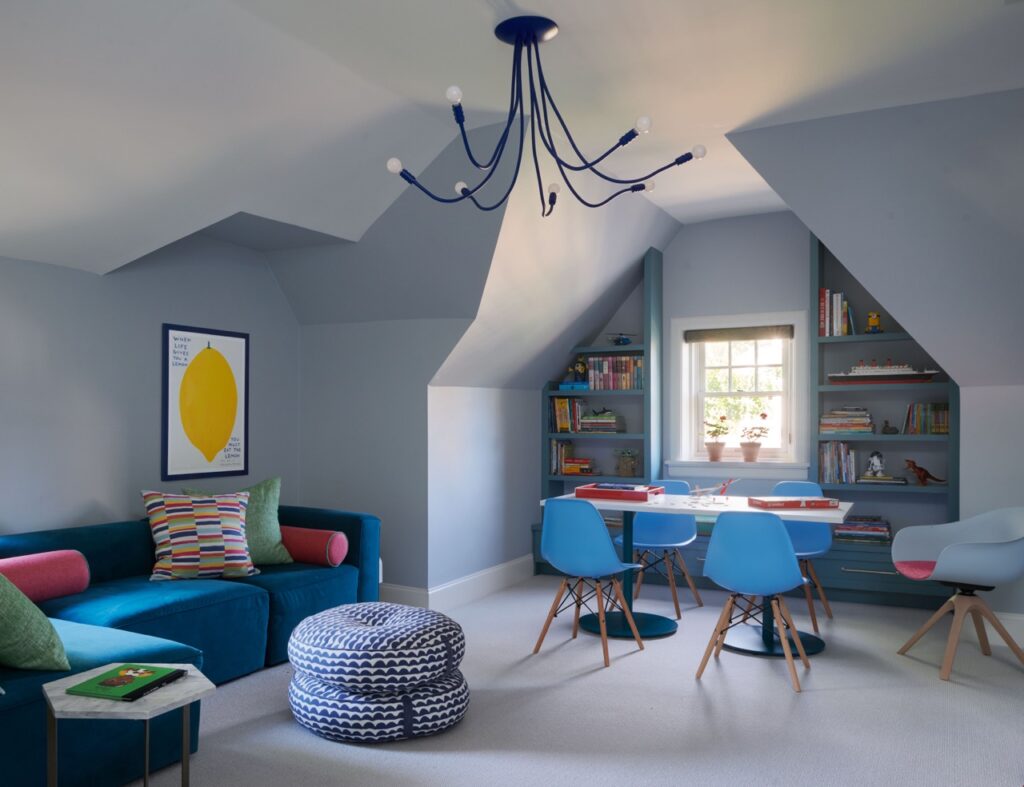
The playroom is subtly sophisticated, especially in its play of color, like the one established between the built-in and the wall. The Chairish chandelier, with its multiple purple arms, is pure fun. Ultimately, Wentz’s work was about coming up with a complex way to combine all the elements into a cohesive whole. “They are a very sophisticated couple—but they also have kids. So I think the point of the story was how to take an old home and make it more livable and approachable. It’s ultimately a family home.”
Story by Stephen Treffinger Styling by Tori Mellott Interior Design by Betsy Wentz Photography by Max Kimbee Flowers by Eleven Mile Farm Art Consultation by Melanie Werner, Galleria Werner
What kind of kitchen is right for one of the hardest working people in the restaurant biz? One that brings a sense of peace and order. Visit the kitchen of Tolga Sevdik, co-owner and COO of the Richard DeShantz Group with us.
Explore Tolga Sevdik of Richard DeShantz Restaurant Group’s Kitchen
So, if Tolga makes it home in time to kiss his 2- and 5-year-old kids goodnight and grab a bite to eat with his wife, Alicia, he’s yearning for peace, simplicity and an easy cleanup.
The Quiet of the Suburbs and Design
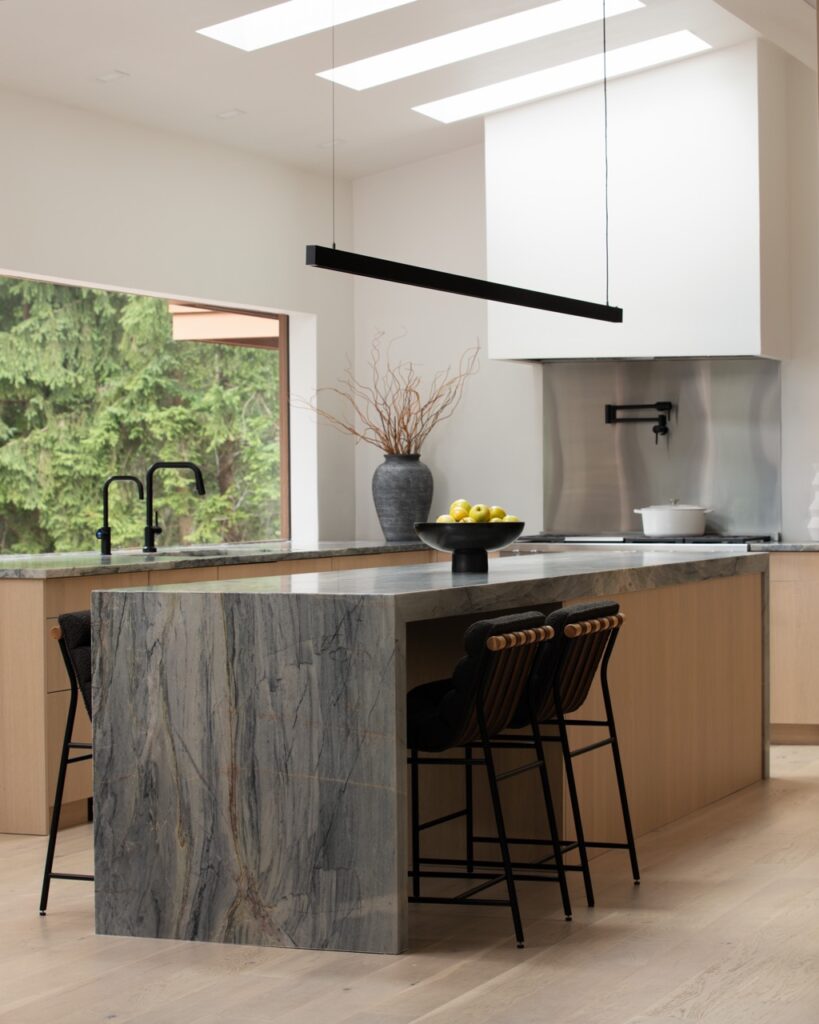
The Sevdiks live in Thornburg, a tiny borough on a bluff surrounded by scenic views about four miles west of downtown Pittsburgh. Tolga, who emigrated from Turkey in 1995, says his goal was to turn the outdated kitchen along with a space the former owners had used as a TV room into a European-style kitchen that would be “easy for us to have a quick sit-down breakfast or dinner and then move on.” He also wanted the space to work as an event/party kitchen. Having watched his partner “Rick” DeShantz design many kitchens, Tolga also was determined to avoid pitfalls. “You learn a lot from building 10 restaurants,” he says.“You see [all the] mistakes.”
Chrissy Norman of C Norman Design brought the Sevdiks’ vision to life with the help of Matt Bauer Contracting. Removing several walls provided a sightline from the kitchen through the dining room to the living room, which also makes it easy for Tolga and Alicia to keep an eye on the kids. Slim black shelves created a home for their books and pottery and flank a cozy reading space that transitions to the dining room. The dining room can now accommodate a long rectangular table for holidays, but most of the time the family gathers around the kitchen’s center island.
Pulling From the Best Brands for Kitchen Design
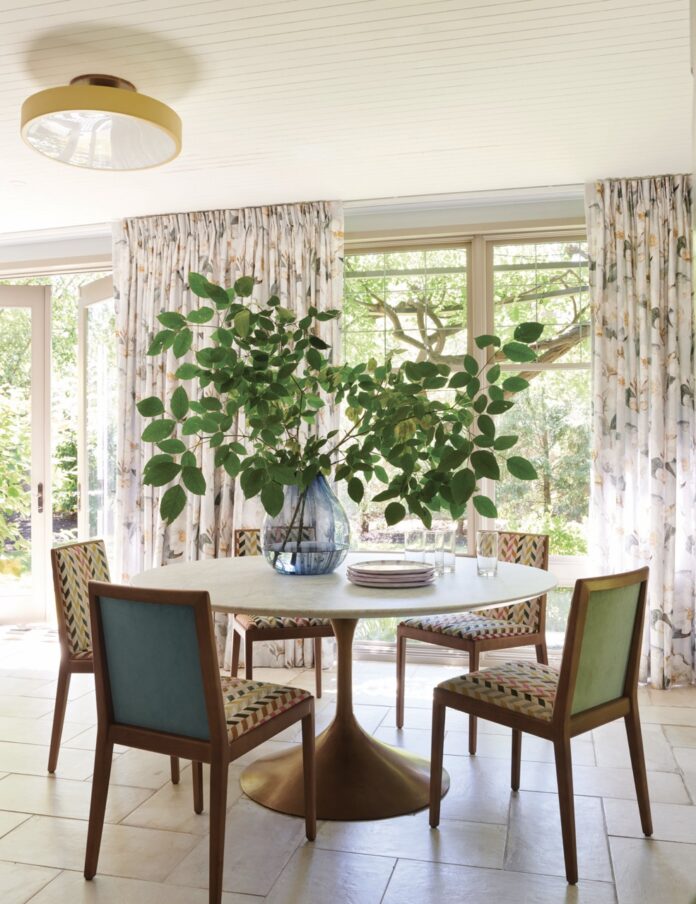
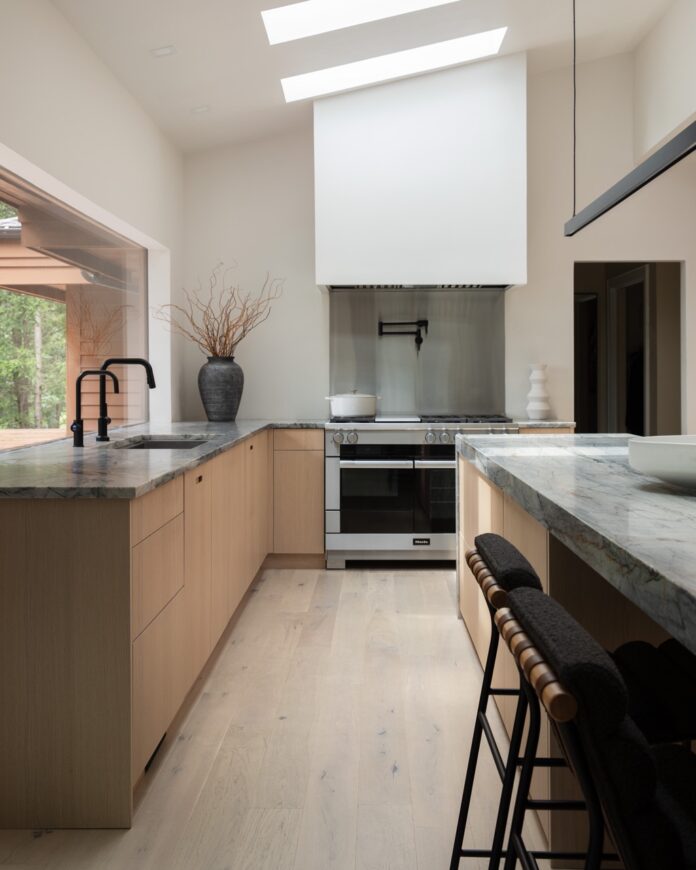
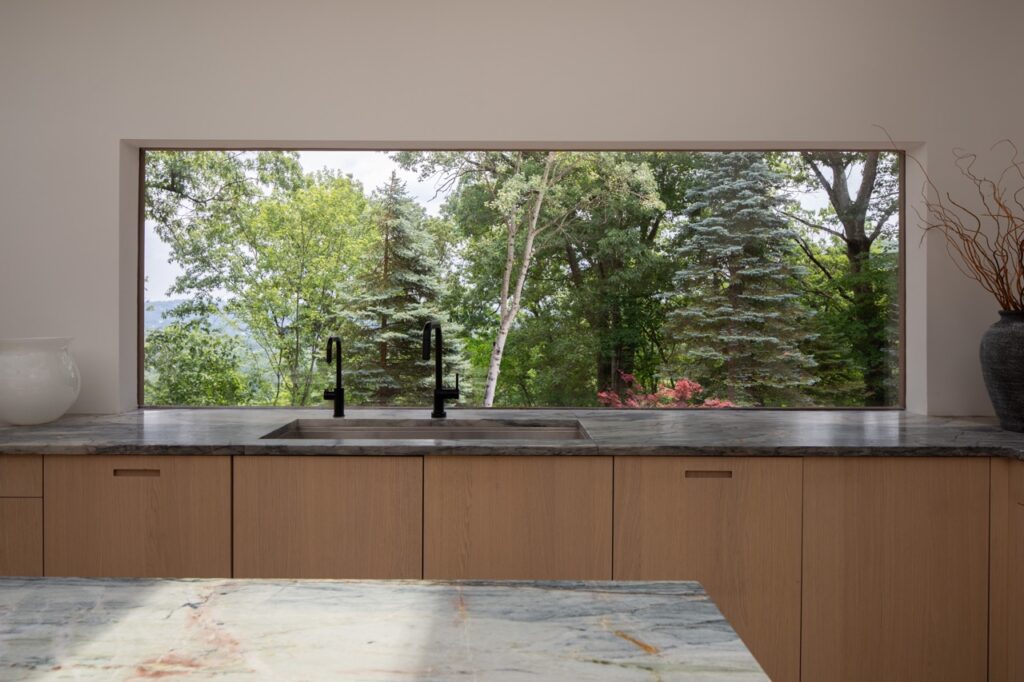
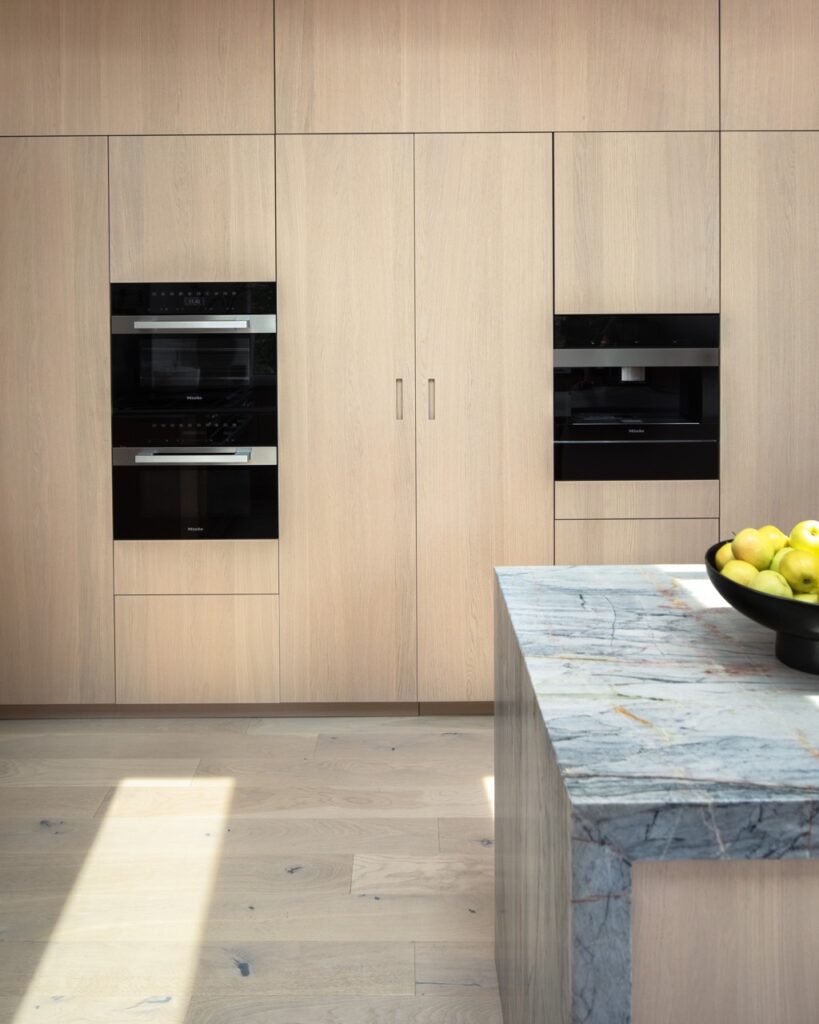
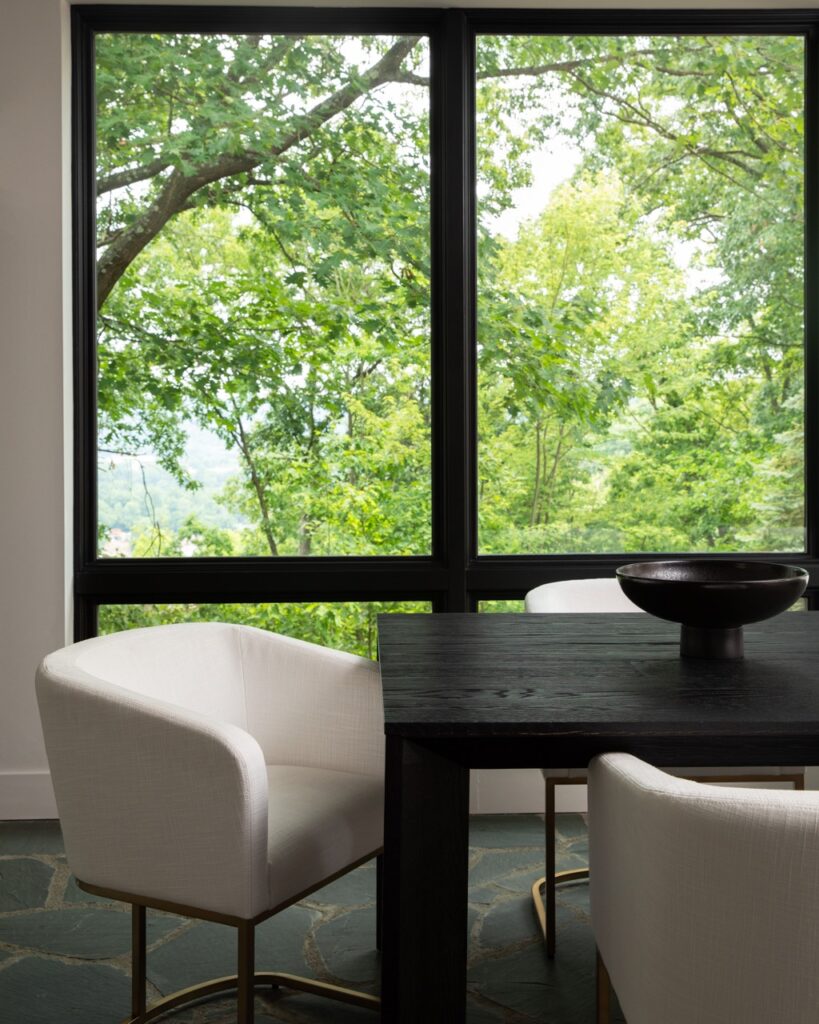
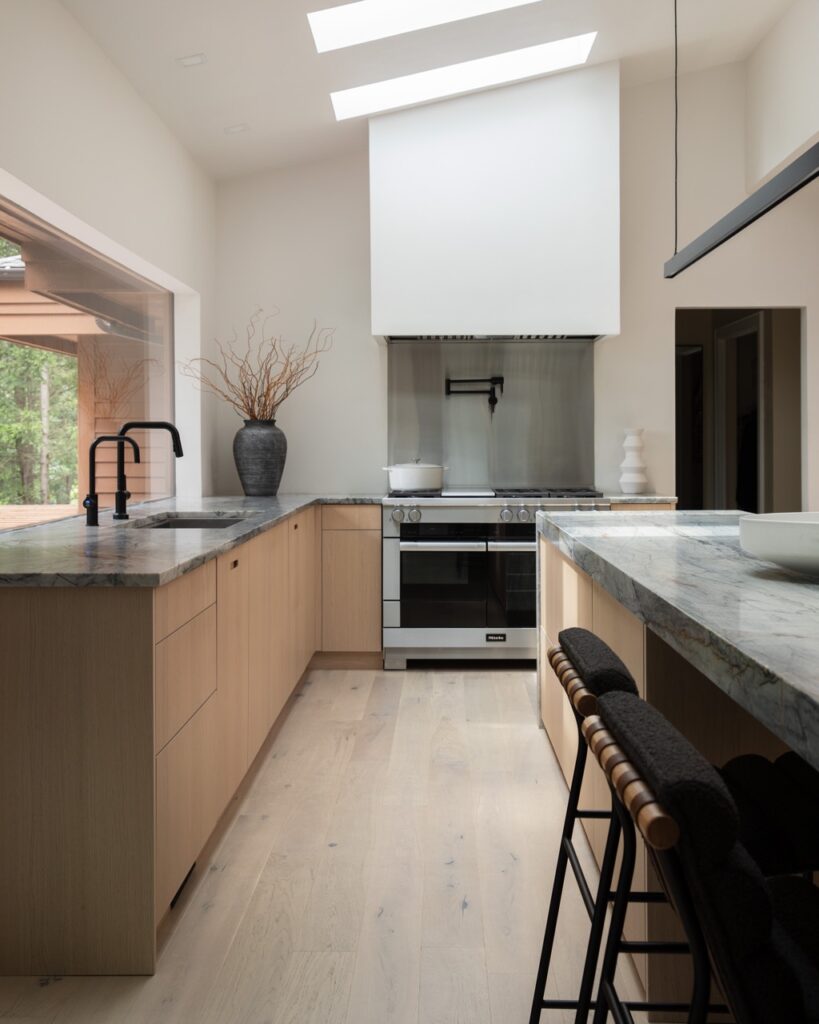
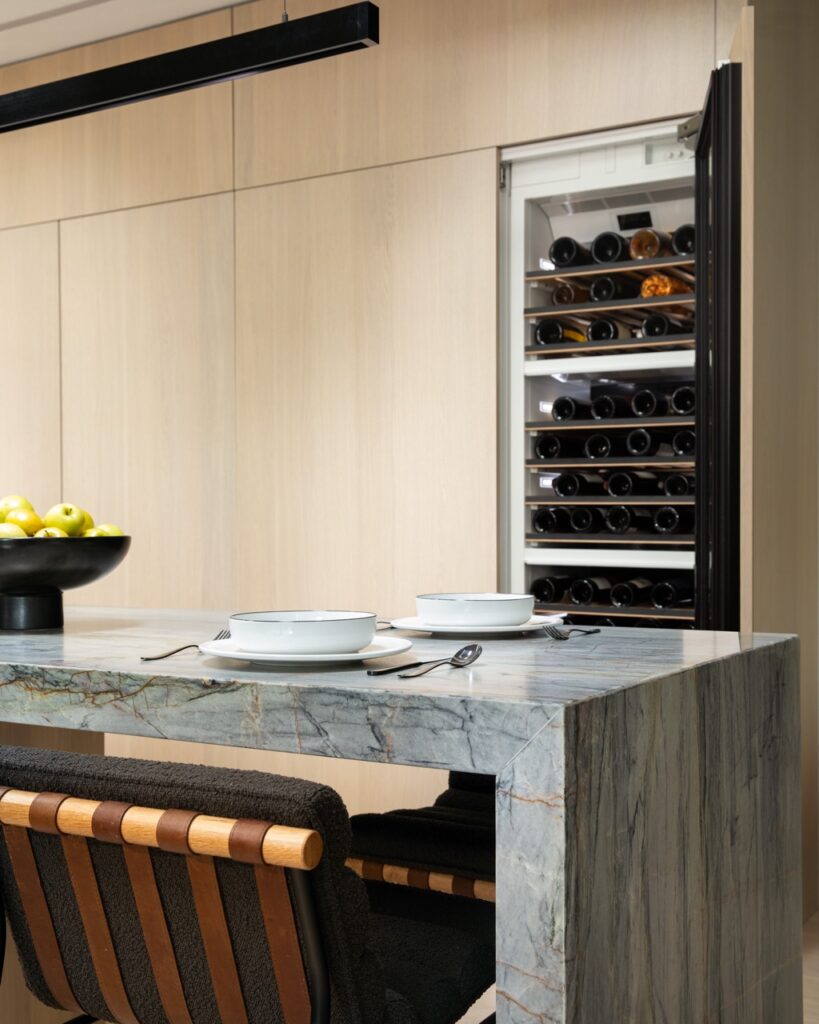
Installation went smoothly, and the finished kitchen’s vibe is as serene as intended, thanks to pale wall colors, lightly veined gray blue Armina Stone countertops, smooth DOCA cabinetry from DB Design Center, white oak flooring, and a huge picture window from Emerald Glass that turns the surrounding landscape unto a mural. “I ordered the largest window I could find,” Tolga says. In the warmer months, their view is pastoral, but when the leaves drop, “we can see all the way to the Parkway,” he adds. There are plenty of modern (but quiet) bells and whistles — a wine fridge and bar, a pot filler over the stove, invisible electrical outlets hidden in the walls, and some “hard-to-find” Miele appliances sourced by Don’s Appliances.
Both Alicia and Tolga cook, but unless it’s Sunday or Monday, his days off, it probably won’t be gourmet fare. Sometimes Tolga just grabs a piece of steak on his last stop of the day and heads home. “You have to have a grill,” he says, laughing.
As with most families, the Sevdiks and their friends tend to gather in the kitchen. No matter the style, the comfortable versatile space is a pleasant reminder for Tolga of times past in his grandparents’ home in Turkey. “You were aways in the kitchen,” he says. “Almost everyone in the family gathers there.”
Story by Susan Fleming Morgans Styling by Justin Matase Interior Design by Chrissy Norman of C Norman Design Photography by Dave Bryce
Interior designer Seashal Belldina freshens up a forty-year old, Frank Lloyd Wright-inspired contemporary home. Her intervention created a lighter, brighter place for family living and entertaining.
Seashal Belldina Freshens a Frank Lloyd Wright-Inspired Home
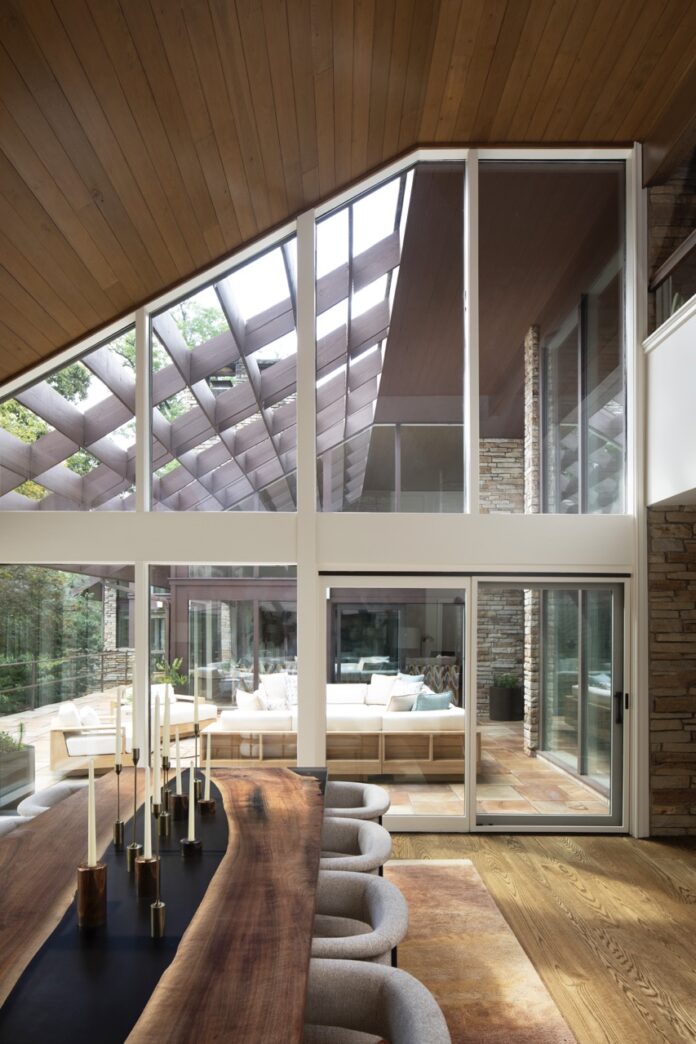
This stunning house is infused with a feeling of openness and flow — yet it was ready for a refresh. The goal? Maintain the integrity of the original design and deliver a modern organic spin on an already beautiful structure.
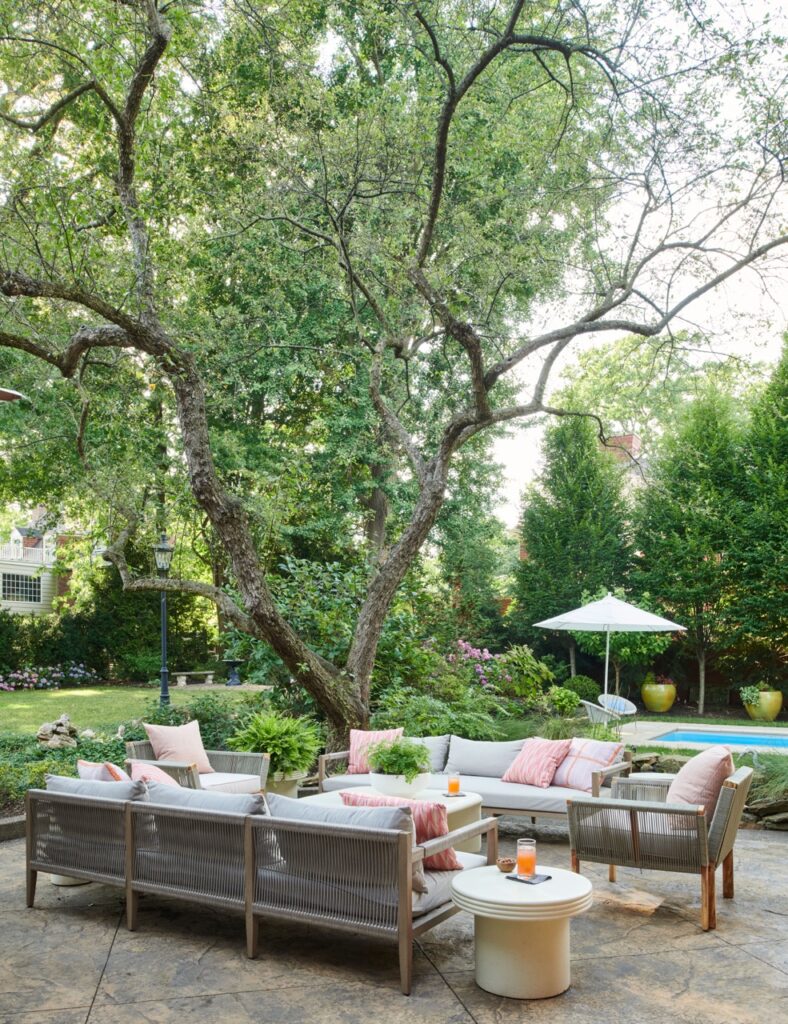
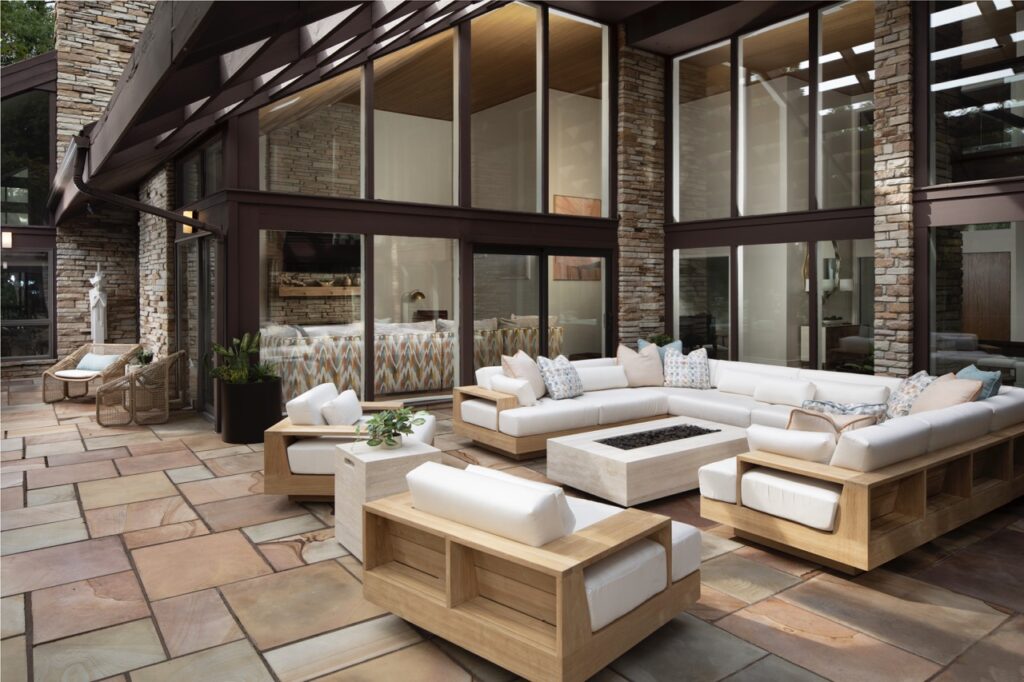
Seashal Belldina of Interiors by Seashal managed the renovations, interior design, and home furnishings. Built in 1985, the home’s owner and their architect were influenced by Frank Lloyd Wright’s Fallingwater. (Fun fact: The patio is now home to one of Wright’s original Midway Gardens Sprite sculptures.)
Mixing Beauty and Function
Belldina approached the project with the central questions that guide all of her work: “How can we make the space feel more functional for you or for your family if you have children? What’s your personal style? How can I blend the architecture of the home, functionality, and the homeowners’ style to create a place that will bring them joy every day and will feel like home?”
Furthering the Feeling of Comfort
Knowing the home would be for plenty of gatherings and playtime for kids, Belldina placed an emphasis on durable and easy-to-clean materials. “I understood the goals that the homeowners had. I’m a mom myself that also loves to entertain. They said, ‘We don’t want it to feel like a museum. We want everyone who steps into our home to immediately feel at ease — like they can kick back, relax, and make themselves at home. Picture them sinking into the couch, grabbing a pillow, and unwinding.’”
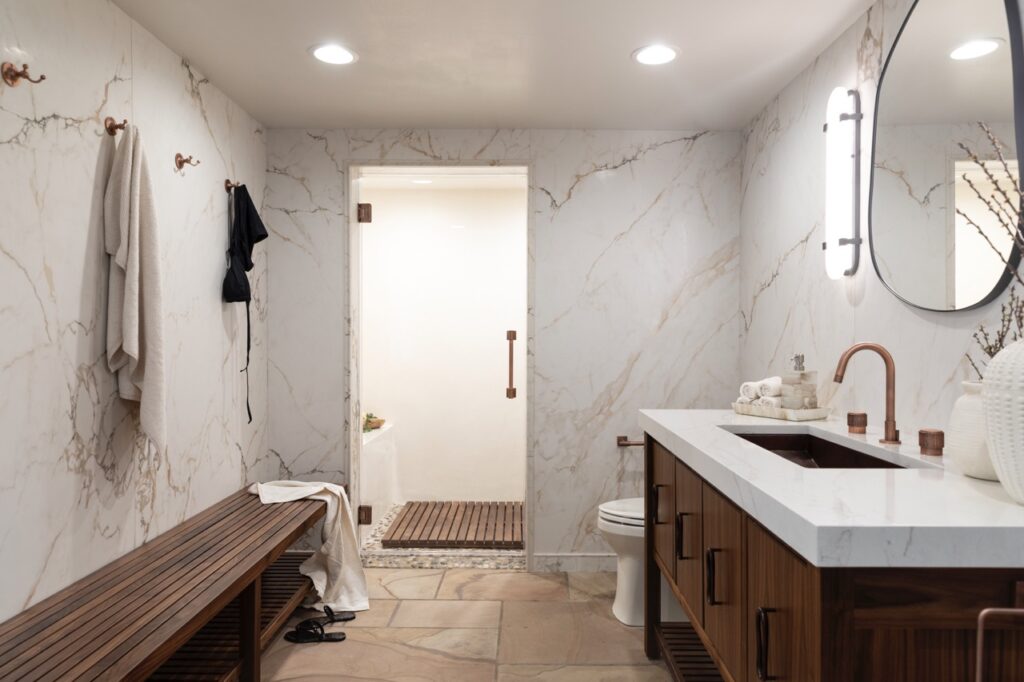
Belldina worked with the existing sandstone flooring and walls by pulling in complementary warm and neutral tones. “The homeowners gave me a lot of free reign on this, which is a dream for an interior designer. But the one thing that they stressed was to make everything lighter. It was really dark and heavy before — the paint colors, tile choices, flooring, everything. They also preferred neutral palettes, but were open to some bold pops of color.
Story by Nicole Barley Photography by Dave Bryce Interior Design by Seashal Belldina
Eighteen months might seem like a long wait for a new kitchen, but it was worth it, says the owner of the 100-year-old “fixer-upper” condo she bought in an historic East End high rise. Her working partners in the project, Cruze Architects and Drury Cabinetry, tell the tale.
Cruze Architects and Drury Cabinetry Collaborate on a New Kitchen
“It was an efficient process, given the scope and difficulty, shortage of trades [people] and permits,” she says. And then there were the challenges of heavy antique masonry, terra cotta tile laced with wiring and embedded in concrete, and a quaint freight elevator unequipped for lifting large cabinets and appliances.
The owner was drawn to the unit because of its “beauty and historic, serene vibe — its sense of place,” and she had a strong vision. But she knew she needed a team of professionals to “tease out” the concept. Architect Liza Cruze of Cruze Architects and Cruze Construction brought the vision to life, designing a modern but traditional kitchen that looks like it always was there. Liza’s husband Doug, an architect who focuses on building, was the problem solver, handling the gnarly structural, mechanical and plumbing issues.
“It was basically a bowling alley that needed articulation,” says Doug. One of the best things about being a married design/build team, he says, is that he and Liza talked about the project every night at dinner. They decided to bring cohesion to the space by using ceiling beams, both existing and new. “Some beams are hiding old beams; others are hiding electrical things,” Doug says.
Picking the Perfect Cabinets
Providing continuity is custom casework produced and installed by Dave and Jan Horner’s Drury Cabinetry in Unity Township near Latrobe. “I picked up Drury’s card in a hardwood store and went to talk to them,” Doug says. “They were incredible. In the future, I wouldn’t use anyone else.”
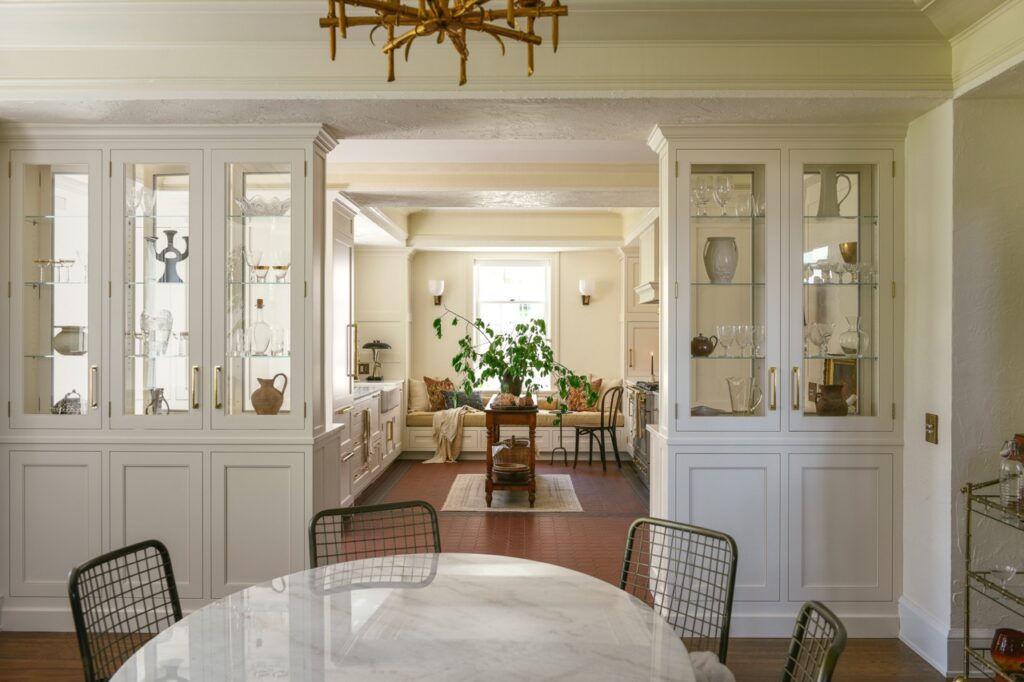
The beautiful but functional Drury cabinets use hardwood from Pennsylvania’s Laurel Highlands. They’re set off by a glass-paned display unit that separates the kitchen from the dining area. Dave, who “will try anything” according to his wife, says installing cabinets to the architect’s specs was a challenge. “All the cabinetry had to line up with the coffers in the ceiling,” he says.
Enhancing With Finishes Touches
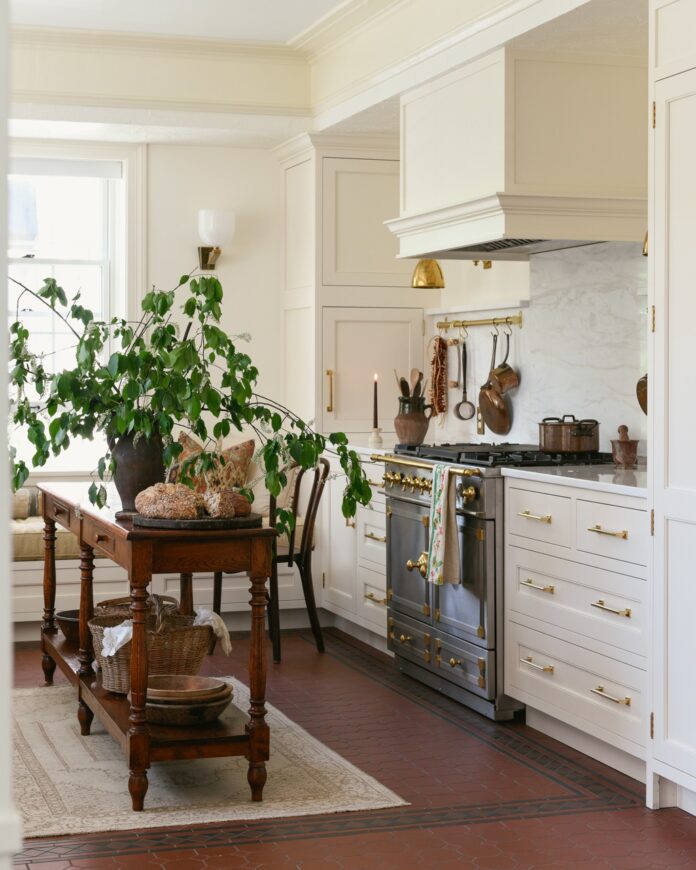
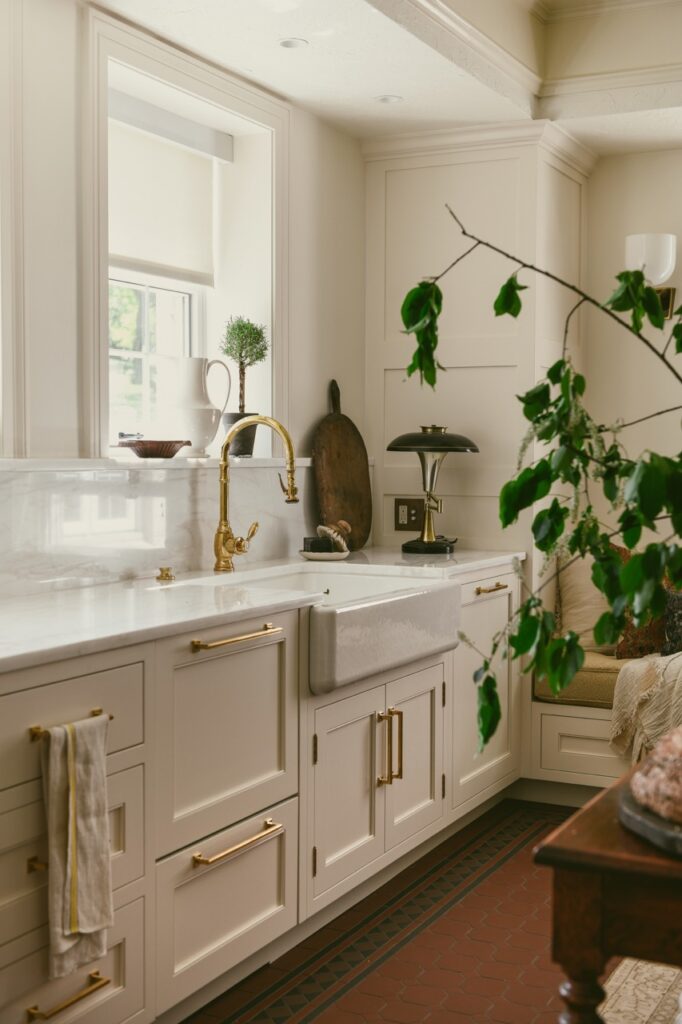
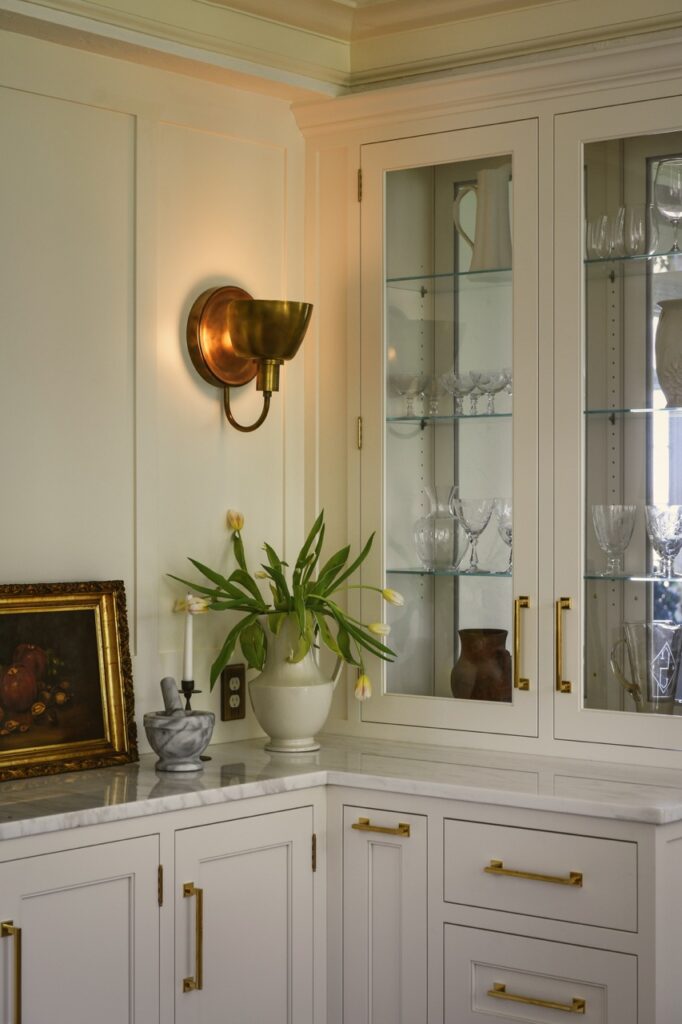
The owner chose creamy colors, sourcing the custom paint from Donald Kaufman Colors in New York City, a consultant to major museums and architects. “As the light changes [from cooler to warmer] during the day, the room responds to it in a very alive way,” she says. She chose the brushed brass handles and other fixtures from Habitat Hardware in the West End Circle, and concrete floor tile that looks Victorian but is more durable from Tile and Design in Shadyside. The appliances, except for the range, are from Don’s Appliances.
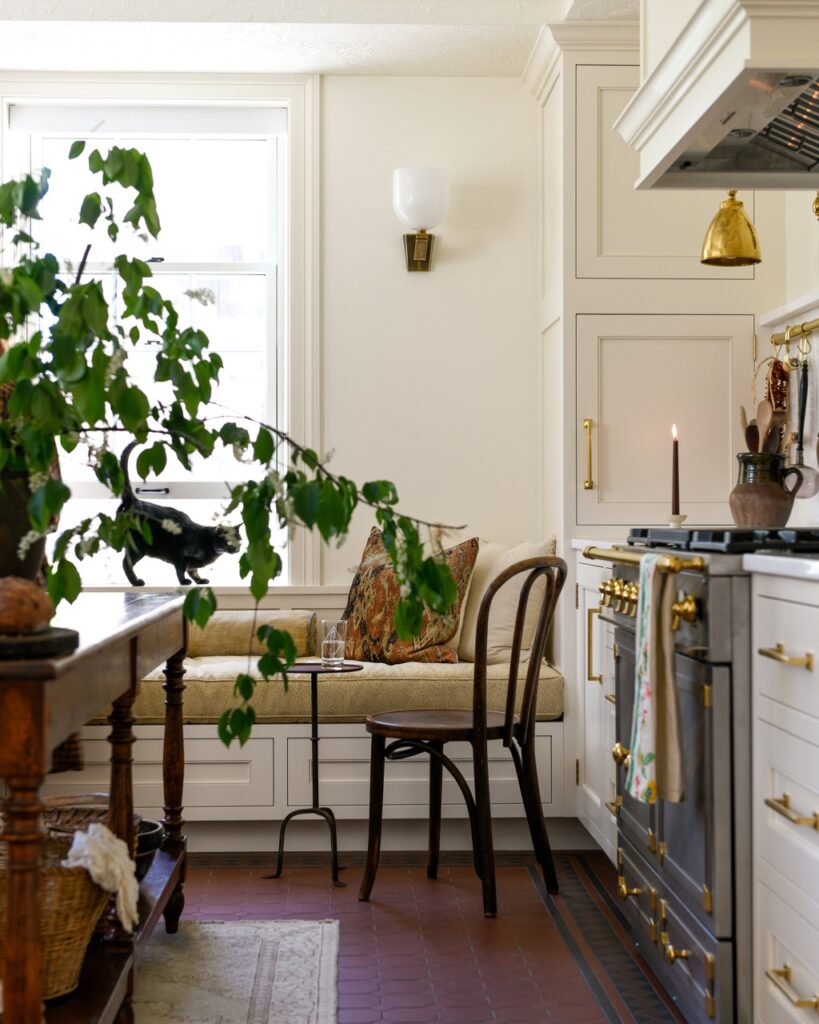
A “secret” powder room hidden behind a bookcase, a cozy window seat with a great view, pantry spaces and ample stone countertops complete the renovated kitchen, providing a utilitarian, flexible and welcoming spot for the owner to cook, curl up with a book or entertain. Or for her cats to hang out.
“We built a secret passageway for one cat to get from the kitchen cabinet into the hall closet,” Doug says, “and the cat uses it.” In fact, the owner might be able to blame her cats for prolonging the project. During construction, Doug says, “We spent a lot of time every night before we left covering up the holes in the wall so the cats wouldn’t disappear.”
Story by Susan Fleming Morgans Photography by Erin Kelly Design by Lisa Cruze, Cruze Architects Cabinetry by Drury Cabinetry
Not long ago, the juxtaposition of the aggressively modern with the storied past was the stuff of controversy. Think back to the I. M. Pei glass pyramid at the Louvre, initially considered variously a joke, a potential eyesore, or the ego-fueled folly on the part of President Mitterrand. Today, the pyramid is a classic, and such pairings seem quite normal.
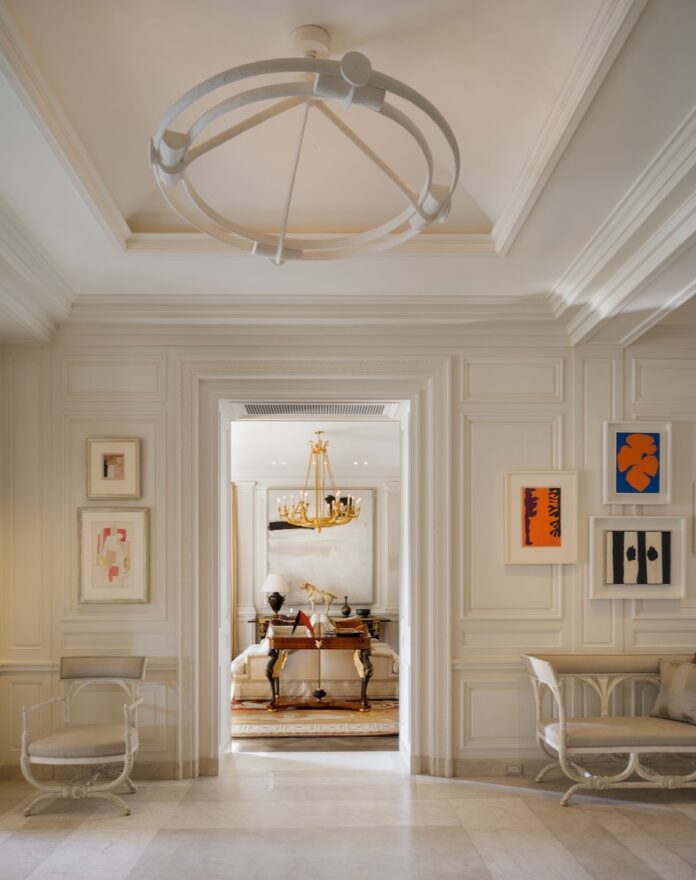
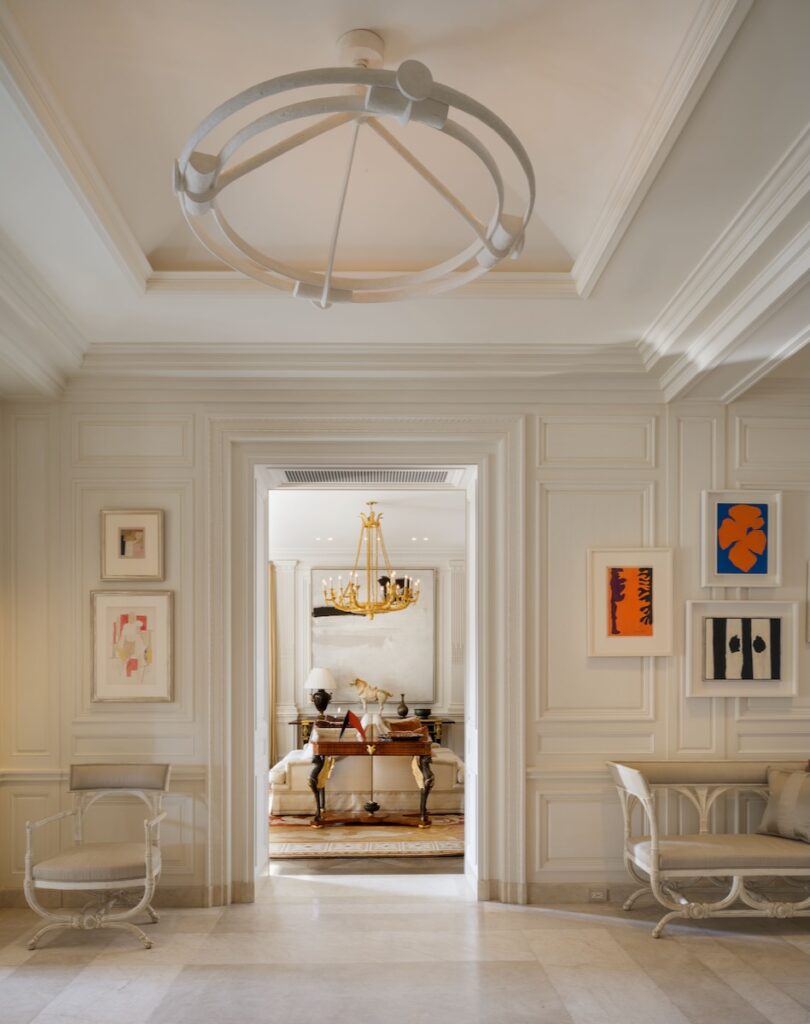
Designer Michael S. Smith’s Park Avenue duplex with Féau Boiseries wall paneling, frames, and cornices in solid oak painted white, used as a backdrop for modern art and furnishings. Photo by J. Pepion.
Féau Boiseries Finds a Balance Between Historic and Modern Interiors
In interior design, the mashup is not always so dramatic, but the effects are still powerful. From a gallery/warehouse/atelier in Paris, Guillaume Féau runs the family business, Féau Boiseries, founded in 1875. His clients, a who’s who of interior designers, come to source paneling and architectural details with the grandeur of the past—although much of it is now reproduced in the company’s workshops and destined for spaces that are resolutely modern.
“More than 80% of my clients mix a classic background with modern furniture and modern art. And it could be with Kusama Murakami, with Warhol, or Basquiat paintings with Neoclassical period paneling painted in white. That mix creates a beautiful effect, and that’s what we try to achieve,” comments Féau.
He says the contrast magnifies what is special. Juxtaposition is sometimes more powerful than period-consistent rule following. Féau talks about a space where a Rothko was placed on wood paneling from centuries prior. “You have this fantastic dialog between your work as a wood carpenter and the Rothko—and the mix is very sexy and very powerful.”
Meanwhile, back at the Louvre, a new exhibition called Louvre Couture places haute couture outfits and accessories from 1960 to 2025 among masterpieces from Byzantium to the Second Empire in the department of Decorative Arts. Balenciaga meets medieval armor, Dolce & Gabbana in dialogue with an 11th-century Italian mosaic. As the French say, “the more things change, the more they stay the same.”
Story by Stephen Treffinger Photo Courtesy of J. Pepionfor Féau Boiseries
Pittsburgh-born food and climate writer Caroline Saunders is always on the look-out for climate-friendly food innovators, what’s coming out of their kitchens, and what’s on their plates. She’s also the author of climate-friendly baking newsletter Pale Blue Tart. She looks at a few chefs from across the globe with our planet’s health (and ours) on their minds.
Climate-Friendly Restaurants Across the Globe
What do a chili oil-drizzled pizza, an oversized buckwheat breakfast pastry, and a briny oyster topped with potato salad and fingerling potato chips have in common? They’re among the kaleidoscope of dishes that chefs are whipping up to make gastronomy a climate solution.
Chefs have long connected the dots between cooking and the health of the environment. But over the past handful of years, as it has become ever clearer that the food system is both a major driver of climate change and vulnerable to its effects, a small but growing number of chefs have started coming up with different takes on what we might call climate cuisine: restaurant menus and recipe collections reflecting a range of ideas about what good eating might mean in the era of climate change.
Shuggie’s Trash Pie
At Shuggie’s Trash Pie in San Francisco, a self-described “climate-solutions restaurant,” co-owners David Murphy and Kayla Abe developed a simple environmental directive for their menu: take purveyors’ and farmers’ food waste and make pizza with it. Reducing food waste tops the research organization Project Drawdown’s list of climate solutions necessary to keeping warming below critical levels, a fact that inspired the approach at the maximalist, glam-ified restaurant.
From starters to pies, the menu is peppered with up-cycled ingredients from the many “little breaks in the food system,” Abe said. Off-cuts like chicken hearts, gizzards, and livers feature in a no-holds-barred take on buffalo wings, and flour made from the pulp leftover after processing oat milk features in the pizza dough along with whey discarded during cheese-making. Pies might have broccoli leaves, stalk pesto, and cheddar, or layers of pepperoni and drizzles of chili oil made of peppers that another company couldn’t sell to their typical customers because the chilis were an unexpected variety.
Aponiente
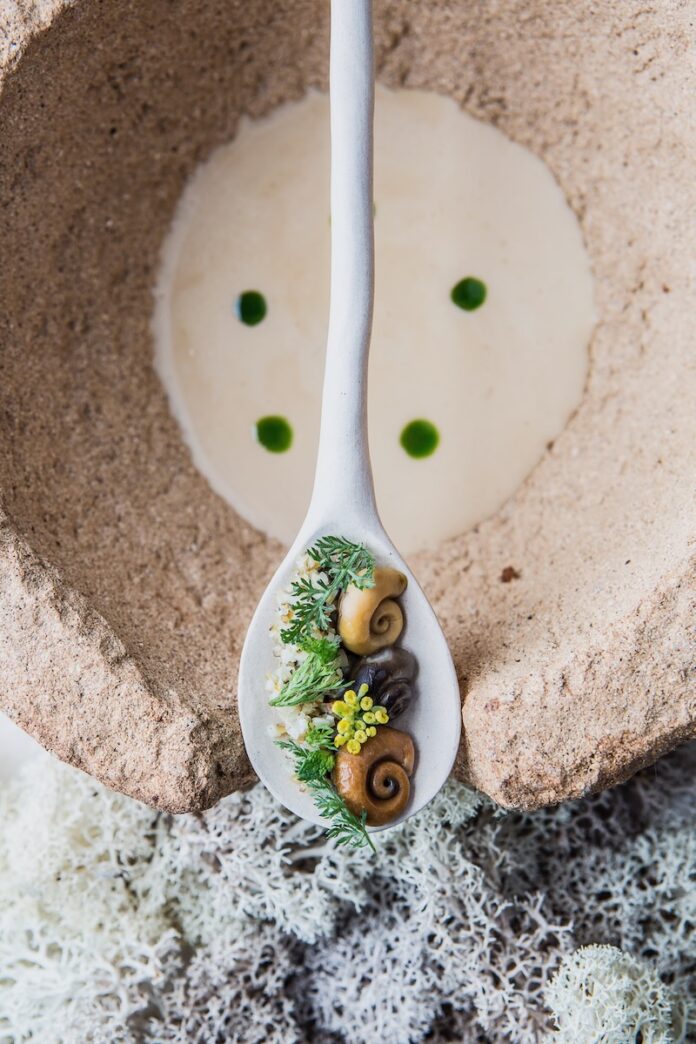
While minimizing waste from purchased ingredients is a common goal at restaurants, designing menus around a pantry of up-cycled ingredients is a rarity. It’s also part of the mission at Aponiente, a three Michelin-starred restaurant on Spain’s southern coast that champions ocean conservation. There, in a converted 19th-century tidal mill, chef Angel Leon up-cycles marine bycatch and under-loved fish cuts into refined fare like seabass-skin biscuit rolls and an entire line of “marine charcuterie.”
Oyster, Oyster
Across the ocean in Washington, DC, chef Rob Rubba is bringing a mid-Atlantic take on sustainable gastronomy to life at Oyster, Oyster. There, the cooking is as close to zero-waste as possible, almost exclusively vegetarian in order to reduce emissions, and based on ingredients sourced from climate-friendly farms. Oysters, Rubba said, tell the story of how over-harvesting in the Chesapeake Bay can paradoxically be reversed by sourcing in moderation from sustainable oyster farmers, who help rebuild reefs by re-depositing empty oyster shells. All the producers the restaurant works with are vetted, since being ‘local’ doesn’t inherently mean ‘sustainable,’ Rubba pointed out. He and his staff look for fair labor practices and regenerative farming techniques, which can include no-till agriculture, crop rotations, and cover cropping.
Sustainability at Home
Climate-friendly farming is also the basis of Los Angeles chef and entrepreneur Camilla Marcus’s sustainable cooking philosophy. Regenerative techniques improve soil health and water retention in ways that make farmland more climate resilient, and also draw carbon out of the atmosphere (though the jury is out on how long). Marcus’s 2024 cookbook, My Regenerative Kitchen: Plant-Based Recipes and Sustainable Practices to Nourish Ourselves and the Planet, outlines several climate cuisine principles: regenerative sourcing, more frequent vegetarian and plant-based eating, zero-waste cooking, and the use of biodiverse ingredients.
Eating a wider variety of foods, Marcus said, is a natural extension of regenerative farming, which typically entails growing more diverse crops than the monocrop farms prevalent in industrial agriculture. Cover crops, for instance, feature in her recipes: popped sorghum makes a resilient popcorn alternative, and buckwheat flour adds a savory-sweet note to a skillet-baked Dutch baby. Her focus on resilient grains echoes that of Pierre Tham, a chef who put West African fine dining on the map and has argued that “lost” crops like fonio can improve food security in a warming world.
Not Only Helpful but Delicious Too
It may still be the exception rather than the rule for climate action to shape menus, but the chefs doing it are receiving increasing attention. Shuggie’s was featured on multiple best new restaurants lists in 2023— the same year that Rob Rubba won a James Beard Award for Outstanding Chef and Oyster, Oyster earned a Michelin star. Oyster, Oyster and Aponiente are both among the more than 500 restaurants worldwide that have been awarded Green Michelin stars since the Guide launched its sustainability-focused honor in 2021.
Camilla Marcus sees the critical acclaim that these expressions of climate cookery have received as an indication that a critical mass of interest is approaching. She said, “I think we’re at the tipping point.”
Story by Caroline Saunders Photo by Álvaro Fernández, Courtesy of Aponiente